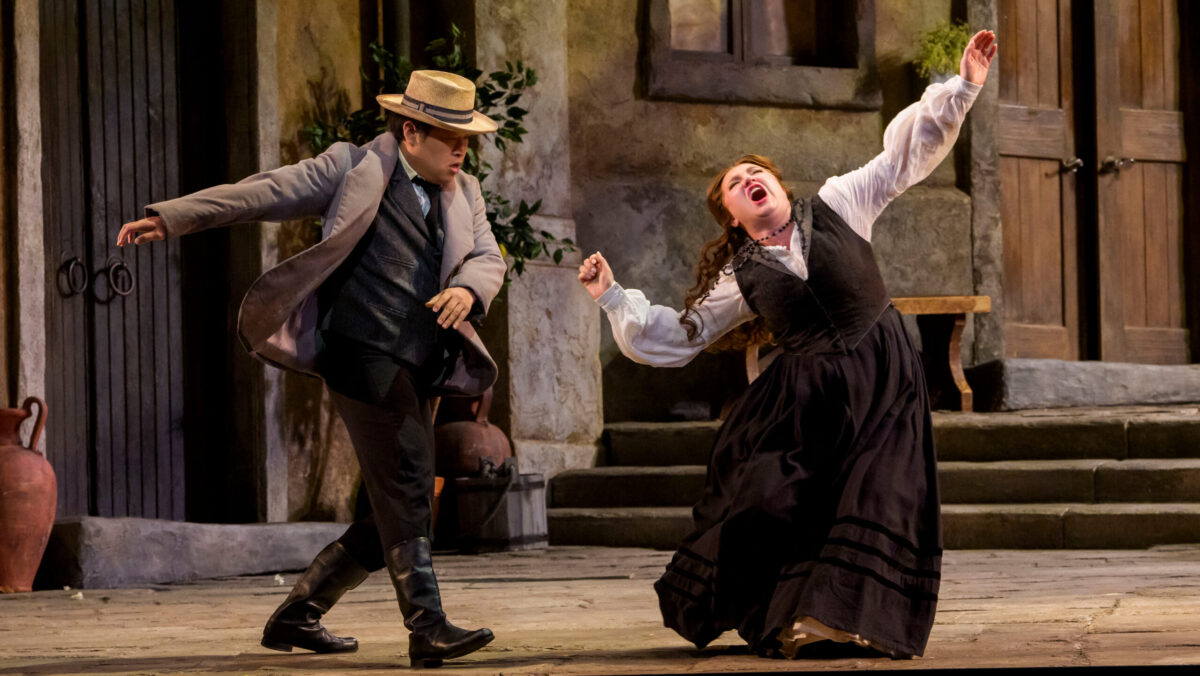
SeokJong Baek as Turiddu and Yulia Matochkina as Santuzza in Cavalleria rusticana / Photo: Todd Rosenberg
When it comes to verismo, the debate on just how “realistic” an opera can be exists in tension with literary verismo in the line of author Giovanni Verga. What a gift, then, that the Lyric Opera of Chicago’s opening Cavalleria rusticana in the double bill Cavalleria and Pagliacci dispenses with realism altogether, collapsing instead into comedy.
To be sure, this was not on purpose. The late Elijah Moshinsky’s production of Cavalleria opens in a traditional Calabrian town square reminiscent of any Olive Garden across the nation. After a sluggish prelude conducted by Enrique Mazzola, we are greeted with nuns, stone steps, and a sunbaked row of apartments. On a purely scenic level, what the production lacks in progressivism it makes up for in a heightened psychological atmosphere—but only briefly. With the set tilted slightly toward the audience, there’s a crushing sense of claustrophobia once the full ensemble appears to condemn Santuzza during the Easter procession.
But any power from that moment is crushed by Peter McClintock, the revival director, whose inflated take on verismo reduces Santuzza to an emotionally stunted villager whose main concerns seem to be choosing whether to wail on the floor or up against a wall. By the time we get to her tear-strewn duet with Turiddu (“Tu qui, Santuzza?”) it’s not hard to understand why he shacked up with Lola. And when that final scream comes marking Turiddu’s death, I found myself stifling chuckles at the near-parodic sight of Yulia Matochkina (Santuzza) stumbling in despair along the stage floor.
Vocally, Cavalleria was at an imbalance. Matochkina brings a dark, burnished mezzo-soprano to the music, but her top just can’t compete with the requirements of the role, especially in “Voi lo sapete.” The high A on what should be the crowning moment of the aria, “Ah! l’amai” (Ah! I loved him), was rushed through leaving no impact and creating a real disjunction given what was otherwise a high-blowing Santuzza. Opposite her, Camille Robles is a cute, sardonic Lola, and Lauren Decker brought an authoritative contralto to Mamma Lucia. Quinn Kelsey was dramatically convincing as Alfio, but he was often buried under the orchestration. His Mafia-esque set of followers equipped with sunglasses aimed for “Cosa Nostra” but landed closer to the three blind mice.
For his part, the tenor SeokJong Baek outshined the other principals. No surprise there: I first heard him in 2022 replacing Jonas Kaufmann in the role at Covent Garden, and the voice has only grown since then. Whereas traditionally Turiddu is not particularly sympathetic in Cavalleria, and to be sure when Baek stares into a hand mirror fixing his hair during the duet he is a prick, the sheer difference in vocal power led to a strange situation whereby Turiddu became the protagonist of the opera. When this histrionic Santuzza disclosed Turiddu and Lola’s affair to Alfio, it came across as spiteful and petty, making it hard to summon the usual compassion for her situation—pregnant and abandoned. With Baek’s technically perfect and blazing “Mamma, quel vino è generoso,” the tragic aria sung right before Turiddu’s death became a victory lap from a tenor who still had plenty voice left in reserve.
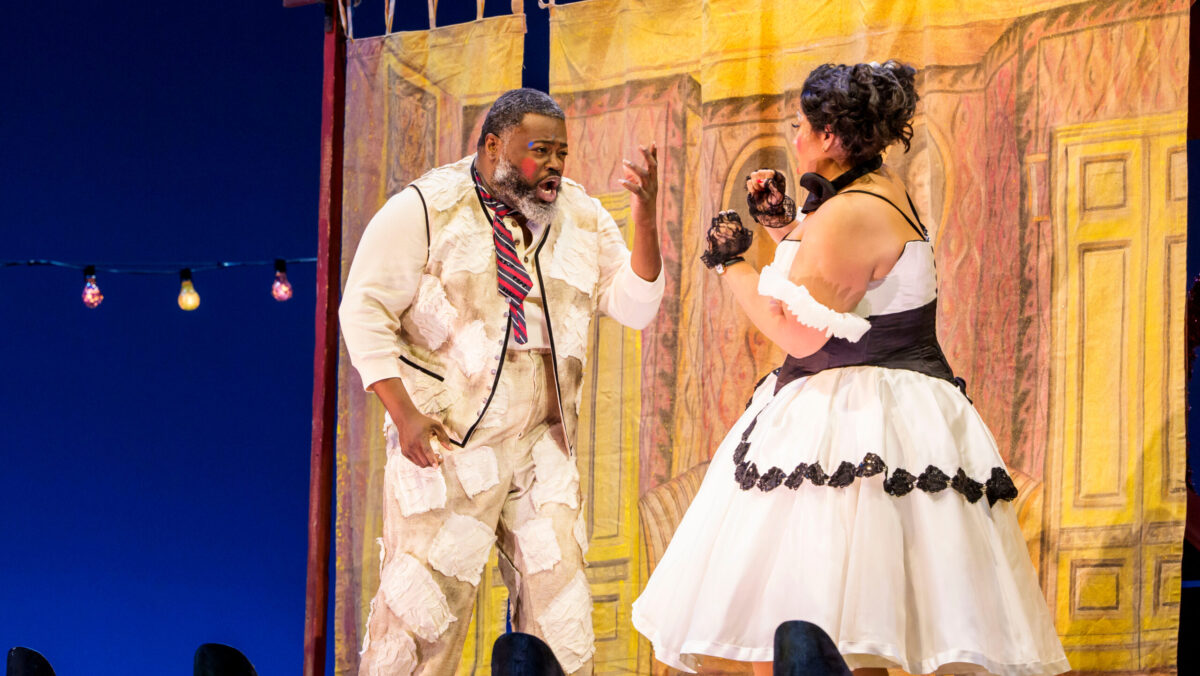
Russell Thomas as Canio and Gabriella Reyes as Nedda in Pagliacci / Photo: Todd Rosenberg
As the night continued with Pagliacci, fresh dramatic readings of these familiar verismo warhorses continued to appear. If Santuzza was overblown, Nedda (Gabriela Reyes) was shallow and coy to a fault. Pagliacci isn’t full of many vocally shining moments for the soprano and Reyes’ “Stridono lassù” passed by as unceremoniously as it arrived.
But the direction did Reyes, too, no favors. Why does she undress in front of Tonio during their duet? Perhaps this adds a heightened sense of danger when Tonio forces himself on her, but it only underscores Nedda’s flippancy in this production. And above all it cheapened Nedda and Silvio’s duet, already a low point thanks to the couple’s extended writhing on the ground; more stilted than seductive.
Baritone enthusiasts had plenty to enjoy in Pagliacci. From the moment he opened his mouth, Luke Sutliff (Silvio) made a strong impression for his Lyric debut with a robust baritone and charismatic presence. As Tonio, Quinn Kelsey seemed liberated as Tonio—repellent by design but vocally more impressive and authoritative than in Cavalleria. His taut delivery and theatrical chops brought a burst of energy to a production beginning to slump before “Vesti la giubba.”
Russell Thomas lent his familiar vocal heft to Canio, but never quite reached the emotional crack; the sob that ought to stab through “Ridi, pagliaccio” never came. By the time the famous aria was over, it felt like time to leave. With Nedda coquettish to the point of flatness, the scandal at the heart of her affair with Silvio never quite registered, leaving Canio’s eventual act of violence feeling weightless at the end. By the final tableau, the sense of urgency had thinned to the point that you almost rooted for Canio to get the murders over with.