Lawrence Sumulong
Anne of Denmark, consort of James I and sister of Denmark’s Renaissance king, Christian IV, had a taste for splendor and for dance she that was unable to indulge in her twenty years as queen of chilly, Presbyterian Scotland. Once they were enthroned in wealthy London, she could afford Ben Jonson to write court masques, which were sung and danced entertainments, architect Inigo Jones to design them, and any number of first-rate local composers to set them to music.
One of these, a creation for Twelfth Night, 1605 (about a year before the Gunpowder Plot), was entitled “The Masque of Blackness.” The “argument” of the masque was various nautical deities, commanded by Oceanus himself and including the river Niger (whose geography long baffled Europeans) and a number of mer-ladies (led by the queen herself) in blackface makeup. The ladies request a “cure” for their blackness, which they attribute to the tropical sun, and in Britain’s temperate clime they soon find themselves the color of the cliffs of Dover. A sequel, “The Masque of Beauty,” was produced three years later.
The verses of the piece survive but not the music. It is typical of bass-baritone Davóne Tines, one of our most original and exploratory singers, that he discovered this outrageous text and devised a way to program it. Some of the songs were re-set to contemporary melodies of similar scansion—this is called a “contrafact,” a term new to me; clearly one with a thousand uses.
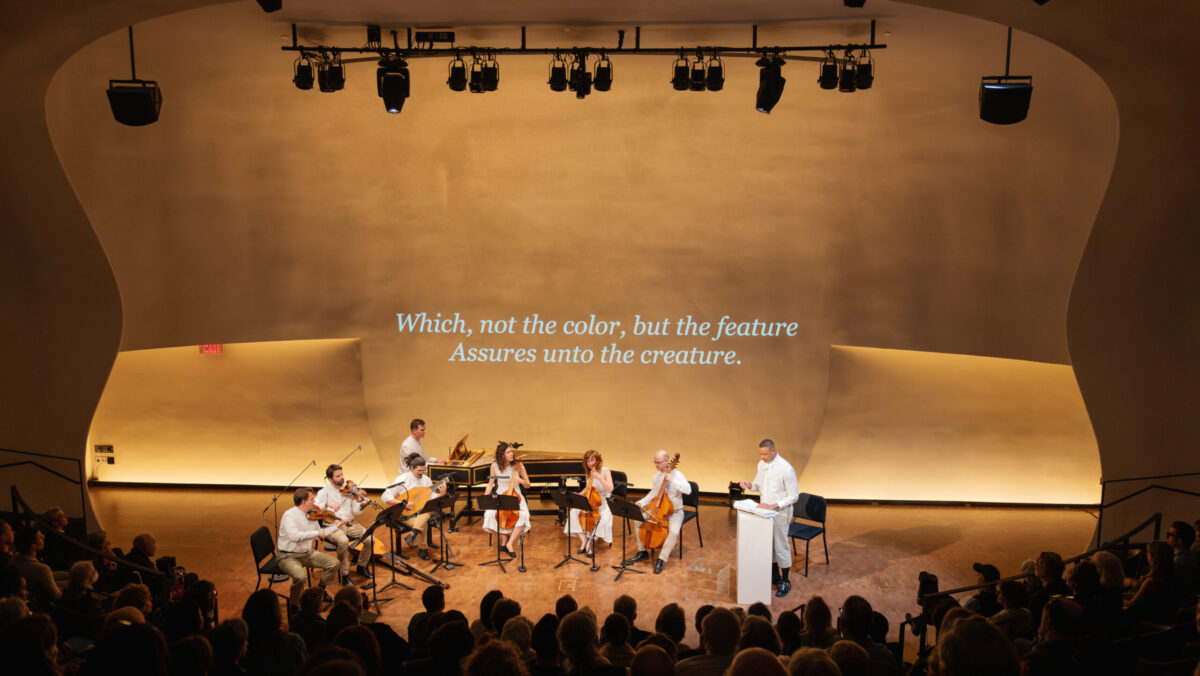
Otherwise, at the Frick Collection last Sunday, Tines was assisted by the early music ensemble Sonnambula. This consists of harpsichord, three violas da gamba (is that the proper plural? Or viola da gambas? One seldom encounters three of them together in the wild), two violins and a lute/theorbo. They passed the time with sprightly and various dance tunes by composers Queen Anne patronized: Orlando Gibbons, John Dowland, William Lawes, Alfonso Ferrabosco II, Anthony Holborne, William Brade, and John Coprario.

Lawrence Sumulong
However startling this fantasy’s racial assumptions are to us, Tines sees it as an opportunity for deadpan satire. He sang four songs to Jonson texts, three in his suave, superbly produced bass-baritone, reined in to permit clarity, and one (Coprario’s “So Parted You”) in a lighter, higher voice, almost a falsetto tenor, to simulate the river that seeks to be quenched in the cooler ocean. Projected texts allowed him to make his points clear. The same air calls for an echo effect, and for this the two violinists went to the landings on opposite sides of the room where their dying phrases, echoing each other, economically produced an effect of distance.
The old, much-loved but acoustically awkward concert hall of the Frick Collection, a round room beside the oval salon at the end of the fountain court, has been eliminated in the reconstruction. A 211-seat replacement, neatly ovoid but multi-tiered, has been excavated two floors below. Its rear wall is bare, making projection of texts, illustrations (a lady in court costume and black face—Queen Anne?) and, in the future, films, convenient.
This short concert, an hour and a quarter, was my first visit. Several of the older attendees were very pleased with the occasion’s brevity, but to me it felt like a prelude, the first half of an occasion we did not see. Perhaps some courtly dancing would have filled it out.
Tines has a plush, robust voice and a knack for acting. He could easily make a career in opera out of this, but he has never cared for that opportunity. He likes to take chances, to vary the stakes and the skills used. At a Tines occasion, you never know what you’re going to get. I first saw (and heard) him as Handel’s Polifemo in a bathtub at National Sawdust with Anthony Roth Costanzo’s Galatea. Then he sang a homespun spiritual version of the Mass at Weill Hall. Then he impersonated Paul Robeson, actor and folk singer and opera singer and activist, at Little Island. Then he turned up at the Met, in John Adams’s El Niño. An old-fashioned song recital is on the schedule for Carnegie Hall in January. Aside from the beauty of the voice and the excellence of the delivery, it is difficult to predict anything in particular.