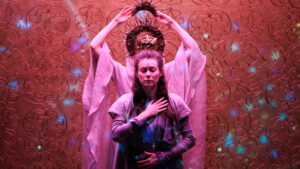

Karen Almond / Met Opera
Daniele Rustioni has quickly emerged as one of the most in-demand conductors in the opera world, with a keen ear for detail, sensitivity, and nuance when working with singers and orchestras. Now the Principal Guest Conductor of the Metropolitan Opera, the third person to ever hold the position in the company’s history, his inaugural season, includes the classic Zeffirelli production of Puccini’s La bohème as well as Giordano’s Andrea Chénier. Rustioni opened up about this exciting new phase in his career in a conversation this summer in Munich, where he held the Principal Guest Conductor title from 2021 to 2023, just a few hours before a performance of a new production of Cavalleria Rusticana and Pagliacci. His thoughts have been lightly edited for clarity.
Starting his first official season at the Met with Don Giovanni, which opens again on Thursday, will be special for Rustioni, particularly in the quintessential Italianate quality of the Mozart/Da Ponte trilogy, which invites the “the wonderful link between words and music and the constant discovery of the new unwritten colors in the espressione of the text.”
“In European houses today,” Rustioni adds, “they give Mozart only to Baroque interpreters. It’s something that drives me crazy,” even though using “original instruments creates some sound that’s not in the DNA of the orchestra.” Meanwhile, with the Met Orchestra’s stylistic sensibilities, if “I can just be free and try to give Mozartian interpretation of Don Giovanni with a fantastic and lyrical orchestra then I will be a happier conductor.” With La bohème, Rustioni will perform Puccini for the first time at the Met and the revival of Umberto Giordano’s Andrea Chenier, which will be livestreamed in cinemas and broadcast on December 13, hearkens back to the company’s rich performance history of the French Revolution-set melodrama.
In many ways, Rustioni, 42, is unique among conductors of his generation for his deep engagement with the operatic tradition. As a boy, he was a member of the children’s chorus of Teatro alla Scala in Milan, and this background prepared him for masterpieces of Italian-language opera. He notes how these early years were a blessing without which he probably would not have pursued a career as a musician. “That experience was the most important of my life,” Rustioni recollected, “because it was a collective experience, and it wasn’t too heavy at all. It was an opportunity to experience music at the highest level without all the technical limits of playing an instrument.”
In addition to his choral singing, Rustioni studied several instruments like piano, organ, and cello. He soon performed in chamber ensembles and orchestras, later accompanying singers in his teenage years. Despite an initial skepticism of conducting, Rustioni picked up the baton in his early 20s. “What made me want to conduct was the practice on the podium, and the sum of all the experiences in chamber music and with both instruments,” he said. It was this practice that enabled him to “try at least to understand what musical breathing is about, and then translating the musical ideas into the arms.”
A definite decision to follow a career as a conductor came after performing Verdi’s Requiem for the first time, on his 25th birthday, in St. Petersburg where he lived from 2008-10. “The beginning of one’s career is a little bit of a gamble,” Rustioni added about starting his career in Italy after returning from Russia, “and they pay you very little.” Nevertheless, Rustioni then worked his way up through the Italian opera house system where the exposure to diverse repertoire is abundant even if the loggionisti in provincial cities can be brutally direct in their feedback.
Yet these sometimes-harsh experiences provided Rustioni with room to grow. They taught him valuable lessons in balance and restraint, such as how the orchestra cannot be bombastic with fast tempi and loud dynamics. Rather, a conductor should take into consideration singers’ vocal colors, the size and distance of the stage, and the dimensions of the hall. “It’s pointless for a conductor to fight and to try to make something happen onstage that is just not happening. Ultimately the opera is sung by singers; they need to bring something true onstage, and I don’t. The audience doesn’t see my face — they see my hair, they see my back,” he lists off. “They see the singer’s face, and in fact, they respond much more to the truth in the eyes of the singer than the truth in the hands of the conductor.”
After Rustioni made his way through the Italian regional opera houses, a busy career and success quickly followed. By age 31, Rustioni had conducted five titles at La Scala, and made a Covent Garden debut at 28. He has since led multiple top ensembles and was Music Director of Opéra National de Lyon from 2017 to 2025, the Ulster Orchestra from 2022 to 2024, the Orchestra della Toscana from 2014 to 2020, and was recently named the Principal Guest Conductor of the Tokyo Metropolitan Symphony starting in 2026.
Rustioni notes that this early path through the Italian provincia is not often taken by other conducting prodigies these days. Indeed, conductors like Gustavo Dudamel and Daniel Harding started with big symphonic repertoire young, whereas Rustioni began with challenging bel canto works like Norma, which he calls an “impossible” opera to conduct and is often more treacherous for a novice maestro than Puccini or Strauss. This approach also informed Rustioni’s engagement with symphonic repertoire: he started with Haydn, Mozart, or Mendelssohn string symphonies, and then moved up to heftier works. In the classical music industry, however, prodigies often tend to eschew this canonical ladder.Young conductors—perhaps spurred by audiences, too—often jump straight to the big, bold symphonies and operas instead of first learning the less-flashy canon. Rustioni shares this concern, noting in the symphonic world that often one might “find a conductor with more Mahler and Shostakovich symphonies than Mozart symphonies, and it’s the same situation with opera.”
But performing “dangerous” bel canto works like Norma instilled Rustioni with greater flexibility and trained his sensitivity for balance in tempi and dynamics as he learned from orchestral players, chorus masters, and singers. He developed an ethos in which “it’s a capital sin if the singers are not heard — it’s rule number one for a conductor. I’ve seen and heard so many times, however, that this rule is not even taken into consideration.” Rather than emulate maestri who come to rehearsal inflexible, Rustioni instead prefers to “create something very new every time.”
He acknowledges that this can sometimes surprise audiences and “stretch the patience” of those who are accustomed to hearing scores performed a certain way, but the end result is always a collaborative one: “I deliberately decide together with the cast and the director to sometimes go into a more intimate, and slower atmosphere.” Speaking about his recent rendition of the Mascagni-Leoncavallo double-bill, for example, he noted how he largely put aside the operas’ fiery, passionate stories of betrayal. “Not everything has to be fast and furious,” he said of his decision to foreground the works’ more religious and intimate dimensions. “Excitement can come from more introspective moments, as more of a question mark than an exclamation mark.”
One of the key duties of his new role as Principal Guest Conductor at the Met is to “do the blockbusters—at least one every season—not to refresh, but to give importance and focus on a set of performances” of these famous works. It is important that every single performance in the season is at a high quality as the “blockbusters” are “backbone of the season. I think it’s really admirable and beautiful to see that there is always a big interest in every cast. There’s no ‘A cast’ or ‘B cast.’ This is the spirit of the Met. I want to come in and get into the spirit of the house from day one.”
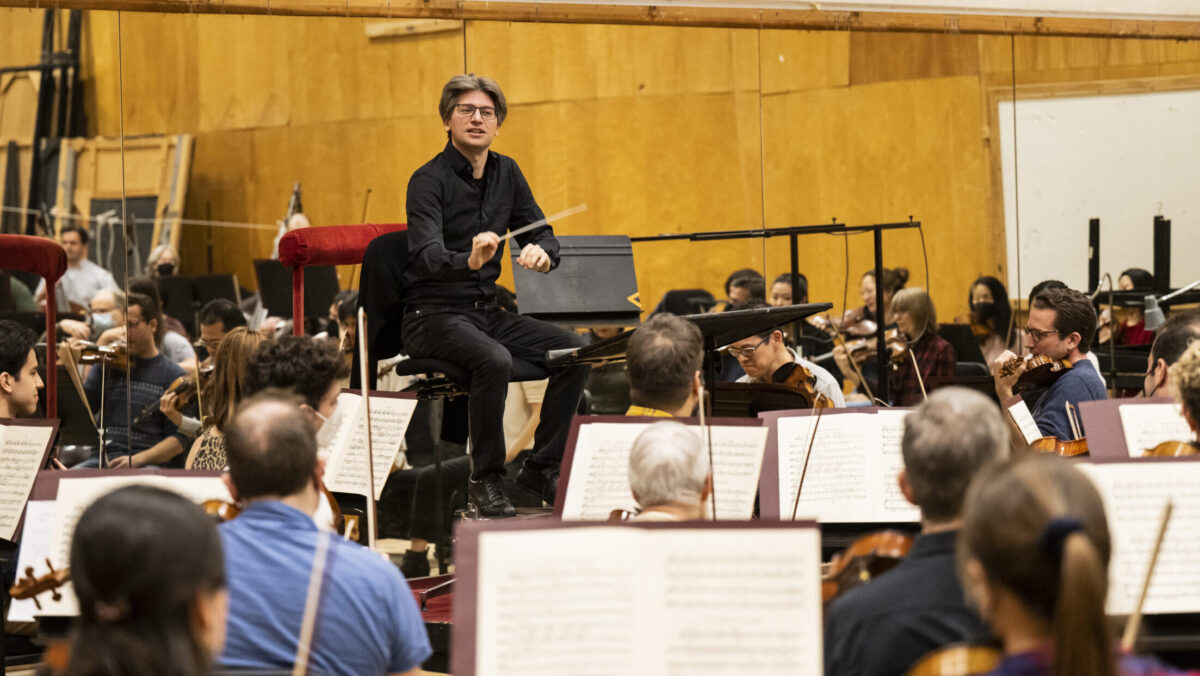
Jonathan Tichler / Met Opera
Moreover, his appearances over the next few weeks will allow Rustioni time to build a sustained partnership with the company, a crucial part of any successful conductor-orchestra pairing and increasingly rare in the age of jet-setting artists. The Met’s massive theater can be especially tricky to navigate for newcoming conductors. “For example,” Rustioni indicates a potential pitfall, “the strings have to deliver a quality of piano that really needs to travel to the last row upstairs.” The sensitivity and sensibility required to provide an intimate sound comes only after listening to and conducting many performances in the cavernous hall, but eight years since his first experiences with the Met Orchestra when he felt like he was “at the center of a storm,” Rustioni has quickly developed a productive and generous relationship with the ensemble. “The time of experimentation is finished,” he says, looking forward. “Now, it is an opportunity to deliver.”
Rustioni’s engagements so far at the Met have been in Italian and French opera. He made his house debut in 2017 with Verdi’s Aida, followed by Rigoletto, Le nozze di Figaro, Falstaff, an orchestral program at Carnegie Hall, and most recently the 2023 New Year’s Eve premiere of Carrie Cracknell’s Carmen production. According to the Met press release announcing his appointment, Rustioni is also scheduled to conduct a new production of Verdi’s Simon Boccanegra in a future season.
“I’m very happy to bring a lot of Italian repertoire and to establish myself with the Italian repertoire,” Rustioni states enthusiastically. In a sense, his current plans in New York mesh with long tradition of Italian conductors at the Met, such as Tullio Serafin, Arturo Vigna, and more recently Fabio Luisi, Marco Armiliato, and Rustioni’s own mentor Gianandrea Noseda. Though they may not have had the “title of musical director,” Rustioni notes, “there were a lot of incredible Italian conductors at the Met. I’m very happy to start following their footsteps and then move on,” by first focusing on the classics of Italian opera and then broadening in future seasons. But when it comes to exploring new repertoire at the Met, though, he wants to take the “panoramic” route: “It’s not a competition. I really want to continue to have a relationship with Met. Of course, of the recent titles that come to mind, I’d love to conduct works like Tristan und Isolde or Die Frau ohne Schatten at the Met, but why burn through all those titles now? In thirty years, I want to look back and see that I made the right path.”
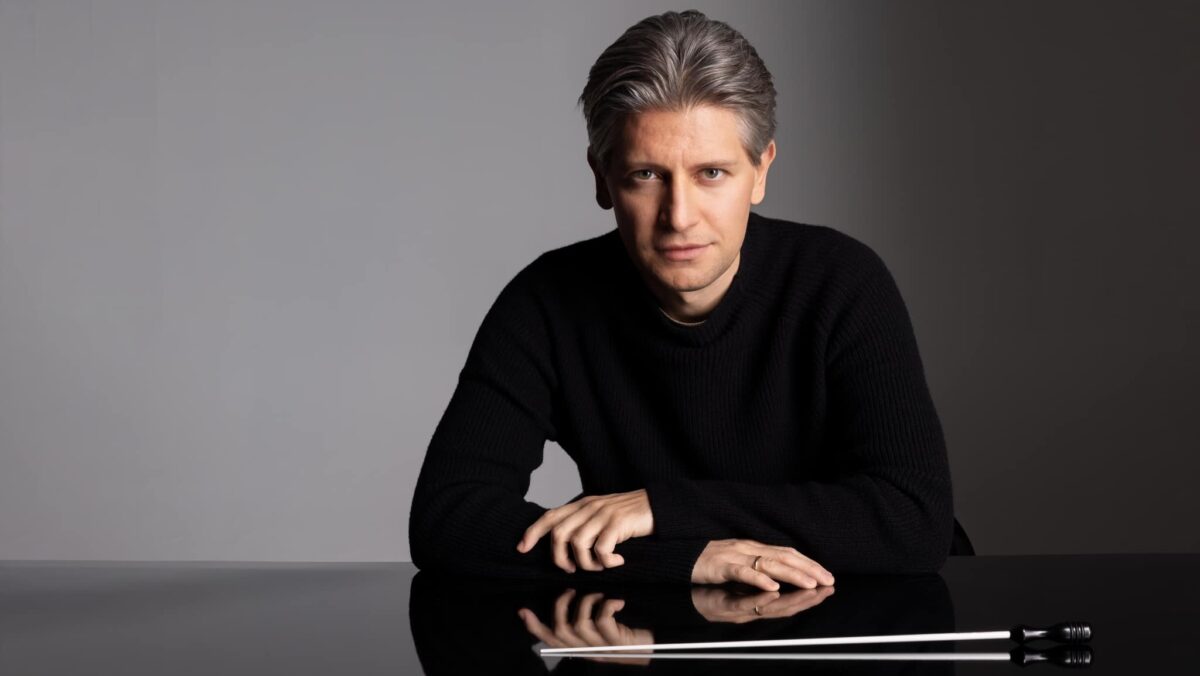
Davide Cerati Fotografia
Alongside his refreshingly measured approach to pacing his career, what stands out in Rustioni’s resumé is how he balances a primary focus on opera with frequent symphonic engagements. This also extends to thoughtful repertoire selection, as orchestral programing can offer more flexibility than the opera house, especially when the operatic canon in the US seems to be shrinking. His relationship to Italian repertoire extends beyond the “blockbusters” and bel canto, often presenting rarer symphonic works during his American guest appearances.
In January 2025, for example, Rustioni introduced American audiences to Alfredo Casella’s Concerto Romano with the Philadelphia Orchestra—a piece had not been played in the US for nearly a century—while his New York Philharmonic debut featured Mario Castelnuovo-Tedesco’s The Merchant of Venice Overture. March 2026 will also see the Dallas premiere of Casella’s Symphony No.2. Additionally, he has recorded three discs on Sony Classics with the Orchestra Della Toscana featuring works by Goffredo Petrassi, Giorgio Federico Ghedini, and others.
These lesser-known Italian figures, largely contemporaries and protégés of Puccini, “are something very close to me,” Rustioni confesses. As for that era’s operatic canon, the conductor considers Wolf-Ferrari’s many operas, Giordano’s Siberia, and Franchetti’s Cristoforo Colombo as underappreciated works “that deserve to be rediscovered.” Though it would be wonderful to revisit hidden operatic gems, Rustioni admits, the “elephant in the room” of commercial opera also requires something popular to fill seats. Rustioni spitballs about how to introduce American audiences to rarer Italian operas by pairing them with blockbusters, suggesting combinations like Nino Rota’s Il Cappello di paglia di Firenze or Franco Leoni’s L’Oracolo with either Cavalleria Rusticana or Pagliacci, or together with a work from Puccini’s Trittico.
At the Met, Peter Gelb has been very open and inviting in the conversation about balancing classics with contemporary opera when programming the Met’s seasons while Rustioni has also indicated a willingness to perform new works in future seasons. For contemporary opera to be viable both artistically and commercially, “the subject, the libretto, is essential and of course, having a musical language accessible to the audience, which is something that the Met is really trying to do. There should be lines, melodies, and the orchestra playing like an orchestra, not just nonsense music or composers always making instruments do crazy stuff.”
Yet Gelb’s approach to invest in the canon and contemporary works—while the catalogue of mid-twentieth century works for American audiences is largely shrinking (Gelb’s jab at Ligeti’s Le Grande Macabre in his New York Times opinion piece indicative of this)— also points to differing operatic cultures between the US and Europe. “I think what the Met is trying to do is very courageous in its openness to contemporary works in a musical language that is acceptable to a larger audience,” Rustioni suggests. “I don’t think that this could be applied to many European orchestras or theaters where they will still need something different from the musical norm, a more avant-garde language. Otherwise, contemporary operas in Europe are not recognized.”
While European audiences may have a greater proclivity for modernist music, Rustioni also suggests the operatic artform itself must also be appreciated in new ways in both the US and Europe. Think of, for example, the escalating use of high-tech in pop concerts: “Even when you go out and see a show, you are bombarded by special effects. And those special effects are not in the opera world.” With reduced attention spans and the instant sensory gratification of social media, the operatic experience offers an increasingly rare opportunity: “You spend it in silence, in the darkness. That kind of commitment and concentration now is hard sometimes, harder than it was in the past.”
“The privilege,” Rustioni terms it, “of coming to an opera is like the privilege of having time to meditate for yourself. It’s super precious time for yourself, like standing in front of the Mona Lisa, because, of course, we are dealing with masterpieces most of the time.” But this “needs to be explained sometimes. Otherwise, why are we still doing opera anymore?” The question is urgent, but it need not always be a heavy one. Opera is “wonderful, it’s fantastic,” Rustioni beams, then adding more playfully: “It’s also a part of Italy. I have to sell it—I was born in Florence!”