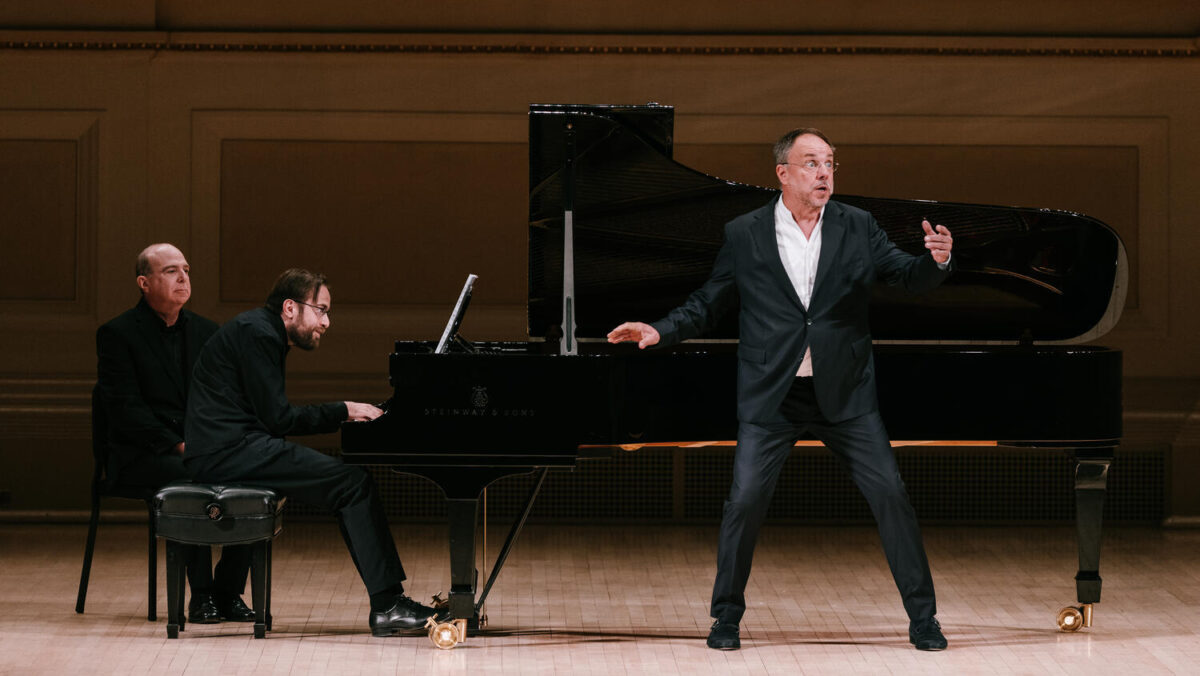
Matthias Goerne and Daniil Trifonov, Photo: Fadi Kheir
No one steps into the same river twice, literally or metaphorically. When Matthias Goerne first recorded Schubert’s Die schöne Müllerin in 2002, his still-lyric baritone devastatingly charted a young lover’s progression from hopefulness to despair. Returning to the cycle in 2014 at Carnegie Hall with pianist Christoph Eschenbach—with whom he’d recorded a second version for Harmonia five years earlier—Goerne settled into a more outwardly rueful interpretation of the music, signaling the character’s doom from the start.
Now, at 58, Goerne again took up the Miller’s sorrowful plight at Carnegie, performing with Daniil Trifonov on the afternoon of October 19. If his earlier accounts offered credible but divergent renderings of Wilhelm Müller’s poetry and Schubert’s timeless Lieder, what emerged here was a hoary and excessive collection of mannerisms and vocal tics that served the artist more than the music itself.
After more than a decade exploring the heavier end of the bass-baritone repertoire, Goerne’s voice now sounds deep and darkened—sometimes artificially so. “Das Wandern,” the vibrant, percussive opening song of the cycle, unfolded with a surprisingly lugubriousness, which extended to “Halt!”, where the Miller spots the object of his affection for the first time. For an artist often valued for the precision of his delivery, Goerne frequently moved between inaudibility and unintelligibility, and at times he took surprising liberties with the text. These faults were amplified by fussy physical business, as when he used his fingers to mimic dancing as he sang the line “Die tanzen mit den muntern Rhein.”
Goerne then floated his voice up to an almost tenorial range when personifying the brook that both gives and takes life from the Miller in songs like “Wohin?” and “Der Neugierige.” The tonal beauty that distinguished him in his early career was most evident in these higher, more lyrical passages, though the upper and lower ends seemed entirely discrete, without a smooth connection through the passaggio. His middle range became evident later in “Pause” and “Mit dem grünen Lautenbande,” although it sounded wan in comparison.
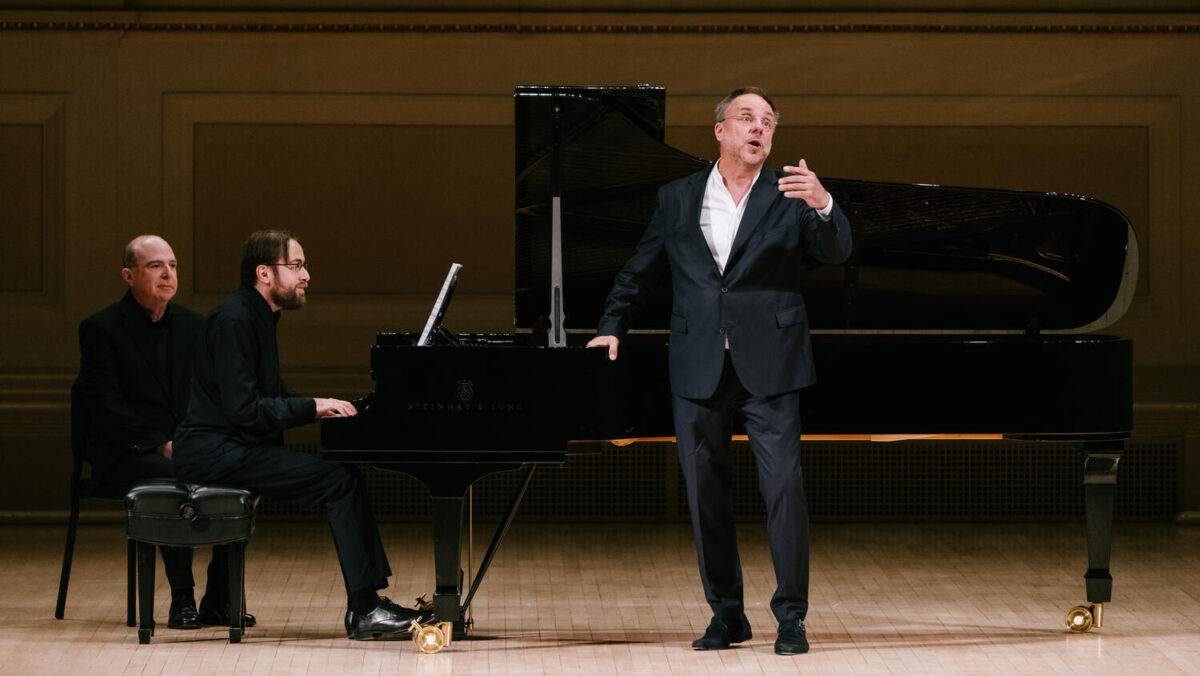
Matthias Goerne and Daniil Trifonov, Photo: Fadi Kheir
Fireworks emerged in the cycle’s most famous moments: an explosively volatile “Ungeduld,” which evoked mania more than love, and an unabashedly self-indulgent “Morgengruß.” But these outbursts felt more like special effects than an extension of a unified narrative whole. The occasional whiplash from tentativeness to eruption, coupled with Goerne’s uneasiness on the words, suggested a lack of rehearsal.
A clearer image of Goerne’s potential vision could be seen in the cycle’s final three songs. For “Trockne Blumen,” he finally allowed himself a moment of vocal and physical stillness—much welcome after an hour of bobbing, weaving and glowering around the stage in attempts at acting. “Der Müller und der Bach” arrestingly married the cadences of the Miller and the water into a heartrending dialogue. Although “Des Baches Wiegenlied” unfurled at a longer pace than I’ve ever heard, and despite Goerne’s occasional scrambling of the text, it provided expected catharsis. The Miller was finally laid to rest, and we could go in peace.
As a pianist who excels in grand strokes rather than pinpoint-perfect phrasing, Trifonov proved a suitable partner in this endeavor. His large sound can often seem heavy and occluded, not unlike the current state of Goerne’s voice, but he understood when and how to inject drama into the proceedings in his own right. He particularly scored in personifying the brook’s relentless currents, signaling danger long before the Miller even realized his fate.
There is something to be said for living with a piece of music for decades, for artists and for listeners. Our understanding can deepen and evolve with time. But our view of a work can also calcify into a series of tropes. Now a Lieder lion approaching winter, Goerne might do well to steer his focus away from the youthful Miller and toward something else that better fits his current style.