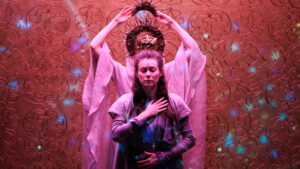
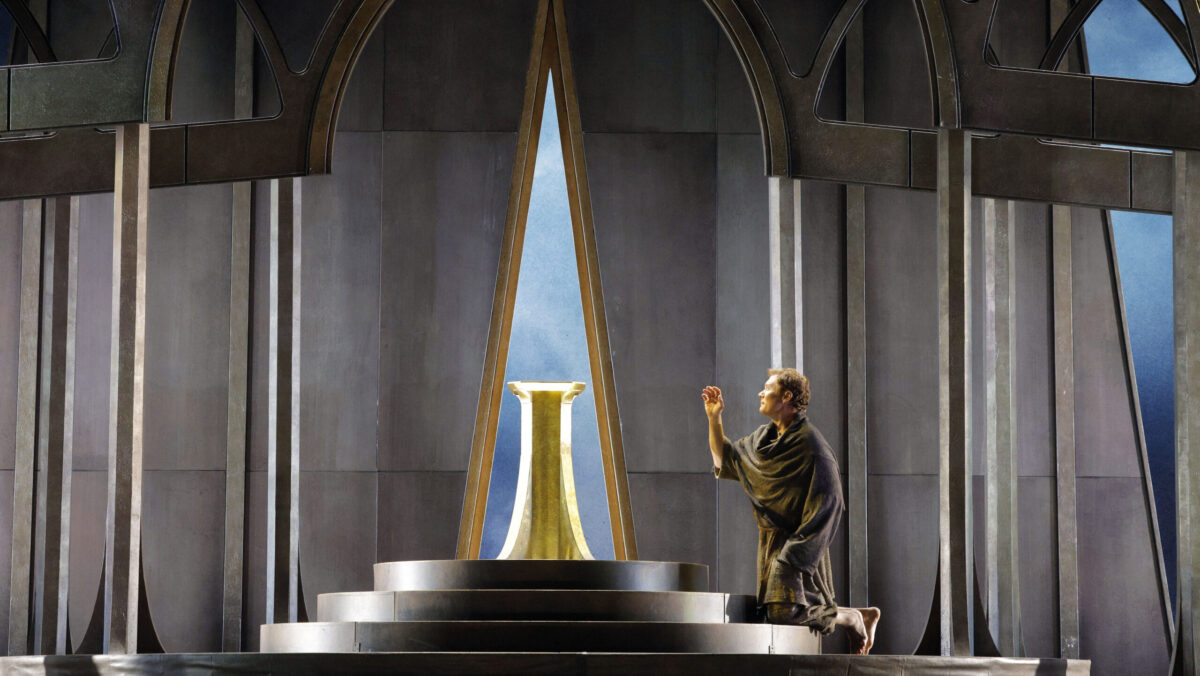
Early rehearsal photo of Brandon Jovanovich as Parsifal in San Francisco Opera’s new production of Parsifal by Richard Wagner, Photo: Cory Weaver/San Francisco Opera
Recounting his experience directing Parsifal, Matthew Ozawa offers up the pun unprompted: “It’s the holy grail of operas”. As Ozawa went on to describe it in our conversation after rehearsals in late September, “[Parsifal] just spins and spins and never concludes.”
San Francisco Opera is mounting a new production of Parsifal which opens 25 October at the War Memorial Opera House. It’s the company’s first production of the opera in a quarter century. It’s also Ozawa’s first-ever Wagner.
We are both stage directors. I mentioned to Ozawa that I directed Hamlet as my first Shakespeare, which seems a lot like his directing Parsifal as his first Wagner. A very eloquent man during our conversation, he could only reply to that observation: “Yeah, it’s no, it’s not it’s…yeah. My gosh.” And trying to wrap one’s mind around Wagner’s ultimate statement about music and theatre feels exactly how Ozawa phrased it — or tried to phrase it.
Why Parsifal? I asked. “Part of wanting to direct Parsifal was the challenge. Part of it was the sort of spiritual tone of the piece and the spiritual foundation of the work that I was really interested in digging into. The fact that it’s his final sort of grand thesis of the height and evolution of his musical and dramatic and philosophical ideas was really alluring to me.”

Matthew Ozawa, Photo courtesy of San Francisco Opera
Perhaps more than anything, Parsifal confronts audience members with their own potential for failure. At the center of the opera are characters who make mistakes, and those mistakes have profound consequences. But mistakes are also a bridge to enlightenment. I asked Ozawa about this theme in Parsifal and he offered his blunt take on our world: “Everyone goes through some element of muck and everyone deserves within the framework of their life to experience forgiveness for something that they have done. I don’t think anyone walks through life having never made an error, having never made a mistake, having never done an action that they regretted later.”
Ozawa points out that in Parsifal the knight Amfortas has made an error so grave that it drives the plot. He bears a physical wound, a reminder of that error for everyone to see. And he’s the subject of scorn because of it. When he takes out the Grail during the course of the opera, the wound causes him agony. He’s never allowed to forget it.
I asked him about the analog to our culture: the fact that our errors are preserved forever, reopening wounds of those harmed and the person who has since atoned and wants to do better. “The idea of forgiveness and the idea of again having compassion–towards what we normally would not want to have compassion towards– is even more important now than ever. The fact is that instead of compassion, people cancel each other.”
This leads to an alienation from each other, perhaps explaining this prevailing sense of being lost that also pervades Parsifal. “What I have tried to do is actually be open to trying to understand in the moment the rawness of what people are feeling and why and how that impacts their choices through the show. Obviously there are these elements that are very heightened spiritually such as the spear or the grail. But I think that we’ve been asking what is a grail? What is the grail: an object or is it an idea? Is the community of knights lost because they actually need the grail to come out? Or is the grail the symbol that allows them to go through a ritual that brings them towards spirit.”
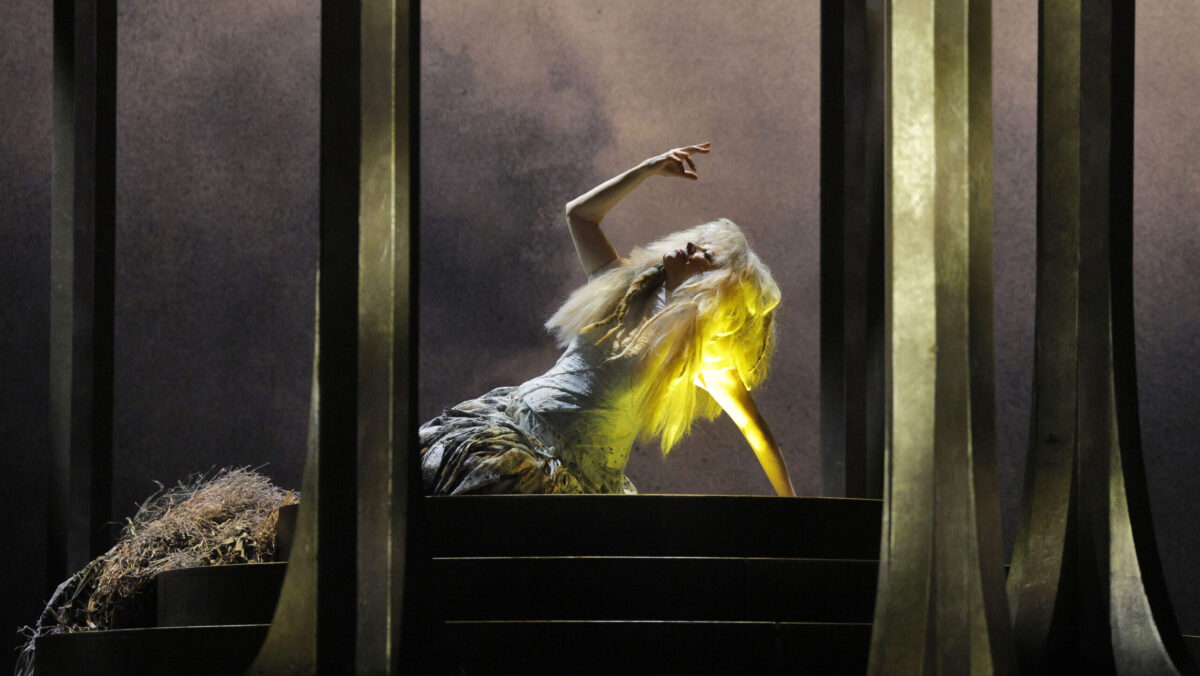
Tanja Ariane Baumgartner as Kundry in an early rehearsal of San Francisco Opera’s new production of Parsifal, Photo: Cory Weaver/San Francisco Opera
These days, not only do we cancel each other, we often simply ignore each other. “I witness more pain and suffering on the streets of San Francisco than I see in any other city,” Ozawa remarked of his host city that prides itself on its liberal embrace of the outsider yet remains a city of great inequalities. “I hope people come out of [the opera] feeling actually compassion towards…people.” The intersection of mistakes, compassion, and forgiveness featured in Ozawa’s two previous productions in San Francisco, Fidelio (2021) and Orfeo ed Euridice (2022), and those operas in turn gesture towards Wagner. You could almost say that his productions of Orfeo and Fidelio prepared the way for a new Parsifal.
Wagner, not known for his generosity toward, well, anyone, held in particular esteem the composer Christoph Wilibald Gluck. In Parsifal we hear Wagner’s indebtedness to Gluck, a composer whose music of dignified simplicity and dramatic integrity he greatly respected. And though they differ musically, thematically, the two are more closely linked: Parsifal begins with an error hanging over the Knights of Grail, Orfeo ed Euridice culminates with it. Orpheus, ordered to escort his beloved Eurydice out of Hades without looking behind him to see if she was there, disobeys only to have her die–a punishment for his lack of trust. In the Greek myth that inspired the libretto, that’s it. Orpheus is cursed to go through life without her before his grisly death at the hands of the Maenads. But Gluck wrote an epilogue, reuniting the two lovers with the help of Love who proclaims: “Orpheus, you have suffered enough for my glory. I give you back your beloved Eurydice.” In Ozawa’s staging, Love descends from the rafters on a seraphic swing, a deus ex machina of forgiveness and grace gliding down maternally to the stage floor. In Ozawa’s production, Orpheus knew he wasn’t supposed to look back, but he did it anyway. He failed a test, but should the consequence be eternal loneliness?
Wagner was also a great admirer of Beethoven, whose Fidelio is less about error as it is about the punishment and suffering Ozawa spoke of in our interview, combined with a similar all-is-forgiven turn toward grace. (For the record, Wagner could not forgive Beethoven his clumsy handling of the opera form, however much he credited Beethoven with revolutionizing music.) Clemency to the political prisoners in Beethoven’s opera is granted much like Love grants Orpheus his Eurydice. The prisoners do not turn their ire on the tyrannical Don Pizarro who imprisoned them, but focus on the grace of the monarch who rescued them and the choice to affirm life over seeking revenge. Ozawa’s production leaned heavily into the horrors of the surveillance state far more bluntly than in productions which set the opera in Beethoven’s time, so the prisoners’ refusal to be bitter is only more gracious.
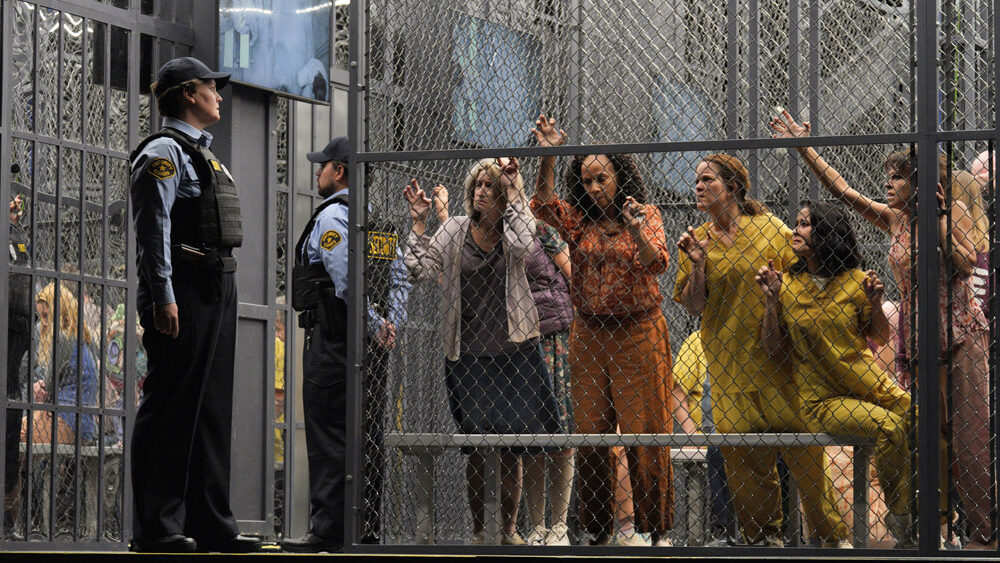
A scene from Matthew Ozawa’s 2021 production of Fidelio, Photo: Cory Weaver/San Francisco Opera
Yet this production of Ozawa’s holds a metacognitive aspect the other two were missing: that we think about the Wagner himself as much as we do about his work. When we engage with a Wagner opera, we rightly think about Wagner’s vitriolic bigotry. We cannot pretend it doesn’t exist, nor should we. We have to confront the degree to which we can have compassion for the composer himself. It’s the open wound that will never heal.
Ozawa’s approach to dressing this wound is to ask questions. “I think…walking into a Wagner opera as a person of color certainly brings up a lot of questions for me [along with] my team.” Why can’t we revisit and rethink beloved works? Why can’t we scrutinize what we put on stage? How has this revisiting and scrutinizing come to be seen as slighting or disrespecting?
Ozawa has already lived this tension around questioning and rethinking popular works that also raise uncomfortable questions if we’re willing to risk that discomfort. He mentioned receiving hate mail after his recent take on Madama Butterfly, co-produced by the opera companies of Cincinnati, Detroit, Pittsburgh, and Utah. He questioned the received wisdom about the piece, about Puccini’s orientalist positioning of a culture that is not his own. In that case, he was shifting an audience’s perspective about a piece about which people have immense feelings, even immense feelings of ownership. “It’s very vulnerable to interpret things that are so sacred, Butterfly being one of them, and Parsifal. These pieces are very, very sacred. People have a lot of feelings about how it should be done when they’ve seen it–and how they’ve experienced it–and what they want to feel again. Because, for them, going back to it is just as religious an experience [as] going to church and going through that ritual.”
There is a devotion to Wagner that is like devotion to no other composer. For those who travel the world just for productions of his operas (and for The Ring of the Nibelung particularly), their obsession mirrors Wagner’s own obsessive personality. Wagner wrote about opera with all of the fulminating zeal of a modern blogger. This zeal also turned ugly. He could acknowledge the importance of Giacomo Meyerbeer’s operas and their influence on his own work (and thank Meyerbeer for his great generosity), then he could turn around and write vicious anti-semitic screeds about him in Jews and Music (1850), a text he was writing as he was beginning his Ring operas. When I hear the breathtaking opening chords of Das Rheingold, as Wagner creates the world in the low strings, I cannot help but think about another world he was helping to create that would come to fruition 70 years later.
I asked Ozawa philosophically, can any production of Parsifal or any Wagner opera act as a way for us to redeem Wagner? He replied: “The art can reveal so much more” than even the artist himself, leaving open the reality that all of us consider the art and the artist in different ways.
Ozawa’s point is well-taken. Wagner’s works are often about behaviors he never actually embraced in his own life. Take the title character of Parsifal. He begins the opera as a reine Tor (“pure fool”) who experiences Mitleid (“fellow-suffering”) that allows him to reach a form of enlightenment. When we watch Parsifal we are giving the fool a chance to do the right thing. And he does. Somehow Parsifal was more willing to admit his own errors than the man who created him. Wagner was not one given to self-reflection when it came to his most deeply-held prejudices.
“Simultaneously, a lot of what Parsifal revealed to me is that people are complex. We have many dimensions and intersections to identity and it’s easy…to box someone into a framework, framing what, actually, the art can reveal so much [better].” The opera house is, indeed, a sacred place, like composer Jake Heggie said when he accepted the San Francisco Opera Medal after the company’s recent production of Dead Man Walking (another work about redemption). That rang true for Ozawa, but sacred can easily become sacrosanct.
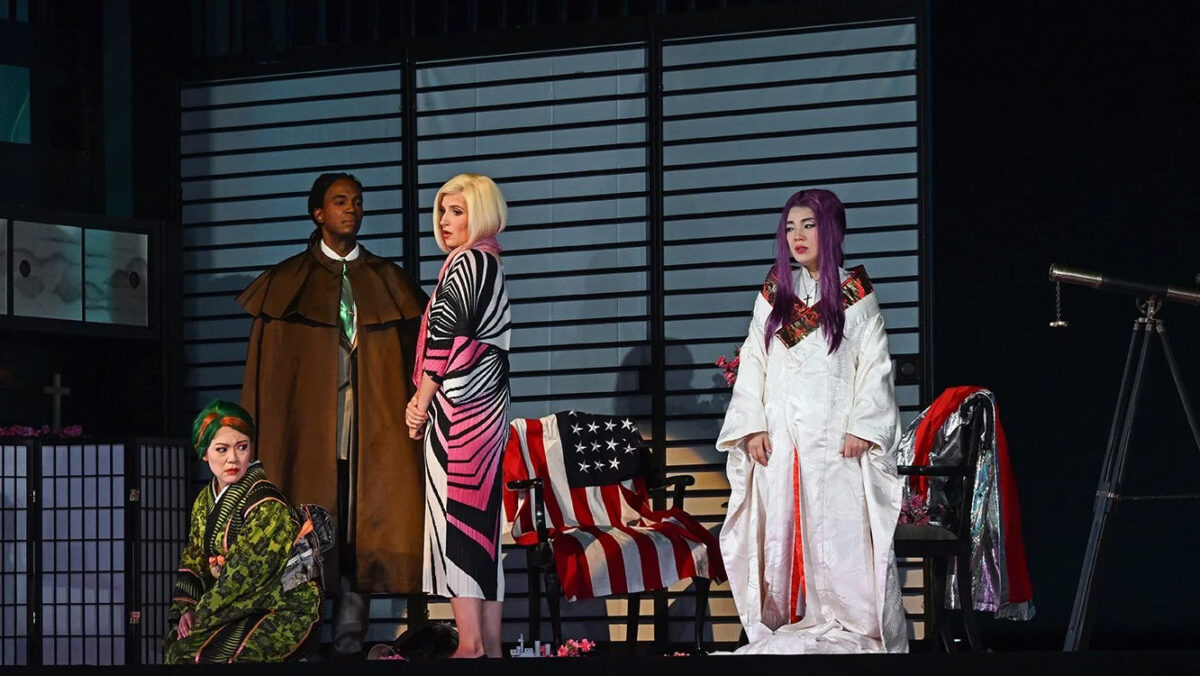
A scene from Matthew Ozawa’s production of Madama Butterfly at Cincinnati Opera in 2023, Philip Groshong
“There [is] an element in America where we are not so open to experimentation or towards new interpretations. I was going to be completely, sort of, reviled…and cancelled by a culture that needs things to be a specific way. Butterfly was terrifying. I mean, we had decided we wanted to reclaim the narrative. For us, this was a fantasy of Puccini and all of the source material.”
When Ozawa mentioned the well-known versions of Parsifal he studied in preparation, he added: “Part of my mission always, as an artist, is finding a way for people to be open towards perspectives that they may usually be completely shut off from.” Yet being asked by San Francisco opera General Director Matthew Shilvock (the third Matthew in this story) to create a new Parsifal means that the company wants something fresh that speaks to us today even as it honors a work of the past. “We have our own culture, our own ideas, and Parsifal was written 150 years ago, right? [So] how do you draw in people to something they’re going to be able to relate to, but also challenge them with what Wagner was doing with this very special sacred piece for the opening of a theater?”
As our discussion drew to a close, I asked him what opera he’d love to direct that he hasn’t been asked to direct yet. “There’s a bunch of Stravinsky pieces that I really want to direct, like The Rake’s Progress. There is just something about Stravinsky’s work that is very primal, but also very contained.” It’s a fitting ending to our conversation. In The Rake’s Progress, Tom Rakewell himself goes on a journey that sees him lost—losing his way, losing himself, but finding a sort of peace in the arms of Anne Trulove even though, in his state of delusion, he doesn’t know it’s her. Whether it’s Tom, or Cio-Cio-San, or Parsifal, when we see their stories, we bear witness to our own imperfections but we can also learn from their courage and their steadfastness.
When we go to the opera, we bear witness to the best (and the worst) of humanity. “Bearing witness in Parsifal is actually letting yourself be present to the moment,” Ozawa observes. “And allowing yourself to almost transcend time and space.”