Roberto Ricci
Ambition is what makes Macbeth tick. It drives Shakespeare’s original tyrant to overleap himself, and it likewise fueled Giuseppe Verdi in his first stab at adapting The Bard. Verdi expressed to librettist Francesco Maria Piave that their adaptation should be, if not a masterpiece itself, then at least “something out of the ordinary,” and indeed Macbeth marks a break with Italian operatic convention in its tone, narrative structure, and subject, even if it often pales in comparison to its source material and the composer’s later Shakespearean adaptations. Yet, its ambizioso spirto, as Lady Macbeth sings of her husband, gives it an enduring vitality.
The Teatro Regio di Parma’s current staging of this work, presented in its original 1847 version as part of its annual Festival Verdi, was not short on ambition or spirit; its final dress rehearsal, like the weird sisters on the blasted heath, promised much.
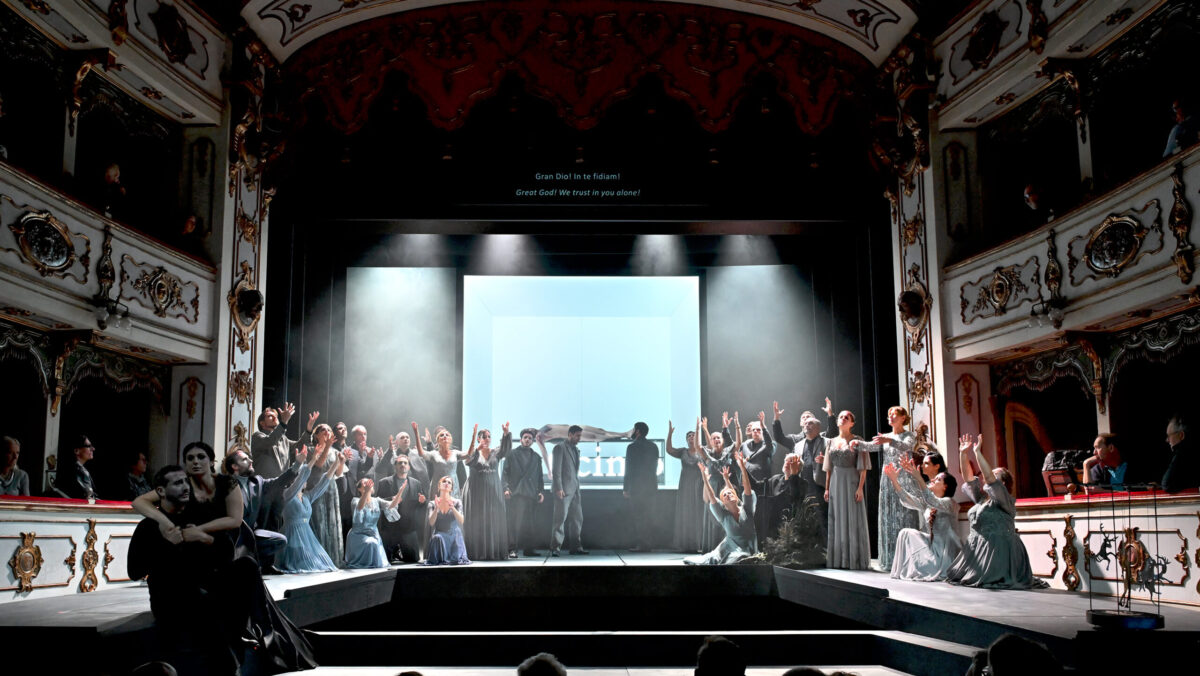
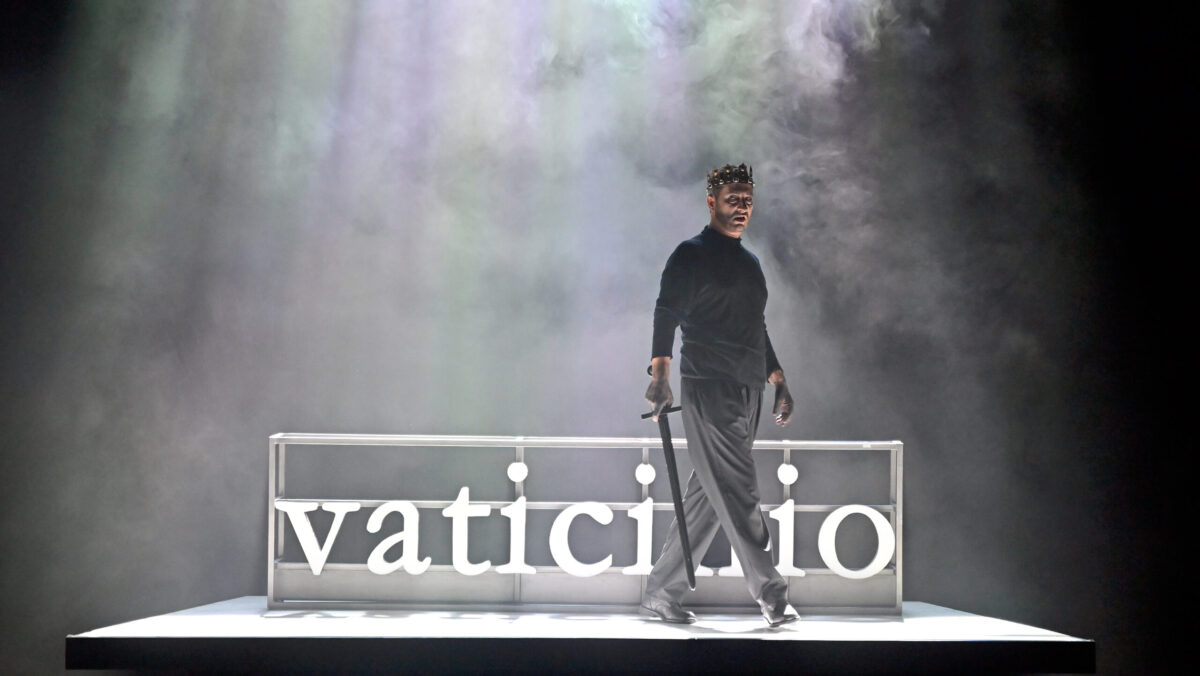
Manuel Renga’s brooding production and Aurelio Colombo’s minimalistic sets effectively condense the work’s epic scope to fit the compact environs of the Teatro Giuseppe Verdi di Busseto, a 300-seat Italian-style opera house in the city’s town hall complex. A neon sign reading “vaticino” (prophecy) glowed and glowered from behind patches of heather and reeds, becoming the altar upon which the corpses of two kings would be offered. Courtiers and witches emerged from behind gray, transparent scrims, as if from the veiled recesses of the protagonists’ minds. Macbeth spends much of the first scene on the stage apron, isolated.
Roberto Ricci
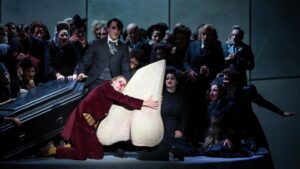
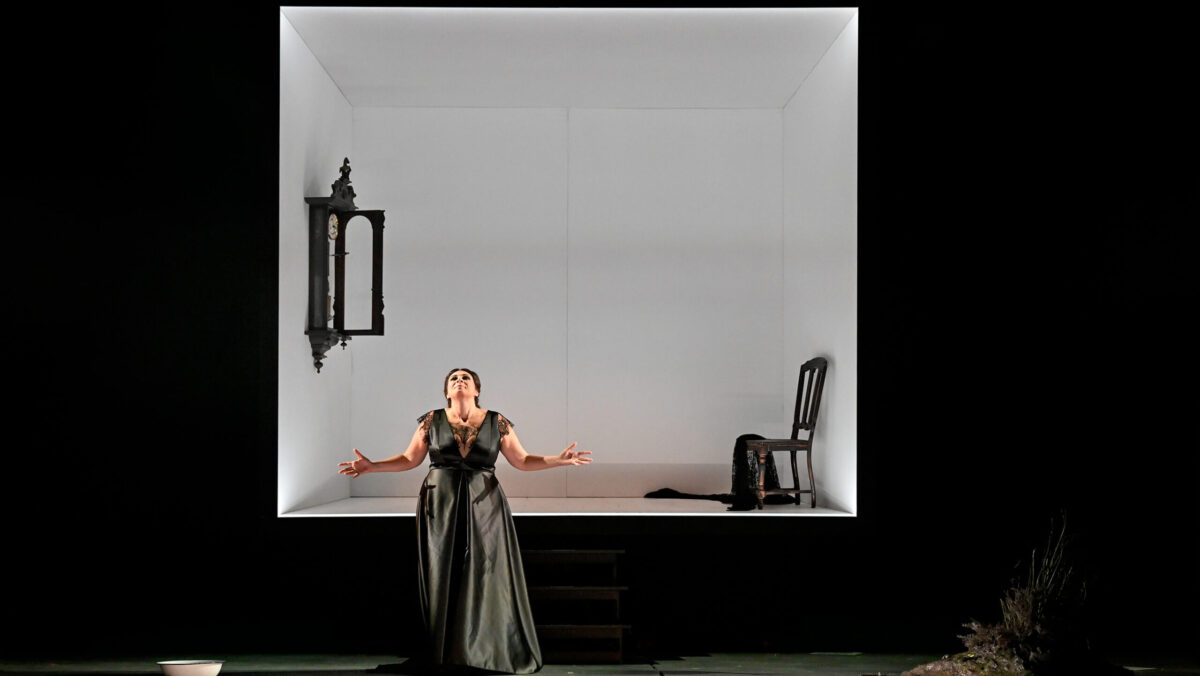
Lady Macbeth’s chamber emerges from the upstage darkness, white as a padded madhouse cell. She sits, Macbeth’s letter in hand, contemplating a grandfather clock. The witches, dressed in Victorian widow’s weeds, scatter arcane symbols and pages around the stage, uncovering a Yorick-like skull amid the opera’s opening chords. In this world, the line between the temporal and spiritual is murky; cloaked in Emanuele Agliati’s shadowy lighting, both realms reveal themselves only through the blinding light of prophecy.
Yet, while Renga was effective in establishing a mood, his direction did little to clarify the relationship between the central characters. The power dynamics of the central couple’s relationship—fertile interpretive and psychological ground, to be sure—remained in the shadows. This palpable detachment between the characters could also be due, in part, to the fact that many in the cast were new to their roles.
Replacing the previously announced Davide Luciano, fellow Campano baritone Vito Priante brought an amber-toned sound to the title role. Having transitioned from early music to the bel canto repertoire, his vocal approach was in keeping with the vernacular requirements of Verdi’s earlier style, displaying ample power and expressiveness while maintaining a rhythmic precision necessary to carry off this fast-moving score. Dramatically, he was more tentative. The turmoil behind Macbeth’s hesitancy to perform the bloody deed did not register; he remained a cypher rather than a monster to pity and fear. Still, the intensity of his “Pietà, rispetto, amore” suggested that his interpretation of the role will only grow.
Roberto Ricci
Soprano Marily Santoro, currently under the tutelage of Raina Kabaivanska, made for an unusually delicate Lady Macbeth. Her bright, supple soprano traversed the role’s tessitura without losing its appealing quality, and her accentuation of the text was admirable, especially during “Si colmi il calice.” Yet her sound, while lovely, did not possess bite or distinctiveness of color needed to flesh out this fascinating woman. Her coloratura during the Act II aria “Trionfai!” was technically proficient but lacked the nuances that should make each vocal flourish drip with venom, and her pared-back phrasing in the sleepwalking scene read as more halting than spectral. It was as if a superb Amelia Grimaldi had found herself suddenly spirited away from Genoa to Scotland.
Bass Adolfo Corrado made a strong impression as Banco, possessing a ripened sound that should carry equally as well in larger venues. His “Come dal ciel precipita” was expansive in its phrasing and emotional gravity. As Macduff, tenor Matteo Roma combined a muscular middle register with tender, fine-grained top notes. His ardent cries for liberty in “La patria tradita” were well matched by Francesco Congiu’s invigorated Malcom. Accademia Verdiana students Emil Abdullaiev and Matteo Pietrapiana were solid as Lady Macbeth’s doctor and the First Apparition, respectively. Fellow program member Melissa D’Ottavi was tuneless as Lady Macbeth’s gentlewoman.
Conductor Francesco Lanzillotta led the Orchestra Giovanile Italiana through a crisp, detailed reading of Verdi’s score. Members of the Coro Del Teatro Regio Di Parma delivered cohesive ensembles under the direction of Martino Faggiani. The women’s chorus was especially strong as the witches, providing a suitably eerie range of dynamics and coloring.