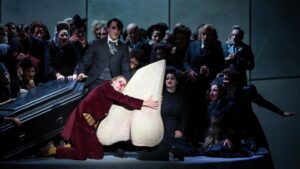
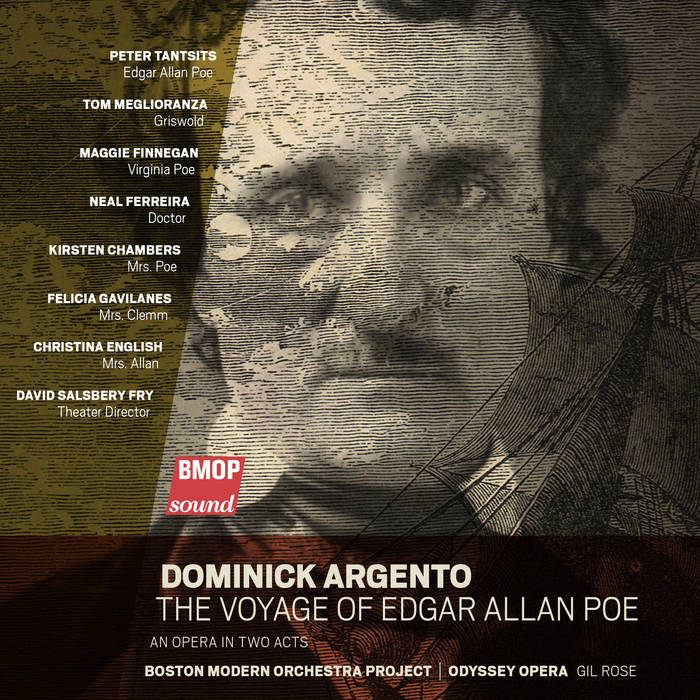
The Minnesota Opera commissioned Argento to write an opera for the US Bicentennial in 1976. (Remember when opera companies used to commission operas to celebrate important historical events?) Argento chose Poe as subject because he considered him the first American artist to achieve “international significance.” He asked playwright Charles Nolte to be his librettist after seeing Nolte’s play about Strindberg, A Night at the Black Pig. The opera was a great success when it debuted, but then was unseen for a decade until the Chicago Lyric Opera revived the work to initiate its “Toward the Twenty-first Century” programming of twentieth-century masterpieces. Again, the work was well- received, but the opera gained no foothold in the repertoire. That Chicago production was supposed to come to the New York City Opera, but this never happened after General Director and conductor Christoper Keene’s tragic death from AIDS.
The libretto reimagines the bizarre circumstances around Poe’s demise. He booked a two-day packet steamer trip from Richmond to Baltimore, but that journey somehow lasted five days. Upon arrival in Baltimore, he was kidnapped by thugs that were taking hostages to control their vote in the upcoming city elections. By the time Poe was found on Election Day, he was already near death. He spent his last days in a feverish delirium.
In the opera, Poe’s journey becomes a phantasmagoric version of This is Your Life emcee’d by Poe’s biographer and nemesis, Rufus Griswold. At its climax, Poe recognizes, just before dying, that he is the bad guy in his own life story. The music is characterful, haunting, layered and dense and includes a significant contribution by the chorus. Despite the complex writing, I found the music engaging and accessible without any sentimentality. The word setting is admirably clear and evocative.
This is an ambitious work that asks its audience to accept its kaleidoscopic, non-linear approach over a two and a half hour running time. Only a Poe scholar will appreciate all the references in the libretto but spotting all the allusions is not the point of the work. Instead, it’s to provide an operatic equivalent to Poe’s hallucinatory final moments. At that, it succeeds very well, though I think it takes a great staging to unleash the full power of this piece.
On this recording, conductor Gil Rose and the musicians do make the best possible audio-only case for the work. He shapes the work coherently and urgently. The very fine singers include important recitalists and advocates for both new and neglected works. Poe is portrayed sympathetically by tenor Peter Tantsits who handles the massive part without evidence of flagging. Baritone Thomas Meglioranza is Griswold along with other people on board who contribute to Poe’s unraveling. He differentiates these many parts well and creates unsettling menace without caricature. Maggie Finnegan, soprano, is Poe’s wife and first cousin Virginia, who predeceased Poe despite being only 13 when they married. Finnegan provides a welcome lyrical contrast, especially in her final benediction for Poe to a text taken from Annabel Lee.
Anyone who is interested in American Opera should give this a listen, provided you can find a detailed summary or libretto. (There is a libretto if you purchase this.) Argento’s song cycles, including From the Diary of Virginia Wolff, Casa Guidi, and The Andre Expedition, are also worth discovering if you do not know them already.