Ken Howard
Great Barrington is a respectable town in Massachusetts, and the Mahaiwe Performing Arts Center, which boasts original 1902 stucco frillery on the stage boxes, is a perfectly respectable small-scale theater in which to stage the Berkshire Opera Festival, despite the almost nonexistent backstage and wing areas. Restrictions encourage creative staging, for which the festival is renowned.
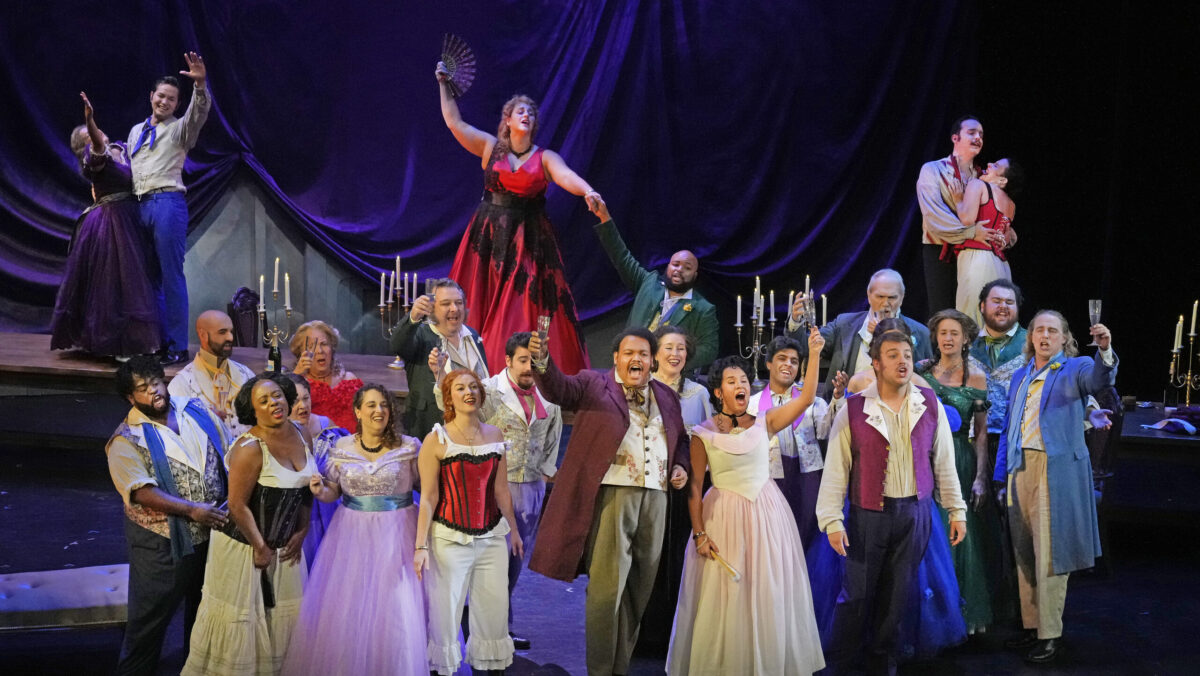
But a Traviata in which Violetta lights cigarettes during the opening number, and even takes a puff or two from some admirer’s pipe? I clutched my pearls! This is 1853—perhaps it’s the demimonde, but … do ladies smoke in public? Maybe it’s a private party. Maybe all those women in lacy culottes are respectable chaperones. (The colorful costumes were by Brooke Stanton.) Maybe I’m too old to admit to blushing. The refreshment counter supplied no smelling salts.
But the real shocker—perhaps it is more tactful to say startler—was to give the piece with three lead singers boasting large, suave voices, soaring gracefully through the iconic (hate that word) leading roles of this most familiar of domestic operas. Cabalettas usually omitted from Act II were restored, at least for one verse each, and why? Because the tenor and the baritone had voices any reasonable audience would want to listen to in a fresh Verdi tune.
Ken Howard
The lady beside me, a veteran admirer of the ten-year-old company, pointed out how inventively director Jonathon Loy used the space—“Did you see their Faust last year? That was inventive too!”—I wonder what they did with the five-part Kermesse, but clearly she had come expecting standards to be maintained and was satisfied they had been.
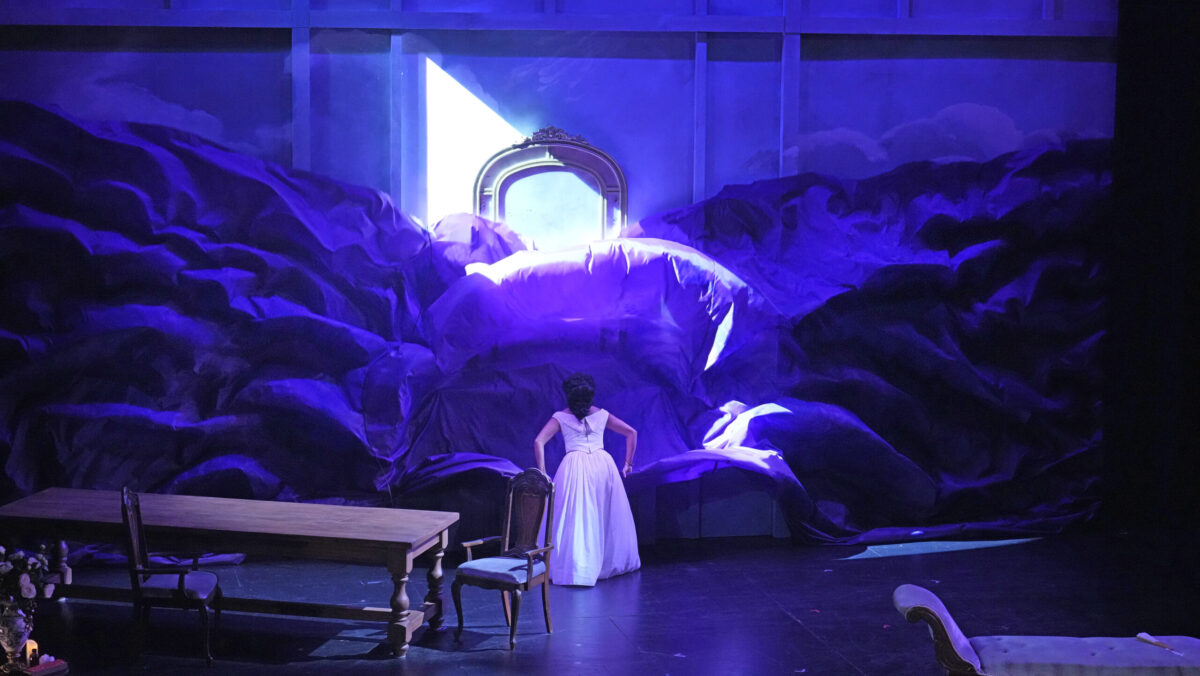
The size and angle of the Mahaiwe stage calls for ingenuity, and Hannah Postlethwaite’s scenery responded to that. Alfredo sang his reprise at the end of Act I not from backstage but from one of the stage boxes—a majestic harp (and harper) set there to accompany him—which gave an informal, boasting quality to the intrusion that (as written) might be taking place in Violetta’s imagination.
Scene changes were swift and witty—Violetta’s party was backed by curtains; she merely had to hurl herself at the wall in despair at the end of “Sempre libera,” then yank on the wainscot until the curtain whisked away and we were in the country house for Act II.
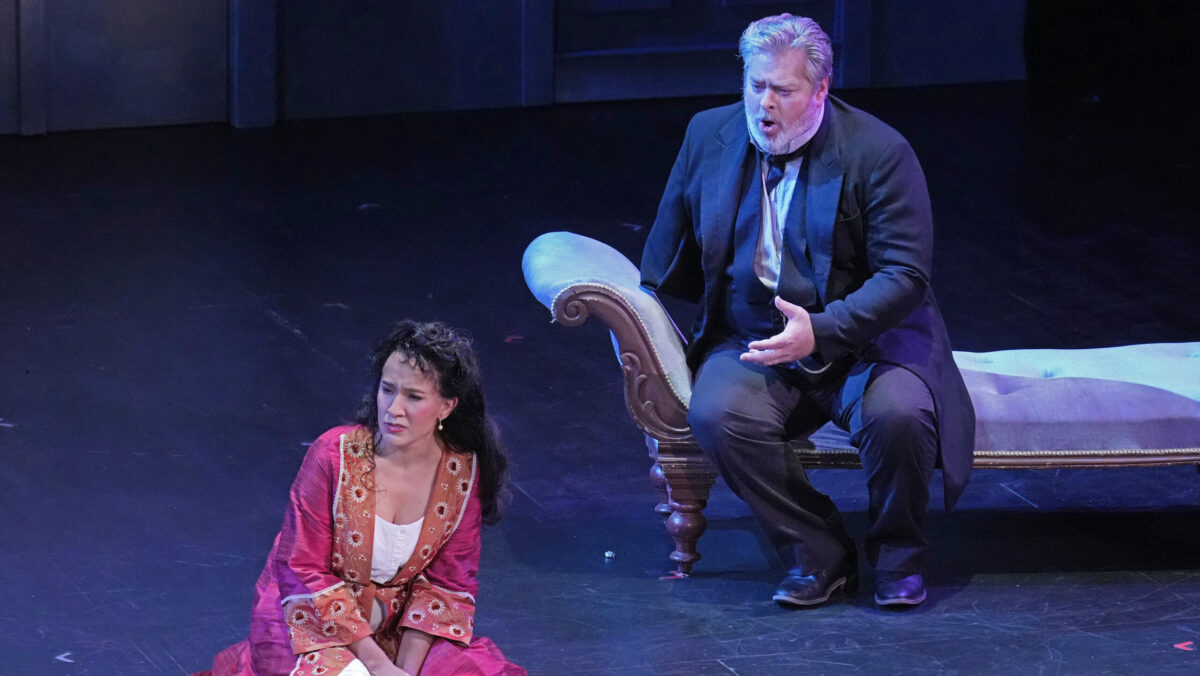
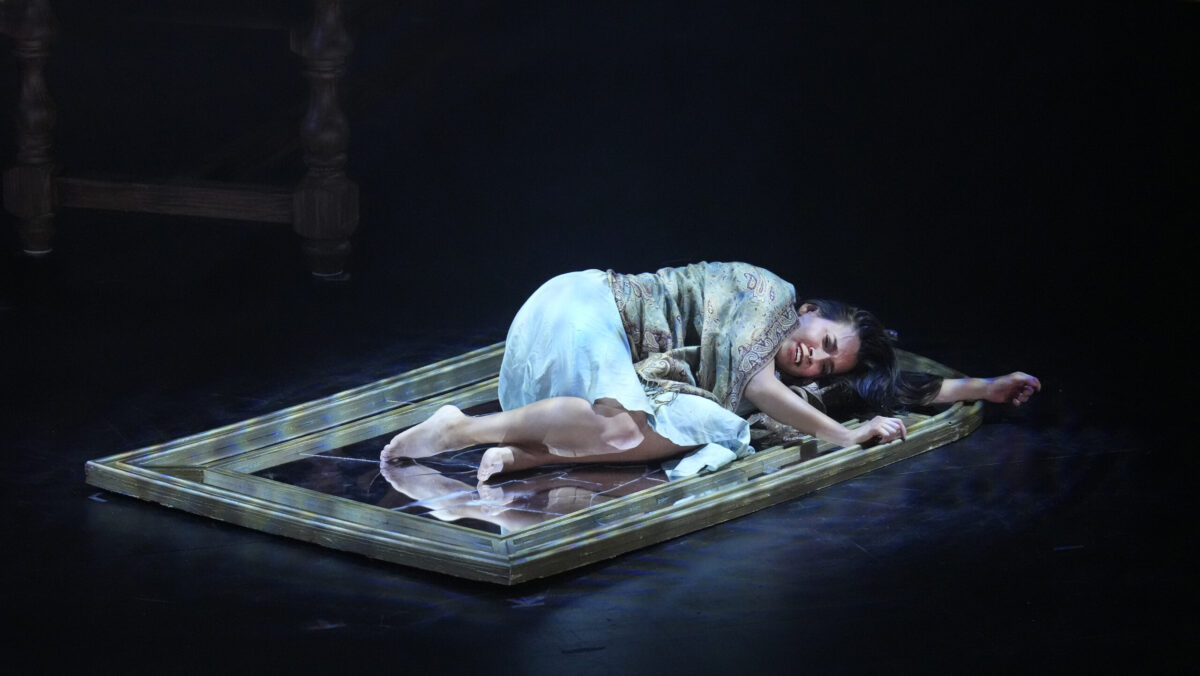
Another cute touch: There has to be a pier glass in Act I so that Violetta can look at herself and mutter, “O, qual pallor,” and notice Alfredo hovering over her shoulder. And there it was. Fancy frame, an out of the way corner. Then, in the final scene—the effect of squalor was achieved by turning the flats around, so we saw the make-shift wooden supports, clever, eh?—beside Violetta’s chaise longue, the mirror, now shattered, occupied on the floor. During “Addio, del passato,” she crawled from her bed and across to the broken mirror that had reflected her beauty when she was in health. Vanessa Becerra, the Violetta, sang the aria from this position, huddling, a wreck. Most affecting.
Ken Howard
Flora’s gala party does not have a Spanish “interlude” but rather became a masque a l’español, with everyone in Hispanic costume, and Flamenco dancers pounding their heels on the tabletops. Those long tables—three of them—were pushed onto the stage to expand the playing space by providing an upper story to the action. The card game, too, took place at the intersection of the tabletops, and Alfredo tossed his winnings in the air—where the audience could see them flutter—rather than hurling them in Violetta’s face, perhaps because they might have gone over her head and into the orchestra pit. Violetta’s public humiliation, too, seemed far more egregious from such a perch.
But I was there for the music. The string sound, of course, was lighter than one is used to in Verdi in a grander house, and Brian Garmon’s tempi sometimes seemed a bit hurried; otherwise this was a by the book Traviata, tender and sympathique, woodwinds sighing as the sad story plays out against the frivolous background. Voices that know how to project, and sound easy when they fill a room have no trouble putting Verdi across at the Mahaiwe.
Vanessa Becerra is a pretty woman with a full-bodied voice, suitable—well, suitable for Verdi. She didn’t chirp the coloratura; she sang it. She did not take a couple of familiar optional high notes — we’re used to them, but Verdi did not think them necessary — and she did not grandstand by drawing out her “Amami, Alfredo.” Her fioritura was pleasingly brilliant if her merriment was not quite convincing, pipe aside. She did not overdo the tubercular breathlessness. Her full, easy soprano rode sweetly beside Alfredo’s tenor and Germont’s baritone, and the pleasure of a small theater for such a show is to see the emotions on the actual faces.
Ken Howard
Joshua Blue boasts a sizable tenor, ardent whether wooing or daydreaming, irate when he flies off the handle. A perfectionist might feel he did not convey the fish-out-of-water provincial that Alfredo is, that he seemed too comfortable with the louche crowd around Violetta. It is important that we notice his naïveté, or we find it difficult to excuse his resentful brutality to the lady he professes to love. Blue is a grandstanding sort of performer, and his voice boasts the size and quality to justify his expectations of applause, but I would have liked a bit more clumsiness, uncertainty, when he is exploring the sordid side of Paris in which he finds himself.
Verdi’s baritones are among the glories of Italian opera, and Weston Hurt’s Germont contributed a fine-grained, thrillingly produced example of it to the long duet with Violetta that is the emotional heart of the opera and the aria (and its usually omitted cabaletta) that follow.
Among the many small parts, all well cast (though the Marquis didn’t seem much embarrassed when Flora caught him flirting around), one noticed the familiar name of John Cheek, veteran of dozens of Met Opera and concert performances, still cutting a somber, mellifluous figure as Doctor Grenvil.
For an audience eager to dally a summer evening with opera, the Berkshire company provides a first-rate event with healthy voices and clever scenic accomplishments up to any reasonable local standard.