
Dario Acosta
The crisis for the performing arts in the United States continues to worsen. Last month the Detroit Opera announced the cancellation of its planned 2025/26 season opener, La fanciulla del West. This was blamed on a shortfall in grants, donations and ticket sales – a deficit that occurred even before the meteor of budget cuts recently enacted by Congress strikes state and local budgets.
At the same time, newspapers continue to gut their performing arts coverage. While one can argue whether newspapers still play much of a role in driving attendance, my off-the-record discussions with several performing arts organizations suggests that coverage of upcoming events does help their advance ticket sales. However, a recent Sunday Arts and Leisure section (July 20) had no articles about music or any listings of upcoming events.
So, the natural response to this singularly shitty cultural moment and mass extinction event for the performing arts is to publish yet another article demonizing Peter Gelb, this one by Jeffrey Arlo Brown in The Baffler. Brown, who is one of the editors of VAN Magazine, declares Gelb to be an utter failure at both financial stewardship of the Met and choosing repertoire for the house. I don’t want to relitigate the finances of the Met; we can save that for whenever the Met publishes its next set of financial statements. However, I do want to explore Brown’s assertions about repertoire.
He claims that the Met should be a “lodestar for opera worldwide.” Since its inception, the Met has always been a company dedicated to providing the best opera that money could buy. There wouldn’t even be a Metropolitan Opera if the Academy of Music had not denied New York’s newly wealthy industrialists access to the Academy’s coveted private boxes. Those wealthy patrons expected renowned singers in mainstream works. The Met did not seek to expand the repertoire significantly; in fact, the Met did not present a world premiere until nearly 30 years after it opened when it presented La fanciulla del West.

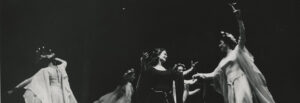
Louise Homer as Mona
From there, it did continue to premiere new works, including ones by American composers but the choices of composers were largely ‘safe.’ (Has anyone heard a performance of Horatio Parker’s Mona? It won a contest sponsored by the Met!) More challenging new works took their time making their way to the Met stage. For example, Pelléas et Mélisande took 20 years and Wozzeck 34 years.
More recently, one way that the Met has led other companies has been with Live in HD presentations – live in movie theaters or afterwards via the Met Opera on Demand. Mr. Brown dismisses Live in HD as a way for operagoers to munch on popcorn during performances. At the “Live in HD” presentations that I’ve attended, audience decorum has been much better than at a typical movie screening. Quiet snacking happened during the intermissions.
Moreover, the Live in HD presentations accomplish two important goals for the Met: reinforcement of the idea that the Met is a “premiere” brand in opera and creating a bond to opera lovers that are far from NYC. The Met does receive many donations from outside of New York and these HD presentations serve to motivate gifts from patrons who may never get to the Met regularly in person. Thanks to the Met’s leadership, most other major opera companies have considerably increased their video offerings in cinemas and on demand. I, for one, am quite grateful for this trend.
Since the pandemic, the Met has also significantly rebalanced the composition of a typical season towards new operas. While some smaller US companies had already done this, the Met was the first major company to do so. No other large company has followed Gelb’s lead. Normally, this adventuresome programming (especially by the Met’s standards) would be lauded. Instead, Gelb has received critical brickbats for the works he has chosen to curate for the Met. Mr. Brown denounces most of these recent premieres as pabulum and decries them as mediocre music with obvious, hackneyed plots. He dismisses them as “second screen operas” meaning they are works that are meant to be enjoyed in the background while you’re doing something else on your phone.
Ken Howard
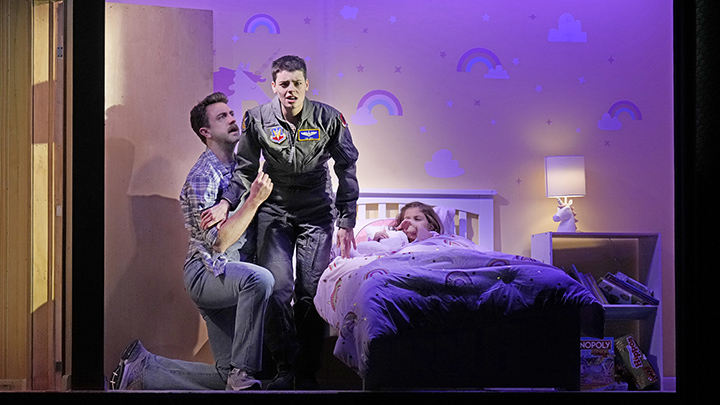
He has particularly savage criticism for The Hours, Grounded, and Champion. He’s entitled to his opinion, but one is led to question his bona fides when he dismisses Jeanine Tesori as the composer of “such groundbreaking works as Shrek: The Musical.” At least give her credit for being the composer of two of the greatest musical theater works of the 21st century in Caroline, or Change and Fun Home.
I do not fault the Met for presenting any of these works, even if The Hours is the only one of the three I want to see again. However, Mr. Gelb undermined his focus on new works with a comically misguided guest essay for The New York Times that managed to antagonize every remaining American classical music critic and informed opera lover.
In “How to Save Opera in America? Make It New Again,” he argued that opera companies in America could be revitalized through “new operas by living composers and reimagined productions of classics that can resonate with audiences of today.” Unfortunately, to make his case for new operas by living composers, he chose to dismiss much of operatic output of the second half of the twentieth century as experimental, mostly atonal compositions that would never appeal to large audiences. He singled out Ligeti’s Le Grand Macabre as his main example of a work that could never be a success at the Met, despite an ecstatically received sold-out run next door at the New York Philharmonic in 2010. Furthermore, he asserts that any critic that dislikes his repertory choices will eventually be seen as being on the wrong side of history.
Naturally, this extreme display of ego results in opera lovers’ getting out their long knives and operatic wishlists to show that they have better taste than the Met’s general manager. For Mr. Brown, he cites works including Luigi Nono’s Intolleranza 1960, Morton Feldman’s Neither, Claude Vivier’s Kopernikus, Olga Neuwirth’s Lost Highway, and Salvatore Sciarrino’s Lohengrin. They are all certainly worth seeing, but most of these are way too small in scale to work effectively at the Met. Once again, one wishes for the Met to find a way to present “smaller” works in an appropriate venue. However, anyone who wants to critique the Met on repertoire has to be aware of what (a) will work in a 4,000 seat house and (b) will attract a donor willing to part with the $2.5 million it costs to mount a new production at the Met.
RICHARD TERMINE
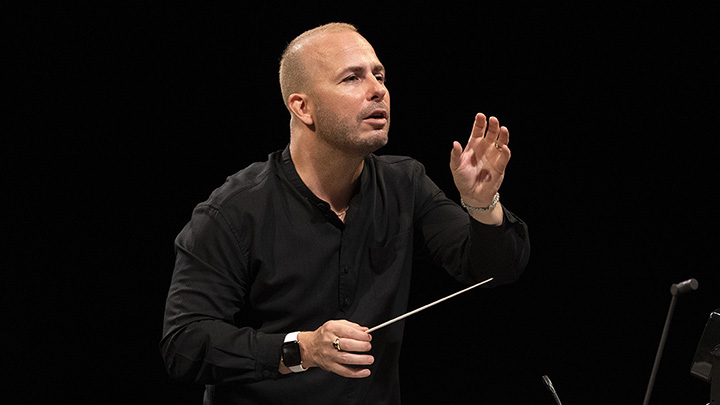
Also, one assumes that all the new works at the Met have the backing and support of Yannick Nézet-Séguin. While it’s easy to criticize Gelb’s taste, the composers with new works coming to the Met are the same composers getting commissions from the Philadelphia Orchestra. I can’t find any evidence that Nézet-Séguin’s has conducted much (if any) Ligeti or similarly “thorny” works. The Met’s Music Director could potentially sway the board to present more challenging works, but I don’t know if even Nézet-Séguin has that kind of sway in the current fiscal and cultural environment. Look how long it took for the Met to grant Jimmy’s wish and produce Moses und Aron and that was during a period of much greater fiscal stability. We’ll have to wait for the next regime to see Le Grand Macabre, The Bassarids or Messiaen’s Saint François d’Assise or [your pet project goes here].
As the performing arts organization with, by far, the largest budget in America, there is a tendency to view the Met as a company that should be able to fulfill any wish that an opera lover can imagine. There is a related belief that the Met can influence the repertory at other companies. Certainly, if the Met had a big success with a neglected work like Roger Sessions’s Montezuma, there would probably be a Montezuma-boomlet, if only because the only way that the Met would stage Montezuma would be as a co-production with multiple companies.
So while we may think that Gelb should be capable of granting our wishes, in reality, he’s in charge of an organization with high fixed costs, extreme fiscal challenges, a conservative board, and a dwindling supply of major donors willing to give the Met the many millions that it needs.
So, I think a lot of the frustration with Gelb is with how he’s chosen to invest his resources in Met premieres. With the demise of OONY and City Opera, the likelihood that we will see any of the operas on our wishlists in New York grows increasingly remote. Gelb’s arrogance about his choices just adds insult to perceived injury.
For those of you who have made it this far, is there an opera company that you consider the “lodestar” – a company that helps define the repertory and a contemporary opera production style? At one time, I might have said that Bayreuth or Stuttgart set the direction for opera productions, but now there is no obvious answer.