Curtis Brown
Verdi’s Rigoletto is about many things: a corrupt court, its rapist leader, a jester with a public life quite separate from his private life. Rigoletto, the jester, is part of the court’s corruption, a man who makes his living through mockery and through encouraging the leader’s bad behavior. At the same time, he tries to protect his young daughter Gilda, but he both hires an untrustworthy duenna for her and fails to fully inform her of the dangers of the world.
Gilda, an innocent teenager confined to her home and her church, falls in love with a handsome man who is the rapist Duke, not an impoverished student. Raped by the Duke, she’s so in love that she’s willing to die for him.
Ideally, your trio of leads consists of a great baritone, a soprano with a youthful lyric voice and good facility in coloratura, and a dashing, attractive Duke. For this iteration, heard on 29 July, 2025, Santa Fe Opera had a cast that is best described as a near miss.
Duke Kim, singing the Duke of Mantua, certainly cut a trim and rakish figure, though his makeup and pencil moustache made him look rather like a cross between Raul Julia as Gomez Addams and the late singer-songwriter Prince. His light tenor sounded dry in Act I, though by Act II he was more warmed up; still, you’d want a more luscious tone for this character. You could believe he was evil and attractive, and even, in “Parmi veder le lagrime,” that he might care a bit for Gilda. Unfortunately, Gilda and the Duke’s Act I scene was coarse rather than romantic or seductive.
Our Rigoletto, Michael Chioldi, who first sang with Santa Fe as an apprentice in 1993, has the right kind of voice for the big Verdi baritone roles, but his legato left much to be desired, with nearly every phrase marred by aspiration and with far too much shouting. His Act II entry (“La rà, la rà, la rà”) had no threat or mystery.
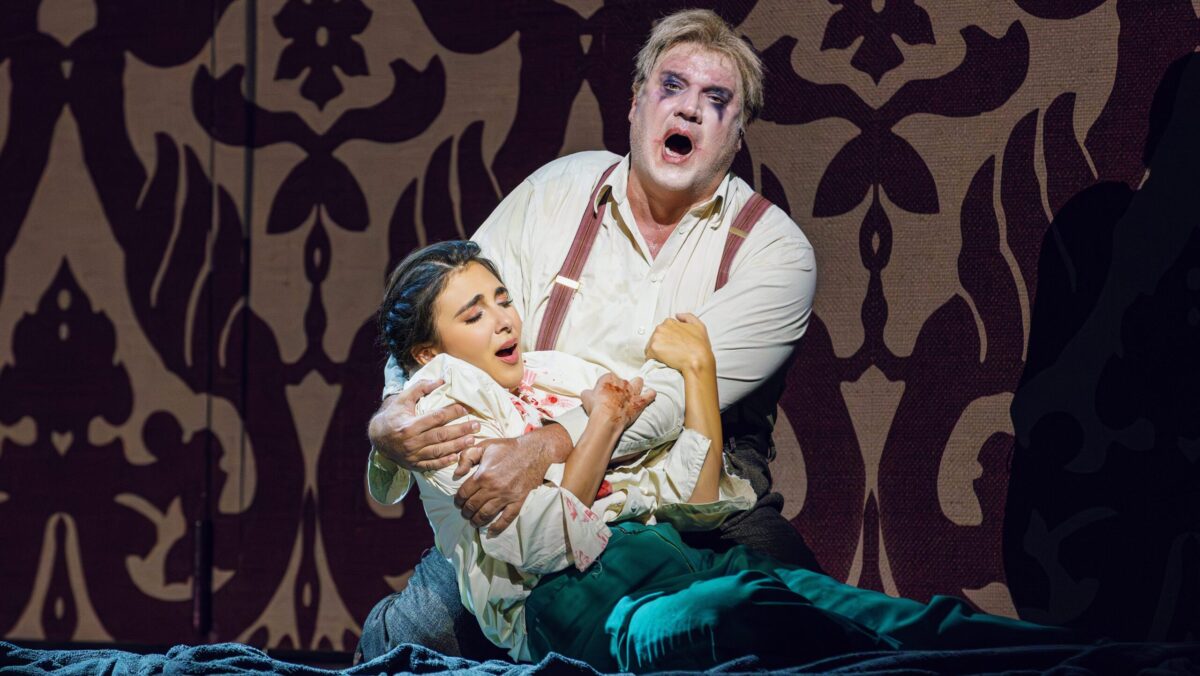
Elena Villalón, so lovely in last year’s The Righteous, fared best in Gilda’s more lyrical moments. “Tutte le feste al tempio” worked beautifully, but “Caro nome” lacked float and repose, and Villalon’s fioriture were choppily phrased. Chioldi and Villalón are both skilled actors and made a moving father and daughter throughout, though when Rigoletto rescued Gilda in Act II, why were they on opposite sides of the stage for the latter part of the scene?
In the smaller roles, Stephano Park was an excellent, threatening Sparafucile, Marcela Rahal a seductive Maddalena. Bass-baritone Le Bu sang with a big, colorful voice as Count Monterone.
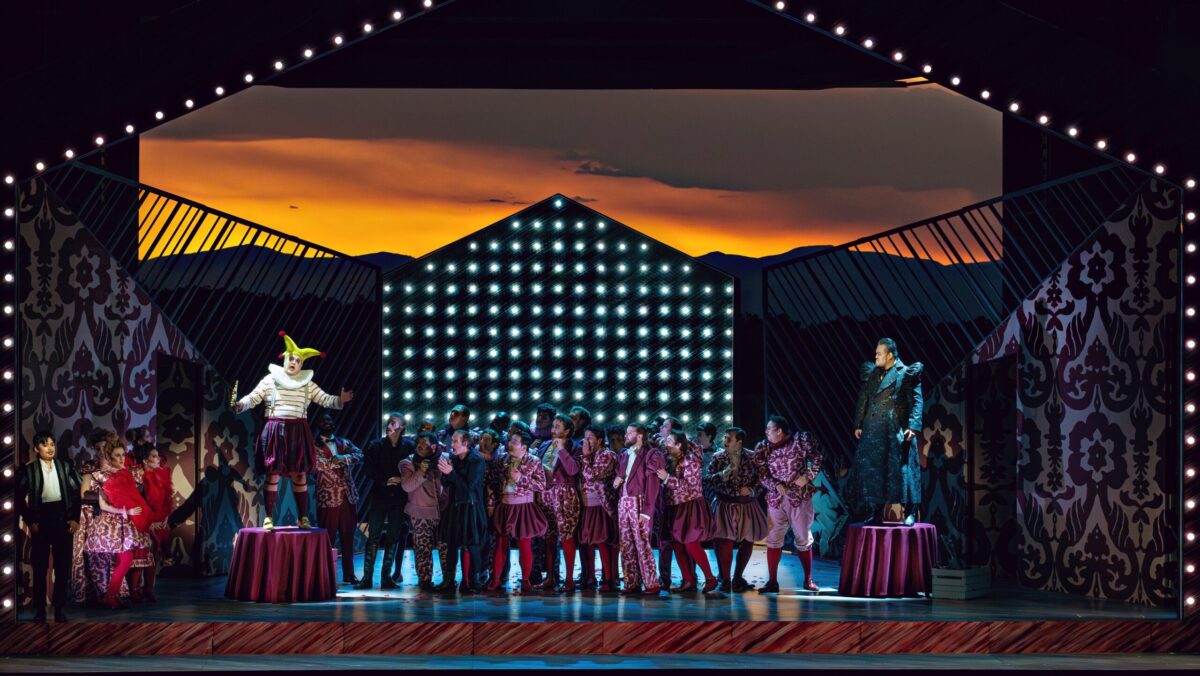
The opera’s plot lends itself to a variety of approaches; a director can set it in Renaissance Mantua, in modern Las Vegas, or in a 20th c. fascist country. Santa Fe Opera’s current production, directed by Julien Chavaz with sets by Jamie Vartan and costumes by Jean-Jacques Delmotte, opts for fantasy Renaissance.
Curtis Brown
The costumes include ruffled collars and pantaloons or breeches for the men and dresses of varying lengths for the women, in fabrics and colors you wouldn’t find in the Renaissance. Neither would you find Rigoletto’s trench coat –– we’re still not out of the Trench Coat Era of operatic costuming –– or the Duke’s Michael Jacksonesque tight pants or the kidnappers’ Homburgs in that era.
Vartan’s set for the court consists of giant cutouts that get wheeled into various configurations; they’re decorated with various flashy patterns, some picked up from the costumes. Rigoletto’s house is a tiny house; Maddalena and Sparafucile’s inn is a bar that could be dropped into any American city without comment.
The set and costumes can put an audience in the right mood, but Rigoletto stands or falls largely on the quality of the singing and direction. Chavez’s direction was largely straightforward, at least in his handling of the principal singers.
Some touches were good and some incomprehensible. Giovanna’s simpering obsequiousness, nicely executed by Simona Genga, worked well for the two-faced duenna, but what were all those lamps on stage during the court scenes? The chorus’s movements didn’t always reflect the character of what they were singing, sometimes looking overly campy.
Carlo Montanaro conducted idiomatically, with drive and good pacing, if not with any particular depth.