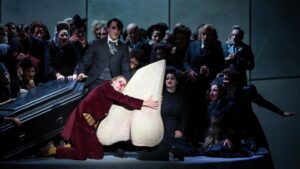
Marie-Laure Briane
Leave it to Munich’s Gärtnerplatztheater to turn bel canto into a glitter ball spectacle and make it work. Director Dirk Schmeding‘s giddy, disco-infused take on Donizetti‘s L’elisir d’amore doesn’t just pop; it fizzes, swirls, and occasionally headbangs. One part commedia dell’arte, one-part Limoncello commercial, this production bathes in the garish glory of the 1970s and dares to transform pastoral comedy into pure theatrical confection.
I should admit upfront that I did not come willingly; relatives dragged me here, insisting I take one night off from the Bavarian State Opera to go “local.” I grumbled all the way to the Gärtnerplatztheater and half-expected provincial farce drowned in rhinestones. What I got instead was something smarter.
Unlike its glossier sibling across town, the Gärtnerplatz is a true Volksoper that wears its 150-year history like a well-fitted velvet jacket. Originally funded by a private company and opened on November 4, 1865, the theater was rescued from financial difficulties by King Ludwig II himself. Designed by Franz Michael Reiffenstuel, the building sits comfortably in its bustling Italianate square. Inside, you find the kind of theater that feels lived-in rather than precious: red velvet, gilded trim, and sightlines that put you close enough to catch every raised eyebrow. With approximately 500 full-time employees, including its repertory soloist company, orchestra, choir, and ballet, it caters to locals; no multilingual programs, no tourists snapping selfies with champagne in the foyer. (Though the olden days of Volksoper companies doing Italian opera in translation are fortunately over; here, Donizetti gets sung in Italian with German surtitles.)
The performance was alit by the cohesive sparkle that comes from shared stage experience that the Repertory system provides; jokes landed precisely because everyone was playing the same game and even singers in the background remained alive to the moment, elevating the entire production through collective attention.
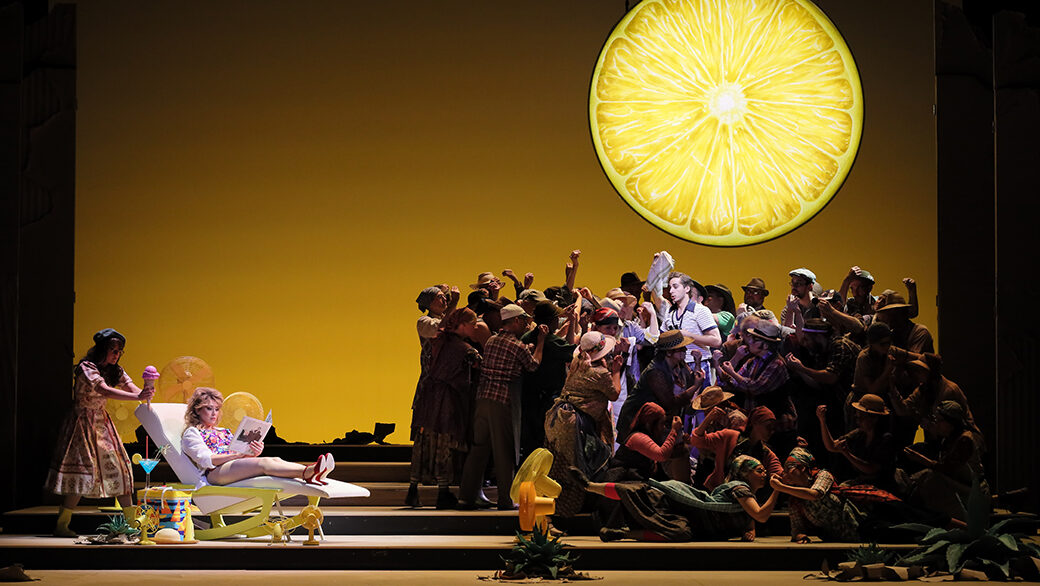
The production, Schmeding says in the program notes, highlights the “summer vacation, summer love” nostalgia at the heart of Donizetti’s work, the universal memory of first love, first rejection, and the deep wounds that accompany youth’s romantic adventures. He and designer Martina Segna transform Donizetti’s sunny village into a louche holiday town trapped in a fever dream of the 1970s. The sun becomes a giant lemon slice hanging over what appears to be a provincial nest built from cardboard scraps, an ironic nod to Goethe’s “land where the lemon trees bloom.” Adina reclines on a beach chair, presumably sipping a Limoncello Spritz. Rhinestone-studded go-go dancers and platinum-blonde headbangers drift through like half-remembered phantoms from Solid Gold. Everything glows in pastel yellows and synthetic textures.
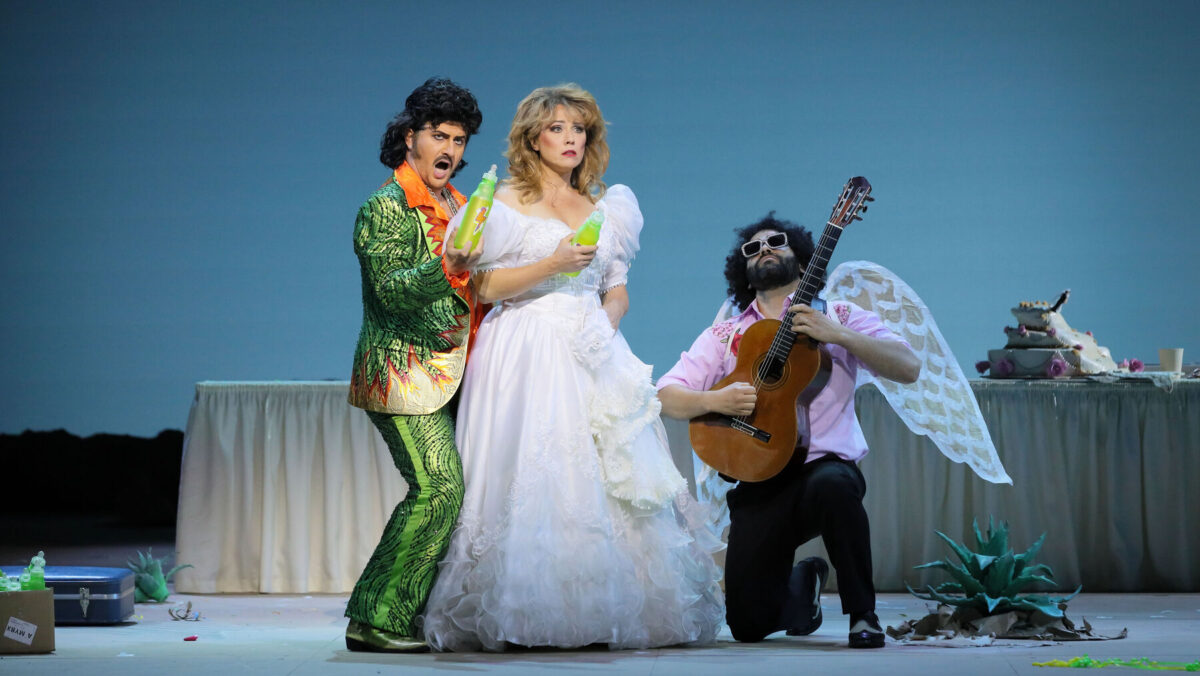
The aesthetic is garish, absurd, and completely serious. Frank Lichtenberg’s costumes amplify the era’s excess: Belcore struts in an ill-fitting uniform with his equally hapless four-man military troupe, while Adina blazes through acts in everything from a sexy one-one piece bathing suit to traditional white bridal wear.
Marie-Laure Briane
Within this cartoonish universe, Nemorino emerged as unexpectedly poignant. Matteo Ivan Rašić‘s performance dazzled throughout. The young Austrian tenor possesses a clean, resonant lyric voice and natural comic timing. His Nemorino fumbles with a television antenna in stonewashed jeans while everyone else grooves, but Rašić played the part with sincerity rather than caricature. Tall, handsome, and athletic, he embodies the kind of Nemorino who might realistically capture Adina’s attention, making his initial rejection all the more touching. That emotional transparency gave real weight to “Una furtiva lagrima,” delivered with clear phrasing and quiet force that moved beyond mere technical display into genuine pathos.
American soprano Jennifer O’Loughlin offered equally compelling artistry as Adina. Her crystalline voice, bright without being steely, handled Donizetti’s flourishes with remarkable control. “Prendi, per me sei libero” was both vocally assured and sharply characterized. As a comedic actress, she displayed razor-sharp instincts, easy physicality, and radiant, almost conspiratorial charm. O’Loughlin, a star of the company (she was named Bayerische Kammersängerin in 2021), navigated Adina’s complex emotional journey from playful indifference through calculated manipulation to genuine vulnerability with remarkable skill. Her chemistry with Rašić built steadily throughout the evening, culminating in a final reconciliation that felt both inevitable and earned.
Matija Meić‘s Belcore strutted with macho energy, delivering robust, bronzed baritone lines and comic swagger while never turning the character into buffoonery. Instead, he played him as a man who genuinely believes his uniform guarantees success. Accompanied by his four-man comic troupe in ill-fitting military garb, Belcore becomes less a menacing rival than bumbling opportunist.
Marie-Laure Briane
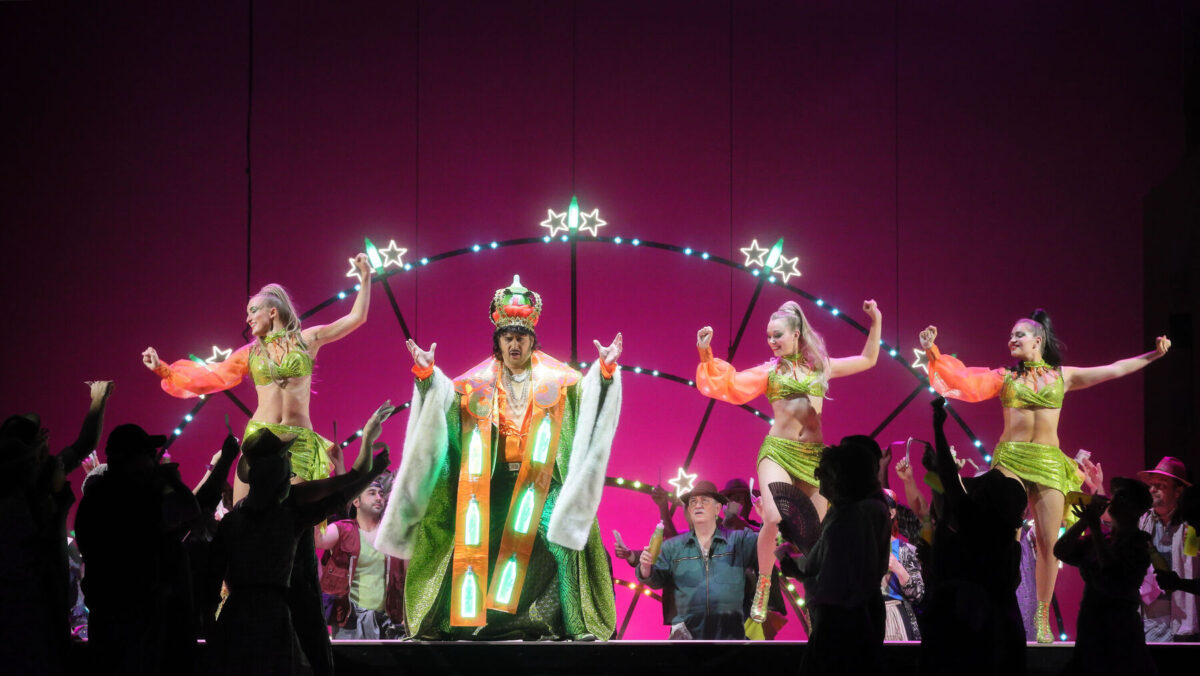
Hungarian bass Levente Páll stole scene after scene as Dulcamara. His commanding voice and gift for comedy were matched by an ability to play the absurd with utter seriousness, which only made it funnier. Dulcamara arrives not by cart but as a glittering TV pitchman emerging from the village’s large television screen, the televangelist of tonic, selling his elixir not just to the characters on stage, but to us. Surrounded by three go-go dancers executing Kerstin Ried‘s deliberately campy choreography, Páll commanded every moment of his stage time with vocal authority of a true bass and masterful comedic timing.
Conductor Michael Balke drove the evening with warmth and clarity, keeping energy buoyant without rushing. After the breathing, lyrically taut woodwind and string passages, he pushed the stretta sections nearly to the limits of what voices could handle, making runs and passages pearl and foam like champagne. The orchestra played with zip and polish, never overwhelming the singers. Special credit goes to onstage guitarist Pedro Silva, whose interjections parodied the schmaltzy serenades of other operas with loving sarcasm. These touches gave the production its tonal elasticity, knowing when to push for big laughs and when to pause and let absurdity breathe. Julia Sturzlbaum brought sweet vocal sparkle to Giannetta, the village girl whose romantic hopes provide a charming subplot to the main action.
The chorus was in on the joke from the start. Every wink, reaction, and background movement added detail. This is not opera where the chorus fades into decorative peasantry. At the Gärtnerplatz, the chorus is a full participant in storytelling, their work precise and joyfully uninhibited.
Rarely has Donizetti’s little love potion tasted quite so sweet. Or so sour. Or so sparkling. The production made no apology for its silliness, knowing exactly what it is and owning it with glee. The standing ovation was well-earned.