
Bernd Uhlig
Gabriel Fauré’s Pénélope, based on the Odyssey, feels in some ways like a farewell to French grand Romantic opera, premiered in 1913 only three weeks before Stravinsky’s Rite of Spring. Aside from a noted recording with Jessye Norman in the title role alongside José van Dam as Ulysse and the Monte-Carlo Philharmonic conducted by Charles Dutoit, the opera remains relatively obscure.
Pénélope also seems to hide in the shadow of Claude Debussy’s Pelleas et Mélisande from a decade earlier, though Fauré’s own wonderful incidental music to Maeterlinck’s play predated the many other famous adaptations. The link between the two operas was apparent in the Bayerische Staatsoper’s summer festival, having programmed Debussy’s work last year, with both works presented at Munich’s more intimate Prinzregententheater. Jetske Mijnssen’s Pelleas framed it as a fin-de-siècle family drama. Conversely, director Andrea Breth—making her Staatsoper debut—made Odysseus’s return to Ithaca feel similarly claustrophobic, with Raimund Orfeo Voigt’s stage design featuring multiple cramped, modular rooms constantly tracking across stage at a glacial pace.
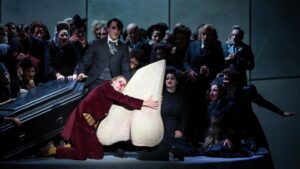
While the Ithacan palace is suffocating, both the prelude and Act II take place in a desolate and gray stage populated only by fragments of Hellenic marble statues, perhaps memories of past glory. In the opening moments, Ulysse sees body doubles of him and Pénélope, the king acting as a caretaker for his wife in a wheelchair. Breth’s thematic emphasis on memory and subconscious is clear from the prelude; Ulysses is imagining what life would have been had he remained on the island instead of fighting in Troy. In Act II, the roles are reversed as Pénélope cares for her disguised husband until Ulysse gains strength to stand up and reclaim his bow. Meanwhile, Pénélope’s body double lies as a corpse for most of the opera, an object of morbid fascination for her suitors on her “wedding” day.
The four suitors were well-cast and balanced, particularly with tenor Loïc Félix’s rounded voice and commanding presence as Antinoüs. In a particularly striking moment, the suitors have a macabre arabesque dance with the servants, grotesquely emphasizing the word “dream” as they fantasize about the queen.
Brandon Jovanovich portrayed Ulysse with sensitivity. He had a surprisingly tender voice in the quieter moments, accompanied by Fauré’s brilliant chamber music-like orchestration. Yet Jovanovich could have been more forceful the moments when the Ithacan king seeks righteous vengeance. Ulysse here was more weary than bellicose. Victoria Karkacheva’s strong voice matched Pénélope’s defiant personality. While her French diction was not always discernible, Karkacheva gave nuance to a challenging role, particularly in the intimate passages unaccompanied by the orchestra.
Thomas Mole as the shepherd Eumée had the clearest diction and projection of the cast. As the oldest character in the story, a more rugged voice might have been apt instead of Mole’s youthful timbre, though his performance was nonetheless impressive, so too Rinat Shaham as the nurse Euryclée.

Bernd Uhlig
Conducted by Susanna Mälkki, the orchestra was mellow and subdued for most of the evening, eschewing a lush string sound and instead presenting Fauré’s music as almost proto-modernist. This was effective particularly in Act III, for example, with the grumbling double basses and bleating trumpet as the suitors’ plans are foiled.
However, the orchestral energy in the latter half of the opera also proved somewhat tricky for the singers, as during the tempestuous moments in Acts II and III anything forte or louder covered Karkacheva and Jovanovich. This balance issue was not necessarily helped by the venue as, even with a deep pit, the Prinzregententheater’s stone walls do not absorb much sound. Nevertheless, the singers, chorus, and orchestra blended well in the final scene’s praise to Zeus as the shepherds slay the suitors, one of the most unapologetically tonal passages of Fauré’s score.
Breth’s subtle production and Mälkki’s restrained conducting made one not only appreciate Pénélope as a hidden relic of late Romanticism but also notice Fauré’s looking ahead to French modernism.