Michele Monasta
“You know they’re doing a different version, right? Of Aïda.” For a brief moment I felt faint, lightheaded, vertiginous. There’s a different version? Like Don Carlo? And I didn’t know this? I chose my words carefully: “Do you mean, the score?” Silence. “Or the production.” “Yes, the staging. It’s different.” “Oh! Yes. I did read about that.” Given that this conversation took place in the back of a golf cart hurtling through Florence towards the Fondazione Maggio Musicale Fiorentino with only 10 minutes to go before curtain (long story), I felt it best to leave it there. I am sure you understand.
The funny thing is, when such a canonically ossified work like Verdi’s Aïda is directed at all (let alone as ambitiously as Damiano Michieletto at the Maggio Musicale Fiorentino), it does feel like a completely different opera, perhaps even a different genre of entertainment, than what you might find at a Met or Teatro alla Scala or the Arena di Verona. Though nominally a spectacle-piece, most directorial touches in your average big-house Aïda are usually limited to the choral numbers and the handful of balletic divertissements with any physical action between the five main characters rendered secondary to whichever position and/or discarded granite slab they can most comfortably vocalize from.
The paradox of those “traditional” Aïda stagings is that by seeking “faithful” non-intervention and representation, they leave the audience with a much thinner conception of the characters and their motivations than the libretto actually affords them. Michieletto’s staging, by contrast, did not treat Antonio Ghislanzoni’s libretto with such contempt, instead instructing the characters to actually enact a plausible drama (a tragedy!) against the backdrop of a bloody ongoing war. Additionally, Michieletto probed several important questions raised by the plot: How do the King, Ramfis and Amneris differ in their possession and deployment of power? What is actually going on between Amneris and Ramfis? What were the exact circumstances of Amonasro’s death?
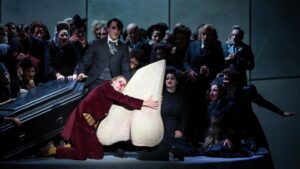
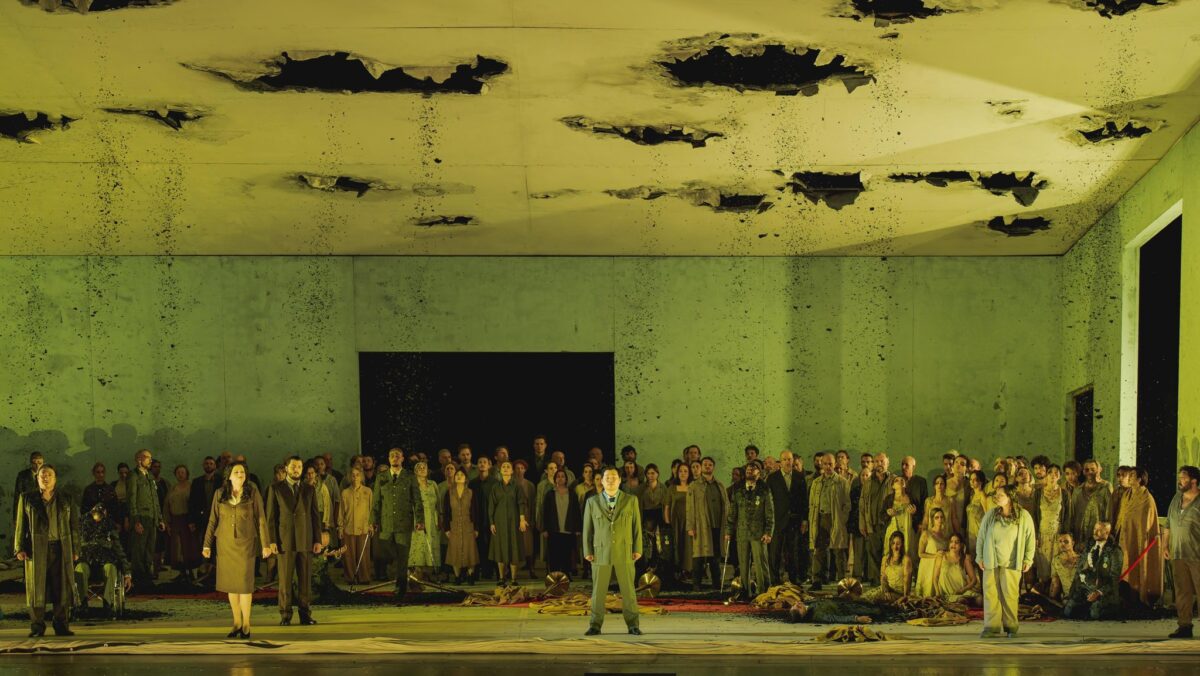
In many ways, these interpersonal dynamics were more successful than some of the larger ideas conceived by Michieletto, whose staging is updated to (roughly) the present day. Far from a sumptuous pageant, much of the action takes place in a deteriorating school gymnasium, the ceiling nearly caved in by recent shelling. (The sets are by Paolo Fantin.) The body of a small child wrapped in a shroud, brought onstage prior to the entrance of the King and his messenger in Act I, immediately reminded us of the human cost of these kinds of stories as well as brought the action to an uncomfortably familiar proximity. The Act II Triumphal March was a harrowing affair featuring a parade of veteran amputees. Black soot poured from the holes in the ceiling during the large, Act-concluding ensembles. These were compelling pictures, but they worked better when I didn’t think too hard about whichever contemporary analog either side was meant to represent.
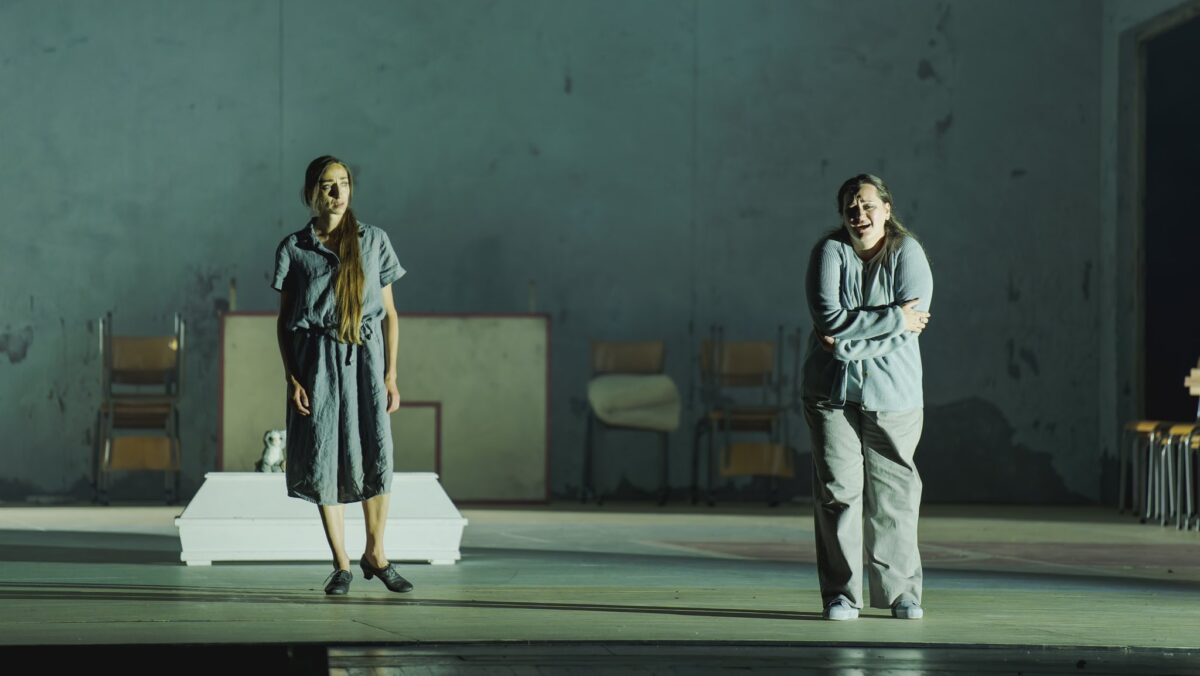
On the other hand, the updated setting enabled Michieletto to effectively develop the main characters within more familiar surroundings. Daniela Barcellona’s Amneris was presented as a kind of administrator, primarily in charge of a group of children (presumably war orphans) and Olga Maslova’s Aïda seemed to be one of several caregivers in her employ. The resulting power dynamic was more nebulous than usual, but this made for a more intriguing love-triangle between the two of them and the newly-promoted Radames.
How secure did Amneris actually feel in her betrothal? Certainly not much, as she spent a significant amount of the action evading a lascivious Ramfis, whose usual aloofness was replaced with a cold sadism. One was given the impression that her desire for Radames was not out of lust alone, but self-preservation. The relative power of the King became even more precarious; if the High Priest can regularly force himself on the daughter of the Pharaoh, what else does he get away with?
Michele Monasta
This rejuvenated dramaturgy was aided on the musical side by an exceptionally strong quintet of lead roles. Of central interest for me was Maslova, a 33-year-old just several years into her international career but already boasting a busy calendar of some of the most demanding roles in the repertory.
To put it mildly, Maslova has an unusual vocal profile for this repertory, a corpus that has somewhat coalesced around a globalized Verdian “house-style.” Though fully capable of unfurling her voice over Verdi’s massive ensemble climaxes, Maslova was more often inclined to dispatch her role’s sweeping melodies with a compact, slender and slightly cool timbre that nevertheless retained both carrying power and center of pitch. It was an Aïda with long, sketched out musical ideas that were greater than the sum of their parts. This was on best display in the third Act when Aïda must use both melody and carefully prescribed dynamics to vivify the Arcadian landscapes that Ghislanzoni inserts into her memories of Ethiopia. We learn, through her poetically achieved deception of Radames, that Aïda’s capacity for reflection — until now, a feature of her inert passivity — is actually what makes her uniquely powerful. At least, we learn this when the Aïda has the musical imagination to deliver a performance that is greater than a catalog of choice phrases and floated notes.
It will be interesting to see where Maslova goes from here. Typically, vocalists of her scope spend their early careers in Mozart. That she is already making her home in Abigaille and Turandot raises some interesting questions about the nature of these roles themselves, as well as the realistic contours of a professional career in the 21st century. For now, we can appreciate that singers are continuing to find ways to meet Verdi without being beholden to every post-hoc convention associated with his vocal writing.
To a somewhat lesser extent, Barcellona’s Amneris was also representative of a more fluid approach to a treacherously demanding role. Never gifted with a particularly sizable or refulgent voice, Barcellona instead made her bones in the florid music of Handel and Rossini, the evidence of which could be heard here in her musical precision and sophistication of line. Moreover, her comfort in the awkward “Musico” tessitura demanded by those earlier composers transferred well to Amneris whose most biting remarks and melting phrases tend to reside in both extremities of her range.
Michele Monasta
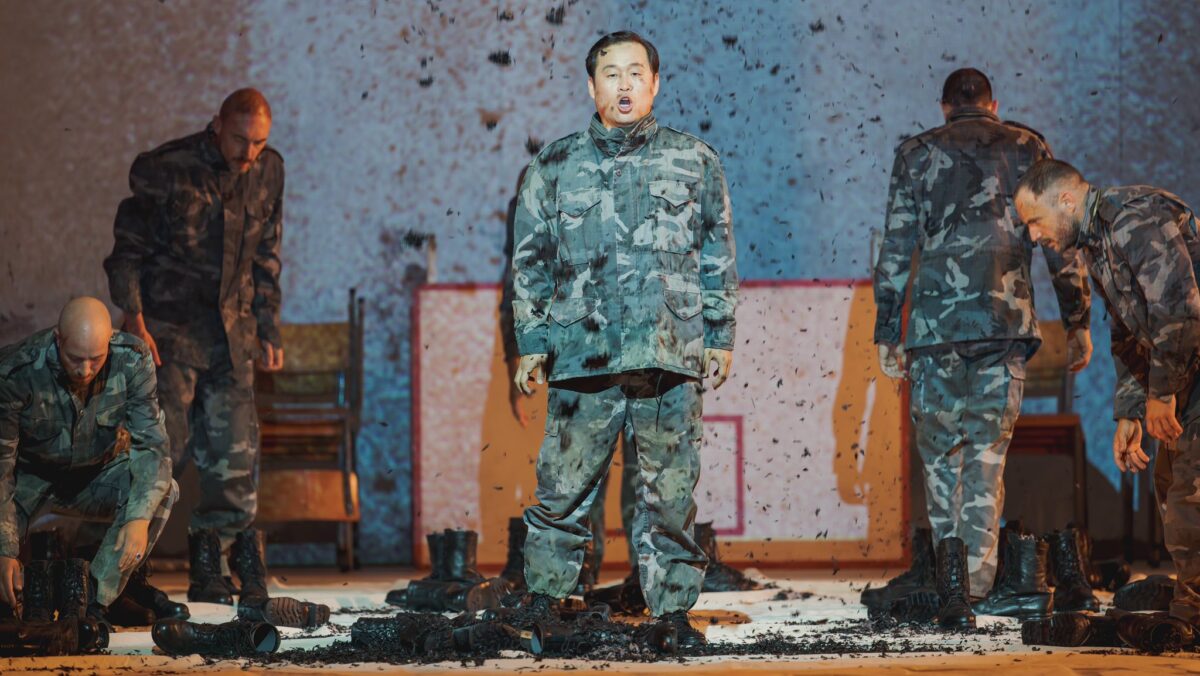
This was my second time hearing Seokjeong Baek’s Radames and I was pleased to find that my extremely positive impression earlier this year was not a matter of chance. There is an unusual fluency to his vocal production that enables him to adapt within a huge array of musical demands while retaining clear and expressive diction. There is a wonderfully symmetrical chiaroscuro to his timbre and a relaxed airflow that gives his vibrato a pleasantly rich texture. I’m feeling bullish on this one, if you haven’t gathered. The contrast of Baek’s marbled, occasionally baritonal delivery and Maslova’s refined, pearly legato felt both deeply modern but intriguingly old-fashioned; not so much Björling/Milanov as Ramon Vinay and Ljuba Welitsch.
Simon Lim’s Ramfis was delivered with a cavernous, throbbing tone, equally sturdy both high and low and shrewdly deployed in his character’s hypnotic (and too brief) incantation sequences. Less musically successful was the King of Manuel Fuentes, whose occluded singing had difficulty reaching past the footlights, but this (perhaps inadvertently) also heightened the previously-noted distinction between his character’s persuasiveness and that of his High Priest. Daniel de Vicente’s Amonasro was delivered in a plush, fearlessly deployed baritone which luxuriated in the often glacial tempi provided from the orchestra.
It was undeniably special to attend a performance conducted by the venerable Zubin Mehta and wittnessing the ecstatic receptions he received from the podium and stage were almost worth the price of admission. The conducting itself was more variable; the performance contained many flashes of his eye for detail and meticulous preparation – the trumpet ritornello in “Pur ti riveggo” was delivered with a delightfully tight and crisp staccato, the Act I dance of the priestesses had a lovely calibration of meter. Always a singer’s-conductor, solo numbers had a breadth and attentiveness that enabled the characters to explore their music fully. However, he often seemed reluctant to accelerate, which left his soloists out to dry in Verdi’s long, complex ensemble melodies.
It remains to be seen if Michieletto’s staging is representative of any changing winds in the Aïda-meta. For those of us who call the Met home, it is sadly unlikely. However, there is no reason why the characters — even in a production that gives top-billing to the horses in Act II — can’t be as textured and engaged as they were under Michieletto’s guidance. If Aïda is to be condemned to a future of “faithful” representation, then directors ought to be duly generous with the depth Ghislanzoni and Verdi conceived for their ancient heroes and heroines, rather than treating them as noisemakers who can drift from one temple ruin to the next.