

Disoriented

The most wonderful thing about opera on video is the vicarious thrill of seeing performances of important works in the most glamorous foreign theaters in gala presentations with musicians of great renown for a piddling fraction of the cost. This performance of Luigi Cherubini’s Koukourgi isn’t even close to such an occasion. Here we are at the Stadttheater Klagenfurt for the world premiere of this opéra-comique that was written shortly after its composer retired to the provinces to wait out the revolutionary unpleasantness in Paris. Where is Klagenfurt? Well, you should ask. It’s a little haven in southern Austria near the border of Slovenia. It’s about 300 miles from Salzburg by car but much, much further musically, if you perceive my meaning.
Oddly, in spite of Cherubini’s enormous success with the French public, Koukourgi was never mounted until these performances in September 2010. A critical edition of the music was prepared by Heiko Cullmann. The original libretto by Honoré Nicolas Marie Duveyrier was lost along the way so a narration was written for the lead character in the vernacular of the audience to fill in the blanks.
I’d be thrilled to report that this DVD reveals a lost masterpiece of great importance but, sadly, it looks like the score was left on the shelf for a reason. The plot, which is conventional in the extreme, concerns the soprano Zulma and her efforts to secure the hand of the tenor Amazan. Zulma’s Father is Fohl, Lord of the Castle, who is trying to marry off his daughter to Koukourgi, the son of General Zamti. Koukourgi has a servant, Phaor, and Amazan a tutor, Sécuro, to round out the ensembles and provide the dreaded comic relief.
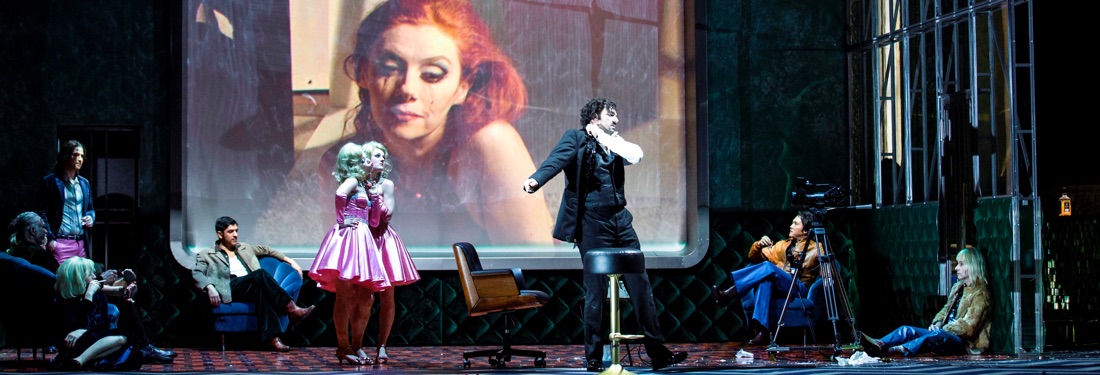
The lights go up on an absolutely stunning front curtain by set designer Johannes Leiacker that becomes much too familiar as the evening wears on. Once that’s out of the way an angry Asian statuary face dominates the stage with a series of small stairs that are constantly shifted about. The ubiquitous neon bars that comprise part of nearly every modern German stage design are set to the sides, raising and lowering slowly during the “storm sequence” for effect.
The curtain rise at Act III gets a rousing hand until the lights came fully up and the audience realizes they were still looking at the same basic set from Acts I and II.
The program notes say that it’s unlikely for Cherubini to have had any familiarity with Mozart’s operas at this point in his career so I guess I’m hearing the influence of Haydn. I’ve never found Cherubini’s music to be particularly individual and these three short acts plod along like a much longer evening than they should. It all sounds like more perspiration than inspiration. I’d blame the performers but it’s much too easy and here’s why.
Daniel Prohaska as Koukourgi owns the evening for his very easy manner and excellent comic skills. Plus, through his narration, he’s the only performer who’s able to develop his character and relate to the audience. An agile performer, he displays an easy character tenor voice with a fairly solid technique and would be an excellent addition to any provincial ensemble.
His rival for the affections of the soprano is Tenor Johannes Chum as the soldier Amazan. His wooden stage presence and uneven vocalization could bode well as a future Tamino if he gets himself in order fairly soon. If not, he’s tall and slim enough to remain on the payroll in Klagenfurt for a while.
In other character parts, Daniel Belcher, Stefan Cerny, Leonardo Galeazzi and Peter Edelmann are perfectly acceptable, if not distinguished, in an ensemble where the comprimarios are hell-bent on trying to put this piece over and make it work. But the chances of this sort of success are severely scuppered by the soprano they’ve been strapped with for the evening.
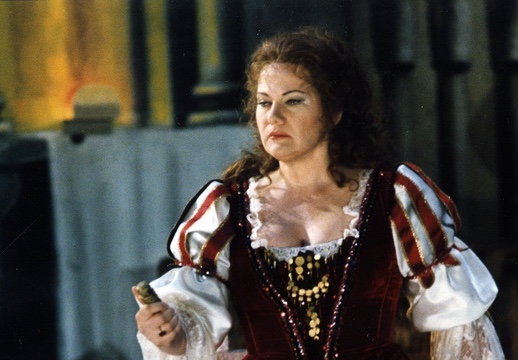
Çigdem Soyarslan is a name I hope only to type this one time in the hopes that she will disappear into obscurity forthwith. Her character, Zulma, has been fashioned as a young female warrior and she makes a flying Peter Pan/Crouching Tiger entrance onto the stage and then bleats unattractively like a baby goat caught in a rut for the next few minutes.
As her voice gains in strength (God help us) it’s accompanied by a tongue so disposed to flutter and quiver it resembles a salmon just recently caught and dropped on a dock. Her makeup plot gives her three red dots going from her brow up the middle of her forehead. I imagined these as the failed assassination attempts of three music critics she had encountered previously. I can only hope that this was a very bad night for her and that the lure of being filmed for the one and only time in her career was what coaxed her from her sickbed.
I almost forgot to mention the stage director, Josef E. Köpplinger, which would be a shame. It’s a name you should all remember on the off chance you see it on a theater marquee in the future so you can run in another direction.
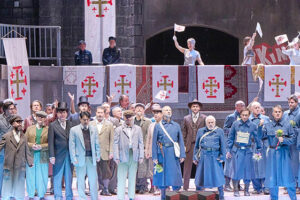
Peter Marschik is in charge of the pit and the Kärtner Sinfonieorchester manage an even, but dispassionate, job with the brief overture and the rest of the score. The Chorus and Extra Chorus of the Stadttheater do their duty well although, frankly, there didn’t seem to be that many people standing on the wee stage.
Sound and picture were very good and it was someone’s bright idea to send all of the offstage voices and chorus through the rear surround track which, although it doesn’t make physical sense, certainly make the right impression in the context of your living room. Bravo.
What we have here is the operatic equivalent of fusion cuisine with an Italian composer writing in French in a Chinese setting with German dialogue and an apportioned musical style of indeterminate cultural school. I’m imagining a serving of Wiener schnitzel on a bed of chow mein covered in Béarnaise with a side of pasta. If you consider yourself a hardcore Cherubini fan, bon appétit!
I’ve had the video of the telecast loaded on my IPad for many months and still have not found the interest to watch it in its entirety.
“……a lost masterpiece of great importance…”
really ? another one ?
A NYC impresario/VIP [he would agree], said Hi at the Maometto II intermission in SFE, and when in response to his question did I like the opera, I said “well produced but a little boring,” he drew himself up with a great puff and intoned “this is a very important opera!” I felt chastised. Until I saw four or five people standing nearby
watching us who broke into hearty laughter.
That’s what happens with these rarities! Oh well, it got me through the
second act.
But aren’t a great many Rossini operas ‘rarities’? -- perhaps you are not intimate with Maometto II … but that doesn’t mean it’s a ‘rarity’ for all of us.
- I cringe at having to try to listen to Ciro (a rarity for me) this summer from Pesaro, but I will make the effort.
- I can’t figure out why people don’t like Maometto II -- unless they don’t care for all the ensemble work therein.
… remembering that “Ciro in Babilonia, ossia La caduta di Baldassare” is more oratorio, and that “Maometto secondo” might be better heard as “Le siège de Corinthe.”
Well, Phoen, history shows us that Maometto II has hardly
every been a success. We went the other night and there
were many empty seats. My impression is that it is toooooo
long. The arias and set pieces have three verses, some of
them, and they do ‘em all — the “new scholarly edition,”
don’t you know. Three hours of mid-voice florid work on a
text not exactly new or different really does begin to pall after
a bit. Compare it to Ermione — same kind of work, but E.
is tighter and more concise, and I could not get enough of
it. Santa Fe has a super cast and superior conductor and the
production itself with an innovative and dynamic unit set
is intresting. So what’s wrong? I heard Siege of Corinth at the
Met a couple of times with Sills, and its a very very different
show, but even there the inspiration level was not great.
Can’t win ‘em all.
Well.
What exactly does this mean: “history shows us that Maometto II has hardly ever been a success”? How so? By virtue of the fact that it did not meet with much favor in Naples upon the premiere? By virtue of infrequent modern stagings? By virtue of your opinion? I ask honestly what you mean, since you say it as if we should all be aware that Maometto doesn’t have much chance to succeed.
I would LOVE to have taken one of the “many empty seats”, as this opera shows Rossini at near to his most ambitious. It is a challenging work -- the sheer length, yes -- but also in the massive vocal structures and the tremendously difficult vocal writing. It really needs highest caliber singers (I cannot speak to the crew in Santa Fe, though it looks promising on paper).
I agree with the VIP: this IS a very important opera -- one that those who listen to a lot of Rossini will surely love, because it shows many facets of his genius (particularly his flair for complex ensembles) that aren’t always so flamboyantly expressed in his more popular titles.
Phoenix -- Ciro is a MUCH less inspired piece than Maometto II (not a surprise since it was composed so early in Rossini’s career). And for those who mentioned Le siège de Corinthe, the two works are vastly different. The French adaptation has a totally different tone, color, and emotional current -- not to mention the language. It is MUCH less virtuosic from a vocal standpoint. The version Sills performed at the MET was an incredibly complicated conflation of the two operas that really served neither (in scholarly terms), but did provide a tailor-made vehicle for Ms. Sills’ vocal pyrotechnics (and of course Verrett, et al.).
Thank you, evenhanded. Mrmyster’s appeal to history is flawed-- it’s history as recalled by one who has little interest in MAOMETTO II to begin with.
The opera made quite a hit at San Francisco in 1988, with an excellent specialist cast-- Alaimo, really something special in those days, Anderson, Horne and Merritt, all at something like their best under Zedda. To my surprise (I disliked Anderson’s recordings and persona) I enjoyed it so much I went back again.
I heard it again at the Opera du Rhin, in their tiny Colmar venue, with a good cast headed by Denis Sedov and Irini Tsirakidis ( whatever happened to them?), both Rossini comers, so it seemed then (2002). Again, I thought it an excellent evening in the theatre-- and so did my brother and 10 year old nephew!
Works much better than the grotesquely disfigured ASSEDIO edition Schippers cobbled together.
It’s *not* a piece that is going to displace BOHEME. But on its own terms I find it very valid.
http://www.youtube.com/watch?feature=player_detailpage&v=TP0xSTScxxM
If I’m not mistaken, Schippers was not the one who “cobbled together” (although it was indeed cobbled) the Sills version of ASSEDIO, that honor went to now artists’ representative Jack Mastroianni.
Randolph Mickelson’s bio claims that the edition of L’Assedio which was presented at La Scala in 1969 was his. I don’t believe the MET edition varied much from it.
Of the two of them (La Scala & the MET) I preferred La Scala version with Horne (not as interesting a singer as Verrett, but it was the performance itself that I thought was better) -- my only reference points are live performances of them both. La Scala version had a musical logic & cohesiveness; the MET version sounded like a hodge-podge.
Maometto Secondo: brilliant, beautiful, fascinating, challenging, important, all those things. . . Rossini opera seria is never going to be a repertory staple outside of Pesaro, but I wish it were. . .
I guess I’d speak a few words on Cherubini’s behalf -- In the clip that was played, we had a nice tempest (shades of Gluck or the French) while the singer struggled a bit to get his lines across. In the next scene, the tenor’s arpeggios on the Eb chord could have been absolutely thrilling and would demonstrate why Cherubini is often seen as someone who taught Beethoven a thing or two. The final clip sounds a bit more like Gretry on steroids. The duets and ensembles in opera comique of this period often sparkle with back and forth, so I’m sure there are some nice effects in there.
So I guess I’d see that there is a pretty identifiable French style of the 1790s -- incorporating the shorter melodies of French music, the professional, expanded orchestra, the use of simple, even primitive elements to drive a point home, the martial tone of many of the pieces, the added emphasis on scenes of “terror” and its concomitant spooky, dissonant music, and some relatively novel harmonic procedures like modulations by thirds. This composite style helped shape the music of Beethoven’s “heroic” period and his Fidelio is pretty much a straight-line extension of the 1790s Opera-Comique style. If you need a catch-phrase, “proto-Beethoven” might help orient you.
But I’m a poor Cherubinite and there are some big gaps in my knowledge -- never heard Eliza or Anacreon, which I believe are major works. There’s some Mehul that needs revival, too, as well as a few LeSueur works. They are all pretty demanding on instrumentalists and singers, though. But I think we’d find a lot of good music to fit around those Beethoven festivals that seem to happen every four weeks. (And I’ll also put in a plug for the Russian Mehul: Ossip Kozlovsky)
As pure music, I am sure you enjoy Cherubini’s religious works -- even I love them.
What have you to say about “Deux Journées”, O Oracle du West?
My feeling has always been, if he was gut enuf for Beethoven, he has gotta be good enough for moi.
Chère Camille, you are asking the wrong person -- I am probably the last one you should enquire about Cherubini’s comedies. My late best friend bought a CD of Deux Journées with Spering conducting about 10 years ago. I listened to it once and I couldn’t wait for it to end. Camille, for me the work suffers from it’s own stylistic limitations of that time -- and I myself suffer from the limitations of being an anti-academician. Of course there is nothing at all wrong with Deux Journées -- far be it from me to go into battle with Beethoven. I approach these works from a personal angle -- not as a critic, musicologist, teacher, etc. Comedies (such as Deux Journées) from the late classical period were composed within the specified musico-performing sanctions of the day -- and the musical results just don’t particularly agree with me.
- On the other hand -- as I stated above -- Cherubini’s masses and requiems should not be overlooked by anyone who enjoys exploring music.
While I genuflect before the accent grave amd e muet bestowed upon “cher Camille”, and I always adore your every utterance, phoenix, YOU are the “Firebird du Far West”, and the esteemed m. croche is “l’Oracle du Far West”!
So yes, you were the wrong person but that does not mean I am not as happy as can be to hear from you. At least you got my gender correctly assigned.
I am always intending to listen to that Cherubini Mass -- in C, I think? Never do.
Happy Summerdaze 2 U, o grande uccello di fuoco!!!!
I’d give a thumbs up to both Les Deux Journées and the stirring Lodoiska.
I have friends who find Fidelio sublime and I have friends who find Beethoven’s opera a sententious bore. Speaking only in terms of style, those who enjoy Fidelio will be more predisposed to enjoy Cherubini’s operas than those who don’t. Inflated with a good deal of heroic rhetoric, as befits life after the Revolution. I prefer the livelier Beecham recording of Les Deux Journées to the slightly airless Sperling, but I’m not really in the business of reviewing recordings. I keep both the de Fabritiis (Ligabue, Prandelli) and Muti (Devia/Lombardi) Lodoiskae on the shelf -- again, no recommendations, but I haven’t de-accessioned either.
Thank you for the thoughts, m., just now received.
Despite great poo pooing from M. Camille, I shall be hearing the Phoenix Pavilion and shall duly report in with my 2 €.
Mucho spasibo, come di solito.
Poo?