
 I would never have imagined that the story of Anna Nicole Smith could be today’s entry in a long line of opera’s “fallen women”—pop culture’s reinvention of Violetta, Manon Lescaut, and Lulu. But that is indeed what composer Mark-Anthony Turnage and librettist Richard Thomas have created in Anna Nicole, commissioned by England’s Royal Opera House and premiered in February 2011. Opus Arte has released a DVD of the February 26 performance that manages to be funny and moving while being as garish, noisy, and vulgar as its subject.
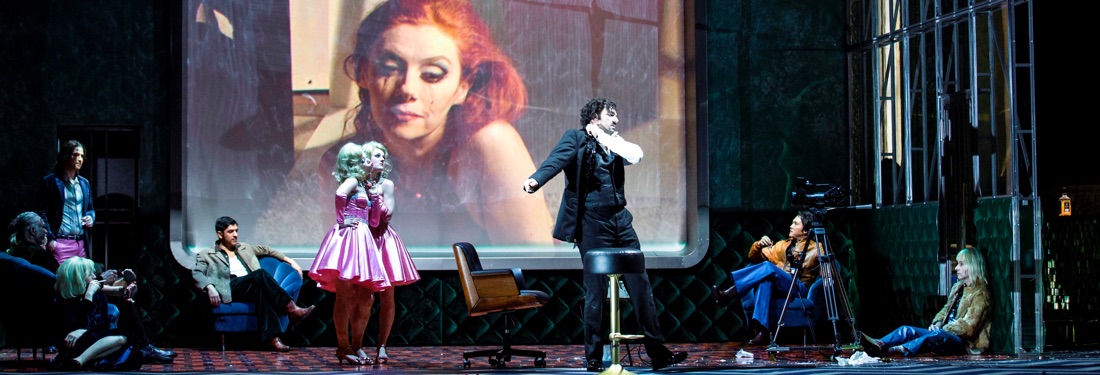
Director Richard Jones and his excellent design team of Miriam Buether (sets), Nicky Gillibrand (costumes), and Mimi Jordan Sherin and D. M. Wood (lighting) have surrounded the world of Anna Nicole with bright and shiny colors, white and pink clothes and lights, and it all works together beautifully. It’s almost as Smith might have designed it herself. It is a tribute to these designers that “90’s tasteless” becomes palatable and serves the story so well.
Smith’s story is told in a series of brief scenes, beginning with her exceedingly humble beginnings in Mexia, Texas where she marries her boss at the local chicken joint. From this brief union comes the birth of her son, Daniel, who figures prominently throughout the opera. In the first act, we quickly move with Anna to Houston where, stuck in a deadend WalMart job, she discovers the “gentlemen’s club” pole-dancing scene. She also acquires huge breast implants and suddenly discovers herself the most popular dancer in the place. Soon, she has attracted the attention of the very rich and very old oilman J. Howard Marshall II.
The first act ends with their improbable wedding. There is a very light touch to the music and the direction in this first act. It frequently veers a bit too far toward the cartoonish stereotypes in all the characters and situations, and the libretto tends toward the cheap laugh. Anna Nicole’s first lines are an example: “I want to blow you all… (laugh), blow you all… (laugh)… a kiss.” The production keeps reminding us that Smith’s life was one of operatically wretched excess, so many of the production’s excesses work in that context. And so does Turnage’s music, full of jazzy and pop-influenced tunes, cacophonous and lyrical by turns.
The second act is the musical and dramatic glory of Anna Nicole. After the death of Marshall, when Anna falls under the influence of lawyer Howard Stern and also falls apart, the characters deepen and the story takes an ugly turn with the exploitation of the drug-addled Anna by the media and Stern. Also making its first appearance early in Act Two is a brilliant production element: black-clad dancers with television cameras for heads, omnipresent in every scene and moving lithely in the splendid choreography of Aletta Collins.
While this may seem an unsubtle way of showing how Anna Nicole’s life became all about being on camera, it works beautifully, especially when Stern convinces Anna to televise the birth of her daughter as a pay-per-view event. Nothing subtle about that! And as Anna stumbles toward her inevitable end, there are only the cameras present to zip her into her body bag.
In this second act we also have the most hauntingly beautiful melody in the piece—the only thing that tenor Dominic Rountree (Daniel) sings in the entire evening. Zipped into his body bag after dying of an overdose in his mother’s bed, he simply and sweetly sings, and the lyrics are simply a list of the dozens of drugs he has taken. It is a particularly haunting touch that the last drug he names is “propofol.”
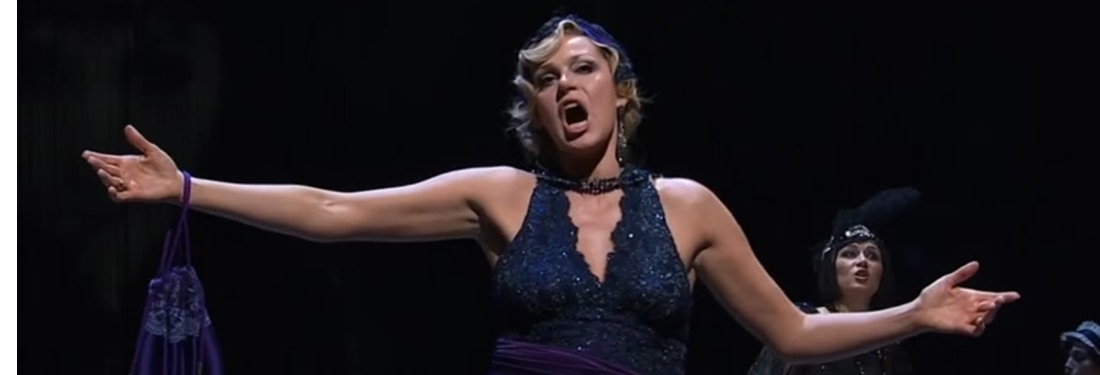
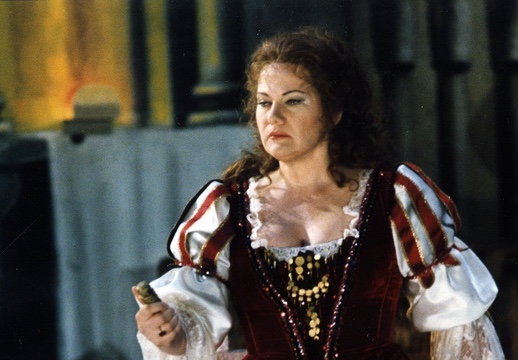
This production is blessed with remarkably fine performances in all of the major roles. Dutch soprano Eva-Maria Westbroek is simply perfect in the title role. Vocally, she manages the numerous quick stylistic changes in Turnage’s score with aplomb, and has power and beauty to spare in the more dramatic passages; she also manages the intimate moments with softness and nuance. Westbroek acts the role very convincingly as well, has excellent comic timing, and never makes the mistake of judging her character. She “channels” Anna Nicole superbly.
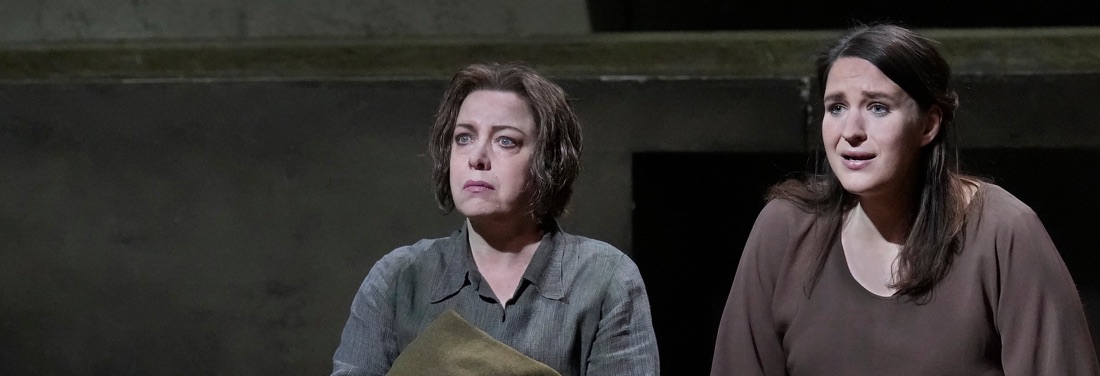
Smith’s mother Virgie, who tries to be the moral compass of her daughter’s life, is brought to vivid life by Susan Bickley. Alan Oke does excellent work as the aged J. Howard Marshall, managing to express the character’s greed and vulgar lust without ever sliding into caricature. And Gerald Finley gives a subtle, gradually evolving performance as the lawyer Stern, singing with clarity (and remarkable English diction) and beauty. The singing of the many smaller roles is an up-and-down affair, but there is fine work from Peter Hoare as an avuncular Larry King and Jeffrey Lloyd-Roberts as a very horny Trucker out of his depth in the “gentlemen’s club.”
Antonio Pappano surprised me with his absolute mastery of this difficult and idiomatic contemporary score, and the Orchestra of the Royal Opera House plays with enthusiasm and brilliance. The excitement of creating a new work is palpable in this performance. The Royal Opera Chorus is dressed in blue television correspondent suits (both men and women) and they sing very well while playing the intrusive, constant media presence in Anna Nicole’s life.
I had numerous quibbles with the libretto. While it was often witty and sharply satiric, there were numerous rhymes that seemed stretched: “Party like you’re bending time/ Party like primeval slime.” How does primeval slime party? Then there’s the moment when the Marshall family is berating Anna: “Back to your sewer…You gold-digging ‘hooer’.” The music, too, is occasionally so loud and noisy as to be annoying, but for the most part, Turnage’s inventive and clever score delivers the goods.
Anna Nicole is a genuinely powerful statement about the destructive nature of our current celebrity culture. Smith herself is a perfect example of a celebrity who used the media to serve her desperate ambition to be famous, then was used and chewed up by that very same media and her venal hangers-on. Even at her most vulgar and trashy, there was always a sweet underlying naivete about Anna Nicole Smith. The exploitation of that naïveté is her tragedy. Anna Nicole and particularly the brilliant Westbroek make that tragedy abundantly clear.
Latest on Parterre



parterre in your box?
Get our free weekly newsletter delivered to your email.



Comments