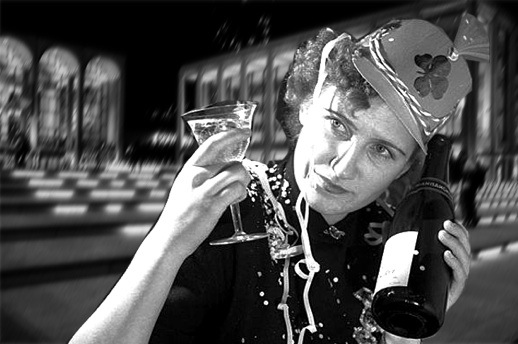
We’ll take a chat o’ kindness yet
As La Cieca (pictured, alas) whoops it up somewhere in the vicinity of Lincoln Center tonight, she hopes that you, the cher public, will at least kick off your festivities with a chat during tonight’s Met prima of La traviata, beginning at 7:00 pm.
Details after the jump.
- Sirius
- Met Listen Live
- Vocal score
- Libretto: Italian, English
Well all this chat about audiences and how they react is very interesting. I think it is easy to lose sight of how evolved the discussion can be on this site, and how many experts there are. I recently was at the Met for the first time in 5 years and I snuck off on my own and went to the Fanciulla performance right after the blizzard, so it was a bit of a muted night, fuller than I thought it would be, though the understudy tenor, Carl Tanner, gave a creditable shot and was loudly cheered.
Around me, in the dress circle I observed the audience. Next to me, a French couple who knew about Puccini but not this opera – he got very agitated because there was a rope in his line of sight, and complained loudly to me about this (touching really) – I told him to wait and see, and he was like a child as the chandeliers ascended and cleared his view. In all acts, except the third he was soundly asleep within 5 minutes. A very elderly couple, exquisitely dressed – he in tails, she in what looked like Fortuny, rather like ‘plants’ from a Fellini movie. Most folks seemed to be tourists and excited to be there, though essentially uncomprehending of the experience. When I wondered around in the interval I overheard a know-it-all elderly gentleman holding forth to a few youngsters – possibly students – about how Puccini was limited in his world and is a ‘literary vulgarian’ – I rather wanted to intervene, a bit like that scene in the cinema queue in ‘Annie Hall’ : ‘I am Puccini reincarnated, and you know nothing, nothing at all about my work’, but I resisted. Another conversation was slightly more knowledgeable, but obviously Fanciulla first-timers – misleadingly on how this opera is not a success, because Butterfly sounds Japanese, Turandot sounds Chinese and Fanciulla has nothing American in it (Oh really – I wanted to interrupt – what about the coconut shell horses, the ragtime quicksteps, the pentatonic minstrel song) – but then figured if it is a first time, then a new score is a bit overwhelming.
But these were the exceptions – most people were excited to be there, a large percentage of tourists, some a bit nervous like deer in the headlights, obviously uninformed about opera and were there as a grand night out, an occasion. Again, I realize I was there on an ‘off night’ – not a debut, or a new production, which will attract the more knowledgeable – but I had the feeling that these were the backbone audience, who, if they did fish up on a stellar night, might not recognize it as such, unless they were told.
And I found myself wondering, what is this here for – for whom is this event – in a foreign language, in a house that is so big that, however clearly signposted, things get lost – I found it rather amazing that it still goes on at all really. I mean, for whose benefit is it? We would all live without it – communing at the altar of a defunct art form that requires all sorts of keys and layers of knowledge and experience to make it at all accessible.
Now, I can basically sing along with just about all of Fanciulla and know the work as if I had written it – and it came home to me that for the uninitiated, which I wager make up the majority of most audiences, these works must go on and on and not really give a clinching immediacy or communication vouchsafed by spoken theatre or TV – so why are they there?
And why did I write this -? Who knows – or cares!
I myself wander around wondering why they are there together. Elderly couples. Doctor and missus. Two guys. Two or three widows. Very young couples touchingly overdressed. Grandchildren being given a first taste of high culture.
The first time I saw Carmen, as familiar as I was with the music from many Saturday radio broadcasts and some records my parents owned, I did not know what the fuss was about the flower song. I found it dull. But the rest of the music held such appeal that I returned and allowed it to grow on me. That presumably is why some people go to the opera, to open themselves to a new experience, or to deepen their appreciation of a piece of art.
Opera also is an exemplar of a bygone age; seeing it is like visiting a living dinosaur. That is one reason why so many people resist modern productions. They want to see the crinolines and the gilt and the 19th century concepts of honor as pieces of history, not as commentary on the human condition today or tomorrow.
“history. Not commentary”
Oh, for an edit function.
So is it really is a museum experience for most people, do you think?
Should we give up pretending it is an art form that needs revitalizing, and just wallow in the plushness of yesteryear?
What can’t opera be both? If it isn’t, then it’s as static as a video game in its permanently locked little universe. Or any other form of entertainment that is a closed loop.
except that the kind of audience we were both describing do not seem partial to the updated and the modern – WE might relish the chance to hear contemporary or recherche exhumations, but the audience don’t seem to know, or care.
funny, cause turandot does not sound chinese at all, in spite of a couple of chinese melodies. actually, when i hear fanciulla, i’m struck at how much fanciulla presages (is that a word?) turandot, and how much fanciulla reminds me of turandot’s music (since turandot is much more familiar to me than fanciulla).
Well that’s the pentatonics, ain’t it? The 5 note scale that makes you automatically think of Oriental music, but in fact pervades most folk musics around the world, including America (Camptown races – doo da doo da day – the original and not Puccini’s rewrite in ‘Fanciulla’……….)
What strikes me in Fanciulla is how the sound world works its way into later American show music, and western film scores
From the youth and novelty for novelty’s sake challenged to the wisdom and decorum challenged: opera is opera, MTV is MTV, and the Second Empire is not on Lexington Avenue.
Ah, that must be it. Alles klar. Tutto e compiuto.
What about Madison?
You are correct, Belfagor; the Second Empire is on Madison. I ate a lovely napoleon there once for dessert.
Sanford, that restores my faith in the best excesses of the second empire – how good to know that such decadence transcends the continents. Vive l’empire.
I’m still intrigued from ‘Lucky Pierres’ post on the ‘Red Shoe Diary’ comments of a few days ago about the Peyton Manning looking security guard… there were none on duty like that last night! maybe pierre got lucky and spent NYEve with him
First TRAVIATA review is a rave for Popsy and the production…
http://online.wsj.com/article/AP69759dbfccb64480b41812d867007769.html
I fully agree with his assessment of the performances. It would wonderful to see some electrifying portrayals from a future cast. Perhaps Mme. Gheorghiu could be enticed…I would love to see her in this, with a passionate Alfredo.
I never saw any money being stuffed into Violetta’s crotch!?! Did anyone else there last night see this? He just threw the money at her as she lay on the clock/roulette wheel.
I was there and the reviewer isn’t making that up.
Agree, Angela would be sensational in this production. Word is that she doesn’t like it, but that could change?
ZZZZZZZZZZZZZZZZZZZZZZ
Mike Silverman of AP, Yes Man #1 to the House of Gelb, wouldn’t know the difference between a Callas or Scotto Violetta and one sung by Snooki.
Well Silverman was no Yes Man when it came to the Bondy TOSCA so that blows your theory right out of the water.
I eagerly await the barrage of negative reviews that will agree with your take on Poplavskaya and the production since you seem to be such an authority on everything.
Get over your own fabulousness.
Don’t count on it. Herva Nelli hasn’t enjoyed an opera since Arturo was shtupping her in the ladie’s room at the old NBC studios.
Herva Nelli has been dead for 16 years, so she probably won’t manifest much enthusiasm for the Poplavskaya “Sempre libera”.
As for ME, Nerva Nelli– I really enjoyed the musical aspects of PELLEAS, a great performance even if a silly staging, and I was there brava-ing for Matos Minnie– even with the limitations of the Rance (esp.), a very fun evening and as fine a Met debut as I’ve seen in a while.
Your comments are even dimmer than usual.
Even”yes men” among critics must acknowledge disasters like that TOSCA Opening Night.Silverman seems to cultivate a “mainstream regular guy” image ( how unlike the home life of our own dear queens!) and that TOSCA review was no surprise. Here he is working on the barrage of PR and Poplovskaya’s babe quotient.
“Nex’!”
So Silverman is a Yes Man except when he’s not–which, by definition, means he’s not a Yes Man at all… but why quibble with your usual ridiculous assertions.
I would think that if Silverman were cultivating a “mainstream regular guy” image the last thing he would be praising would be a Regie, minimalist production that replaced the most mainstream TRAVIATA production imaginable. But I’m sure you’ll come up with one of your patented conspiracy theories to explain that away.
I must have missed your post praising that “moron” Gelb for putting together the PELLEAS revival and convincing Simon Rattle to do it.
Hope you and the Vicar had a lovely New Year’s in that basement listening to your LP’s!!
xxxoooo
You’re not overly bright,are you, sterlingkay? But probably a good (enough) industry cog.
Alas, I have no basement and my turntable hasn’t been set up in over a decade.
I wish you many happy hours of listening to “the next great Russian soprano”.
I’m bright enough to recognize when someone is living in the past and holding on desperately to hoary ideas about what OPERA should be. I’m also bright enough to know that you and your kind will soon enough be irrelevant (if you’re not so already).
I will, indeed, keep listening to Poplavskaya but I’ll also keep my eye on Ms. Matos’ career since you have anointed her the next great thing and you have such a high regard of your own opinion. No doubt Ms. Matos’ career will be taking off soon. We shall see, as they say….
I have no idea what straw man you think you’re bravely denouncing, but I do not live in the past nor through old recordings. I attend many new operas (and other new music and theatre) and have no beef with Regie if it’s interestingly done. Plus I hear lots of little-known singers I like every year.
I’m just not ready for cool telegenic looks and hype to replace vocal technique and meaningful investment in words. I’m actually quite looking forward to seeing the TRAVIATA staging. I just wish they had hired someone who could sing the leading role much better than I expect from having heard Poplavskaya several times. Maybe she’ll surprise me
Matos, as can be heard on Youtube, is not the most polished of singers, and I would not want to hear her in everything, but she had a scope of performing and evident generosity with the music that was very pleasing after hearing Fleming’s narcissistic jazz stylings, Gheorghiu’s rehearsal pianissimo wedded to zero spontaneity, Garanca’s supermodel chilliness and the vocally inadequate likes of de Niese, Measha B.and Marina P. being cheered essentially due to reclame and fashion consultants.
I’ll have to take your word that you’re a fan of “intelligent” Regie….I’ve never read anything you’ve posted that suggests so (I may not be “overly bright” but I have a very good memory) but maybe you’ll surprise all of us soon with a post that doesn’t smack of someone who wishes productions looked like the pictures in the VICTOR BOOK of OPERA.
I think Matos was very lucky to have made her debut as the alternate to Voigt, who was admittedly awful. But Matos’ hopelessly old-fashioned, bug-eyed performance coupled with a voice that has a myriad technical problems did not impress me. However, she’s loud and has the high notes…that’s enough for some people, I guess. She also looks like sopranos used to look which again appeals to those here who’re looking to turn back the clock and who cast a suspicious eye on any singer who is “telegenic”. To me Matos sounded like Guleghina did when she first came on the scene and odds are she will follow in her footsteps.
But perhaps you’re right and hers is the most important debut at the MET in some time. Time will tell….
I agree it is perfectly possible to enjoy live performances, and at the same time go back to old records, or recall to mind performances you have attended ages ago. One thing never spoils the other for me. That said, being part of a live audience is always more magical to me, even in the case of mediocre or bad performances. I always feel that being there at the moment a work of art is performed, you more or less complete it. And something new happens the next day.
Well, of course, the director of Pelleas tried to do something different so you didn’t like it. With each post, you just prove my point that this place has an awful lot of reactionary old fogeys and silly sad queens who prefer a cup of tea and an old Callas record.
operaqueen says:
January 2, 2011 at 8:30 AM
Well, of course, the director of Pelleas tried to do something different so you didn’t like it. With each post, you just prove my point that this place has an awful lot of reactionary old fogeys and silly sad queens who prefer a cup of tea and an old Callas record.
OK, this is really stupid. You must be a theatrical naif if you thought that Dr. Miller’s stuffy “Merchant Ivory” PELLEAS was something different in the context of his work which is very often set in Edwardian Engand in white and tan muted hues with lots of servants and distractions ( like in this case, Pelleas’ father wheeling on just to make sure we saw a wheelchair, the ultimate 80s cliche). One can stage PELLEAS in almost any way but this was no novelty.
Actually I don’t post much about stagings here per se, for reasons of my own. I sometimes like (in the right rep, not say in Handel, Gluck or Mozart) singers who SOUND like they belong in the VICTOR BOOK- their look offstage matters little to me as long as they can convnce onstage. But it is simply ludicrous for industry stooge (I am guessing) sterlingkay or “operaqueen” to impute any love of old-fashioned productions to me.
If the ability to sing a score and to make meaningful connection to the text is old fashioned than my tastes in singing are old-fashioned. If you would rathet go see someone pretty or “strapping” do neither but act the director’s idea of the subtext, go ahead.
I am not sure I would call them “Regie” stagings, but stagings I have seen in the last few months that departed far from the stage directions and libretto than I enjoyed a lot have included Juilliard’s POPPEA Houston’s PETER GRIMES and Tanglewood’s ARIADNE. Some parts of the Aldenized QUIET PLACE worked well, and most of the Wadsworth BORIS, which often did not follow the stage directions.
Nothing at the Met this season, I’m afraid, has matched the brlliance of the Chereau HOUSE OF THE DEAD (a good name I think for the kind of opera patron you think you are attacking). But Sher’s HOFFMANN sucks– as did WOMEN ON THE VERGE, a total mess as a production except for some of the performers– and the Bondy TOSCA was a fizzle, not worthy of calling Regie. As I have said, I look forward to seeing this TRAVIATA live- I detested the Zeff one more than any other of his work.
But good singing remains a central component of my ideal operatic ecperience. Or otherwise, why bother?
Much as I suspected none of the so-called “REGIE” productions you claim to have enjoyed are of the standard operatic repertory– this is something the old-guard loves to do which is to “accept” daring production concepts at the margins of the repertoire but don’t you dare fiddle with TOSCA or TRAVIATA!!!. Calling the Wadsworth BORIS a “REGIE” production tells me all I need to know about your theatrical savvy. I have had enough arguments with the old-timers in my seating section at the MET to understand exactly where you’re coming from. The ship has sailed and you’re sadly screaming your lungs out on the dock. BON VOYAGE!!
‘Madison’ is not ‘mad is on’ and Proust is not Popeye. Having seen Popsy as the Queen in ‘Don Carlo’, I am not too curious to hear what she does in Traviata. Reading the above review, I just can’t get excited about a clock turning into a roulette wheel. I think I will skip this. I already saw parts of the Trebs video and I was not thrilled by her ending of the ‘Sempre libera’. Seeing those Marie dresses at the Parterre level reminded me of Joan doing la misera che un di caduta for Sarah. Now, if something like that was being done at the Met, I would go in a New York minute.
I don’t know why there are so many comments about opera being a dead form. The mere existence of the comments proves it is very much alive. In Spain a town is not a city if it does not have a bull fighting ring. I believe there are many like me who find bull fights and base ball games utterly, utterly boring. Any city mindful of human rights should have an opera house. That is my Parterre Manifesto!
The roulette wheel in Traviata has already been done. I saw Malfitano as Violetta strapped to a large roulette wheel and swirled around at a Washington Opera performance back in the 70′s.
Times take: http://www.nytimes.com/2011/01/03/arts/music/03traviata.html
I am going to be very intrigued with how some respond to this review.
Oh, and Out West is up too:
http://outwestarts.blogspot.com/2011/01/beat-clock.html
OK, sorry, but this is def worse than TT’s.
Reading this review helped me understand the general derision directed towards TT from these readers. When he talks about that Act II tenor aria, I wanted to smack him. Doesn’t he realize that the whole point of this staging is that Violetta and Alfredo are so comfortable with each other that they can joke about each other?
Ugh.
Unless Decker has published a comprehensive thesis on his production (has he? is it in the Playbill?) I’d say that there isn’t a 100% correct interpretation of that scene. I haven’t seen it, but from the description I’d probably agree with your interpretation over TT’s. But its hardly a huge transgression like his Strapping Baritone Thesaurus.
“I haven’t seen it, but . . .”
The quintessential Parterre Box comment.
No, if it was the quintessential Parterre comment it would’ve been followed by some comparison to a performance at least a decade ago, with a singer now retired or dead who was the only person with any business in the role, and a final quip about the monster of the moment (Gelb, Popsy, Renay). Perhaps with a youtube video only vaguely related thrown in.
Natalie and Benjamin were there – in the front row. They led the standing ovation
as they seemed to be the first to pop up.
http://www.bloomberg.com/news/2011-01-01/scene-last-night-feinberg-flowers-toast-new-year-at-met-traviata-gala.html
Arsht (whether Adrienne or Arlene)?
Seriously?
ARSHT???
Some comments from Decker himself on this production (the article indicates this is in the Met’s January programs):
“To get to the essence of a piece,” he says, “I try to take away the especially historic aspects, because I want to bring things closer to audiences nowadays. If you look at Violetta as a person from 19th-century Paris, the character automatically gets away from you into a historic distance.”
http://www.metoperafamily.org/metopera/news/features/detail.aspx?id=14278
Is Hamlet any more relevant wearing a Paul Smith suit than 16th century pumpkin breeches? “Nowadays” audiences are not too dumb to understand a universally themed work that has successfully moved people no matter what the setting, as long as it’s done well and are not “automatically” distanced when confronted with action set a mere century earlier. I hate it when directors trot this old excuse out…it’s perfectly valid to try different periods and places; just don’t cite this as your main reason.
“Pumpkin breeches” could work but a Comme des Garcons suit would
make the character more approachable. I would certainly prefer the later BUT
I would never make a rule about it. In the hands of an artist, ANYTHING can work. Decker is talking about his approach – he’s not offering an ideology.
“If you look at Violetta as a person from 19th-century Paris, the character automatically gets away from you into a historic distance.”
This is the sentence I have trouble with. “Automatically” to HIM. Not to the universe. This sounds like more than an approach, it’s stated as if this is an accepted idea.
Personally, I like seeing a work set in the time it was conceived by its author, if possible, but I much prefer any production that makes sense dramatically and visually. Decker’s production does, even though to me it was heavy -handed and made its point too many times, as if nhe didn’t trust the audience to “get it.”
And why on earth would anything other than a modern costume distance anyone from understanding a play or opera?
Well, there is “automatically” and there is “the tendency is…” I do believe there is a general romanticizing tendency in setting a story in a locale or era that is or picturesque to the audience. If you look at most film romances, for example, they tend to be set in an exotic locale (e.g., The Painted Desert) or a period distant enough from the present to be not a part of the audience’s direct experience (e.g., Gone with the Wind). The fact that Verdi and Piave pressed to have their opera performed as a contemporary piece suggests that they too understood that the story would be damagingly softened by historical distance.
A converse of this situation can be seen in the TV series The Tudors, where the designers have deliberately distorted period design to make the 16th century look more like the early 21st: that way the characters seem less forbiddingly distant and more “real” to the show’s intended audience.
And we should recall that our own experience and expectations are not those of a more general audience, even a more general opera audience.
That said, a broader point that Decker is probably not quite so forthcoming about is this: Traviata is an opera that has been produced thousands of times, and a star stage director is supposed to find a new and different way of doing it if he wants to be recognized as a star stage director. Just as there are very few diva performers who genuinely mean it when they say they “serve the music,” a director with a healthy ego is going to want to intervene, not just “honor the creator’s intentions.”
History *does* provide distance, though, doesn’t it? If I made a joke about, say 9/11, I would be rightly reviled. If I made a joke about the St. Bartholomew Massacre, less so- despite the fact that many more people died.
I’m trying to reply to La Cieca’s excellent posting, so I hope this lands in the right place. Very well stated, LaC, and I especially agree with your last paragraph, which is spot-on.
Interesting point about the Tudors – I saw True Grit today and it appears that the Cohen brothers purposely distort the narrative to *purposely* distance you from any stereotype you may have of a movie about the old West. It’s certainly not 21st century. Very very good film.
The gold standard of Decker’s staging of La Traviata will remain the 2005 Salzburg production dominated by Netrebko, Villazon, and Hampson. After five years, critics reviewing the Met’s present revival they cannot escape referrring to that production, no matter how positive they write about the Met’s singers and staging.
Constantine, indeed; the future of this production at the Met really rests on the casting of the 3 principals. They have to be electrifying performers like the three you cite, who are comfortable physically onstage, willing to show a little flesh, have agility on that seriously raked stage, sing and act brilliantly and be able to clamber all over those couches. Polenzani was a bit awkward physically and none of the 3 I saw last night had the wattage to make it truly special.
Why wouldn’t they mention the production originated in Salzburg? To omit that would be sloppy reporting. Also, the Met’s presentation was to feature Netrebko and Villazon repeating their performances, so why not mention them.
Given that this is only the third time the production has been presented (twice with the same soprano), I think it’s a little early to declare Salzburg was the gold standard. Maybe after 7 or so casts have been through it, then we declare a “winner.”
Salzburg has the huge asset of ‘festival conditions’ with probably three times the rehearsal time allotted to Amsterdam and the Met. Combined with the juice inherent in the spirit of creative energy, this advantage will not fade.
OT -- Elina Garanca is at her considerable BEST with Gustavo Dudamel and the Berlin Phil on New Year’s Eve --
Quite good indeed. Thanks for posting!