
Headshot of La Cieca

Cher Public

  • Camille: Gee, that is bizarre—R 11;I was thinking of you a while back and wanting to let you know I HAD... 4:02 PM
  • kashania: I also checked out the second act finale and agree completely. It’s rare that a moment of hysteria... 3:59 PM
  • Lucy: Like arepo, I’m seeing Andrea Chenier: 1. Courtroom scene, just before “Si, fui soldato.”... 3:51 PM
  • grimoaldo: Hi Camille, you were interested in “Craig’ ;s Wife” with Rosalind Russell.I watched... 3:20 PM
  • Camille: “Inno ad Imene”. Sorry. Just had to try it on for size. Thanks, operaguy. 3:11 PM
  • lorenzo.venezia: hair-raising. that’s why the tee shirts were so surprising. it has been a while since the... 3:04 PM
  • operaguy: Down in the Depths on the 90th Floor is a Cole Porter song from “Red, Hot and Blue” –... 2:56 PM
  • Clita del Toro: Cammie, well, Swiffers do make this old lady’s life much easier. You can Swiffer around the... 2:54 PM

Giusto ciel, in tal periglio…

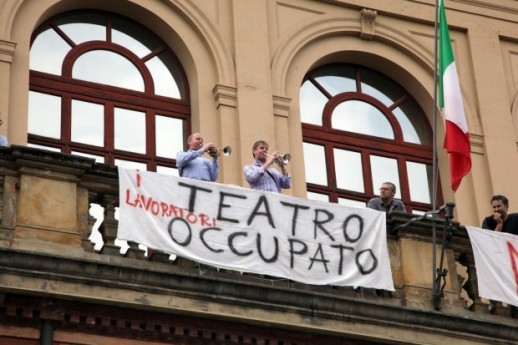
teatro_occupatoUPDATE: Tonight’s performance of Simon Boccanegra at La Scala (featuring Placido Domingo) has been canceled because of a strike called by unions protesting the “decreto Bondi,” a measure to privatize all of Italy’s major opera houses and reduce salaries at these theaters across the board.

Our Own Ercole Farnese reviewed yesterday’s news reports about this crisis in Italian cultural life. His summaries follow the jump. 

The blog Il Fazioso offers details about the situation the “decreto” is meant to address:

The Government each year distributes 260 million euros to the 14 Fondazioni existing in Italy, to which is added 110 million coming from Regioni (regions), Province (provinces) and Comuni (townships). Nevertheless, opera companies lose about 2.7 million euros each year, and they have a cumulative debt of almost 300 millions. The 5,600 workers (who have open-ended contracts) cost about 340 million euros, accounting for about 70% of the total expense.

Opera costs Italian citizens almost 400 million euros and produces about 3,000 performance each year. That means that each performance is subsidized an average of 135,000 euros, which the Treasury finances without security. The Enti Lirici have very limited programs and poor results. They are the least productive in the world: La Scala gives about 100 performances each year, all the others produce half of that.

The decree will pressure orchestra members and employees who to renounce their “monster bonuses” and to negotiate contracts on a national level; it intervenes temporarily blocking turnover and introducing new parameters to hire new members. It intervenes especially on the allocations (disbursements) from the Government, introducing a selective criterion based on quality. Previously, whoever spent more money on personnel, received the most money. Henceforth, the most financially “virtuous” companies will have larger financing and autonomy.

Il Giornale, a right wing daily owned by Silvio Berlusconi — and therefore not very sympathetic to the cause of the workers of the Enti Lirici — speaks favorably of the ministerial decree (which President Napolitano made operative with his signature) that re-organizes the structure of the Enti Lirici, lowering the salaries of orchestra, chorus and ballet members and every type of laborer (stage hands, electrician, cleaning staff etc).

The decree minimizes as well certain supplementary allowances, which Il Giornale mockingly lists: the “al fresco humidity indemnity”, which guarantees orchestra members more money when performing outside. At the Arena di Verona the extras do not go on stage if they do not receive the ” fake weapons allowance (or bonus), if they are not assured that the weapons are actually fake, or the “tailcoat bonus” when they must perform in formal dress. At the San Carlo in Naples there is the “language bonus”: chorus members receive extra money if they must perform in a foreign language. If there is even one foreign word in the score, they are entitled to the bonus.

Under the new decree ballet members will have to retire at 45 (now they do it at 52).

Florence canceled the second performance of Die Frau Ohne Schatten conducted by Mehta; Torino canceled Il barbiere di Siviglia, and Bologna will cancel the prima of Carmen this week.

Last week, workers at the Teatro Comunale in Bologna occupied the theater and Marco Tutino, the Sovrintendente (General Manager) called the police, who evacuated the workers, leaving one of them trapped inside the theater.  She is now suing them for kidnapping.

PREVIOUSLY: The President of the Republic of Italy, Giorgio Napolitano, has signed into law a measure to privatize all of Italy’s major opera houses and reduce salaries at these theaters across the board. According to La Repubblica, performances are canceled at theaters throughout Italy and artists and staff from the 15 enti lirici have taken to the streets in protest.

Massive demonstrations are reported in Torino; in Milano carabinieri reportedly attacked orchestra players protesting outside La Scala; and in Firenze, Zubin Mehta led protesters in a performance of “Va pensiero.”

63 comments

  • enzo says:

    Not just Italian singing. You should hear the awful performance of Hollander that’s taking place at the Met right now.

  • papopera says:

    A young milanese once told me that opera was for faggots

  • Constantine A. Papas says:

    Some Euro-currency countries, like Greece, Italy, Spain, ect., are finacially broke. For opera to survive, you have to go back to the patrician model. Wealthy aristocrats and nobility subsidized the arts and entertained their friends in their mansions! In the old Greece theater was made possible by the rich who also paid for the public to attend. In Greece all summer festivals are run by the govenment. Greece was not listed in Opera News this year. When you cut salaries of state emloyees to avoid going under, elite institutions will be the first ones to go. Wealthy Europeans are not as generous as Americans are. It’s sad but real.

    • CruzSF says:

      Aw, c’mon Constantine. Don’t forget that Portugal is financially broke, too!

  • Sanford says:

    There are a couple of people posting at the moment who absolutely drive me insane.

    As someone who loves history, especially ancient history, let me point out how much of what we know about previous civilizations comes directly from the Arts. To wit:

    The Greek plays of Aeschylus, Sophocles, and Euripides
    The Roman plays of Seneca
    Malory’s Le Morte d’Arthur
    CHaucer
    Shakespeare
    Mozart
    Verdi (who inspired the Italians to revolt against the Austrians
    Michelangelo
    Rembrandt
    Etc etc etc

    It is short cited, at the very least, to think that people don’t care about the potential damage to opera. People will notice eventually and will come to realize what they lost.

  • vendorune says:

    Peisistratos, tyrant of Athens, sponsored first staging of Homeric Epic. First in the West for non-religious purposes. Giovanni de’Bardi was the first patron of Opera. Simply put — we can’t have meaningful performing arts without sponsorship — government, private, corporate, w/e. Completely private enterprise doesn’t work, period. Why? Because when general public doesn’t know anything about a performance who want to see a tragedy? Comedy is so much better! (But it isn’t). Who wants to see the fat lady sing when you can have skinny underage chick? This rolls down hill real fast…

    Berlusconi is just showing how shallow he is and chauvinist on top of that. Of course Italian Opera is a mess! But a wise man would try to reform it through improvements and innovation. Berlusconi doesn’t understand art at all and simply want to bury it.

    As far as carabinieri… Oh I do agree there! Italy is not Greece. (and not US in that respect either).

  • Quanto Painy Fakor says:

    The prelude to Heggies’s new opera of Moby Dick is beautiful, but already when the singers start it gets boring – needs cutting and revision, but sounds like a winner.

    • CruzSF says:

      Can someone who actually saw Moby Dick weigh in? It received good reviews in the NYT and the Washington Post.

  • aloki miyeyi says:

    More recently, the United States is the country that re-elected George Bush. One fatuous comment deserves another, no?

  • wladek says:

    The larger question from a most
    dispassionate view is – except for the few, does opera serve any purpose
    as does a painting,or the spoken
    word ? Why does the opera lover
    feel the whole world must share their
    enthusiasm for the entertainment and
    those that don’t are of a “lower order” and not up
    to the opera lovers so called “refined” taste which is bogus
    most of the time . Why should a
    government support opera when;there are
    more important things to attend to -

    • Indiana Loiterer III says:

      What makes you think paintings or spoken drama serve a purpose that opera doesn’t? It’s all art, and art is without purpose in the sense that hospitals or armies have purposes…

    • Nerva Nelli says:

      wladek say subsidy moneys only should be for wagner canon
      let fools loving miss lucy and bellini dreck pay for what not art, more like tv dinner or hula hoop

      • wladek says:

        18.2-your response is a perfect
        example why opera should not
        be susidized under any condition .

        • richard says:

          Gee, I kinda thought Nervi Nelli’s use of English was sorta catchy. It has a certain ring to it? No?

        • wladek says:

          18.2.1.1 – yes quite catchy much like the clap .

  • aloki miyeyi says:

    Privatization is another word for the looting of a public resource and responsibility by modern capitalism, which has changed fundamentally. To wit: the parks in New York are run by “conservancies” and privatization has meant commercial exploitation; charter schools are another stratagem to allow a private or semi private entity to exploit a public resource.

    In the case of Italy, this sounds like union busting. If the opera is privatized there, the money which is spent on the salaries and benefits of musicians will be transferred to the profit line of the private entity which the government is enabling with public money. Opera has always required subsidy, either by a wealthy elite, or by the government. So have public schools, hospitals, parks, museums, etc. A society must decide on priorities. The international trend today apparently is to squander money on further enriching rich philistines, or spending it on weapons and violence. The private sector will always tout cost efficiencies and the superiority of the market for making decision, but the health care industry gives the lie to the first, and as for the second, there is no free market when lobbyists for corporations can so blatantly purchase government officials and public opinion.

    • BETSY_ANN_BOBOLINK says:

      Aloki, you are a Miyeyi after my own heart.

    • wladek says:

      Parks ,public schools , museums,
      hospitals serve a purpose -pray tell
      who do screaming sopranos serve
      other than their screaming fans
      who anoint their favourites to
      ridiculous “divadom” – as for freemarket it’s interesting to observe how two major opera houses go after rich widows as
      a free market source .It seems the term” philistines” applies to those
      that have money and don’t give it to entertainment projects under guise
      of art. It all depends on whose ox
      is being gored and arrogant nerve
      to tell people where to” squander” “their money , more so since it is not your money .

      • BETSY_ANN_BOBOLINK says:

        Wladek, you disappoint me. “Parks, public schools, museums, hospitals all serve a purpose.” Pray tell me what purpose do parks serve? In the center of New York City itself is a huge wasted area just crying out for development. Keep your workers busy enough they’ll have no need for ‘recreation.’

        Public schools? Hell, show me someone with basic promise and I’ll train him to do what I need hiom to do. That’s what our personnel department is for. Otherwise, just keep the little bastards sedated until it’s time to send them down into the mines. The main thing is to free their mothers, who are after all grown working women, and those that won’t work can go into our brothels,.

        Museums are an impossible waste of money. Relics and artifacts, nothing else. If I see something I like, I’ll buy it and throw it down an elevator shaft so no one else can sully it with their stupid little eyes. If I can’t buy it, I’ll ahve it stolen for me. There’s a spot on my palace wall just perfect for that Muensch thing.

        Hospitals? Holy shit, man, are you serious. I pay two doctors damned good salaries to keep me healthy. The poor have an obligation to die, and get off the public roles. If you live too long, you get senile and unproductive. Do what you’re supposed to do — die when it’s your time. And you’re time is when you are no longer a profitable investment.

        Grow up, man

        • wladek says:

          -” parks” do serve
          a purpose ref. you to “Night
          at the Opera” with
          Groucho finding opera still ongoing orders driver to go
          around park once again until
          opera is over .

  • oh rest says:

    These poor politicians who are lobbied by these big bad corporations. are you kidding me?

    • Bluessweet says:

      Birds of a feather, my friend. (I always say my friend when I think somebody would love to do me over.)

      In fact, a good portion of lobbyists ARE old politician retreads.

      We have also seen the absolute arrogance of those big bad corporate leaders in the GS debacle just last week, my friend.

      While I’m not in favor of attacking GS per se, (Full disclosure: I stopped out my shares after the first day of testimony) because we do need the investment banking function and GS has done the best job of it, there might be just a tad of additional regulation, a tad more transparency, a check into how big does an organization have to be to serve the function and a look into how much additional benefit would be gained from much more competition generated by a much larger group of smaller firms.

      Hey, I’ve been in corporate board meetings and I’ve seen the “brilliance” displayed. Thanks just the same but you’d be surprised at how those titans are really not a candlepower smarter than most of the posters here.

      Can I ask what real difference is there if a government entity collects money of the citizenry and planks it down to support the arts or if Andrew Carnegie does the same? In either case, the general public has forked over funds to an entity that is making a choice of art-worthiness for them, funds that otherwise would have been used at their own discretion. Does it really matter? I don’t get to select what pieces get performed or in what venue in either case.

      Let’s not go into whether the general public has the interest or taste to determine what is of lasting value. You do not want to see the collection of sheet music that I have from just one family, circa 1900. Many more clunkers than gems.