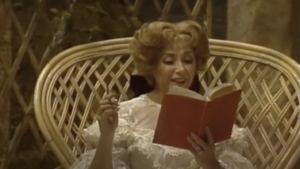
Il faut parterre: #16. is my memory playing tricks on me or did I not see Madame Nilsson sing (and dance) Salome quite a few times in the mid-60s at the Met?
And, my dear, she was stupendous in every way possible.
I don’t think large voices are ‘scarcer’ – human genetics don’t evolve so quickly that in 50 years the physical structures needed to create large voices are present a smaller fraction of the population. What may have changed is that fewer people with these gifts are being drawn to opera as an art than 50 years ago. One hears how interest in opera in Italy is a fraction of what it used to be. Also, for decades, it has been discussed that the level of voice instruction in Italy has plummeted. On top of that, when a large voice is discovered, it is thrown almost exclusively into the heavy rep because we are so desperate to cast those operas. It must be hard when offers come right and left and everyone says you are a great to say, no, I need to work on my technique more and I need to sing no more than a few Amnerises per season, even if it means I’m unemployed a few months per year.
Looking back at Cossotto’s career, she started young, but she had excellent training (Mercedes Llopart, teacher of Kraus and Scotto), and she had 5 years of mostly smaller roles at La Scala until her unexpected breakthrough replacing Simionato one night in Favorita. While things took off fast from that point, she still mixed the heavy Verdi roles with Adalgisa, Favorita, Carmen, Rosina, Capuleti Romeo, Neris, Urbain, Preziosilla, etc. for at least a decade.
I’m going to go put on some body armour here and wade into this debate with something I have been pondering. So just to put it out there, and see what y’all think – I find myself wondering if the idea that big voices require time to mature is a)true – or as true as often as casting directors seem to think – and b)plays a part in the dearth of great Verdians. When you look at the great, huge voices of the past, they were singing big roles in their early twenties – occasionally even teens. For example, Ponselle was 21 when she did Trovatore at the Met, and our beloved Fiorenza was 24 when she recorded Verdi’s requiem for the first time.
Clearly my sample size is small – but I am sure the Parterreans can come up with many more examples. So here are my questions – is it a myth that big voices “always” mature later? Do voice teachers largely embrace the idea that Verdi and Wagner are dangerous for younger singers? In order to get any roles at all (and because they’ve internalized this narrative about big voices) do singers mostly stick to Mozart and Handel in their early years, resulting in undersinging and an artificial vocal production? And are we missing out on some spectacular singing from 20-somethings and settling for harsher, wobblier sounds from the 50-somethings?
And now I’m going to get REALLY provocative – Birgit Nilsson said the best teacher is the stage, declaring herself to be self-taught. The same would apply to countless other singers we consider to be among the greatest. If there is any merit to my argument that big voices can be ready for the big time in their twenties, are we forcing them to endure years of potentially harmful interference from well-meaning vocal teachers by making them wait until these roles are “safe” for them to approach? As well as just tempting them to damn well give up and get a real job?
Clearly there are young singers out there who are singing big roles, and I am sure you will all send me examples, as well as examples of singers who tackled big roles too early and blew out their voices. But I do wonder if this narrative about what roles are appropriate for younger singers is as widely accepted as it seems to be, and if it impacts the big voices and our opportunities to hear them.
PirateJenny – You raise a lot of interesting points. I think the main point is there are no absolutes.
Many big voices were ready to go at an early age. Some of the differences are training – the days of daily voice lessons and coaching are gone. Also the expectation of how long a career was to last. In the past, you could start at age 24 and if you retired in your 40s because the voice gave out, those 15 years of prime time were enough to be considered a success (Antonietta Stella for example).
I agree with an earlier poster – we’re so desperate to have big voices that they’re not going to get locked into Handel and Mozart. Even in conservatories, they could sing Mimi or Violetta rather than Pamina and Cleopatra.
Nilsson did go through a standard conservatory training, though she felt one teacher was particularly harmful. I think her point is that once one has a technical foundation, a lot of the solidification of technique takes place in performance and in independent work. Corelli was like this too. On the other hand, if you’ve had a more positive conservatory experience with a great teacher, you may disagree with Nilsson.
I think that all voices mature differently so there’s no easy formula. Varnay and Nilsson were the same age, yet Varnay’s soprano career was already on the wane by the time Nilsson’s career really took off. The singers who start singing big roles very early typically retire much earlier as well. If I may make one generalisation, it’s that those who ease into the heavy roles are more likely to have a 30-year career whereas those start off very young typically have more of a 20-year career (though with dramatic sopranos, they often make a successful transition to a mezzo career and still end up with a long career). But basically, it’s a 20-30 year career.
You know, kashania, re your generalization, I’ve often wondered if it’s more generally (to be redundant) applicable, i.e., if singers who start early end early, no matter the fach. A striking similarity, to me, of Callas, Tebaldi, and De Los Angeles, is how young they were when they became famous and sang a lot and widely (and, it’s true, often fairly heavily, though to different degrees); and they all started having troubles by 40. I’m sure there are exceptions to this (offhand, I think of Peters lasting many years, though I don’t know how great her late years were).
Oops.
Il faut parterre: #16. is my memory playing tricks on me or did I not see Madame Nilsson sing (and dance) Salome quite a few times in the mid-60s at the Met?
And, my dear, she was stupendous in every way possible.
kashania @ 29 “and there isn’t a hint of camp to be found.”
Not even in the opalescent eye shadow?

I don’t think large voices are ‘scarcer’ – human genetics don’t evolve so quickly that in 50 years the physical structures needed to create large voices are present a smaller fraction of the population. What may have changed is that fewer people with these gifts are being drawn to opera as an art than 50 years ago. One hears how interest in opera in Italy is a fraction of what it used to be. Also, for decades, it has been discussed that the level of voice instruction in Italy has plummeted. On top of that, when a large voice is discovered, it is thrown almost exclusively into the heavy rep because we are so desperate to cast those operas. It must be hard when offers come right and left and everyone says you are a great to say, no, I need to work on my technique more and I need to sing no more than a few Amnerises per season, even if it means I’m unemployed a few months per year.
Looking back at Cossotto’s career, she started young, but she had excellent training (Mercedes Llopart, teacher of Kraus and Scotto), and she had 5 years of mostly smaller roles at La Scala until her unexpected breakthrough replacing Simionato one night in Favorita. While things took off fast from that point, she still mixed the heavy Verdi roles with Adalgisa, Favorita, Carmen, Rosina, Capuleti Romeo, Neris, Urbain, Preziosilla, etc. for at least a decade.
I’m going to go put on some body armour here and wade into this debate with something I have been pondering. So just to put it out there, and see what y’all think –
I find myself wondering if the idea that big voices require time to mature is a)true – or as true as often as casting directors seem to think – and b)plays a part in the dearth of great Verdians. When you look at the great, huge voices of the past, they were singing big roles in their early twenties – occasionally even teens. For example, Ponselle was 21 when she did Trovatore at the Met, and our beloved Fiorenza was 24 when she recorded Verdi’s requiem for the first time.
Clearly my sample size is small – but I am sure the Parterreans can come up with many more examples. So here are my questions – is it a myth that big voices “always” mature later? Do voice teachers largely embrace the idea that Verdi and Wagner are dangerous for younger singers? In order to get any roles at all (and because they’ve internalized this narrative about big voices) do singers mostly stick to Mozart and Handel in their early years, resulting in undersinging and an artificial vocal production? And are we missing out on some spectacular singing from 20-somethings and settling for harsher, wobblier sounds from the 50-somethings?
And now I’m going to get REALLY provocative – Birgit Nilsson said the best teacher is the stage, declaring herself to be self-taught. The same would apply to countless other singers we consider to be among the greatest. If there is any merit to my argument that big voices can be ready for the big time in their twenties, are we forcing them to endure years of potentially harmful interference from well-meaning vocal teachers by making them wait until these roles are “safe” for them to approach? As well as just tempting them to damn well give up and get a real job?
Clearly there are young singers out there who are singing big roles, and I am sure you will all send me examples, as well as examples of singers who tackled big roles too early and blew out their voices. But I do wonder if this narrative about what roles are appropriate for younger singers is as widely accepted as it seems to be, and if it impacts the big voices and our opportunities to hear them.
PirateJenny – You raise a lot of interesting points. I think the main point is there are no absolutes.
Many big voices were ready to go at an early age. Some of the differences are training – the days of daily voice lessons and coaching are gone. Also the expectation of how long a career was to last. In the past, you could start at age 24 and if you retired in your 40s because the voice gave out, those 15 years of prime time were enough to be considered a success (Antonietta Stella for example).
I agree with an earlier poster – we’re so desperate to have big voices that they’re not going to get locked into Handel and Mozart. Even in conservatories, they could sing Mimi or Violetta rather than Pamina and Cleopatra.
Nilsson did go through a standard conservatory training, though she felt one teacher was particularly harmful. I think her point is that once one has a technical foundation, a lot of the solidification of technique takes place in performance and in independent work. Corelli was like this too. On the other hand, if you’ve had a more positive conservatory experience with a great teacher, you may disagree with Nilsson.
16 I thought it was Rossini who said that?
The first Aida I ever saw was with Corelli, Amara, and the fabulous Cossotto. What a lucky boy I was.
I think that all voices mature differently so there’s no easy formula. Varnay and Nilsson were the same age, yet Varnay’s soprano career was already on the wane by the time Nilsson’s career really took off. The singers who start singing big roles very early typically retire much earlier as well. If I may make one generalisation, it’s that those who ease into the heavy roles are more likely to have a 30-year career whereas those start off very young typically have more of a 20-year career (though with dramatic sopranos, they often make a successful transition to a mezzo career and still end up with a long career). But basically, it’s a 20-30 year career.
You know, kashania, re your generalization, I’ve often wondered if it’s more generally (to be redundant) applicable, i.e., if singers who start early end early, no matter the fach. A striking similarity, to me, of Callas, Tebaldi, and De Los Angeles, is how young they were when they became famous and sang a lot and widely (and, it’s true, often fairly heavily, though to different degrees); and they all started having troubles by 40. I’m sure there are exceptions to this (offhand, I think of Peters lasting many years, though I don’t know how great her late years were).