Talking head
Our Own JJ discusses Maria Callas and her Voice Of Perfect Imperfection with NPR’s Lynn Neary.
Copyright © 2012 parterre box - All Rights Reserved
Powered by WordPress · Parterror Theme by Nick Scholl for DIS Magazine
OH, great, a Callas feud. Unbelievable. No problem, all you need to do is pull that Forza del destino score from the shelf and listen to most soprano recordings you have. Yes. Faithfulness to the score. Oh yes. Callas is practically the only one (and I’m referring to the allegro section in the prologue / act I) to do the following :
1. p. 78 (Ricordi full score) – link the D to the first allegro G and do it con slancio, as written
2) fully observe the (many difficult) slurs Verdi has written and breathe ONLY at the end of a slur – very difficult in “con te sfidar impavida (breathe) di rio destin la guerra”
3) the Only soprano to accent the E in the above mentioned phrase, again as written
4) “mi fia perenne gaudio d’eterea volutta” is written pp dolcissimo e legato – again, the only person to observe the marking, and create a softer, almost other wordly sound is, yes, Madame C.
5) crecendo on D natural into forte on “Ti seguo Andiam, dividerci”, while the G’s are all accented.
All this without mentioning the supreme, instrumental legato pp in “ti seguo, andiam” in letter G, and of course, a famous Callas trademark, beautifully, perfectly articulated dotted eight notes beginning in bar 5 after G and crescendoing into the tenor’s entrance.
A paragon among singers, a musician’s paradise. Complete faithfulness to the score. Why argue at all, it’s all there for the hearing.
If Callas didn’t exist, the haters would have needed to invent her.
Now, I don’t dream about Callas, or think she’s the greatest I’ve ever heard, but I can appreciate her in ways similar to JJ’s explanation: she sang all out, conveyed acting through her singing, and I find new facets to her performances on re-listens. This last sentiment by JJ can be — should be — applied to all great artists and works of art, whether they be writing, visual, or musical: does the art reveal new layers upon revisiting?
Cruz – I’m not arguing that some singers have indeed SUNG the music better, i.e. have produced better notes and made more pleasant sounds, whether in alt or otherwise. I for one like the timbre of Callas’ voice and really don’t mind the occasional hard or unsteady note, up until 1960 or so.
What I’m saying is actually something very different. With the encouragement of Walter Legge and the help of the various Maestri, Callas managed to create, in studio conditions, a lasting gallery of vocal portraits, differing in timbre, varying in heaviness of tone. It was actually a laboratory of trying out and finding what would happen if one would approach the score in a new way and do EXACTLY what is written there. Of course, the few bel canto roles recorded in the studio presented editorial problems and were heavily cut and mangled in the usual practice of the times. Zedda and Gossett were far off in the horizon. There is no comparable studio achievement in the recorded history of opera, to the best of my knowledge.
I might want to further elaborate on the subject by using Ritorna vincitor, but not now as I have to go.
Of course, the live Callas is a distinct, different phenomenon. But even here, and relatively early (before serious studio work) some hard, meticulous is evident. The live 1952 Trovatore from La Scala is a case in point. The opening stacatto of the cabaletta “di tale amor” are given a different colour and accentuation than the ensuing “I, mio destino compiersi”, although the line begins in a similar way. But the harmonic context is very diffent. Once heard, it just ruins your way of listening to the music because you look for the same musical insight in other soprano’s work and all you hear are spintos coping (some more successful than others) with the staccatos. But no comparable coloring.
CF, I thought I was agreeing with you and cheering you on. I like the Callas timbre, too, and don’t find her voice “ugly” as some detractors here have written. She doesn’t melt my heart but I’ve found her never less than interesting and I always enjoy returning to her best work for additional listens.
I especially like your statement here: “you look for the same musical insight in other soprano’s work … But no comparable coloring.” Now, I only have 3 Callas recordings so far (Tosca, Lucia, Traviata) but in each of them the insight into marrying the music to the character to the drama is impressive.
Sorry Cruz, I guess I have a tendency to get carried away with the issues I really care about (ref. the thread on Cenerentola )
I hope you have the Karajan 1955 Lucia and the 1955 Giulini Traviata. Wenn schon, denn schon!
Anyway thought I might highlight this Callas phenomenon of ‘creating’ a vocal character for each of her recorded heroines.
Here is Rossini’s Fiorilla from 1954
And this is Leonora, same year!
(btw notice the sudden piano on “in queste solitudini”, written in the score, because she has arrived to a place of reverence and silence) -- 2:20
And Norma, same year.
Same singer, yet not the same, in all three excerpts
CF: oooo, I have the Callas/Serafin Lucia, not the one she did with HvK.
Cruz -- this is for you -- though I guess you might be familiar with it
Warning -- the sextet may never be the same after you’ve heard this
Thanks, CF. the sextet was absolutely beautiful with each part distinguished very well so that we can hear the blending in harmony, not a blurring in a wall of sound.
Speaking of Lucia sextets -- here is one of the worst versions that I have ever heard -- everybody barking away.
But the real fun part is RF’s gown and hairdo. OMG OMG OMFFG!!!!!!!!! ROFL
Wow, that really is something, CF. Brash, overcooked, unpleasant, vulgar, totally lacking in taste.
And don’t get me started on the sextet…
This is from the period where Renee was doing her dramatic coloratura thing. Too bad she had to look like a pregnant carrot. This is somewhat better:
Javier, thanks for the Maria Padilla, really lovely.
As a matter of fact, I DO cherish RF’s early forays into bel canto, her Pesaro Armida is really spectacular IMHO, and so much better than that godawful Summers DECCA CD. UGH! And no, I’m not talking about technical issues. In that BC CD she sounds bored, bored bored and looking for some innocent skat fun.
I don’t know that much about fashion, but that orange gown definitely wins the prize for the worst concert dress ever. And I’ve seen most of Simone Kermes’ clips.
ArmerJacquino – were you refering to the Karajan or Rudel clip? LOL
CerquettiFarrell, will please confirm the source of the recording used for your post 11.1.1.4? My copy of Lucia has a slightly less fabulous sextet and I’d like to acquire another version.
I have the Callas/Tagliavini/Cappuccilli/Serafin, recorded, I think, March 1959 (well after the chords were well-worn, I guess).
Thanks!
No problem. The recording was made live in Berlin 1955 under Karajan and the cast is Di Stefano, Panerai and Zaccaria. I have this version:
http://www.amazon.com/Donizetti-Lucia-di-Lammermoor/dp/B000TERLWW/ref=sr_1_2?ie=UTF8&s=dmusic&qid=1266391218&sr=8-2
And here’s the Enrico-Lucia duet. There will never be another Lucia like that, I think. The legato phrases are out of this world.
Thanks, CF. It’s now on its way to me (I opted for the CD version, not the MP3 version.) I was sorry to learn about the cuts in the score for this recording, but from what I’ve heard so far, I think this time it’ll be worth it (to me) just to have that energy everyone seems to bring during the live performance.
Yes, lots of energy, but immense control too. This is High Art with a capital A.
Control, too, yes. Amazing control. Harnessed power. It’ll be interesting (if a little sad) to compare Callas’s voice in 1955 to that of the 1959 recording.
People have mentioned here that her rapid weight loss probably played a role in the vocal changes/decline, but I don’t know how that would affect it. Is it the weight loss, or the speed of the weight loss, that affects a voice?
BTW, CF, thanks for backing up your comments with actual support.
CF–I think I’ve fallen in love with you. QTM
(looking for an emoticon signifying blushing)
Jo Barstow did it all better, and in good, clean English!
What , did Bastow get her good proper English ‘mop & bucket’ voice out? As she got older, she certainly did not wipe …..but smeared the floors. By the time of Un Ballo for von Karajan we even needed our ears to be cleaned & squirted out….. from her ‘filth’!
One is so proud of J.J. and the way her carried off that interview with such style and rich content, that one regrets to observe that he made no mention of Our Doyenne, who after all taught him everything he knows.
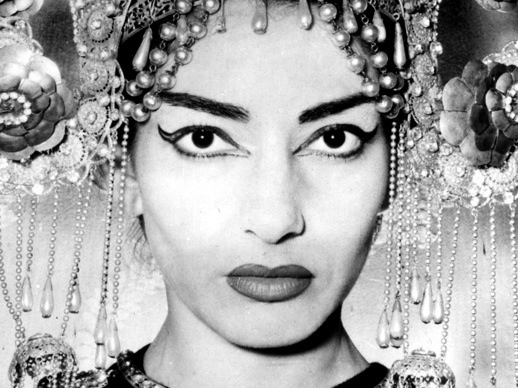
The Callas photo at the head of this thread reminds me of two definitions:
A VICIOUS QUEEN: Someone who says, “You’re not going to wear THAT, are you?”
AN EVIL QUEEN: Says nothing and just lets you wear it.
My only question is how did Callas get ahold of Dorothy Bishop’s head dress?
CF – beautifully said! Few artists have so faithfully followed the scores in spirit and in practice as accurately as La Divina.
Vicar, to put Jo Barstow, in an implied comparison with her just proves once and for all you are totally off your rocker.
Alto you should be so lucky as to ever wear such a stunningly beautiful headdress like that.
Sweet Sanford… just wait until your father gets home!!
I apologize for making a joke out of Herva Nelly’s name. She does have her virtues. I just wish Toscanini had used more interesting singers in most of his recordings, they are so precious. Of course, nothing is perfect, not even a Toscanini recording of a Verdi opera, and the failing there is not in the conducting or the orchestra, but the singers he often uses.
If there is someone I admire above Toscanini is Verdi, of course, and he was not above using star singers in his operas. As we all know, the first Leonora in Oberto and the first Abigaile in Nabucco was Giuseppina Strepponi, a big star soprano at the time. Of course, Verdi was unknown then, but even after, and when Strepponi’s voice had given out, Verdi had her in performances, as Elvira in Ernani and Lucrezia in I due Foscari.
La Divina always said in interviews that she sings what the composer intended, and that she finds her clues in the written music. I believe her, and I believe Verdi would have gone insane with enthusiasm at, for example, her May 30, 1950 Aida at Bellas Artes, and the E-flat at the triumphant scene. Of course, we’ll never know, Verdi had been gone for half a century, but we can speculate. I think Verdi would have thought that is the way the scene should be handled by the soprano, and had he at the time had an Egyptian that could sing as well as la Grecca, he would have put that E-flat in the score.
I know, it is dangerous to play with what the composer would have wanted, but this is an unusual example. I thank CerquettiFarrell for the many examples. Callas was mostly faithful to the composer’s intentions. I feel Callas knew more about the composer’s intentions than Toscanini. There is drama in those operas, there is something that moved the composer to express himself in music. Toscanini sometimes chooses boring singers. Verdi never intended singers to be boring. Callas was never boring, neither was Strepponi, but of this last, unfortunately, we have no recordings, but we do have the testimony of her contemporaries.
I don’t think we need to invent a Toscanini vs. Callas feud here. Pace wladek, there’s no reason to assume that Callas wouldn’t have responded to Toscanini’s guidance as avidly as she did that of Serafin, Karajan or Giulini. Early in her career, he remarked to friends on her diction, saying he couldn’t understand the words. (She was not, after all, Italian.) I’m convinced that she knew about the comment and took it to heart—one reason the diction of Callas in her prime is such a paragon.
In fact, Callas and Toscanini had made tentative plans to collaborate on Macbeth, but these never came to fruition: http://www.norpete.com/op1598.html
Yes. One thing I would like to have today, almost as much as a Verdi’s Il Re Lear, would be a recording of a Toscanini-Callas Macbeth. Pity the past is what it is and neither happened, though they almost did. We do have many Verdi operas, many Callas recordings, and many Toscanini recordings. Thank heavens for all of those.
A question about that high E flat at the end of the Triumphal Scene. Does anyone know if that was a one-time thing or did she do it at other performances of Aida? She sang three Aidas while in Mexico in 1950. Did she do it at all three or just one? She had also sung Aida in Milan and Naples in the weeks preceeding the Mexico performances. Any history as to whether that was a spur-of-the-moment interpolation or had she discussed it with the conductor ahead of time? What did the conductor think of it? Was it considered at all for her studio recording?
She certainly sang it again in Mexico City, in a performance with (I think) Baum and Dominguez.
And the reason most usually given for interpolating it was that the tenor in that first performance (Del Monaco?) had pissed her off, so she put it in as a big Fuck You. I have no idea if that’s true though.
According to the records I’ve seen, Callas sang three Aidas in Mexico in May/June 1950. Others in the cast were Simionato, Baum/Filippeschi, and Weede. Picco conducting. Then in July 1951 she sang three more Aidas with Domingue, Del Monaco, and Taddei. de Fabriitis conducting. I believe that the pirate recording available on YouTube and elsewhere is from one of the 1951 performances. But that’s one recording of one performance. Was that the only time she added the high note?
I don’t know about the other performances in that run. But I have heard that at the perfromance in question, Kurt Baum was holding on to high notes all over (as he was wont to do, whether it made sense or not) and Callas and the other cast members were so fed up that she asked the others if they would mind if she threw in a high E-flat to put Baum in his place. It created such a sensation that the following year, when Radames was sung by del Monaco, Callas repeated the E-flat because the audience expected it.
Ooops, I got it the wrong way round. Sorry all.
Thanks, kashania. That makes a believable story. I wonder if she ever did it again. Like for example at the Verona Arena in 1953? (Seems like an ideal situation for it.)
I think de Fabritiis encouraged her in this but Kurt Baum went wild, not exactly with joy. She just went ahead and did it, without notifying him beforehand. Everybody else knew about her intention. She kempt doing it in all three performances and by the time of the 1951 revival Baum was replaced with Del Monaco.
By the time of her 1955 studio recording that E flat wasn’t really feasible. She had the note, but not in this context. Anyway come her studio effort, the outstanding features were to be found elsewhere… ref that unique, revealing Ritorna vincitor.
And while I absolutely love the E-flat in the Mexico City recording, I think it would have been out of place for a studio recording (and Callas would probably have agreed). In Verona, however, it would have been perfectly appropriate.
I think what happened was that the AD of the festival suggested to Callas that she ought to sing the e-flat as an earlier diva called Peralta (?) had sung it in Mexico. She declined, and suggested if he wanted to hear her E-flat he should hire her to sing Puritani (?).
As it turned out Baum was a dick and before Act 2 one night Callas asked her colleagues’ permission to sing the E flat. They all agreed. Although Baum was not impressed, the Mexico audience was.
The follow year (?) she sang it with Monaco as Radames. He (?) suggested she sing it again – with him joining her. Now this is where I am not sure – but I think he sang the note in one performance in falsetto but it was not as loud as her note – so he dropped it. But she continued to sing it in the run.
Although, the note is very effective in that scene – it is in my opinion not what the role is about as “Aida” has left the bel canto world of “Trovatore” all together and is moving towards the (vocal) verismo world of Puccini. Also, on a practical side ever-practical Verdi would never write a note that would exclude a great many sopranos from singing it – a good example is the absence of an E-flat at the end of “Traviata” Act 1.
Worse for Toscanini was RCA using that dreaded Studio they recorded his artists and orchestra in. Tympani…..like a box off the ears with a tambourine. It was not Hi Fi.. It was a knuckle dusting punch or a double ear smack of High -fives. Ouch!
Harry -you are correct – one of the
worst if not the worst . And yet his genius as conductor managed to somehow balance all sections , I believe
it was engineers who made it more difficult , with their constant dial twisting to get balance to suit their ears.Toscanini was only interested in clean sound
and dynamics -no one liked the studio .
Valkyrietta -Do you honestly believe what you write . Do you think for one second that Verdi wasn’t a master of
the theatre and new all the tricks of the trade ? Do you believe it took an
ego driven soprano years after he had written the work to insert a top note
for effect to please the unwashed in the balconies? You think he wasn’t aware of top notes ? Verdi from
studies, would have gone into a rage
if some half demented soprano tinkered with the score-Toscanini
knew less about Verdi than Callas ?
Where are you coming from? Toscanini was hand picked by Verdi to conduct his operas ,as Verdi wrote “he knows what I want “. Do you think for one moment if Verdi wanted that top note for effect ,he
would not have put it there .? There are notations on where Verdi expected applause and he was correct, he knew the theatre so well.the opening aria for tenor ends
with ppp dim. to morendo -tell me
how many so called great tenors do this as written-? yes it is difficult
and Verdi wouldn’t allow a transposition to make it less so .
GBShaw writes the only one he heard
sing it down to fading ppp was Jean De Reszke ,at which point the opera crowd wouldn’t applaud and Shaw
writes De Reszke stares them down with that’s how it goes and that’s what you get . Most singers however
famous were terrified if they knew Toscanini was in the house and the only soprano I know he approved of was Albenese.His expectations were so high that few stars dared work with him ,as they couldn’t use their
bag of tricks and had to be note perfect . But when he got what he
needed the results were hair raising
without inserting top notes a half
assed soprano thinks necessary
for her applause meter. Apostrophe
group , take note .
‘half-assed’ is usually written with a hyphen…
This site is becoming instructive in more and more unexpected ways. I especially cherish the fine distinction between “ass” and “arse”, since my dictionary completely ignores it. But now, I have a chance to avoid many faux pas [what's the correct plural in English?] in future…
Liana
There is something titled -
The American Heritage dictionary of the English
Language
Arse (ars) Chiefly British n.
Variant of ass
boughten —
though they list the word
boughten as past p of
bought- we left overs use it
in a differnt sense .
Note taken of the dictionary, thank you Wladek. I actually might buy it, since my own really doesn’t explain the difference between the two a-words
. And i really didn’t mean to be ironic, rather fascinated by the turn a discussion on an opera website can take.
oh see are a pee. Double see are a pee. Same old same old. People who live in glass houses should not throw stones. I know that and I try to live by it. It’s just that I can’t resist; it’s my nature, my training, my vocation, my blood. However, I try never to fire unless someone sets him(her)self up as a target. LindoroAlmaviva got a complete pass from me for an error-ridden post on another thread, because it was written in passion as well as in haste. Moreover, LA did not at the same time set himself by trying to give correction to others on either American English, English English, or Mid-Texan second generation Vietnamese English with a hint of Spanglish English. O hell, here goes. Wladek, I very much enjoy many of your posts and I respect your erudition and experience but I must point out in Post #17 “and new all the tricks of the trade” renders you unfit to recommend your seemingly unused dictionary to anyone.
Betsy, I absolutely understand the vocation (and enjoy the results, probably because I haven’t become the target so far
). I actually do more less the same with my students, but it’s hopeless, you know. Recently a student who made really many mistakes in a very short essay explained to me that it wasn’t his fault, since something was wrong with his MSWord, and it didn’t correct the essay as it should. And if his grammar was not very correct, well, unfortunately, Word doesn’t correct Polish grammar, so what could he do? The idea of using a dictionary never even occurred to him
.
amerjacquino -
you are correct -it’s only when referring to sopranos that i leave
out the hyphen.I feel if they can insert an E flat I can certainly
leave out a hyphen for dramatic
effect .
*doffs cap*
Well, then by all means, let us never perform Verdi operas again – after all, Toscanini was the only one who could POSSIBLY know what Verdi wanted. I imagine Verdi never wrote for specific singers, either….although, all composers did. Why is there a high F in “Magic Flute” (several, in fact)? Because the singer Mozart was using had the note. And the reverse can also be true. Perhaps the sopranos Verdi had in mind didn’t have the Eb, but it doesn’t mean he wouldn’t have considered it if another soprano did.
If all music was not subject to interpretation and growth, we wouldn’t need repeated performances….let’s just get some literal singer in there to record it exactly and we’ll all be happy forever. Sorry, but I’ve seen too many literal singers…and they bore me. I don’t want something completely ruined, but I’m OK with an interpretation that may be different than what I’m used to.
What a restrictive, sad little world it would be with no interpretation.
figaroindy- no need to go to extreme =for a time Toscanini was
the fountain of truth when it came to Verdi , because he was there
when it all happened . I witnessed
interpretation at all times as
he was no robot-and I agree with you interpretation is vital to make
a musical work live but —–
there is a great difference between interpretation and tampering (.adding or subtracting notes }The singer Mozart used
for Queen of the night was his
sister-in law (for hyphen watchers) who had an extraordinary range , and could knock the aria out to left field ,
the Irish tenor writes– rather than adjust notes for singers limitations he
rewrote arias not only to suit
singers but to keep the the opera moving . And as long as you could sing what he wrote he was fine ” but Lord help you if you
didn’t sing what he wrote “.
Verdi at this stage was a master of the operatic stage and could get any singer he wished and
I don’t doubt many could hit the E flat with no trouble . But this is what he wrote with no suggestion of” alternate note if one could mange it,” the” scene” was
more important than a soprano
shrieking out her top note so the gallery can go into hysterics .
Yes interpretation is the all as
in “interprete the notes,”. otherwise we soon will get this-
” To be or not to exist”
that is the question . You would be furious if someone tampered
with your writing , unless what you write means nothing ..so lets
once in a while get a little pissed off when a soprano inserts her two cents worth into a work the
composer is content to send off into the world as a finished inspiration .
I heard once a very early recording of Sempre Libera with so many interpolations that it was almost unrecognizable. I don’t remember the soprano’s name but I was told that Verdi admired her Violetta. There’s a time and a place for everything and a super high note at the conclusion of the Triumphal March sounds just fine to me. I can’t imagine Verdi objecting.
I saw Callas in Norma, Traviata, Lucia, Tosca (’56 and ’65) and a concert Il Pirata + two of those awful concerts in the early 70′s.
One unforgettable aspect of her Norma (my first Norma, 1956) was that Callas’ singing of the recitatives/arias/duets, etc. were so well integrated with each other and given its proper weight (not one phrase was anything approaching a throwaway); so that combined with her acting, gave us a virtually seamless performance/characterization of the Druid–it was kinda like watching a play rather than an opera–she simply was Norma (I know it’s a cliche)– the first time I had ever experienced this in opera– and it was eye-opening after having seen Milanov and Tebaldi (whom I adored) earlier.
I did have problems with her voice at that time (temporarily) as I was expecting a huge voice that was a combination of Ponselle, Milanov, Muzio and Tebaldi, based on her earlier recordings. LOL
I was young!
Clita – I guess you’ve heard her post- 1953 diet, after which the voice has reportedly changed and slendered.
I hadn’t finished editing the above post–when it suddenly appeared–what happened???
CF: AS always, thank you for your comments. People go on about Callas the actress, Callas the stage animal, the drama in her voice, etc. But Callas was, above all, a MUSICIAN. Few singers pay as much attention to the details of the score the way Callas did.
‘Callas was, above all, a MUSICIAN’
Exactly. There’s the wonderful moment from the Julliard classes, quoted by Ethan Mordden in ‘Demented’, when a young mezzo attempts to defend herself after going awry at the end of ‘Condotta ell’era in ceppi’ by saying ‘But it’s a cry of despair!’
Callas replied ‘It’s a B flat’.
Ha! Love it.