
this diva looks like that matron
La Cieca is fully aware that Anna Netrebko is a dress size or two bigger now than she was a couple of years ago. And yet, there is no excuse, no excuse I tell you, to transform the young courtesan Violetta Valery into the middle-aged dowager Mrs. Claypool.
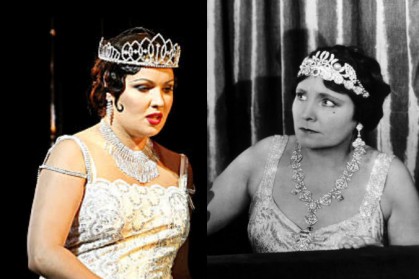
Now, La Cieca has a couple of things to rant about here.
First off, 1920s attire is, in general, not particularly flattering one for operatic figures. Lyric sopranos in general tend to be somewhat curvy, in defiance of the flat-busted and boyish-hipped visual aesthetic of the jazz age silhouette. Of course, there were some singers active in the 1920s who look perfectly charming in the fashion of that era.
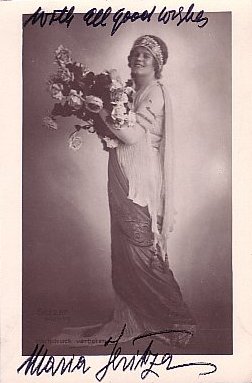
But, let’s face it, not everybody has Maria Jeritiza‘s height, superb posture or — this is perhaps the most important point here — her “tempestuous” perfectionism. La Jeritza would never have emerged from her Künstlerumkleide in so ill-fitting a garment as this:
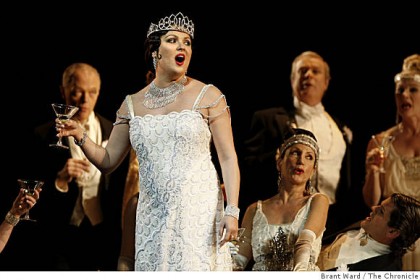
[Netrebko photos by Brant Ward / The Chronicle]
But even when this dress is properly fitted on a slimmer soprano (Elizabeth Futral), the line is not particularly flattering.
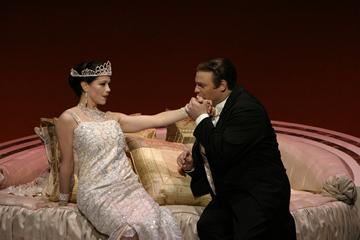
So can someone remind La Cieca what’s the point of updating Traviata in the 1920s?
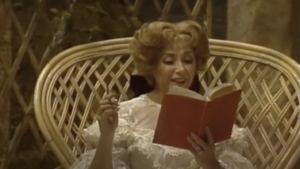


Lindoro: Get with the times, Man. Schrott and Netrebko were married last year.
Why would a diva (and a truly beautiful one to boot) wear that crap while performing in front of an audience? A mystery.
The reason for updating Traviata is so you can change the COUCH!!!
I always wait for the third act just to hear everybody singing my name – regardless of the period they never fail to do this.
Fakor
Is Netrebko married or not? I just read an interview with her conducted recently in which Schrott was referred to as her fiance. Do we have a definitive answer or is it one of those “In our hearts and minds we are married” things?
The interview I refer to, by the way, was in the SF Chron and dated yesterday!
How odd to see Jean Harlow used as an example of a period where “the predominant woman’s shape was flat chested”! Yikes.
“So can someone remind La Cieca what’s the point of updating Traviata in the 1920s?”
I’m puzzled too, so I can’t be of help, but I have a couple of guesses. Maybe the director saw ‘La Rondine’ and liked it and got inspired? Not all inspirations are happy ones. Maybe, also, the director wanted to give the opera a larger dimension, by hinting about the fate of Lady Beekman’s tiara?
48 – Lady Beekman!! And my favourite Marilyn film moment: “I am not marrying him for his money….I am marrying him for YOUR money!”
just here to lend my support to whomever suggested that the breaking up of the comments into multiple pages is a pain.
And today is Helen Traubel’s 111th birthday!