noch mehr tristan! noch mehr isolde!

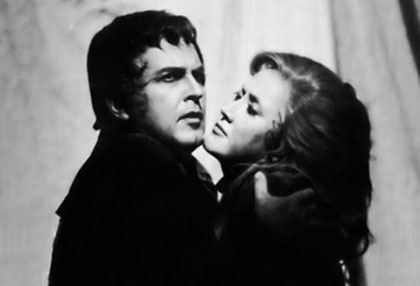
La Cieca just can’t get enough of the old Love-Death. So this week’s edition of Unnatural Acts of Opera begins a classic performance of Wagner’s music drama from the 1976 Bayreuth Festival under the magical guidance of Carlos Kleiber.
UPDATE: Well, you can spank La Cieca’s butt and call her “Tony,” because she foolishly neglected to check her facts before writing the script for tonight’s podcast. The Tristan in this performance is not Helge Brilioth (as your doyenne announces) but rather Spas Wenkoff.
IIRC Jean MAdeira died of a terminal disease and was still performing while pretty sick.
I saw a reference to her singing ‘on borrowed blood’(?)
The context was wonder that anybody could perform Klytamnestra’s music (already some of the creepiest ever written for the human voice) while actually being as sick as she was.
Mrs J.
A friend of mine was at the Elektra. Borkh didn’t yell at Mitropolulos. It was because patrons were still being seated as her monologue began. I believe she says. “Was is das?” as in “What the f*** is going on here?”
I do love that Elektra, which if I remember correctly has Yeend as Lil Sis and Thebom as Big Mama.
Best Elektra in concert story. Dear Varnay sang three Elektras in four day with the NY Phil under Steinberg in the mid-60s. She said to a friend backstage after number 3, “Next time I will read the contract with my glasses on, before I sign.” BTW, cast included our own Mistress Quickly and the divine Phyllis Curtin.
This blog is reminding me of the number of Elektra recordings I have in one format or another. The Klytemnestra of 2/27/71 is Jean Madeira, along side Birgie, Leonie, Tom Stewart and Robert Nagy, conducted by Bohm. It sounded amazing and I wonder why the audience went wild after Elektra’s “Was bluten muss?”. Did something special happen apart from Nilsson doing duty? I got the recording from Mr Tape in New York about 30 years ago.
Celmo. I saw the third of those Elektras with Astrid, I think it was a Sunday afternoon, but maybe it was a Sat mat because I went with my aunt from Brooklyn who didn’t like Germans and said she had a headache afterwards. I remember thinking Stienberg was slow (I hadn’t brought my score for some reason) and very loud. Astrid was past her best but knew how to make the big moments count, but I have to admit I didn’t like her as much as I did on some of her pirated Elektras from the 50′s as well as Inge (I think I had four recordings with her) and I think I had heard Birgit by then (her best role). I AM Phyllis Curtain, I saw her constantly even later in Vienna (Countess in Capriccio and unless memory is making me a fool Salome) I adored her so much more than the sunt who threw her under the bus. But as for Regina… well….!
Phyllis Curtin did indeed sing for two seasons at the Wiener Staatsoper (1960-61) and among her performances of 5 different roles, she sang 3 Salomes in 1961 spread over 12 months. There is no record of her essaying the Capriccio Graefin at the Staatsoper though it was in repertory at the time with both Schwarzkopf or della Casa for all the performances except one sung by a certain Mara Ehns who must have been a replacement for Schwarzkopf or della Casa. After 1964 Claire Watson also sang Capriccio plus Gerda Scheyrer and Elisabeth Schreiner. It dropped out of the repertoire for a few years and was revived for Gundula Janowitz with Christa Ludwig as Clairon and Edita Gruberova as the Italienische Saengerin, a role taken earlier by Lucia Popp. This production of Capriccio went from 1960 to 1994. The previous production (1951) had Christel Goltz and then della Casa. The new production this coming June stars Renee Fleming who has not sung at the Staatsoper since 1995. Capriccio is to be repeated 4 more times in Vienna during October, 2008 though the cast has not been announced, probably Fleming again as it is not Isokoski who should be marvelous in the role.
Isokoski, however, is singing in Intermezzo at the Theater an der Wien in December and will repeat her Marschallin at the Staatsoper in January with Garanca as Oktavian. Many in Vienna feel that Garanca is the best Oktavian there since Trudeliese Schmidt (44 Oktavians from 1974-1991) or even since Irmgard Seefried (last Oktavian September 1970 with Jurinac as the Marschallin.) In the 1960s most of the Oktavians there were sung by Seefried, Jurinac or Ludwig (what riches !) with a spate of marvelous Marschallins and Sophies. Fritz Wunderlich sang the tenor (Saenger) 17 times in a 3 year span. In 1968 Bernstein came with his new cast – Ludwig as Marschallin, Jones and Grist. After those performances Schenk came back and rehearsed a more Viennese cast (Jurinac, Seefried, Popp) under Krips in the same new production. Many Viennese felt more comfortable with Jurinac, Seefried and Popp who they thought was echter in style than the Bernstein cast.
Curtin sang Violetta, Cio-cio-san, Fiordiligi, Donna Anna plus the above mentioned Salome in Vienna and apparently with some success though she never returned after 1961. Don’t know why but at the time she was married to a well known history professor at the University of Wisconsin named Curtin.
Mark– What then did/does Vienna think about the Octavians of Brigittte Fassbaender and Angelika Kirschschlager? When I heard the latter there 3-4 years ago she was cheered to the echo…
Christel Goltz as the Countess in Capriccio? Eeeek! I’m glad I’m not old enough to have seen that. I think she’s still alive, in her 90s, and still well remembered for her Salome, Elektra and Färbersfrau. I think she was the first Marie in Wozzeck at Covent Garden, or sang it early on.
Has Renée sung Capriccio in the States yet? It would be a perfect role for her if she would study the text a little more assiduously. She looked lovely in the Carsen production in Paris. I adore the opera, but hard to think who the ideal Countess would be today. Isokoski sang it in concert at the Edinburgh Festival a few years ago, but her face was embedded in the book, and she’s done it since in Dresden, presumably in a production set in the Brazilian rainforest. We had Gabriele Fontana in a Cologne production at Edinburgh last year. I wouldn’t wish her on my worst enemy.
She’s singing the Kaiserin in Amsterdam in September which is making me think twice about going.
Well Angelika Kirschschlager is a very fine Oktavian as is Sophie Koch also as was Fassbaender (also a wonderful Brangaene). There is endless discussion in Vienna among opera fans there regarding the various nuances of the many great exponents of the 4 main Rosenkavalier roles particularly when a new singer takes on one of the roles for the first time in Vienna. Kiri was knocked about quite a bit after some Marschallins at the Staatsoper, not unfavorably, but for her lack of Viennese warmth and weak command of the language. I was told that the Viennese find it titillating to have a slightly feminine Oktavian playing a man who then has to prance around as a chambermaid – Oktavians such as Jeritza, Seefried, Ludwig were inately feminine in physique, Jurinac also. I cannot speak for Jeritza (before my time, or Lotte Lehmann when she sang Oktavian) but Seefried was, despite her buxom figure, very masculine on the stage and in her movements. Her rather boyish soprano sound with not a great deal of vibrato helped her voice blend wonderfully with the various Sophies (Streich, Rothenberger, Popp, Lipp, Gueden. Muszely, Grist among others) with whom she sang (and with Schwarzkopf in the 1947 recorded presentation of the rose). I always wanted to have a tape of a performance of Seefried as Oktavian with Schwarzkopf as the Marschallin as they always sang their best when singing against each other in performance. They did it together in Vienna under Boehm, Karajan and Krips plus others and in San Francisco 1964 under Leitner, but I never heard of any taped evidence of these performances. Schwarzkopf was Seefried’s first Marschallin in Vienna (1960) and Seefried was Schwarzkopf’s last Oktavian as well in Vienna (1965) when Schwarzkopf made her farewell to the Staatsoper (though she may not have known that at the time). Della Casa was also a popular Oktavian though, unfortunately, I never saw her in that role.
Rosenkavalier is in the news today for Maureen Dowd’s column in todays NY Times compares Hillary Clinton as the Marschallin and Obama as Oktavian, Hillary teaching Obama how to debate properly and defend himself against political adversity before he waltzes away from the older Hillary for other pastures.
Regine
Christel Goltz will be 96 this July. She made her debut in 1935. singing mostly in Dresden until moving to Vienna after the war. Her Salome (one season only) was a success at the Met though it followed Welitsch a few years earlier and no one then could compare with Welitsch (except maybe Cebotari for a few short years). At the Met, after her Salomes, Goltz took a solo bow and Bing had banned solo bows for a season or two, so Goltz was not invited back. She was best known, at least later in her career, for singing the “intellectual roles” meaning more modern operas. I doubt she had the radiance of voice for Capriccio and later usually sang Clairon. Her farewell in Vienna was in 1970 as Adelaide in Arabella. She did appear at a matinee for Irmgard Seefried in January 1989 at the Staatsoper (Schwarzkopf, Jurinac, Kunz and Dermota on the stage, Welitsch and many others in the audience) and in 1995 for the 50th anniversary of the re-opening of the Staatsoper together with most of the Honorary Members singing in 1955 (della Casa did not come – nor did she appear for the ceremony when she was granted the Honorary Membership of the Staatsoper – the highest honor bestowed mainly to long term stars and conductors or general directors. I have never heard of della Casa appearing in public at all since her farewell to the Staatsoper as “Arabella” in 1973. And she has granted only a few interviews since then. A pity as she is one of the last remaining members of the legendary Viennese Mozart ensemble after the war. Jurinac is alive also, Kmennt and only a few others of this era. Goltz was not a Mozart singer though she essayed Donna Anna and a few First Ladies. But then virtually every leading prima donna sang the First Lady including Welitsch, Jurinac, both Konetznis, Kupper, Zadek, della Casa at Salzburg, Grobl-Prandl, Janowitz, Claire Watson etc. Nowadays it seems the only opera house casting the 3 ladies with leading singers is the Budapest Opera which still has an ensemble (with many excellent singers not well known outside Hungary).
They had a luminous Parsifal in Budapest last week and all the flowermaidens were leading singers – breathtakingly sung.
Evie Lear about Fassbender, “if she touches me there again I’m kicking her in the balls!!!”
Thank you for your info Bill. People liked Fassbender but my faves were Jo Minton, the very greatest Lisa Della Casa (with Evil Incarnate, I mean Lizzie, at her debut). One sang and was in tune, one did Sprechstimme and when singing, choose any pitch that was comfortable. Yet the great pitch expert on Opera-Hell, Bob Rideout, will tell you he has PERFECT pitch and Lizzie was heaven. She was a shrewd self presenter as Bichette but unfortunately her season was marred by the horror of her Donna Elvira. The story was that she begged Bing to let her cancel for she was sick. He is alleged to have said, “yes, you may cancel, but I vill haf to inform ALL OF AMERICA, that ve cahn’t do the b’cast today because Madame Schwarzkopf has refused to sing.”
She went on, was booed, and I was told left weeping, got in a limo and raced to the airport for the first plane, probably to Brazil where her true friends could wine and dine her.
As for Oktavians in the Met, first Soederstrom, the best physical interpreter and later a heart breaking Marschallin (in DC with Flicka and Battle), Troyanos especially in her earlier days was transcendent. I thought Ludwig was too butch and hard (no way was she 17); the Seefried performances I saw found her challenged at the top but she was quite a personality it’s true. I thought Jurinac was way too girly in look and manner, but I loved her sound and phrasing, though I did not catch her in her absolute prime (one can of course see her in prime in the Czinner movie with that other sinner, Evil Incarnate).
Impressions in Vienna must take into account that it’s a small house and almost everyone sounds large there. I always thought Domingo had a small voice, til I heard him do a Chenier in Vienna where he sounded enormous and even had high notes (his voice grew in later years, even in the Met volume was not his problem in Siegmund and Parsifal, the words and inwardness were his problems).
Christel did not have a mic voice but her very first Salome recording (1944? 1950?) is actually nicely sung; and in the best conducted Salome ever (C. Krauss, circa ’54), she certainly holds her own, though her voice had hardened. But who would be without Marguerite Kenny? Americans grew up with her Dyer’s Wife, in the recording where nobody sings in tune but which was the ONLY commercial one for years (however I had on tape the incredible Munich performance with Kempe, and a very good cast especially the amazing Metternich as Barak and the much under appreciated Marianne Schech as the Dyer’s wife (I got to see her late in the day in Munich and liked her very much, I had seen her Sieglinde at the Met but was too young. “That-a lady is-a no singah” was my grandfather’s take).
I would love to have Welitsch’s Manon and Minnie, she sang them in the late 40′s in Vienna (possibly with Roswaenge in the Puccini). Everyone loved her in 49, so I was told, amazing etc. But the horror people felt in 52 was still recounted some years later. My grandfather and great uncle thought she was a ridiculous Aida and Tosca (of course in the first they had had to deal with my adored Ramon — “that’a man is no singah,” said grandpop even as I made him take me to EVERY Ramon performance we could get to, and Peggy Harshaw, who I saw fairly often, but who I don’t really remember except that she had a really big voice as a soprano but no one I knew thought she was any good. In Tosca, Scarpia was Schoeffler, who my old relations detested, since they thought he was ridiculous in Italian and as for Hans Sachs, well, they had seen Schorr and Janssen, the latter possibly not vocally overwhelming but according to them heartbreaking. Schoeffler was my first Hans Sachs and I had the Kna LPs (I think there were six in the first pressing.) But I was spoiled by the Schorr records, where he is much more in his prime that he would have been at the Met (there is a heavily cut 36 b’cast where he is in pretty good form, the later b’cast is not so good). I most remember Paul posing a good deal in a style that looked odd to me. “That’a man is a singah, but he is not important,” said grandpop. Then we would get the stories of Cesare Formichi as Sachs — this was a time when NOBODY had ever heard of Formichi, my old relations had seen him in Rome several seasons running, or so they said — when I look at chronologies I wonder if he’s the one they really saw or if they saw him some place else since they traveled a lot looking for work. I know they saw Journet in Paris, “era finito ma un artista” said grandpop, but Journet’s late recordings sound pretty impressive to me, and he sang Sachs both in Italian and French, so I think they actually saw Journet in Italy as Sachs and Formichi do Wotan in Walkiria and got them mixed up.)