Master class
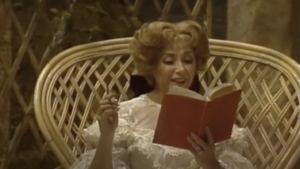
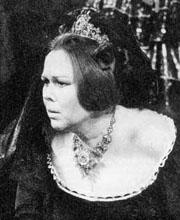
In response to the recent lively(ish) discussion about the suitability of Maria Guleghina to the rigors of the role of Elena in I vespri siciliani, La Cieca has decided that she should demonstrate how this music should be sung. No, actually La Cieca is not going to sing it herself; rather, she will present Renata Scotto‘s peerless interpretation from La Scala in 1970. This will also mark La Scotto’s debut with Unnatual Acts of Opera, and an overdue debut it is when you recall that she is La Cieca’s favorite singer, ever. La Cieca once opined that Scotto is the nearest anyone ever came to being the Bette Davis of opera; for that matter, La Davis could certainly be called the Scotto of the Silver Screen. But La Cieca digresses. This gala Vespri also stars Ruggiero Raimondi, Piero Cappuccilli and Gianni Raimondi, under the baton of Gianandrea Gavazzeni. Maestro G. took a number of cuts in the score, which means that we have time for some delightful extras following the acts, with Leyla Gencer, Anita Cerquetti, Boris Christoff and Renato Bruson headlining. It all begins Monday on Unnatural Acts of Opera.
I was a Drunken, French Rapist Soldier Supernumerary in a 1993 production of “I Vespri Siciliani” at the San Francisco Opera, in a cast that included Samuel Ramey, James Morris and Chris Merritt (in fine voice, for a change).
Though I know La Cieca is not a big Carol Vaness fan, her performance as Elena was one of the greatest things I’ve heard, ever, singing truly fiendish music that’s different in each of the five acts perfectly on-pitch throughout the entire range of the score.
I’ve been listening to Miss Vaness live since she was about 20 years old and singing Vitellia in “La Clemenza de Tito,” making the Mozart sound so effortless it was as if she could do it every morning before breakfast without taking a large breath. Her musical instincts and perfect pitch really were something to behold, and Andrew Porter’s worship of her in “The New Yorker” at the time was not at all misplaced.
But like other divas, Ms. Vaness (like Bette/Renata in “Norma” at the Met, for instance) lost her perfect voice with age after singing one too many fiendish Verdi roles such as Elena in “I Vespri Siciliani.” She returned to San Francisco for a pretty dreadful “Norma” in 1998, and followed it with really off-pitch singing in “Un Ballo” and “Simon Boccanegra” which I found personally painful to listen to.
But in 1993, she was still God, and she sang the hell out of the uncut, five-act “I Vespri Siciliani.”
The best part of being a Drunken French Soldier was that at the end of each act we would usually get to run onstage with guns, kneel in front of the principals with the chorus ranged behind them, with the orchestra at our butts, and we got to be Dead Center for yet another Verdi finale, an aural experience which can pretty much cure cancer.
Plus, after being evil for four plus hours, the chorus came after us with knives and pickaxes for the Final Finale, which goes something like “Vendetta, vendetta, vendetta!” It was too cool. And so was Carol Vaness.
I’ll share with La Cieca my experience with Scotto and I Vespri. As La Cieca undoubely knows, Ms Scotto sang several roles with the Met between 1965 and 1972. Then she and the Met could not agree on repertoire and the contract was not renewed. In exemplary prima donna fashion she publicly chastised the Met in a New York Times Sunday article.
The following season, the Met produced I Vespri for the first time with Sra. Caballe. Sra. Caballe was also scheduled to open the following season (1974-75) with that work, but she cancelled and the Met found itself struggling to find a soprano capable of singing the role and at the Met no less. Look around the map and who’s there? Mme Scotto herself. She had sung it to great acclaim in the Scala production that La Cieca remembers and also in a sister production to the Met’s in Paris.
Scotto, however, was at the time opening the San Francisco season, and professional artist that she is, she was not about to abandon loyal SF for last-minute-begging Met. But she was magnanimous enough to agree to sing three performances of I Vespri after she was finished with her performances of Butterfly in SF.
Needless to say that her return to the Met was anticipated there with some trepidation. She had never sung with Maestro Levine, and it would not have been unreasonable for her to show some hubris. As it turned out, that was the beginning of the love affair between Levine and Scotto that made Mme Scotto the reigning diva at the Met for the next decade.
The first performance was on Saturday evening, October 26, 1974. I was there. And it was the most exciting performance in all of my opera-going years, which as you can see go back at least thirty years. The cast included Domingo, Milnes and Pliska. Not shabby. It was truly an electrifying performance. Verdi would have been at her feet.
For those who have read this far and may be curious, Cristina Deutekom sung the opening performance that season. Marilyn Niska sang the broadcast in the Spring.
The cast of Studer, Merritt, Zancanaro, Furlanetto, et.al. for Muti/La Scala 1989-90 surpasses Scotto, Vaness, et.al. and anyone since, anywhere anytime.
Speaking of “Vespri”, Nelly Miriciou (sp?) was excruciatingly bad as Elena at the Met last season. Leo Nucci was fantastic as Monforte, though.
Right on, Cieca-
Scotto is the deal. If she needed a kidney, she is welcome to take one of those Vespri daggers and cut it out of me herself.
How random is this: I love her in that problematic studio ‘Le Prophete’ with Horne– the only way that the soprano character in that opera works is if she is completely psychotic, and Scotto sounds insane. Demented even in the studio.
And the recitation in Act 3 of ‘Adrianna Lecouvreur’ makes my hair stand straight up. Other singers could only dream of making pulses race the way Scotto could. Ah, if only she had recorded ‘Maria Stuarda’.
The divine Renata should be canonised immediately. Even in her declining years, she always had something pertinent and exciting to say about the music.
My two cents:
Carol Vaness is an amazing singer, but has sadly made some mistakes in repertoire selection, just as sfmike pointed out. But I think Elena was a good choice for her. Just recently I saw a live video performance where she and Jennifer Larmore sang the ‘Mira, Norma’ duet – it may have been lacking in dramatic interest…but who the hell cares when vocally it was one of the BEST I’ve ever heard!
Secondly – Cristina Deutekom is a total Goddess – she is severely underrated in the opera world and probably should be included in the top 5 best sopranos ever. If you don’t believe me then listen to her recording (either the studio OR the live one) of her singing the Oh-so-demanding-rarely-sung-because-
it’s-so-fricken-difficult-that-no-one-
can-get-around-it-cause-either-their-voice-
is-too-light-or-they-can’t-move-that-quickly role of Griselda in Verdi’s I Lombardi. After you hear her sing that, you will understand why she is one of the FIERCEST bitches to have ever walked across ANY operatic stage. Also, her Queen of the Night far surpasses almost all Queens – the only true contestants are a young June Anderson and an ever-flawless Edita Gruberova. But I’m sorry, anyone with a voice THAT BIG and powerful who can sing High F’s and all those tricky staccato passages THAT perfectly and THAT in tune!!!!! deserves to be recognized as more than a mere mortal of the opera world! Yes, her technique o singing runs is a bit unusual – but get over it.
Third – I refuse to believe that Cheryl Studer ever sang anything worth mentioning as ‘good.’ ‘Acceptable’ and ‘passable’ I can give her at times – she was unfortunately one singer who felt that she could sing everything – sadly, she barely was able to sing anything! I realize that my words might seem extremely cold…I wish to point out that many people find her to be a wonderful person and good colleague. However, I have never, in all my life, heard her sing anything (outside of Eva in Meistersinger) that wasn’t painful to listen to. She abused what could have been a truly beautiful instrument and exploited her wonderful talents. The woman is capable of learning a score at the snap of a finger – no matter what the difficulty. As a result, she has attempted far too much music that spans the bel canto, Mozart, Verdi, Verismo, French, and Germanic repertoire – when she should most likely have stuck to being a Germanic soprano with a few tiny excursions into other realms of singing. I do not wish to speak ill of her, but I do feel offended everytime I have ever attempted to listen to one of her recordings. However, legend has it, she did sing the hell out of Beethoven’s Ninth at one time – a pianist that I have collaborated with was in the chorus and owns the recording which I have not had the opportunity to hear. She tells me that Cheryl’s singing was truly amazing. I do not doubt the potential, but I am skeptical.
And lastly I shall say a few words about La Scotto. This was a voice I had begun listening to in my early exposure to opera. I had a recording that included highlights from Madama Butterfly (still my favorite Puccini followed by Tosca – a sentiment shared by the composer himself) where she totally sings the shit out of La mort di Butterfly. I fell in love with this woman – her Sonnambula is quite amazing. But over the years I discovered that Renata had recording more than just Puccini and Bel Canto operas. Of course she did equally well in some of the lighter verismo operas – like Adriana and I Pagliacci. What came as a totally devastating shock was when I began to listen to her recordings (studio and live) of her performances in Verdi operas. I have never been so disappointed in my life. The sad truth is that her voice was never meant to sing those types of heavy roles. Tosca should have been the heaviest thing that she ever sang – and had she not sung Nabucco and Trovatore and Macbeth and Don Carlos and I Lombardi and Aida, she probably would have done very well with Tosca. Now look…I know some of you are probably aghast at what I am saying, but truth be told, Renata went too far and damaged her once-magnificent instrument. She is and always will be an artist of supreme ability, however, her selection of repertoire was very faulty. Renata, like so many other great singers – Caballe, Callas, Horne (as per her Azucena and Eboli performances), June Anderson, and plenty more – has made a few too many errors in judgement about selection of roles and has payed an unsettling price.
Some performers are driven not by the musical aspects of an opera, but by the dramatic affects of a particular character. Singers of this nature were La Callas, Josephine Barstow, Hildegard Behrens, La Scotto, Leyla Gencer. All these singers are FANTASTIC and are some of my personal favorites. What is so interesting about them…and possibly one reason why audiences adored them…is their almost complete and utter disregard to their voices as a musical instrument and their concentration on using their voices to bring to life the character and the drama therein. Sadly, each one went a little too far with certain things and thus destroyed their vocal capabilites of being able to provide that same dramatic intent and intensity while at the same time having vocal chords that can respond to that intensity in a healthy and virtuostic way. I am in no means putting down any of these singers…but as a singer myself, I find it important to learn from other’s mistakes. Had Callas not sung so many Aida’s and Isolde’s and extreme dramatic repertoire…her voice would have probably upheld her much longer than it did. It was by no means the prettiest of sounds…but who the hell cares!? However, one cannot ignore and feel extreme pity for her when one hears her warbling and wobbling on high notes during the last third of her singing career. We all forgive her, as we should, because her level of artistry is what not only each musician, but any person who seriously involves themselves in an artistic craft, should strive to emulate.
Despite some of their ‘mistakes’ throughout their careers, there is much to be learned and appreciated by each great singer. I truly love Scotto and would be thrilled to hear this Elena of hers that has been mentioned. I just wish that she would have left Nabucco and Lady Macbeth alone. We as singers, must find a harmonious balance between what we are vocally capable of and what we can dramatically through and alongside the voice. Pavarotti destroyed himself with Otello’s and Manrico’s; Francisco Araiza went off the deep end with Lohengrin!! (Who told him!!!!) and then continued with Hoffman and now no longer sings – which is a travesty.
It may seem like I am being very judgemental…and in some ways, yes I am…
but I wish to share this thought so that those who have been reading this can understand better where I am coming from on this.
When I began singing opera, at the young age of 12…I knew very little repertoire and I knew nothing of the Fach system or voice types. I sang everything from Papageno to Radames to Violetta (at pitch) because I could and I wanted to. I had, by the time I graduated High School – committed the entire roles of Radames, Pinkerton, Rodolfo, Alfredo, Ferrando, Almaviva, Ramiro, Siegfried (in both operas), and Tamino (just to name a few) almost completely to memory. And I was truly prepared to run out and sing all of them!
When I got to college someone told me that I would never sing Radames because it was a ‘dramatic tenor role.’ This meant nothing to me…I just assumed that as long as I sang it with MY voice and with MY lyricism that I would be able to do the role justice. The sad reality set in when I saw, in a masterclass, a girl attempt to sing “Si, mi chiamano Mimi” – which is by no means a very ‘heavy’ aria, but also not for the faint-of-heart. The girl had a lovely light soprano voice (an -etta/-ina voice) and she crashed and burned MISERABLELY through this performance. Then I saw another soprano get up and try to sing Elvira’s aria from Ernani. And she sang the WHOLE thing – she got through it, but just barely. That was when I realized that it was true, I would never sing roles in Aida, Forza, Der Ring, Otello, etc. etc. It was completely devastating to me!!! I mean, the whole reason that I wanted to sing that kind of music was because I loved it so much and I felt (and still feel in some ways) that I have something to contribute to the part!
Now, I was very young and thankfully my vocal chords were so limber at the time, it didn’t matter that I was singing this ‘heavy’ repertoire – I certainly wasn’t singing it with the kind fo heft needed to get through it – I was just singing notes on a page. People still ask me to sing Nessun dorma just because my way of overcoming it vocally in a much more lyric way is enjoyable to them. But I promise you I would NEVER attempt it with an orchestra. A pianist who isn’t pounding the shit out of the piano accompaniment yields me to sing that aria (which, since it is set so high in the tenor tessitura allows me to negotiate it vocally) whereas I would truly die were I to sing that with an orchestra behind me!!
I am very thankful to have had that friend who informed me of this condition so early in my development as a singer – without that knowledge and having had a fantastic teacher – I probably wouldn’t be able to sing much of anything at this point! It was only by accident that we ‘discovered’ that I am naturally disposed to sing Rossini.
So, dear readers, forgive me if I sound a bit harsh with my asessments of certain singers and their repertoire decisions. I share with them that same burning desire to sing certain things because the music moves me so or because I feel like the character provides me with a burning desire to perform it. But I have chosen the road of longevity and therefore avoid and turn away such urges in my musical career. The point, as The Interpolator has mentioned before, is to sing as well as you can for as long as you can – and not just for practical reasons, but for the purpose of being able to do the music that one performs the justice the composer deserves from you as the one who brings his music to life.
You’re not being harsh, Tenore di Coloratura Superba, just realist.
I agree with most of what you say about Scotto. She’s a singer who made me “live” her performances. She communicated in extraordinary ways, even after her voice had declined severely. At one of her last Normas, her voice was no longer dependable, but I remember watching her while the others sang. She was mesmerizing. She radiated more emotions than those who were doing the singing at that time. She made you feel Norma’s pain. Perhaps not surprisingly, I only remember her from that performance. Can’t even remember who the other singers were.
Having mentioned her Norma, I should add that I disagree with the many who have claimed that she was not a Norma, should not have sung the role, did no justice to it, etc. I saw her as Norma in Houston in 1978 and in Philadelphia in 1979. They were magnificent performances. And she had every note. I have a tape of the Houston performance to prove it. (With Tatiana Troyanos as the Adalgisa) No, she was not a Cigna or Callas type of Norma, but she was probably a lot closer to what Bellini had in mind and heard in his lifetime. A Norma AND a Sonnambula. Unfortunately, by the time she sang Norma at the Met, her voice was no longer quite what it had been.
That of course, as you said, was undoubtely due to her choice of repertoire after she had her second child in 1972. She lost her highest notes after that and went on to try a heavier repertoire than may have been natural for her.
I disagree with you, however, in that I found her more of a Verdi than a Puccini or verismo soprano. Mimi, Butterfly, Liu yes; Tosca and Giorgetta… hmmm, not so sure. Those roles, plus Adriana and Gioconda required her to produce lots of volume in the middle range, and I never felt that was natural to her voice. On the other hand, I found her knowledge of bel canto quite welcome in her interpretations of Leonora and Elena. These roles are more often than not sung by more dramatic sopranos not versed in the delicacies of bel canto. (The same goes for Norma.) But (1) I suppose this may be matter of taste, and (2) you’re a professional and I am not, so your view is taken seriously.
A small correction: Scotto never sang Aida or Abigaille on stage, although she did record a complete Nabucco.
Dear Interpolator, your latest posting made me go rummaging through my old LPs, and voila, I have the Sutherland recording of “Vorrei spiegarvi.” Ah yes, isn’t that wonderful singing?!!! Thanks for bringing it up.
Sometimes one takes singers for granted and then rehearing an old recording like this brings back the memory of first hearing a spectacular singer. I was listening last week to a pirate recording of a concert Puritani that she sang at Carnegie Hall in 1963. Wow, what incredible singer she was!
Incidentally, the tenor in that performance is Nicolai Gedda and he’s also spectacular. After his aria/scena at the beginning of the last act – yes the one with the stratospheric notes for the tenor – the applause goes on and on and on. His ovation actually lasts longer than Sutherland’s. It’s a pity that the mishap in the recording offered by Mme La Cieca a few weeks ago found its way to posterity. It’s totally unrepresentative of that artist. Gedda had rock-solid high notes and was one of the few tenors never to transpose the arias in Faust, Boheme, etc.
Hope you’re all enjoying the beginning of the fall weather.
ITDG
ITDG – I apologize that I missed seeing your entries here and responding to them. I completely agree with you about Scotto…and I am aware that she did not sing Nabucco or Aida on stage – her recording of Nabucco is rather upsetting when you think of how beautiful that voice once was. And I should have been more specific regarding the limitations of the verismo world – generally, I have found, that when we speak of the verismo singer, we speak of the lighter/middle ground of that repertoire. The heavy girls that you mentioned, Gioconda, Giorgetta, Tosca, all fall under the dramatic repertoire, even though they are ‘verismo’ operas. Scotto was not a dramatic soprano and therefore should not have attempted those girls. Norma was definitely in her reach and I agree that she could have been very successful with Trovatore and Ernani – I have not listened to her sing those operas, so I cannot comment on them. I may have avoided listening to them because of my knowledge of how she helped to deteriorate her voice with certain roles. However, a word about both of those roles – they are MUCH heavier than they appear on the page. A soprano really must be a dramatic with a good flexiblity and strong top range in her voice to sing those parts – even Norma. That is why Leontyne Price and Maria Callas were much more successful singing Trovatore and Ernani than Caballe and Sutherland were. Yes, they had large voices and great techniques, however, their voices were not capable of endure the kind of work that is inflicted on any singer who attempts Elvira or Leonora. Joan sang the latter to mild success – but the video with Pav and Horne is just dreadful. Her last performance at the Met, age 61, she actually does a fantastic job with the role – it seemed that her voice finally caught up with enough weight to really get through the role (but not without some sever cuts and elaborate ornamentations and variations – obviously to keep the voice in motion and to avoid singing some of the heavier vocal lines). Those soprano roles are brutal and it really does take a specific kind of voice to pull them off stunningly. I think they would have been great roles for Scotto had she made them the outer limitations of her repertoire selections. I will have to go and look for recordings and hear them myself and then make further comment.
I too have the Sutherland recording of Rossini’s “Vorrei, spiegarvi” which is wonderful! I also have her recording of Mozart’s concert aira “Vorrei, spiegarvi” which also demands a High E (this time ppp) which Joan completely avoids, sadly. But then again, she really didn’t ever have a very comfortable High E. She managed to spin some really good ones out in her first recording of the bell song and her earliest Semiramides, but after a few years, she was left only with an Eb. (Also, her Bolero from Vespiri has a MAGNIFICENT High E that she sings! Truly breathtaking!)
And Gedda…I have nothing I can say except that the man had a voice from God. He gets my vote as the greatest tenor to have ever lived. Period. End of story.