My impossible wish would be to hear one of the great castrati who dominated opera for most of the 18th century.
The internecine machinations of those who ruled—or sought to rule—the Roman Empire have long provided rich material for writers and composers, and on Thursday evening operamission continued its ambitious plan to stage in chronological order all of Handel’s operas by presenting one of the most delicious of those Roman-based works, Agrippina which premiered in Venice in 1709.
I can think of no other case that resembles Handel’s complex relationship to the story—derived from Ovid’s Metamorphoses—of the ill-fated love between the shepherd Acis and the sea nymph Galatea.
Handel’s first surviving musical composition is Almira, the opera he wrote in a hurry when shake-ups at the Hamburg opera house, where the 19-year-old had been playing in the violin section, left a planned production unfinished.
Giulio Cesare at the Met proved an evening that added up to much more than the sum of its uneven parts.
Nearly 30 years after a Handel opera last played there, Carnegie Hall presented The English Concert opening a three-year opera-oratorio project on Sunday afternoon with Radamisto.
That’s what it must have been like in 1726 London when Handel composed Alessandro for perhaps the three most famous (and expensive) singers of the day.
As if last week’s survey wasn’t enough, a few more recent diva-recital disks remain worthy of attention particularly since they arrive from five front-rank singers.
Handel’s 1711 opera Rinaldo was the first Italian opera ever written specifically for the London stage.
Here’s the thing about puns, Betsy: summer going to enjoy them and summer not.
By the time Rossini was 20, he had produced six operas, most of them brief, comic and slight. He admitted to admiring Mozart (not then well known south of the Alps), but the melodies of his early works show more of the influence of Paisiello.
If it wasn’t anything special as art or even entertainment, Lyric Opera of Chicago’s recent production of Rinaldo (March 24) does offer an excellent peg on which to hang an argument about the future of opera in America.
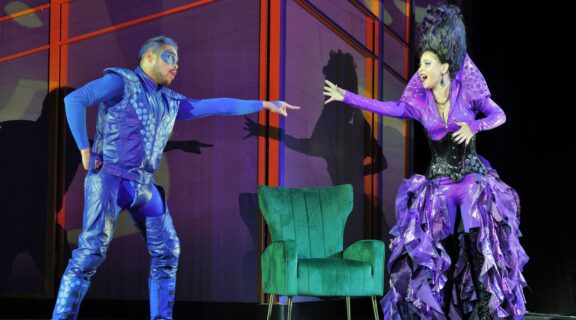
By the end of its 2012-13 season, the Met will have presented four HD transmissions in less than two years featuring countertenors in prominent roles.
Few singers today cause me as much consternation as Vivica Genaux.
The New Year’s Eve gala at the Met ushering out 2011 was the world premiere of the much-anticipated mash-up The Enchanted Island AKA “baroque opera for those who hate (or at least don’t know) baroque opera.
“Hey the line forms, on the right dear / Now that Macheath’s back in town / You’d better lock your doors, and call the law / Because Macheath’s back in town.” So concludes Marc Blitzstein’s famous English translation of the song that opens Die Dreigroschenoper.
Despite baby-steps over the years, America’s musical scene, especially opera, remains decidedly un-HIP. (HIP: “historically-informed performance,” also called “period performance.”) While European opera houses turn increasingly to “original instrument” orchestras and specialist singers for seventeenth and eighteenth century works, this rarely occurs in the US.
Other than binging on seven or eight Agatha Christie novels in seventh grade, I can’t recall ever again reading another mystery novel, or what they now call “crime fiction.” Perhaps it’s a coincidence but around that same age I attended my first opera and began subscribing to Opera News. Hence, Commissario Guido Brunetti, hero of…
As part of the massive CD/DVD release celebrating the 40th Anniversary of James Levine at the Met, “In Concert at the Met, 1982-83” offers generous excerpts from three memorable Gala Concerts: from February 1982, Troyanos-Domingo-Levine; from March 1982, Price-Horne-Levine; and from January 1983, Domingo-Milnes-Levine. I had the pleasure of being in the house for each…
Tell us: Filth or dementia?
Hasten thee to feed another quarter of conversation for The Talk of the Town!
Sign up for our free Newsletter.
Support Parterre Box
Donate to keep opera's liveliest publication free and independent. No paywalls, no institutional backing, no bootlicking.
Get our free newsletter
Opera's top reads delivered to your email weekly…ish.
Join over 100k readers.
The best opera magazine on the web.
Reviews, breaking news, critical essays, and brainrot commentary on opera from those demented enough to love it.
Essentials
Copyright © 2026 Parterre Box.
All rights reserved.
Registration or use of this site constitutes acceptance of our Terms & Conditions and our Privacy Policy. Do Not Sell or Share My Personal Information.
Sign up for Parterre’s free newsletter.
Exclusive opera reviews, commentary, and top reads
delivered to your email weekly…ish.