My impossible wish would be to hear one of the great castrati who dominated opera for most of the 18th century.
Joined by the Choir of Trinity Wall Street, The English Concert concluded the US leg of its current tour at Carnegie Hall Sunday with a complete performance of the darkly moving Theodora, Handel’s penultimate oratorio.
The internecine machinations of those who ruled—or sought to rule—the Roman Empire have long provided rich material for writers and composers, and on Thursday evening operamission continued its ambitious plan to stage in chronological order all of Handel’s operas by presenting one of the most delicious of those Roman-based works, Agrippina which premiered in Venice in 1709.
The behavioral phenomenon of limerence has been described as “an involuntary potentially inspiring state of adoration and attachment to a limerent object involving intrusive and obsessive thoughts, feelings and behaviors from euphoria to despair, contingent on perceived emotional reciprocation.”
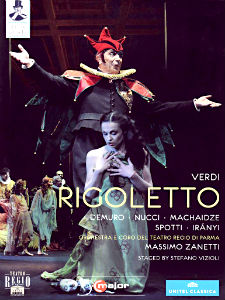
I’m happy to report that Rigoletto from the 30 DVD Tutto Verdi set from the Teatro Regio di Parma is a blockbuster.
East is West and West is East—the border ever less easy to fix.
Name a Verdi opera, based on a play by Voltaire, described in the immortal words of the composer as “Questo e proprio brutto.”
Handel’s first surviving musical composition is Almira, the opera he wrote in a hurry when shake-ups at the Hamburg opera house, where the 19-year-old had been playing in the violin section, left a planned production unfinished.
Probably no more than 100 gathered Tuesday in a curtained-off space in the lobby of NYC’s Gershwin Hotel to witness the North American premiere of Rodrigo by operamission.
For better or worse, Decca’s new Norma recording will ultimately be embraced—or dismissed—by those reacting directly to Cecilia Bartoli’s controversial portrayal.
Giulio Cesare at the Met proved an evening that added up to much more than the sum of its uneven parts.
That’s what it must have been like in 1726 London when Handel composed Alessandro for perhaps the three most famous (and expensive) singers of the day.
As if last week’s survey wasn’t enough, a few more recent diva-recital disks remain worthy of attention particularly since they arrive from five front-rank singers.
If you’re the sort who prefers his diva to be an unapproachable sphinx prone to infuriating cancellations while radiating ennui, I suspect that the sunny, hard-working, grateful persona of American mezzo soprano Joyce DiDonato will not appeal to you at all.
Reflecting my new mantra — “and would have gone on longer, had he not died” – here is The Curate’s Egg edition of the Saturday breakdown.
Sneaking in under the wire during the final week of May were two highpoints of New York’s opera season: the Cleveland Orchestra’s Salome with a stunning Nina Stemme and operamission’s revelatory US stage premiere of a complete edition of Handel’s first opera Almira.
Orlando is the first of three Händel operas based Orlando Furioso, Ariosto’s 15th-century adaptation of the 12-century poem, Chanson de Roland, the other two operas being Alcina and Ariodante. This epic tale of heroism, love, reason and madness also served as the basis for operas by Lully, Vivaldi, Haydn and Scarlatti. In fact, Händel based…
Joyce DiDonato enjoys the rare cachet of having three studio-recorded operas released in the past three years while other famous divas must be content with “just” DVDs. Although two of Renée Fleming’s Violettas have found their way onto video in less than five years (why??), “the people’s diva” has only recorded one studio opera in…
Despite baby-steps over the years, America’s musical scene, especially opera, remains decidedly un-HIP. (HIP: “historically-informed performance,” also called “period performance.”) While European opera houses turn increasingly to “original instrument” orchestras and specialist singers for seventeenth and eighteenth century works, this rarely occurs in the US.
This mostly wonderful performance of Handel’s Theodora opened the 2009 Salzburg Festival in honor of the 250th anniversary of the composer’s death. Written at the beginning of the last decade of the composer’s life, it was a work that he held in very high regard even though he knew its subject matter would not excite. Only…
Other than binging on seven or eight Agatha Christie novels in seventh grade, I can’t recall ever again reading another mystery novel, or what they now call “crime fiction.” Perhaps it’s a coincidence but around that same age I attended my first opera and began subscribing to Opera News. Hence, Commissario Guido Brunetti, hero of…
This Cleofide must have been conceived as a perfect target for haters of Italian baroque opera. While many might (grudgingly?) acknowledge that Handel is indeed an important operatic composer, here we have a virtually unknown name often relegated to dusty music history books. Not only has no one ever heard (nor probably even heard of)…
Simpler can be better, as Pocket Opera of New York demonstrated in the back of the Bechstein Showroom on Wednesday evening for their double bill of Ravel’s L’enfant et les sortilèges and Debussy’s La chute de la maison Usher. When I heard these operas would be presented in English with piano accompaniment, I was initially…
Tell us: Filth or dementia?
Hasten thee to feed another quarter of conversation for The Talk of the Town!
Sign up for our free Newsletter.
Support Parterre Box
Donate to keep opera's liveliest publication free and independent. No paywalls, no institutional backing, no bootlicking.
Get our free newsletter
Opera's top reads delivered to your email weekly…ish.
Join over 100k readers.
The best opera magazine on the web.
Reviews, breaking news, critical essays, and brainrot commentary on opera from those demented enough to love it.
Essentials
Copyright © 2026 Parterre Box.
All rights reserved.
Registration or use of this site constitutes acceptance of our Terms & Conditions and our Privacy Policy. Do Not Sell or Share My Personal Information.
Sign up for Parterre’s free newsletter.
Exclusive opera reviews, commentary, and top reads
delivered to your email weekly…ish.