
Unmoored
Little Opera Theater of New York attempts to breath life into Wuthering Heights but ultimately loses the fight to Carlisle Floyd’s uninspiring libretto and score.
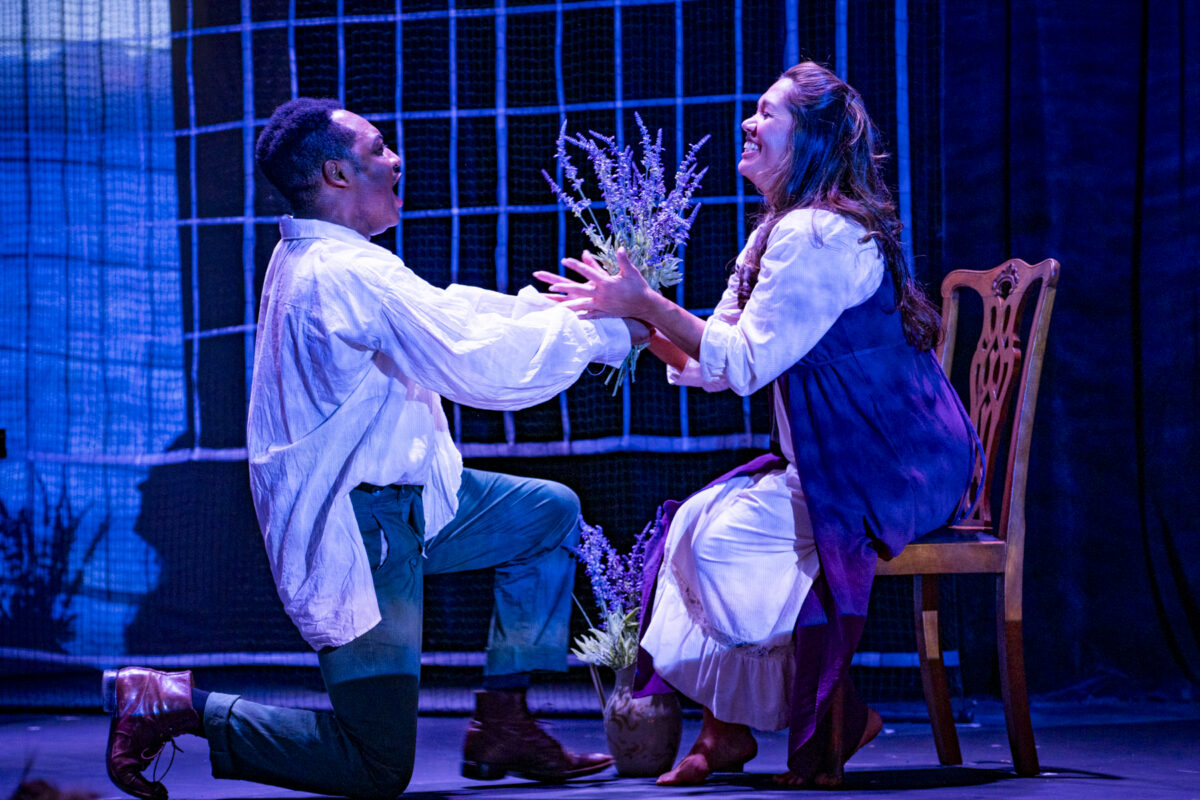
Photo: Russ Rowland
This year, the late Carlisle Floyd is celebrating his centenary, and various celebrations have been planned throughout the U.S. to commemorate the event. Little Opera Theater of New York has produced two of his one-act operas: Slow Dusk and Markheim in 2014. In 2017, LOTNY staged the premiere of his last opera, Prince of Players (based on the novel Stage Beauty). Artistic Director Philip Schneidman clearly champions Floyd’s work.
Their contribution for the centenary was to revive Floyd’s Wuthering Heights, which premiered at Santa Fe Opera in 1958 and then came to New York City Opera the following year. The opera—especially the third act—was heavily revised in 1959 for New York. Phyllis Curtin, a Floyd muse, sang Cathy in both productions. Floyd crafted his own efficient libretto that focused on the first half of Emily Brontë’s 1847 novel, following the example of the 1939 William Wyler-directed film adaptation. The libretto, while not digging very deep, uses dialogue from the Brontë novel wherever possible and follows the guidelines of the 1939 screenplay by John Huston, Charles MacArthur, and Ben Hecht.
The music, however, needs to deepen and expand the story and characters while providing atmosphere. Floyd fails here. The orchestration has a typical open Americana sound with major tonal chords that fail to capture the wild moors, the clouds, rain, or anything English. Occasionally, there are punctuating chords to suggest something dramatic has occurred, like in a 1950’s radio play or television soap opera soundtrack. The vocal lines tease at melody and attempt arias but often fall into sing-song tuneless declamation. Nothing is inept but nothing is inspiring (or inspired), and thus the story turns into a soap opera with interconnected romantic triangles. The depth and passion of Brontë’s novel are MIA. The first two acts drag on for over 90 minutes without intermission. The third act is shorter but ends abruptly with the death of Cathy and Heathcliff’s despair. A prologue framing device is abandoned after the first scene.
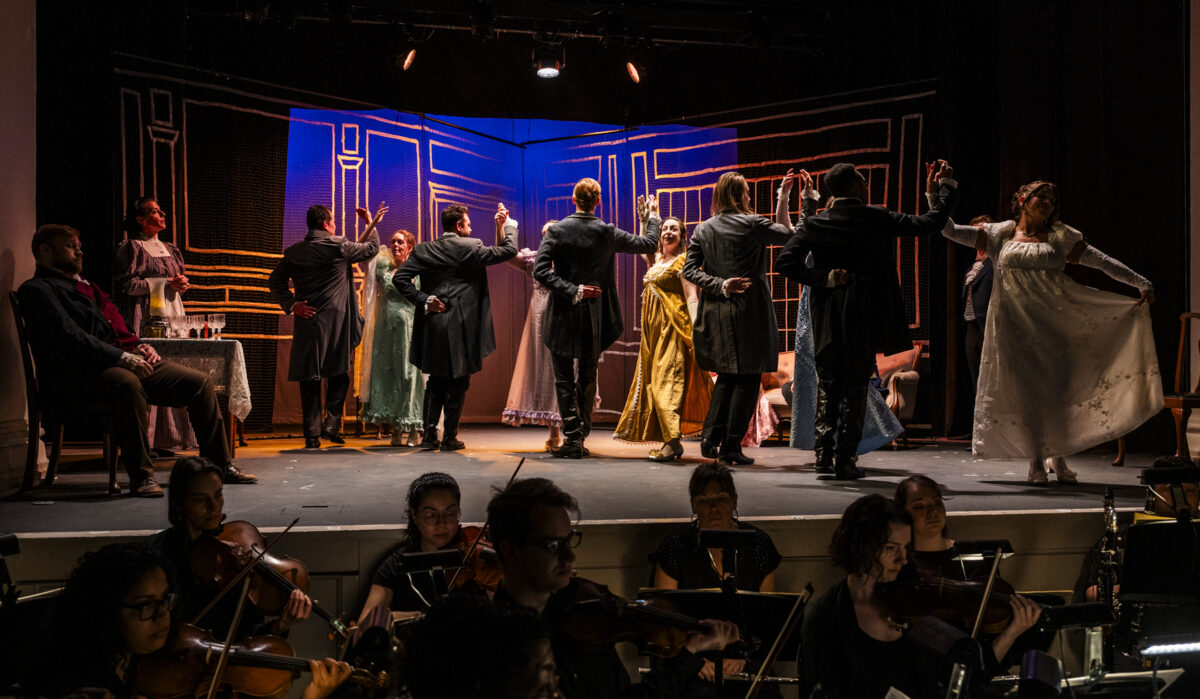
Photo: Russ Rowland
Philip Shneidman‘s simplified staging aimed for clarity with minimal resources. The unit set by Claire Karoff was a skeletal drop representation of a late eighteenth- or early nineteenth-century drawing room with windows and a fireplace. Projections of cloud-swept moors on the walls of the theater around the proscenium (by Alex Basco Koch and Stephanie Beattie) added some needed atmosphere and gave a view of nature and the outdoors, so dear to these lovers that was otherwise absent visually and aurally.
Orchestra sounded impressively in tune and coordinated under Richard Cordova, who ably led a more than decent cohort of musicians. Nevertheless, there were balance problems, as the Loreto Theater at The Sheen Center for Thought & Culture is a small hall that has the orchestra playing on the unraked audience level—voices were too often covered, especially in concerted pieces, and the horns could overwhelm the other sections.
There were two casts, both with decent voices, though a few more so than others. But English diction was not always optimal, and there were no surtitles. The opening night cast had lusher, more glamorous voices but fuzzier diction. Standouts included the young Yale-trained lyric tenor Charles Styles as Edgar Linton; Janara Kellermann’s anguished, severe Nelly; and Vanessa Isiguen’s rich-voiced Puccinian Cathy. Markel Reed sang handsomely as Heathcliff but lacked danger in his stage presence. Styles gained an ovation for his sweet-toned rendition of Edgar’s proposal aria.
The second cast was marked by a major indisposition on Sunday: Sara Kennedy (Cathy) had both an ankle injury and was sick. She sang the talky, mid-range parts of the score while the second cover, Alexandra Wiebe, seated stage right, pitched in with the higher-ranging, sustained vocal sections to relieve her. I will praise Ms. Kennedy’s diction and poised, focused acting while reserving comment on her vocalism which had no mishaps. She lip-synced in a fashion worthy of a RuPaul’s Drag Race contestant in her ventriloquist dummy moments. Wayne Hu’s chiseled torso had more definition than his rather retiring stage manner and attractive but soft-edged baritone as the alternate Heathcliff. Veteran Margaret Lattimore was a more maternal Nelly with a warmly sympathetic mezzo-soprano. Both Isabella Linton sopranos sang well, but second cast Teresa Castillo had clearer diction than the vocally gifted Elizabeth Novella (both are Teatro Nuovo prima donnas) who was lovely sounding and looking but incomprehensible. Tenor Spencer Hamlin as Hindley was also clearer textually than his strong-voiced alternate.
Wuthering Heights has been largely absent from the stage since the City Opera production over 66 years ago. Unlike the ill-fated Bernard Herrmann Wuthering Heights adaptation, Floyd saw a few staged productions in his lifetime. Little Opera Theater of New York did a valiant job in bringing the work back—but the life pulse needed to be provided by the late composer-librettist, and therefore this attempt at resuscitation ultimately failed.
-
Topics: carlisle floyd, Review
-
People: Alex Basco Koch, Alexandra Wiebe, Charles Styles, Claire Karoff, Elizabeth Novella, Janara Kellermann, Margaret Lattimore, Markel Reed, Philip Schneidman, Richard Cordova, Sara Kennedy, Spencer Hamlin, Stephanie Beattie, Teresa Castillo, Vanessa Isiguen, Wayne Hu
-
Works: Wuthering Heights
-
Places & Organizations: Little Opera Theater of New York



Comments