
Candide yams
Los Angeles Opera mounts a delectable revival of Candide, anchored by stars Patti LuPone and Scott Bakula.
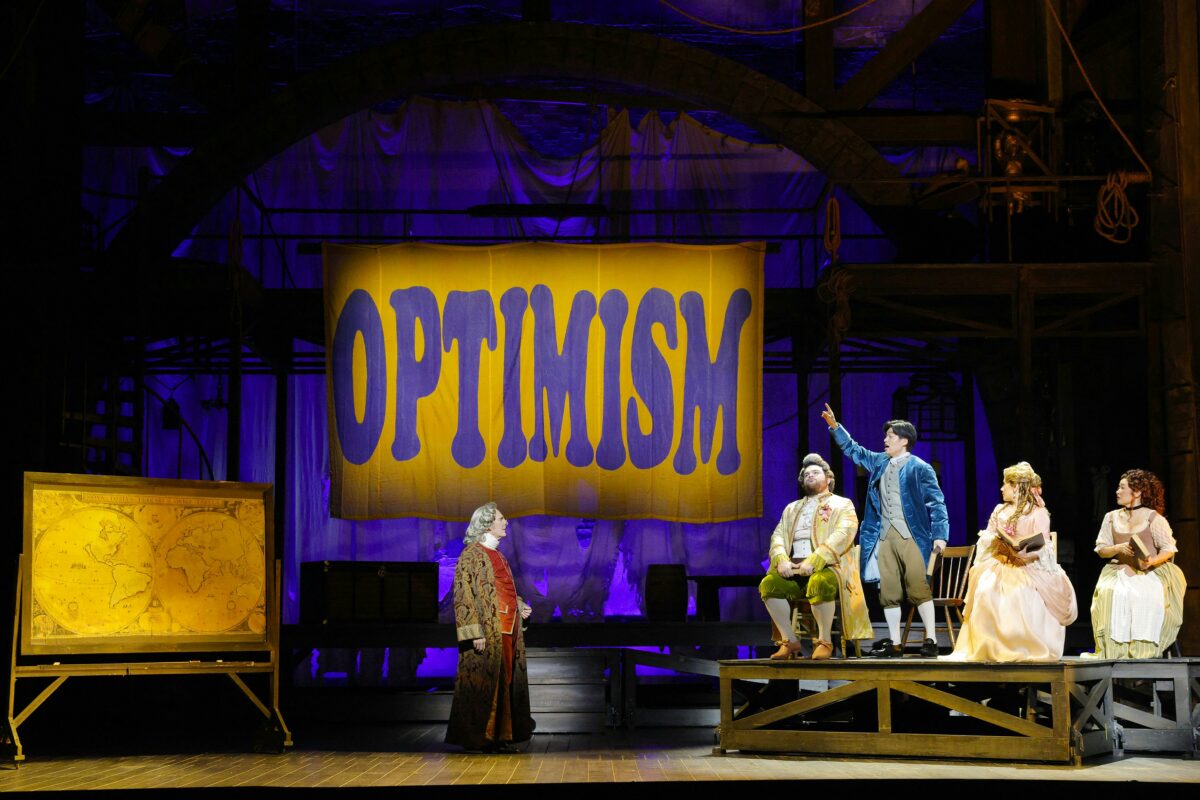
Scott Bakula (Pangloss), Mario Manzo (Maximilian), Duke Kim (Candide), Meghan Picerno (Cunegonde) and Kristen Choi (Paquette) in LA Operas 2026 production of Candide. (Photo: Cory Weaver)
We are often told to “keep spirits up” when times get rough, and the world grows uglier. Nevertheless, excessive optimism carries an inherent danger, as cautioned in Leonard Bernstein’s operetta Candide, which enjoyed a sparkling revival at Dorothy Chandler Pavilion on Saturday, November 21, performed by the Los Angeles Opera (LAO).
Based on Voltaire’s 1759 satire of the same name, Candide’s libretto was originally written by Lillian Hellman, with lyrics by Richard Wilbur. The work has had a history as tumultuous as the title role’s adventures since its disastrous Broadway opening in December 1956. Confusion over whether it was an opera, an operetta, or a musical certainly didn’t help. The first Broadway revival in 1973 replaced the book with Hugh Wheeler’s one-act version and omitted many of the numbers, creating the so-called “Chelsea version,” directed by Harold Prince. Prince was also responsible for the expanded two-act “opera house version,” which premiered with New York City Opera in 1982. Even Bernstein himself, in 1988 (two years before his death), couldn’t resist revisiting Candide and created the “final revised version,” which he recorded for Deutsche Grammophon, with Jerry Hadley as Candide and June Anderson as Cunegonde. In 1999, the Royal National Theatre produced Candide in a new version by John Caird, which became the basis for the LAO production. Credits for this production indicated this colorful history: “Book adapted from Voltaire by Hugh Wheeler, in a new version by John Caird. Lyrics by Richard Wilbur. Additional lyrics by Stephen Sondheim, John La Touche, Lillian Hellman, Dorothy Parker and Leonard Bernstein.”
Francesca Zambello’s production of Candide is a co-production of the Glimmerglass Festival, Opéra National de Bordeaux, and Théâtre du Capitole de Toulouse. It premiered at the Glimmerglass Festival in 2015 and traveled to LAO in 2018, in time for Bernstein’s centenary. LAO’s then Music Director James Conlon conducted the performance, starring Jack Swanson as Candide and Erin Morley as Cunegonde, with Kelsey Grammer adding a touch of Hollywood glamour in the dual role of Voltaire/Pangloss. This time around, the main selling points were celebrities Patti LuPone and Scott Bakula, whose images were plastered all over Los Angeles as the Old Lady and Voltaire/Pangloss, respectively.
I didn’t see Zambello’s 2018 run. Seeing it fresh, I found the staging refreshing and staying close to Prince’s original ideas. The whole thing was a play within a play, with Voltaire narrating Candide‘s story as the action unfolded, making it feel like a figment of his imagination. James Noone’s proscenium set of an unfurnished theater suggested Voltaire’s creative process, with props brought in and out to tell the story. Candide is notoriously hard to stage (because of the volatile nature of the title role’s adventures), and framing it as Voltaire’s imagination helped soften many thorny aspects of the narrative, while keeping the action moving without requiring many scene changes. Bakula was a great asset here, as his extensive theater (and TV) experience gave the characterizations of both characters great depth. It was astonishing to see how the 72-year-young actor so easily assumed these two polarizing roles (after all, Pangloss was an alter ego for Leibniz, whose optimism was lampooned by Voltaire in Candide), particularly in the super entertaining “Dear Boy” soliloquy in Act 1.
There was much to recommend in Zambello’s treatment of the score, most notably in emphasizing the comic-romp nature of the whole story. Candide can easily bog down under the weight of the heavy realizations of the catastrophes referenced in the piece, such as the Seven Years’ War and the 1755 Lisbon earthquake. The decision to stage the problematic Auto-da-fé as a straight-up musical-theater-style number made a lot of sense, and in this scene, Associate Director and choreographer Eric Sean Fogel’s contribution truly shone, keeping the momentum going and smoothing the lyrics’ rough edges. Fogel’s gorgeous choreography was on full display in the Old Lady’s number “I am easily assimilated,” which LuPone performed with glee, even joining in a bit of the tango. LuPone was well known for participating in the star-studded 2004 New York Philharmonic concert in the same role, and more than two decades later, her brand of acerbic wit still dominated the character – more appropriately this time, methinks – even if she mellowed out vocally.
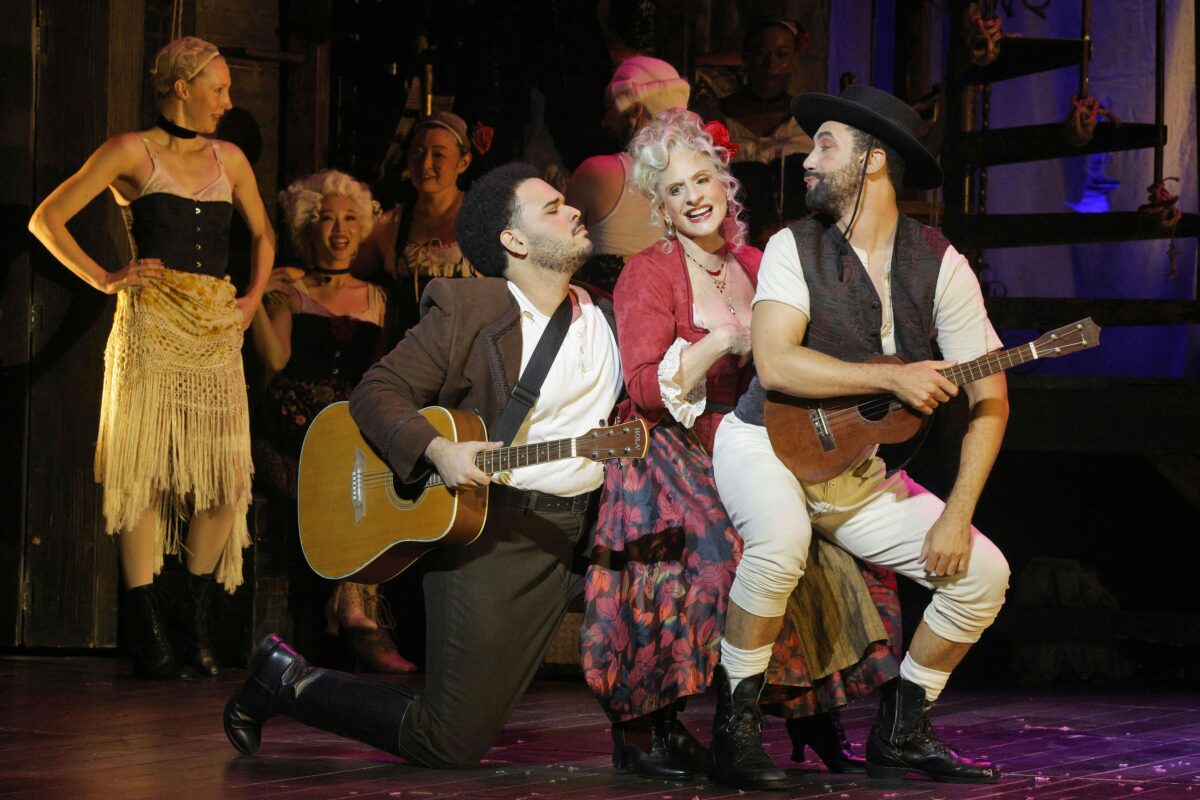
Patti LuPone as the Old Lady, with Samuel Wallace (left) and Nicholas LaGesse (right) as the Two Señores, in LA Opera’s 2026 production of Candide. (Photo: Cory Weaver)
The production employed a 12-person “Principal Ensemble” (Erin Alford, Andrea Beasom, Julia Harnett, Jawan Jenkins, Joanna Kim, Nicholas LaGesse, Gibran Mahmud, Madison Manning, Peter Murphy, Elliot Peterson, David Prottas and Alicia Russell Tagert) to liven up the story, many of whom have Broadway credentials (some also appeared in last season’s West Side Story. They sang and danced very well together, giving the show the feel of a well-oiled touring company rather than a one-off production, even on opening night. Costume designer Jennifer Moeller and revival lighting designer A.J. Guban rounded out the creative team with their colorful, place-specific costumes and storybook lighting. Special kudos to sound designer Andrew Harper, who solved the near-constant amplification issues in the opera house and delivered balanced sound across the dialogue, singing, and orchestra.
Resident Conductor Lina Gonzáles-Granados led the LAO Orchestra in a spirited reading of Bernstein’s charming score to match Zambello’s fast-moving production. After a slight mishap at the beginning of the Overture, Gonzáles-Granados injected vigor into her reading while remaining sensitive to the singers. She conducted Bernstein’s kaleidoscopic score with aplomb, showcasing its full range of musical styles and colors. She was particularly effective at bringing out the music’s lyricism; the accompaniment for “Candide’s Lament,” and especially “Nothing More Than This” in Act 2, was marked by remarkable tenderness, which greatly helped Duke Kim in the title role.
Returning from singing Tony in West Side Story last year, Kim imbued the bright-eyed character with youthful innocence and naivety, and he fit the role like a glove, even more so than his Tony. He floated gorgeous high notes in the two songs mentioned above, and I felt he enunciated the English words much better this time. Acting-wise, he performed the highly physical role without reservation, whether in the fighting, dancing, or even being flogged. He also established a good rapport with Meghan Picerno as his materialistic lover, Cunegonde. Replacing the originally announced Deanna Breiwick, Picerno was no stranger to the role. Her first musical theater crossover was performing Cunegonde in New York City Opera’s 2017 Prince mounting, before Prince cast her in the US premiere of Andrew Lloyd Webber‘s Love Never Dies (and her subsequent Broadway debut in its predecessor, The Phantom of the Opera). Her familiarity with the score allowed her to fully embody the role, which she delivered with great comic timing. On Saturday, her top notes sounded metallic at times; nevertheless, her “Glitter and Be Gay” number brought the house down.
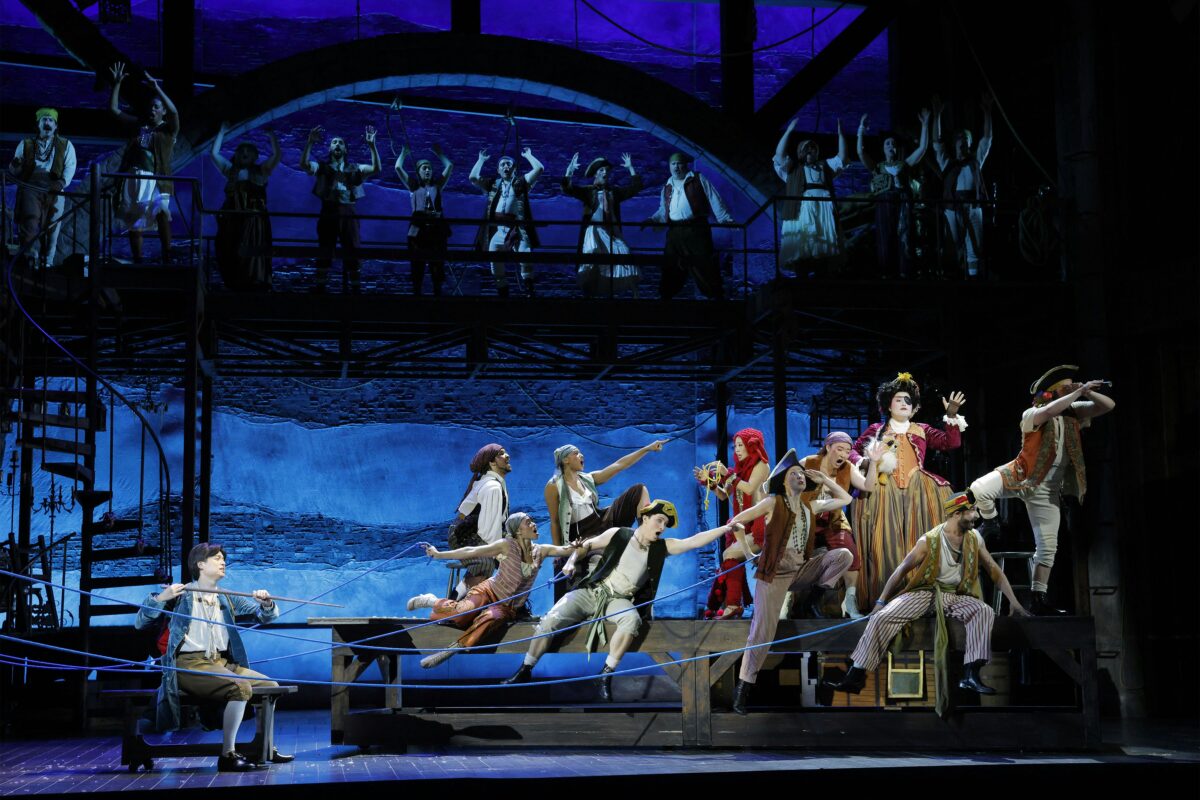
Duke Kim (left) as Candide and Katie Trigg (right, with eyepatch) as Vanderdendur in LA Opera’s 2026 production of Candide. (Photo: Cory Weaver)
Kristen Choi completed a full circle by performing the saucy servant girl Paquette, having originated the role at Glimmerglass and in Toulouse and Bordeaux. Four current members of the Domingo-Colburn-Stein Young Artist Program graced the smaller roles handsomely. Mario Manzo brought much laughter in his flamboyant take on Maximilian, Cunegonde’s brother, while Samuel Wallace demonstrated friendship and loyalty – in Samwise Gamgee’s style – as Cacombo. With his booming voice, Vinícius Costa made the most of his “Words, Words, Words” number in the dual roles of James the Anabaptist and Martin, while Katie Trigg had a lot of fun playing the conniving slave trader Vanderdendur (and also Baroness). Debuting tenor Bernard Holcomb rounded out the principal cast as the Baron, Don Issachar, and the Governor.
There was so much joy and laughter from the audience watching this show. In a world that is increasingly depressing, the best we can do is go out and “make our garden grow,” so the message of this charming production is timely and relevant to the time we live in. Any questions?
-
People: A.J. Guban, Alicia Russell Tagert, Andrea Beasom, Andrew Harper, Bernard Holcomb, David Prottas, Deanna Breiwick, Duke Kim, Elliot Peterson, Eric Sean Fogel, Erin Alford, Francesca Zambello, Gibran Mahmud, James Noone, Jawan Jenkins, Jennifer Moeller, Joanna Kim, Julia Harnett, Katie Trigg, Kristen Choi, Lina Gonzáles-Granados, Madison Manning, Mario Manzo, Meghan Picerno, Nicholas LaGesse, Patti LuPone, Peter Murphy, Samuel Wallace, Scott Bakula, Vinícius Costa
-
Works: Candide
-
Places & Organizations: Los Angeles Opera

Comments