
Tossing the toga
William Kentridge‘s symbolically-dense L’Orfeo at the Greek National Opera does not look back.
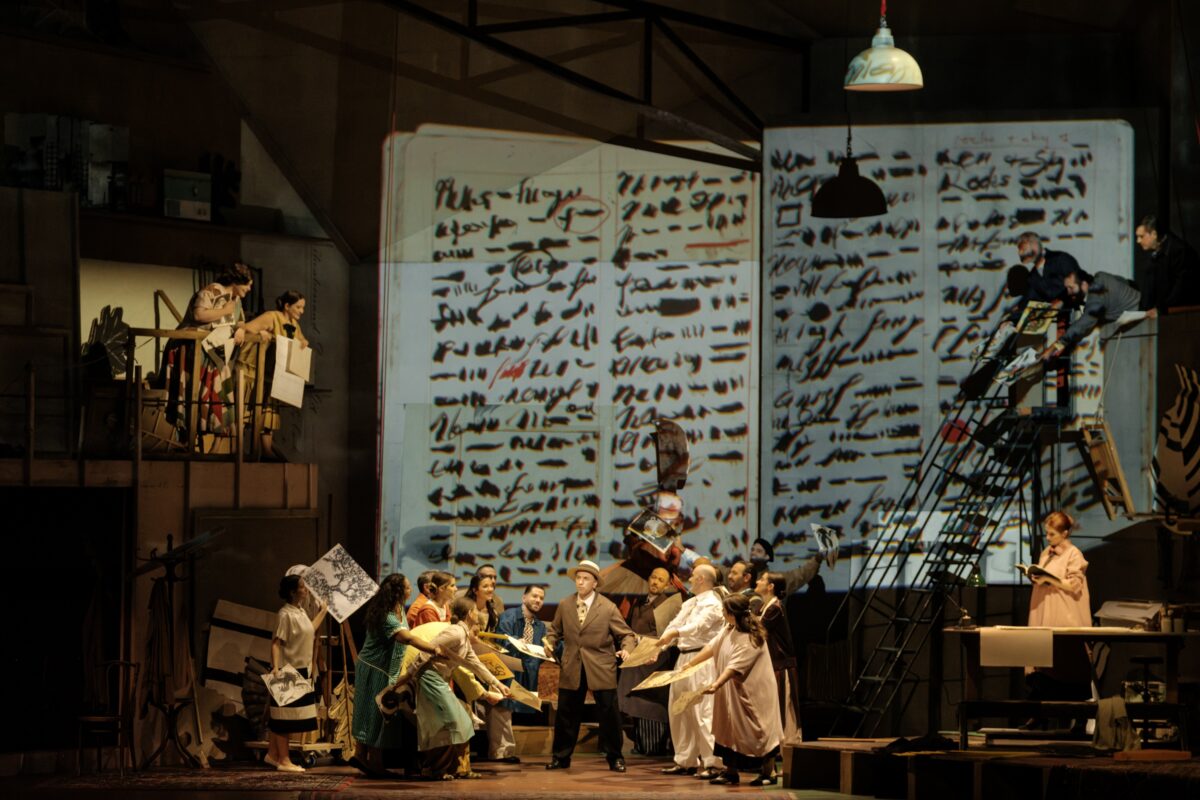
Photo: G. Antonoglou
For the first time in the Greek National Opera’s 87-year history, Monteverdi’s L’Orfeo has entered the company’s repertoire. While the foundational opera and its mythological basis appear as a natural fit for the Greek company, the South African director William Kentridge’s aggressively subtextual production feels decidedly less intuitive. The internationally focused GNO is trying to fix that.
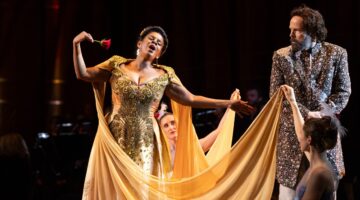
Kentridge’s production premiered earlier this year at the Glyndebourne Festival, where L’Orfeo was also performed for the first time in the British festival’s history. What Glyndebourne lacks, however, is the historical baggage an antiquity-laden opera such as L’Orfeo brings to the GNO. Purists might clutch their pearls that Nico Muhly’s modern orchestral arrangement of Monteverdi’s score and the South African artist’s gestural aesthetic do not channel the “unbroken” spirit of ancient Greek drama here in Athens. But tossing the toga aside is also the production’s greatest strength. Through Sabine Theunissen’s set design, modeled on early twentieth-century Johannesburg art studio, and a fast-paced video design by Janus Fouché, this production is fundamentally anti-nostalgic. Antiquity exists here only in spectral form among the rotating images of Grecian urns painted over loose encyclopedia sheets and other found ephemera straight from Kentridge’s new solo exhibition in Athens, Imitate the Sleep of Stones.
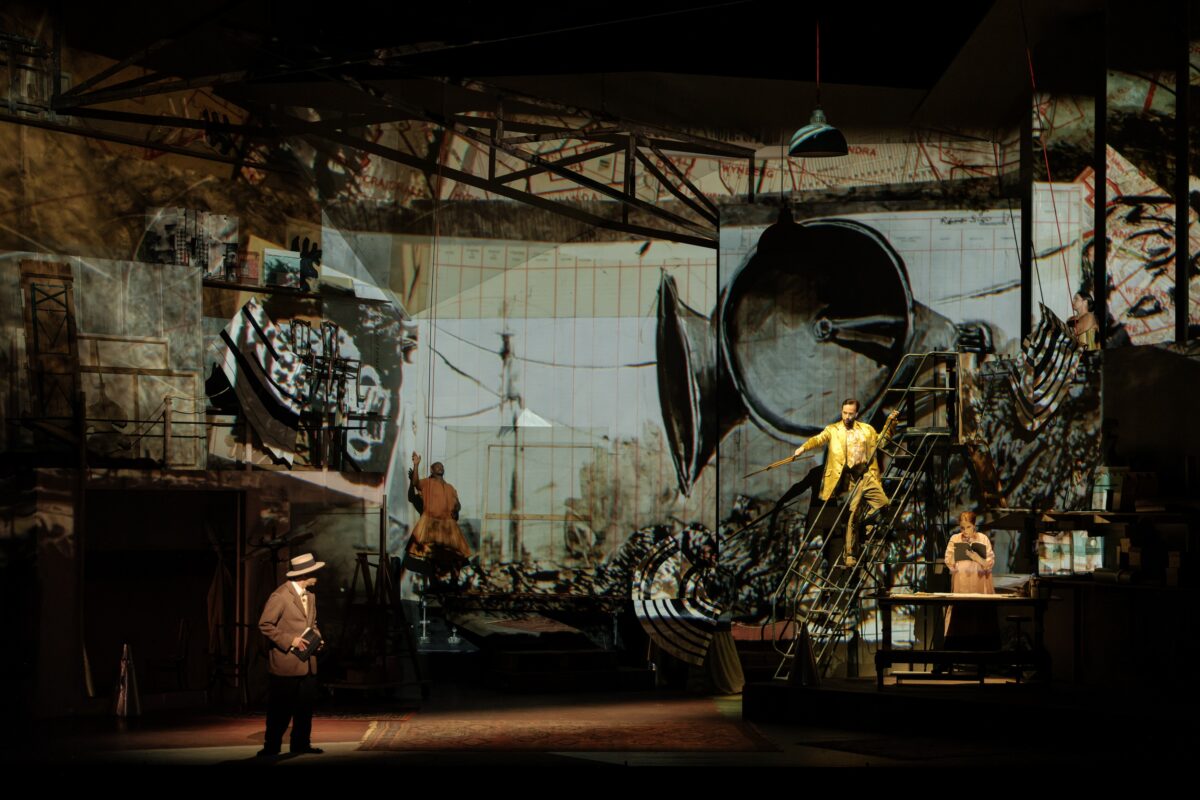
Photo: G. Antonoglou
The volume of detail is so hermeneutically rich in this production that it begins to draw attention to its own mechanics. Some elements such as portrayal of La Musica (Maria Kostraki) as an artist in her workshop and the substitution of Orfeo’s (Christos Kechris) lyre with a sketchbook are intriguing. As the music wears on, we might ask why Orfeo turns to spin a chair in the middle of act two for a moment. Or why shortly after, one of the unnamed featured dancers, performed by Albert Fana Tshabalala, repeatedly squats alone in the back of the production while holding what appears to be a cardboard cutout of a knife. Or we might not because these stage features become so overwhelming that contemplating the symbolic meaning of all the movement, gestures, and shifting figures in the video design begins to feel like a chore. By the time we hear the messenger’s aria “Ma io, ch’in questa lingua,” we can connect Tshabalala’s knife to the aria’s text, but the sheer force of subtext is desensitizing. As a spectator you can almost envision Kentridge and his associate director Luc de Wit coaching the cast on how to hit their marks.
For all that, there are some truly haunting moments that speak to contemporary Greek politics of loss, grief, and trauma. Vocally, the canonical account of Eurydice’s death by snakebite is reinforced, but visually the staging frames her death as the result of a train crash. On screen, minutiae flash across—financial papers for “Locomotive Running Charges,” damaged Greek sculptures, and a train—as the stage plunges down into the underworld. Here in Greece, train imagery immediately recalls the Tempi train disaster where 57 people were killed in February 2023 after two trains collided head-on in northern Greece. I found myself thinking less about romantic devotion in L’Orfeo, which, admittedly is not really a love story as told by Monteverdi and his librettist Alessandro Striggio since very little music is devoted to developing the bond between Orfeo and Eurydice, and more about sudden, senseless loss. The tragedy in Tempi is largely thought to have been preventable, yet it occurred, in the view of much of the Greek public, due to bureaucratic incompetence and decaying infrastructure. But just as fast as this subtext occurs, it’s over, and the resonances between the production and the national trauma of the Tempi disaster do not appear again after.
If as Kentridge says, L’Orfeo is about “the fear of death, the inescapability of death, and the absolute desire we have to undo, to unhappen a calamity that has happened,” it’s difficult to spot that in this staging. Eurydice haunts the production predominantly as a voiceless dancer (Nosiphiwo Samente), while her sporadic vocal lines are sung by soprano Maria Kostraki (who also doubles as La Musica and Eco). The great “intervention” occurs when we at long last reach the finale. Samente remains onstage after Orfeo ascends with his father Apollo to the heavens. As the now-dead Eurydice she delivers an elegiac dance until finally letting out a large grunt as the lights go out. Perhaps this is one last try to recuperate Eurydice’s voicelessness in Monteverdi’s original score, but it’s one last allusive call for interpretation in what is already a highly symbolic production.
The conductor Konstantinos Terzakis led a solid, well-paced account of the score, although at times the unsteady brass section diminished the overall orchestral sound. The Greek tenor Christos Kechris (Orfeo) powered through the act three aria “Possente spirto” with an impressive stamina, however, his Puccini-ready vibrato would not please early music enthusiasts. Although he held small supporting roles, the countertenor Angelo Kydoniefs surpassed all expectations of the “third shepherd” and “spirit” with a crisp, penetrating voice that left me wishing he had more to sing. Whatever my reservations about Kentridge’s L’Orfeo, I respect the GNO’s willingness to seek out more experimental stagings instead of remaining a repository for operatic antiques.
-
Topics: Review
-
People: Albert Fana Tshabalala, Angelo Kydoniefs, Christos Kechris, Janus Fouché, Konstantinos Terzakis, Luc de Wit, Maria Kostraki, Nosiphiwo Samente, Sabine Theunissen, William Kentridge
-
Works: L'Orfeo (Monteverdi)
-
Places & Organizations: Greek National Opera
Comments