
HIPs and tits
William Christie and Paul Agnew lead Les Arts Florissants in a program of Monteverdi’s horniest madrigals.
 By
Dan Johnson
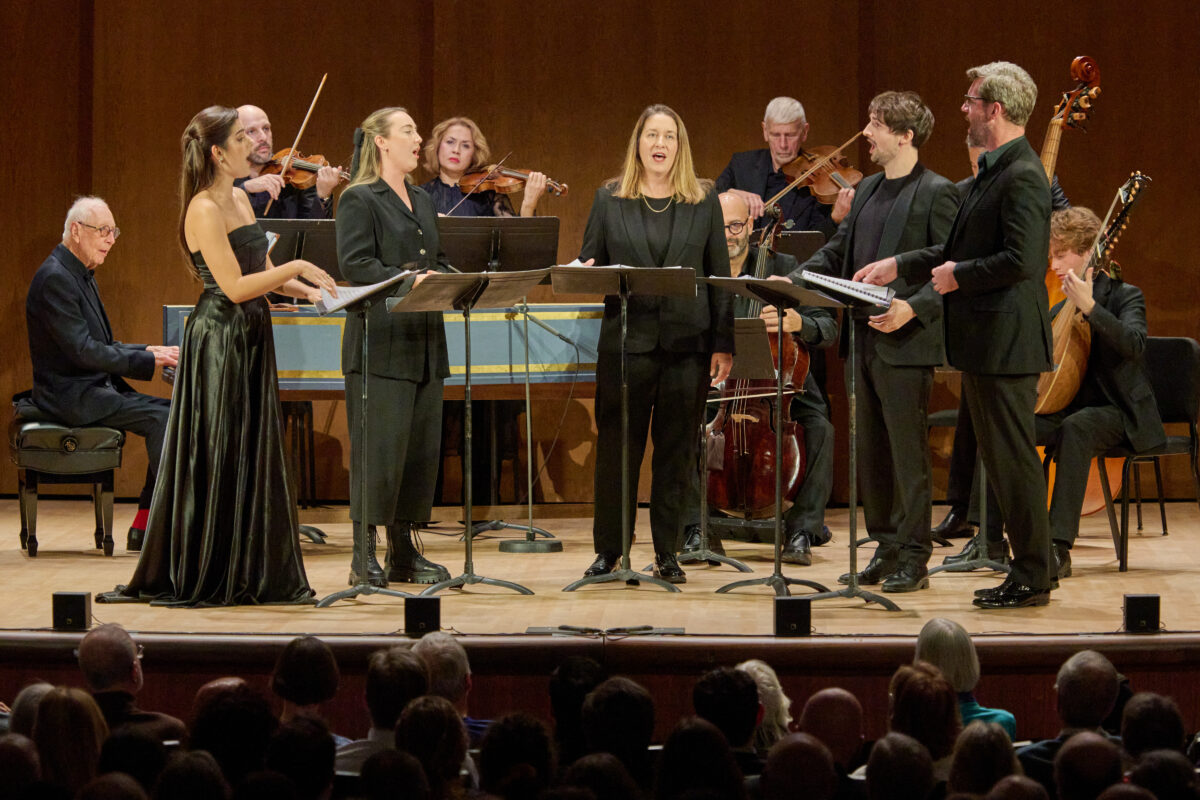
Photo: Joe Sinnott
Too bad “early music” used to have such a reputation for aloof and arid intellectualism, when the Monteverdian madrigal is perhaps the horniest body of repertoire in the Western classical tradition. The sighing resolution of dissonances, the intimate interplay of voices, the word-painting of Petrarchan texts of love and desire—it all drips with desire.
Thank God this repertoire has champions like William Christie and his merry band, Les Arts Florissants, whose interpretations of music from the era have always aimed at maximal lusciousness of sound, and who gave Wednesday night’s audience at the 92nd Street Y a sexy survey of Monteverdi’s evolving approach to the madrigal form.
While the word “madrigal” tends to evoke an a cappella setting, for a handful of singers, of a Petrarchan lyric, Monteverdi’s late forays into the form more closely resemble his operas, with extensive vocal solos, obbligato instrumental parts, and narrative texts, and it was with one of these late madrigals, Volgendo il ciel from Book 8, that the recital began.
The band, led as usual by Christie from the harpsichord, fiddled their dance rhythms with hoedown-y zest and flawless ensemble, while tenor soloist Bastien Rimondi gave the opening solo with bright, supple voice and pleasingly over-the-top stage presence. The rest of the vocalists fairly sprang from their seats to make their entrance, their well-matched voices racing around Monteverdi’s melismas with a refreshing combination of energy and accuracy.
Even clearer in the next two, much earlier madrigals on the program—Baci soavi e cari and Ecco mormorar l’onde from Books 1 and 2, respectively—was the ensemble’s delicate attention to phrasing. Tenor Paul Agnew, co-credited with Christie as music director for the evening, cued the a cappella performance of these two numbers with glances, breaths and shakes of the head.
Agnew is a very important musician to me, personally—maybe even more important to me than William Christie—by virtue of his deeply sensitive, yet simply sung recordings of oratorios, lute songs, and the like. And yes, a few decades into my membership in the Paul Agnew fan club, his never-exactly-Verdi-sized instrument may have thinned out a bit in the middle, but his deliciously detailed interpretations of these madrigals showed that his musicianship remains undimmed.
The ladies took the lead in the next two madrigals, soprano Ana Vieira Leite and mezzo Rebecca Leggett embodying the text of Book 7’s Chiome d’oro, bel tesoro, more vividly than I had any right to hope, singing about a “shining,” “laughing” beloved in shining, laughing tones, and with an intimate intertwining of lines that frankly kicked the Lakmé Flower Duet’s ass and left it groaning in a ditch.
Next came one of Monteverdi’s best-loved numbers, the Lamento della Ninfa from Book 8. I heard somewhere that when actors have to cry on command, sometimes they’ll think about trying not to cry, and the act of holding in their emotions pushes them over the edge; I couldn’t help but think of this when I heard Leite’s Ninfa, which gained incredible power from restraint. She sang some of the madrigal’s bitterest lines with the lightest tone and least vibrato, as if numb from heartbreak.
Two more a cappella madrigals followed, from Book 4: Sfogava con le stelle, and one of Monteverdi’s very horniest works, Si ch’io vorrei morire, whose text is 100% tits and tongue and getting off. And by golly, they sold it—when Agnew and Rimondi sighed together about “questo bianco seno,” they looked as if they were about to fall into each other’s arms, and the quintet shaped the climax of the piece into the musical money shot the score frankly demands.
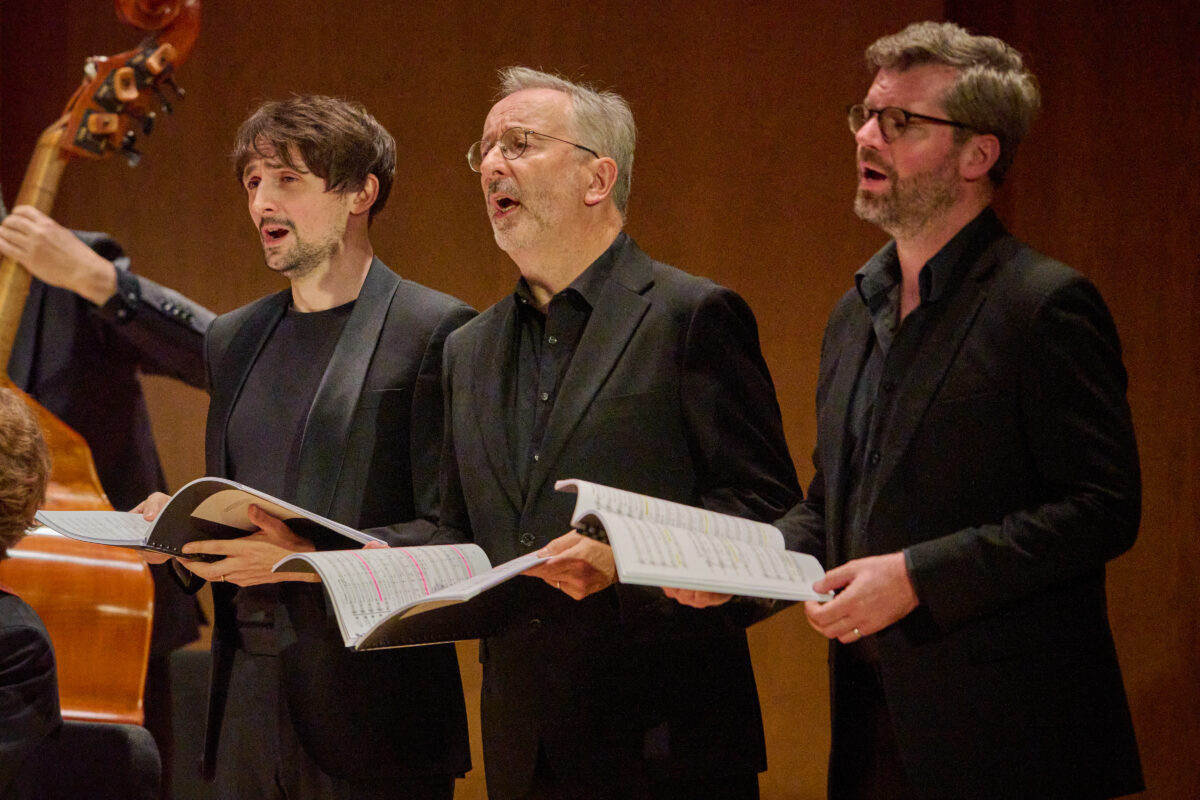
Photo: Joe Sinnott
The last number the intermission was book 8’s A quest’olmo, a quest’ombre, which finally gave bass-baritone Edward Grint his chance to show off his low range. It was steady and fine, but Monteverdi’s writing is so charming in those exposed passages that I wished he could’ve unleashed one of those massive choral bass freak voices that lays down bone-rattling low notes way out of proportion to everybody else’s instruments.
Throughout the evening it was clear that Les Arts Florissants’ dedication to music drama is not limited to their gorgeous stage productions. There were no sets, no costumes—the only flash of color amidst the uniform black was Christie’s crimson socks—but Il Combattimento di Tancredi e Clorinda, from Book 8, was almost semi-staged according to the composer’s instructions. Though not actually masked or armored, the two unwitting lovers (Rimondi and Leggett) faced off against each other in battle, even from opposite ends of the stage, while Agnew narrated between them.
The extensive solo tenor writing gave me ample opportunity to survey the strengths and aforementioned weakness’s of Agnew’s voice—if thin in the middle, still lovely in its high range, and with a pleasant warmth throughout—but the overwhelming impression I came away with was the dramatic effectiveness of the performance. While the band made each brutal sword-blow palpable to the audience, I kept forgetting to take notes and just stared, transfixed, to watch the narrator catch the mortally wounded Clorinda and gently helped her to her knees.
An instrumental Passacaglia by Biagio Marini, not listed in the program, carried on the extraordinary playing from the band, before the soprano and mezzo returned with another sexy duet, Ohimè, dov’è il mio ben from Book 7.
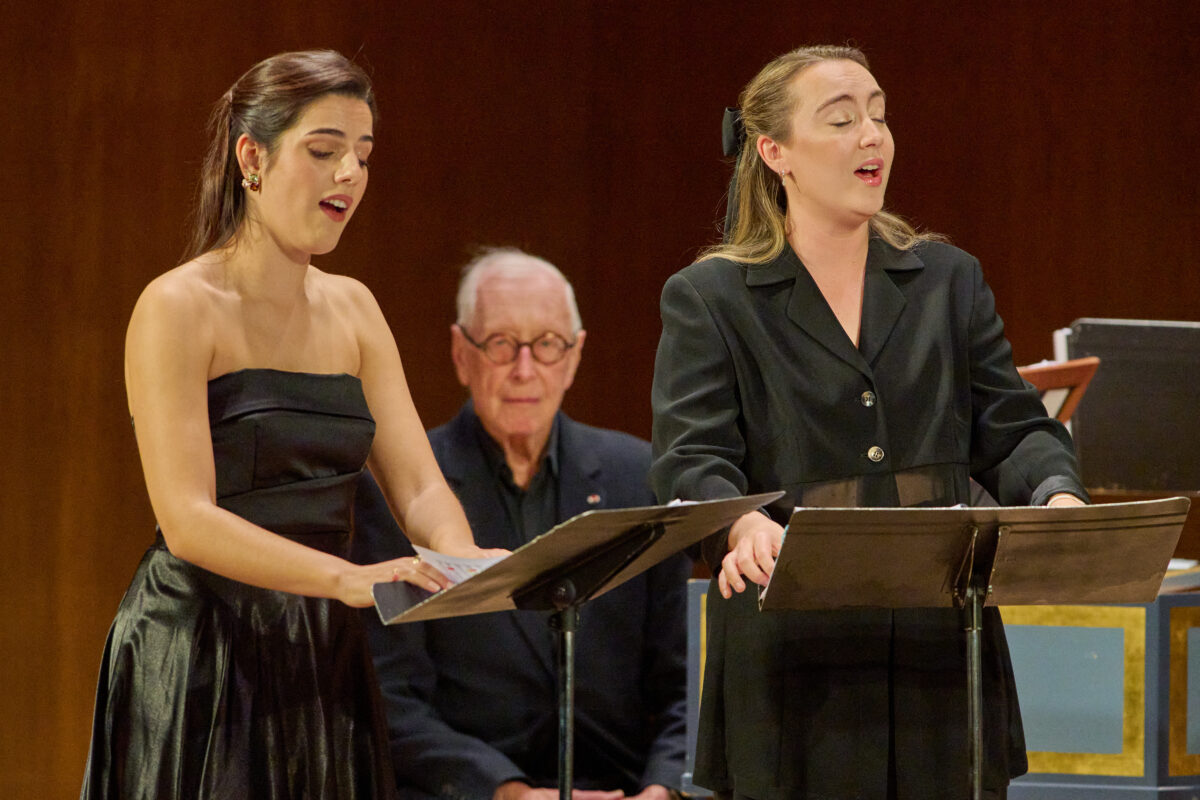
Photo: Joe Sinnott
I’ve said a lot about everyone else in the choir, but the MVP of a Monteverdi madrigal is secretly the alto, the pivot-point of the ensemble. The writing demands a perfect androgyny of tone, capable of seamlessly passing material back and forth between tenor and mezzo. Throughout the program, but especially in Zefiro torna from Book 6, Mélodie Rubio was that pivot-point, capably anchoring the singers with her focused and subtle musicianship.
Ending the concert with Tirsi e Clori from Book 7 was almost cheating. It was a showcase for the entire ensemble’s elasticity of tempo, everyone able to switch instantly between racing, dawdling, and dancing as a unit. It also provided ready closure, like when a movie ends with an all-cast dance-off. Who could hear this music and not feel the urge to leap to their feet and frolic along with the goats and lambs and birds and bees and whatever the hell else is frolicking in the text of this pastoral number? Certainly not the audience at the Y, who leapt to their feet and offered a passionate ovation.
Dan Johnson
Dan Johnson was born in the desert and learned to play the fiddle. Now he lives in Brooklyn, working as a freelance writer and music communications specialist and helping to throw some of the city's most notorious underground parties.
-
Topics: concert performances, early music, historically informed performance, monteverdi
-
People: Ana Vieira Leite, Bastien Rimondi, Edward Grint, Mélodie Rubio, Paul Agnew, Rebecca Leggett, William Christie
-
Works: Tancredi e Clorinda
-
Places & Organizations: 92nd Street Y
Comments