
In for the kill
Saioa Hernández makes a no-hold-barred house debut in The Metropolitan Opera’s prematurely dusty Tosca.
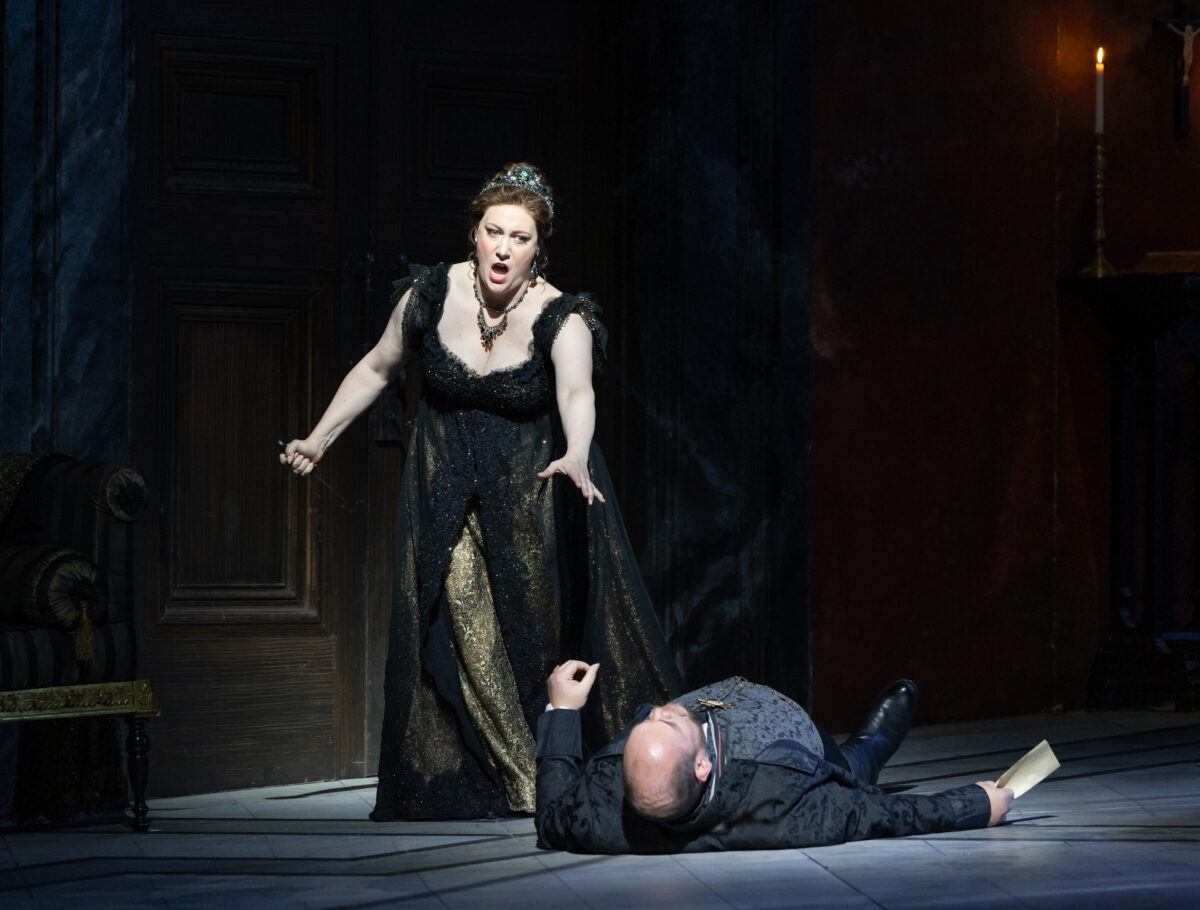
Saioa Hernández in the title role of Puccini’s “Tosca.” Photo: Marty Sohl / Met Opera
Full disclosure: I wasn’t around in the days when you might find Birgit Nilsson singing Tosca at the Met, with the likes of Franco Corelli as Cavaradossi and George London as Scarpia. And I’m not suggesting that Saioa Hernández, SeokJong Baek, and Quinn Kelsey are exact facsimiles of their Golden Age counterparts. But this trio certainly enlivened the opening performance of the current Tosca revival, adding vocal glamour and a much-needed shot of dramatic intensity to a production already showing its seams.
Sir David McVicar’s staging debuted less than a decade ago, and it offers no fresh ideas except bad ones. (Sarah Ina Meyers oversaw the direction of this revival.) Praised by some as a return to traditionalism after the brutally unsentimental Luc Bondy production that preceded it, this Tosca features hulking sets, period-specific yet unflattering costumes, and very little in the way of insights. It wears its tackiness rather heavily: In his first moments onstage, the Sacristan (sung by the adequate Paul Corona) takes a hit of snuff, prays to the Madonna, then immediately proceeds to steal money from the collection box. As Tosca approaches, Cavaradossi uses holy water to comb his hair.
I mean, really. Even if this wasn’t a revival that likely received minimal rehearsal time, you’d be left with the sense that the performers have to make their own luck. Happily, the principals rose to the occasion. In her Met debut, Hernández proved a Tosca of the old school, her hot passions tempered with quiet dignity as she charted the character’s progression toward Scarpia’s murder and her own suicide. She made a perfect foil for Kelsey’s menacing presence—their second act confrontation had me leaning forward, as if I hadn’t watched this exact scene dozens of times in the past. If Baek was not as natural an actor as his co-stars, he still cut an ardent and dashing figure: romantic in the first act, defiant in the second, and movingly circumspect in the third.
Hernández’s profile has risen steadily in a short time: it’s easy to forget she made her US debut last year at Carnegie Hall, as part of a wide-ranging program sponsored by her home company, Madrid’s Teatro Real. In addition to her dramatic temperament, she possesses a voice with enough amplitude to easily fill the Met. Unlike some others in that category, though, she can also claim a genuine beauty of tone, with security across all registers—especially a solid lower range. Individual phrases burst forth with specificity and distinction: I can’t remember the last time I heard “E avanti a lui tremava tutta Roma” voiced so well.
When you have a really strong Tosca all around, “Vissi d’arte” can sometimes feel like an anti-climax. Not so with Hernández. If up to that point she seemed to sing everything forte—even lines meant to be whispered contemplatively—she demonstrated impressive command of pianissimo and morbidezza here. She actually sang phrases that sometimes get screamed, and she brought a sense of grace to Tosca’s final moment, which gets rushed in this production.
Four other sopranos will sing Tosca at the Met this season—the opera is being presented 25 times, an almost Bohème level of performances—but it’s hard not to think the company saved the best for first. And I can only hope Hernández will be asked back quickly and often.
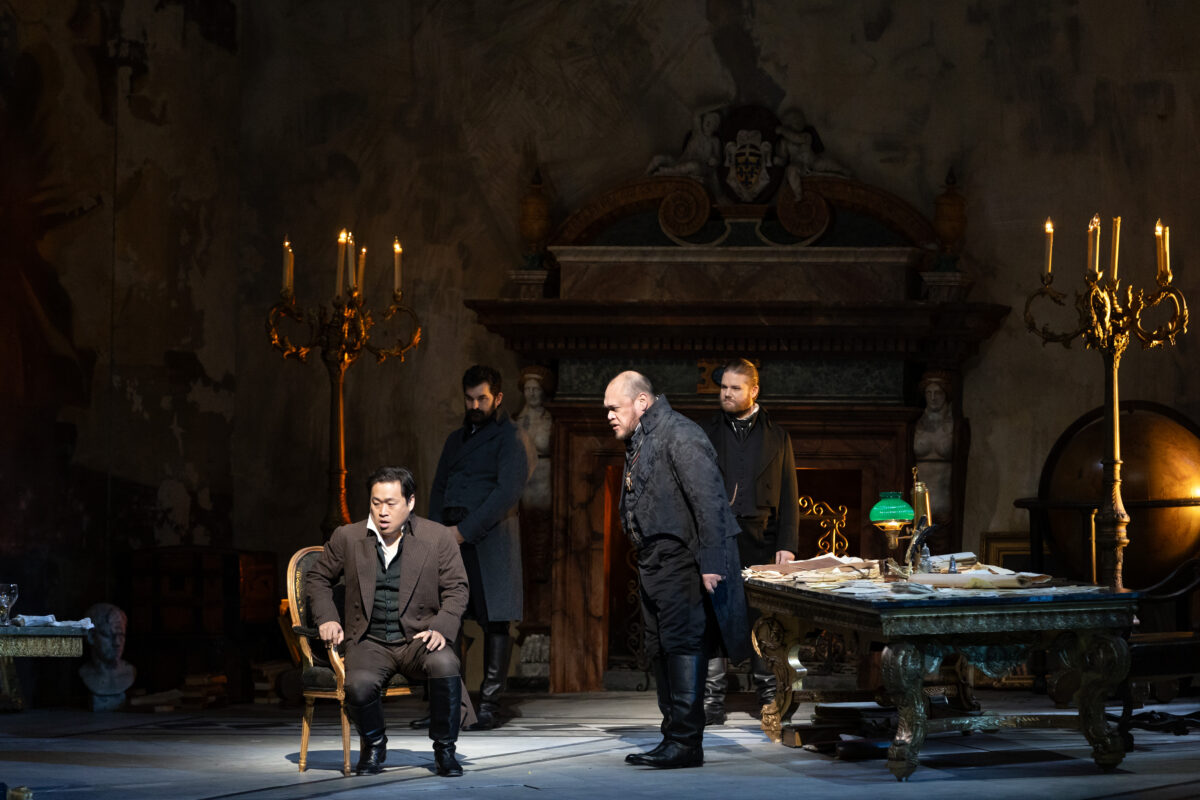
SeokJong Baek as Cavaradossi and Quinn Kelsey as Scarpia in Puccini’s “Tosca.” Photo: Marty Sohl / Met Opera
Hernández’s male co-stars are known commodities in these roles, and they delivered as one might expect. Baek is not an artist who values restraint. Yet even as he flooded the auditorium with sound during “Recondita armonia” or dined out on his cries of “Vittoria,” he never sacrificed tonal allure or stylish legato phrasing for sheer power. Kelsey provided a Scarpia of the truly irredeemable variety, but he sang with such beauty you had to stop and wonder if you might be seduced by his strongman rhetoric. Are there perhaps shades of the contemporary fascist in the American baritone’s characterization?
Aside from a few tuning issues in the brass and some squally woodwind playing in the third act, the Met Orchestra sounded rich and refulgent under Oksana Lyniv, whose inexorable sense of forward momentum propelled the action forward. The chorus under Tilman Michael’s preparation sounded as close to their pre-pandemic level of excellence as I’ve heard in some time.
Tosca could hardly be described as a neglected work, but on the vocal and dramatic levels, this performance exuded a sense of discovery. Sometimes it takes a new voice to make you hear old music as if for the first time.
-
People: David McVicar, Oksana Lyniv, Paul Corona, Quinn Kelsey, Saioa Hernández, Sarah Ina Meyers, SeokJong Baek, Tilman Michael
-
Works: Tosca
-
Places & Organizations: Metropolitan Opera

Comments