Bitches and broods
Sonya Yoncheva tackles one of opera’s mothers from hell in the Metropolitan Opera’s revival of Medea.
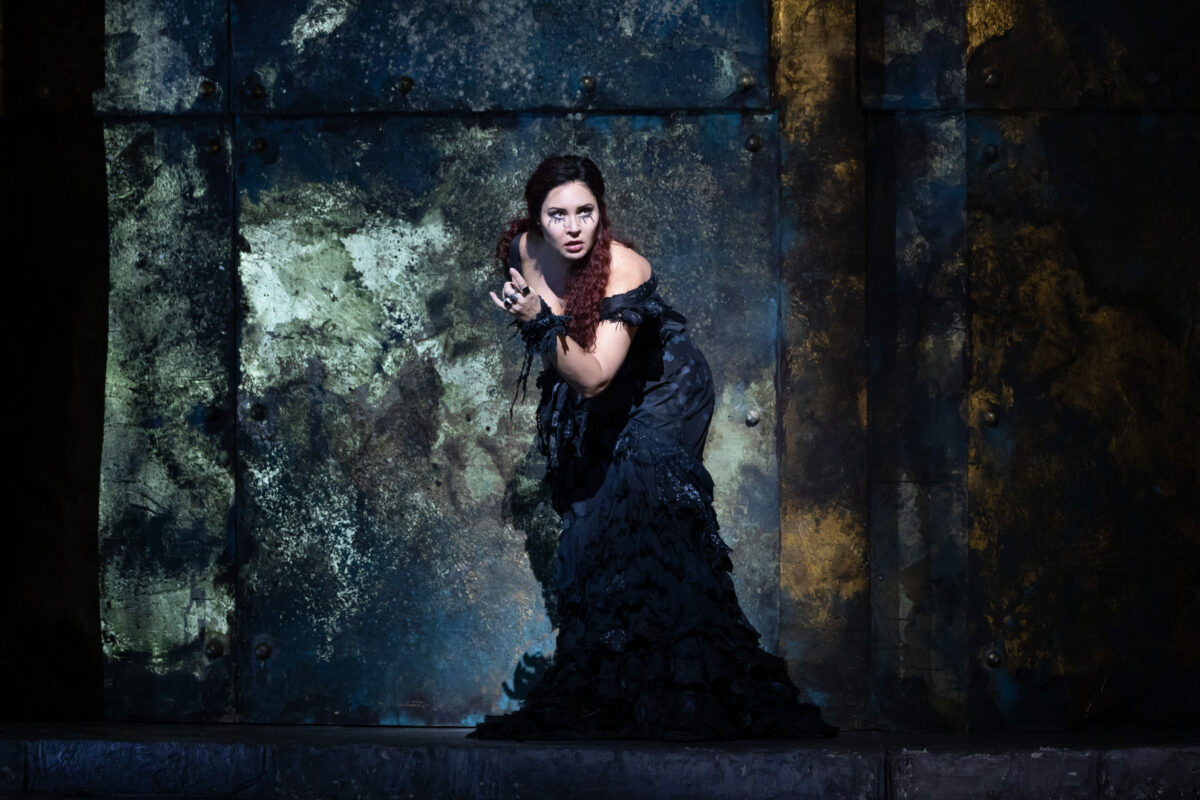
Sonya Yoncheva in the title role of Cherubini’s “Medea.” Photo: Marty Sohl / Met Opera
Perhaps the best production I’ve ever seen of Euripides’ Medea was given by the Greek Active Theater Company in a Seattle tavern named Squid Row. It began with the entrance of the chorus, the Drag Queens of Corinth, lip-syncing “Don’t Leave Me This Way,” choreographically making plain the desperate situation of the heroine. From that moment, we were unmistakably inside the drama.
Luigi Cherubini’s Médée (1797)—or rather Medea, as the Italian translation that is far more frequently performed—is, in contrast, almost a monodrama, an opera driven by a single character: an exceedingly strong woman, a foreign intruder, with children and a bitter grievance against their unfaithful father.
Unlike Bellini’s Norma, with which Medea is often paired in the public mind because both were so memorably played by Maria Callas, Medea is the only striking, fully drawn character in the opera. Other characters make appearances and defend themselves from Medea’s vindictive assaults, but only Medea is fleshed out, so to speak, dashing about among many moods, raging, flirting, threatening, devising and committing barbarous deeds. The others are ciphers—they might almost not be present—a mistake Bellini (and Romani) did not make with their similar story. Medea the sorceress, the murderous alien princess, may inspire terror in chorus and rivals, but we do not feel their terror— we merely accept it as an explanation for certain actions.
In the original play, Medea has a not-unsympathetic chorus to plot with, to entreat her to calm down, to make arguments against her ferocity—in the opera, the chorus plays an insipid, almost entirely offstage role. (In Sir David McVicar’s clever staging, in its first revival at the Metropolitan Opera, the offstage choruses are visible to us on a huge, cantilevered mirror where their actions recall the ceiling of some baroque palazzo). But we still aren’t part of their activity. Their reactions are general: rejoice at a wedding, horror at bloodshed. Cherubini’s title character seethes and plots alone, foreground and downstage, and explores only her own primal demons.
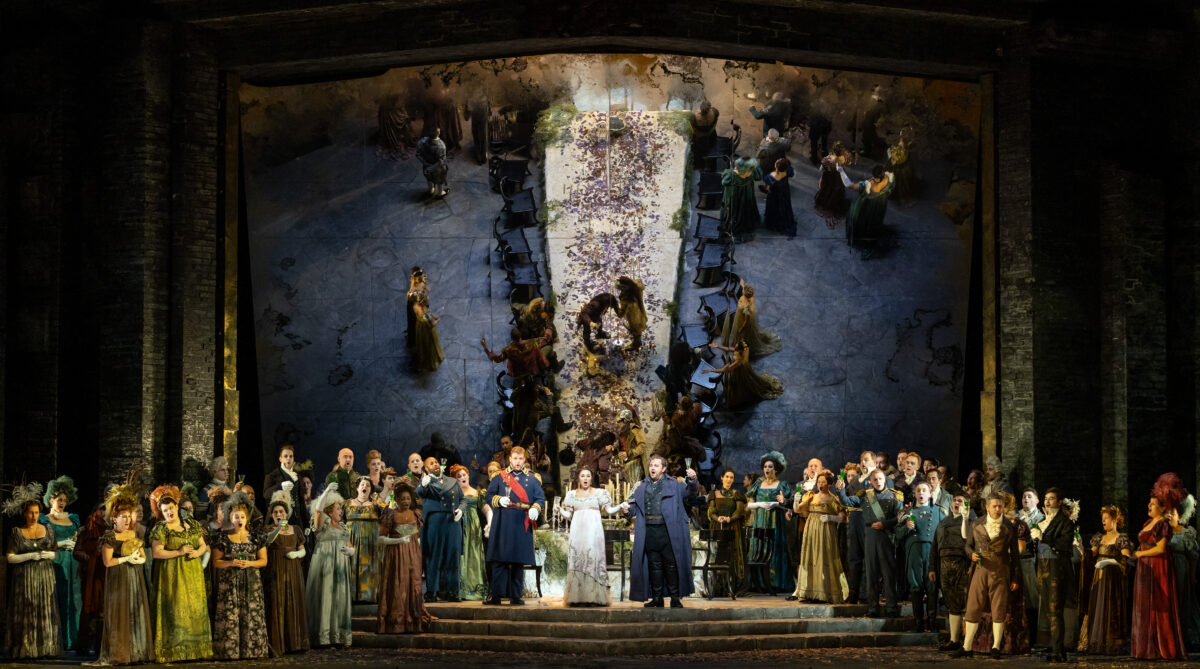
A scene from Cherubini’s “Medea.” Photo: Marty Sohl / Met Opera
Cherubini’s opera, like most of his works of the 1790s when he was a principal figure of the Revolutionary Era in Paris, is an opéra-comique, with spoken dialogue between the numbers. Médée was not a great success then, though it did inspire a couple of parodies, which suggests the Parisians found the story ridiculous. But in short order an array of German translations appeared in Berlin, Vienna, Dresden, and Frankfurt, usually with the dialogue remade into recitative, the most successful of which were those composed by Franz Lachner for Frankfurt in 1855.
Medea had its Italian premiere in 1908, in a translation of Lachner’s German, recits and all, by Carlo Zangarini. It is this version that Callas sang—and Rysanek, in Vienna, and both Maralin Niska and Grace Bumbry at the New York City Opera. At last, the opera had its Metropolitan premiere in 2022, starring Sondra Radvanovsky, who later took the McVicar production to the Lyric Opera of Chicago. A vocal and bel canto actress of striking technique and forceful if not always dulcet presentation, Radvanovsky scored a triumph. The role might have been made for her.
Last Friday, this handsome three-dimensional production returned to the Met in an effective revival led by Sonya Yoncheva. Yoncheva, who has also sung Norma and Tosca here, has a large and effective voice, especially in the mid-range where a dramatic Medea must make her most important points, her nastiest denunciations, her most desperate pleas. Yoncheva’s wrath is impressive, but so is the sweetness of her sound when she turns it to cajoling her the errant Giasone. This made, when she was on stage, a satisfying first act.
But her highest octave did not extend evenly from this emotional base. It is a thin sound up there, keening rather than extending her singing. And in the final scenes a wobble crept in and she sounded exhausted—sung phrases sounded spoken, closer to recitative and her pitch grew uncertain. This was not a riveting star performance of what must be riveting to be compensate for the insignificance of the other characters. Perhaps she will improve as she sings it more often.
Carlo Rizzi conducted well during the stormy overture and the stormy and murderous conclusion, but the intervening scenes lacked tension. The entire long opening scene—nearly half an hour—when Giasone is betrothing the hapless Glauce was tuneful but empty, and Elena Villalón was sweet insipidity itself. The princess’s dread, which should communicate its apprehensions to us, raised nary a goosebump.
The Giasone of Michael Spyres and the Creonte of Alexandros Stavrakakis were highly satisfying pieces of singing and of formal oratory, soothingly stylish throughout the baritenor and bass ranges respectively. Spyres has proved that he can sing anything and Stavrakakis, new to me, is clearly rich with potential. If they came over as unemotional figures in a stiff tapestry, the fault, I believe is Cherubini’s.
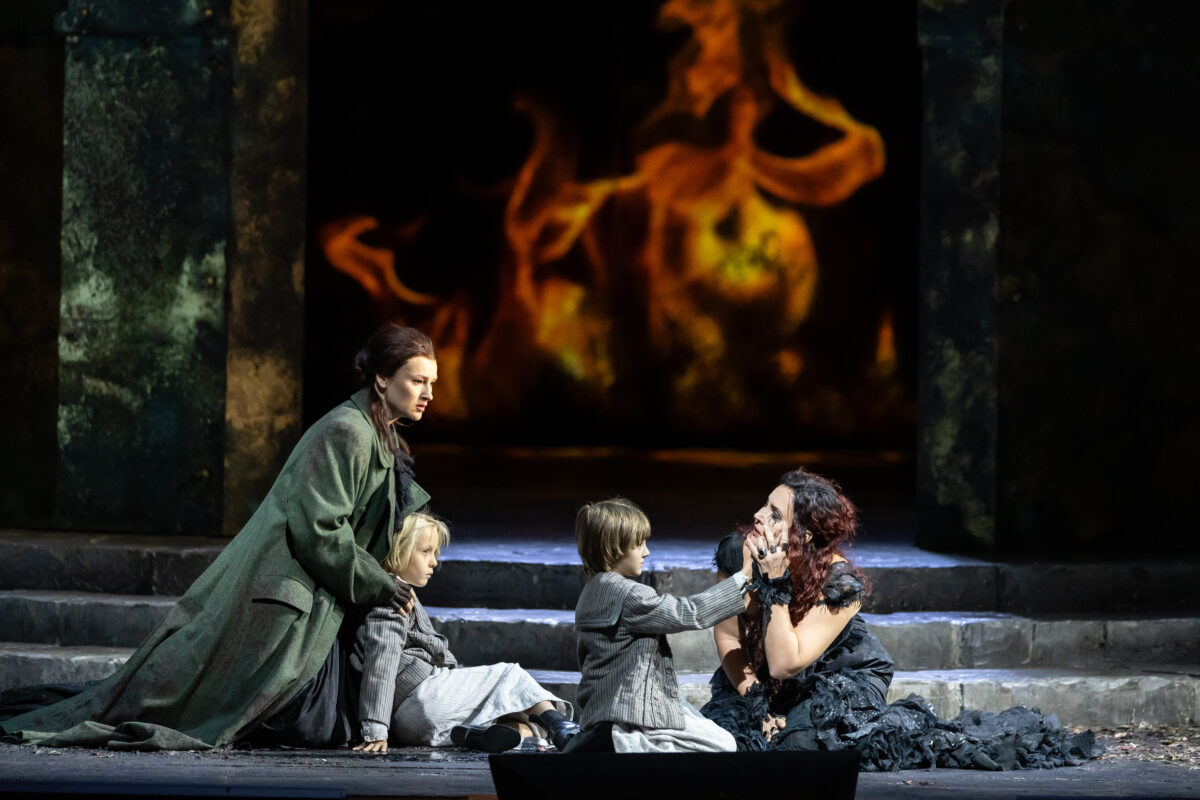
Victoria Karkacheva as Neris and Sonya Yoncheva in the title role of Cherubini’s “Medea.” Photo: Marty Sohl / Met Opera
The great delight of the evening was a debutante, Russian mezzo soprano Victoria Karkacheva, who sang the single aria of Medea’s nurse, Neris, a luscious melody attempting to soothe the character. Karkacheva brought a thrilling velvet sweetness to the occasion, the brief interruption in Act II’s hurtle to calamity. I hope to hear her in what we used to call the “Borodina” roles, such as Paulina (Queen of Spades) and Lyubasha (Tsar’s Bride)—indeed, she’d make a superb Brangaene or Didon.
On re-encountering Medea, I must revise my opinion that it is a neglected masterpiece. The opera can be such a thing, but it requires a stage presence that holds the eye and ear from entrance to finish without apology, and the vocal mastery to brood at strength for two hours. Yoncheva did not, on this night, seem up to the task.
John Yohalem
John Yohalem's critical writings have appeared in the New York Times Book Review, American Theater, Opera News, the Seattle Weekly, Christopher Street, Opera Today, Musical America and Enchanté: The Journal for the Urbane Pagan, among other publications. He claims to have attended 628 different operatic works (not to mention forty operettas), but others who were present are not sure they spotted him. What fascinates him, besides the links between operatic event and contemporary history, is how the operatic machine works: How voice and music and the ritual experience of theater interact to produce something beyond itself. He is writing a book on Shamanic Opera-Going.
-
Topics: Review
-
People: Alexandros Stavrakakis, Carlo Rizzi, Elena Villalón, Michael Spyres, Sonya Yoncheva, Victoria Karkacheva
-
Works: Medea
-
Places & Organizations: Metropolitan Opera