A first opera from a first people
In Juneau, the world premiere of the Tlingit-language opera Ḵutulagaaw: The Tlingit-Russian Battles raises new questions about cultural ownership while singing a song all its own.
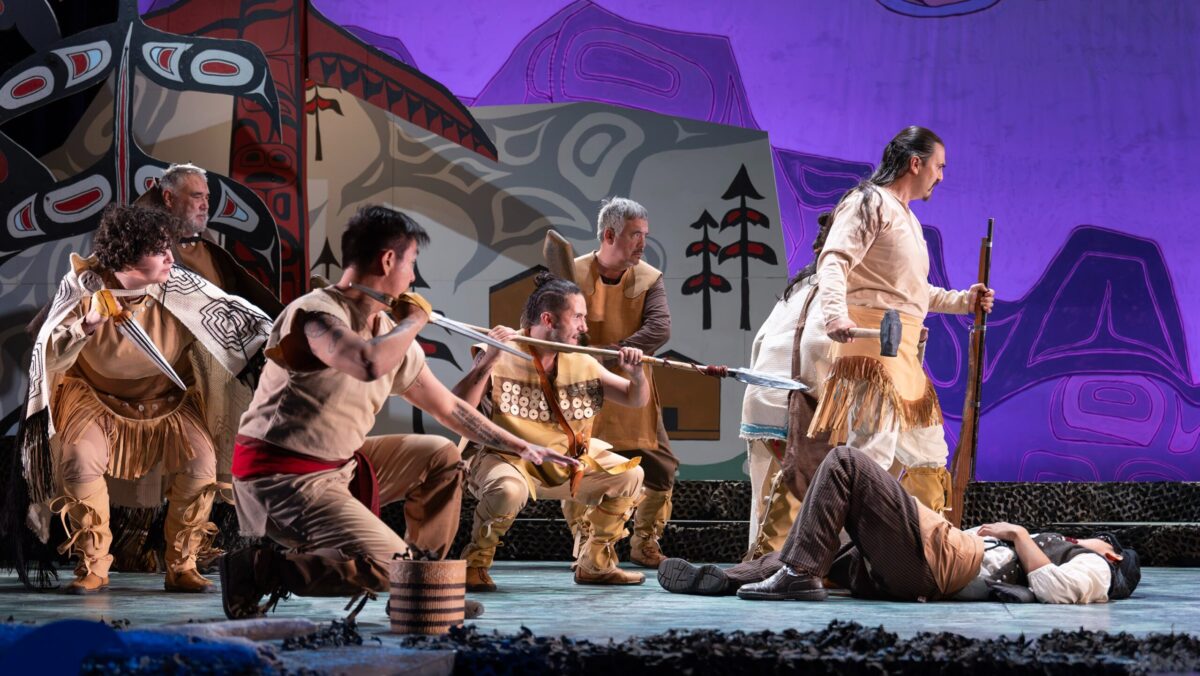
Ḵutulagaaw: The Tlingit-Russian Battles at Perseverance Theatre in September, 2026 / Photos: Sealaska Heritage Institute
Mazal tov! It’s an opera!
One of the strange, unfortunate aspects of the opera industry is that rigid gatekeeping continues to exist in the midst of the art form’s infinitely porous boundaries; new creators are faced with a seemingly endless set of conflicting requirements to prove that their work is “real” opera, as if the historical tradition has not been full of hybridization, controversy, offensive obstruction, reinvention, technological innovation, translation, and every other form of adaptation. Opera is a much more resilient, wilder animal than many of us imagine.
On 11 September, when an audience gathered in Juneau for the birth of Ḵutulagaaw: The Tlingit-Russian Battles, the world premiere of the first full-length opera in the Tlingit language, the composer cautioned fans of the genre to adjust their expectations. And surely, there were a great many ways in which Ḵutulagaaw was novel beyond its language, but it was surely an opera — and an excellent one, at that.
Ḵutulagaaw places the sound of Tlingit at the center of its musical construction, attending closely to its pronunciation while finding considerable expressive variety within it. Presented by Sealaska Heritage Institute and Perseverance Theatre at Thunder Mountain Middle School with a fully indigenous cast and beloved ancestors seated front and center, this notable first succeeded as compelling art through attentive vocal writing, forceful percussion, purposeful orchestration, and exceptionally thoughtful casting.
The opera concerns the conflicts of 1802 and 1804, when Russian colonial expansion met organized resistance in Southeast Alaska. Forces from the Tlingit tribe expelled the Russians from their settlement near present-day Sitka in 1802; two years later, the Russians returned. Following a tragic loss, the Kiks.ádi clan defended their fort before withdrawing to preserve their people and continue resistance. And that is the central conflict: assuring meaningful continuity of a culture versus the quest for a totalizing “victory.”
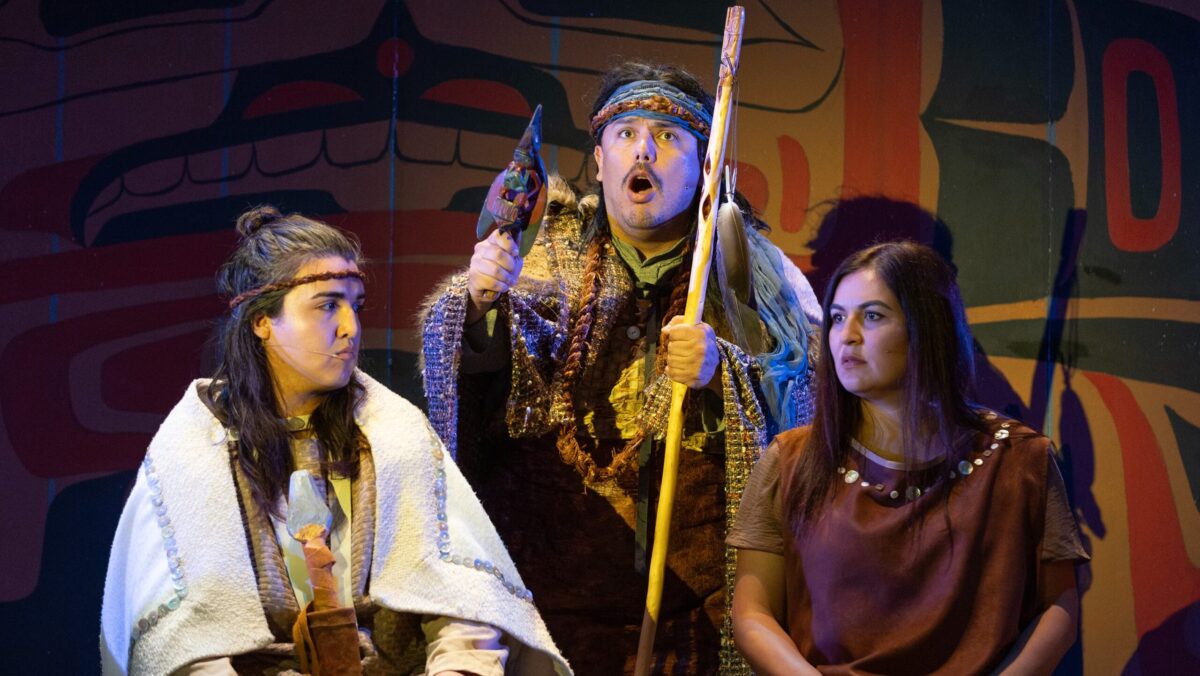
Ḵutulagaaw: The Tlingit-Russian Battles at Perseverance Theatre in September, 2026 / Photos: Sealaska Heritage Institute
Composer and conductor Shaaḵindustóow (who goes by Edward Littlefield) worked with librettist T’set Kwei (Vera Starbard), translator and language consultant X̱ʼunei (Lance Twitchell), and orchestrator Rory Stitt. Despite an increasing number of second-language learning opportunities in Alaskan schools, Tlingit’s transmission remains precarious after generations of cultural suppression and the natural loss of native speakers. An operatic setting, it is hoped, could become one of the ways people encounter and learn its sounds.
Each language has its own music, and preserving the integrity of Tlingit means avoiding any temptation towards bel canto lines or expansive vowels, instead emphasizing fricative consonants not often heard on the opera stage. The breath moving through those sounds supplied a distinctive texture, mingling with instrumental percussion.
Performed without supertitles, the shape of the words became clear through repetition. Rather, Yèil Shì Gis’òok (Sovereign Bill) provided a dramatic English framing at the beginning and end, explaining the history and its significance in character.
Percussion was the focal point of the writing and proved especially persuasive. Shaaḵindustóow, himself an acclaimed percussionist, has explained that his melodies should remain viable as traditional-style songs accompanied only by a hand drum. The beat provided a meaningful backbone in more elaborately instrumentalized sections, but was most powerfully realized as the heartbeat of the people in passages using only those two traditional instruments, especially the ceremonial, almost sacred scene of the women lining up to drum and emit war cries. With drums active both onstage and in the pit, rhythm was a more immediate and complex dialogue than it often is when smothered by a sea of strings. Nonetheless, the orchestral writing expanded the range of expression, providing atmosphere, momentum, and distinct musical treatment for individual characters.
Among its finest effects was the plaintive violin pizzicato associated with the Sugpiaq sharpshooter–a member of another one of Alaska’s tribal groups who historically served as slave-soldiers–coerced into fighting for the Russians. He had no sung words of his own, the meaning of the violin translated directly into Tlingit through Tíx’. The instrumental representation provided dignity to the man’s predicament without putting a position into the mouths of a different people. The Russians, too, were denied words, instead grunting and bumbling over musical lines that made their menace seem oafish.
The casting was superlative. A diverse ensemble with widely varying performance backgrounds produced a remarkably assured evening, each voice appropriate to its character. Perseverance deliberately recruited performers across opera, theatre, Tlingit language, traditional dance, and community-performance backgrounds, promising training rather than restricting auditions to conventional opera résumés. The variety of vocal approaches remained a strength, creating individual identities without weakening collective scenes.
Srpaa’ti (Bo Shimmin), a classically trained tenor from the Pueblo of Acoma, was superb as the leader Xaldleit. His vocal confidence and dramatic authority reinforced one another, producing a naturally compelling image of a man pulling strength up through the worry in his steady, warm voice. Shaa X̱eidí Tláa (Madeline Soboleff Levy), an attorney, was an equally rewarding discovery as Tíx’. Her strong, controlled voice gave substance to a character whose work as translator and mediator makes communication consequential.
Kenny Ray Ramos, an Iipay/Kumeyaay actor from the Barona Band of Mission Indians, brought the appropriate impatience to Ín. The character’s youthful, “fight-to-the-last-man” anger registered in his impetuous delivery. The contrast with Srpaa’ti’s more conventionally operatic singing helped distinguish their positions within the community. This was casting attentive to how a person sounds, how that sound communicates, and what a role actually requires. More established opera companies could usefully take the exercise as seriously.
Under Shaaḵindustóow’s musical direction, the orchestra supported a convincing dramatic progression, although amplification occasionally left it too prominent against the singers.
Achokayis (Madeline Sayet) directed a production whose visual vocabulary was equally specific. Aanda (Robert Davis Hoffmann) and Troy Hourie’s scenery represented the landscape through Tlingit artistic traditions; the stylized formline trees were particularly striking, reinforcing the lack of distance between legend, history, and present in the production. Danced combat and sharp flash-and-bang effects conveyed battle without resorting to gruesome spectacle. In choreography credited to Hali Duran and Ḵáaḵ’utx̱éich (Kai Abraham Monture), human action shaped the world. The most striking scene, the narrative turning point, features three young warriors carrying ammunition in a canoe. Instead of adding one more prop to the stage, the dancers simply took up their oars and created a realistic canoe, the weight of its load, the force of the water against them, with the finely relayed movements of their bodies. There was even a charming bit of comedy in their navigation, making the catastrophe that followed more affecting.
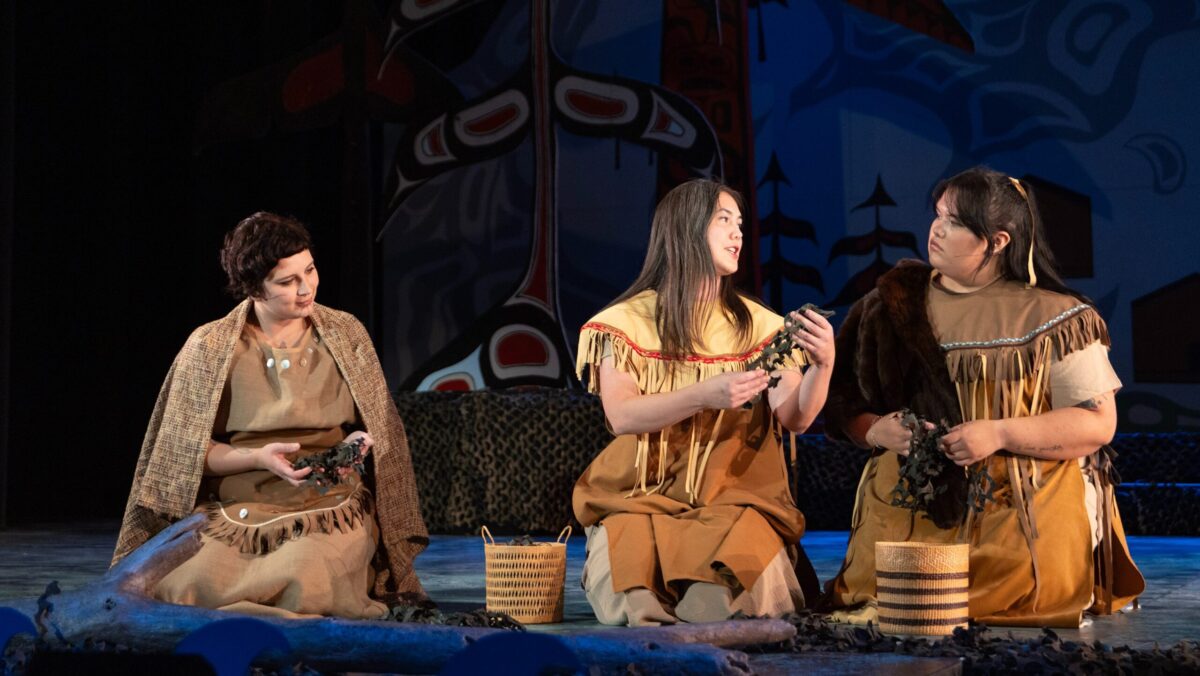
The story was framed not just by the English explanation of what had brought us to the story, and where we had come since, but by ecstatic musical processions in front of the stage with performers and other participants with instruments, wearing traditional Tlingit and Haida regalia alongside contemporary adaptations paired with blue jeans. While the military battles have long been over, the task of choosing continuity remains.
For the Tlingit, that continuing relationship also entails responsibilities rarely encountered in the classical canon. Because Tlingit clans regard each other and themselves as holding exclusive ownership of their stories and their songs, creating a performance piece based off of stories told by elders yields substantive issues surrounding permissions. Here, it remains disputed. After the premiere, Kiks.ádi representatives told KTOO that permission to use their story had not been obtained; Ḵaaháni (Rosita Worl), president of Sealaska Heritage Institute, maintained that the history invoked belonged collectively to the participating clans and Haida. The disagreement may seem utterly foreign to the promiscuous–and perhaps at times unabashedly appropriative–genre of opera, but transmitting the cultural traditions of one’s people reliably also means considering traditional ethics, including sharing stories responsibly and transmitting language accurately.
Shaaḵindustóow cautioned that Ḵutulagaaw would be unlike any opera even long-time residents of the Box would have experienced before–but if opera is going to survive, it must continue to adapt, reinvent itself, experiment. This is opera that’s alive and plans to stay that way.
Note: while many prefer to use the spelling “Lingít,” this review follows the conventions used in the opera’s marketing materials.

No'a L. bat Miri
No'a L. bat Miri is a multilingual writer and educator. Her main interests include religious and philosophical opera, Indigenous and minority-language opera, rarely staged works, unusual voice types, and opera created under political or material constraint. When she's not chasing down the world's unlikeliest opera performances, she is busy composing her own works, creating perfumes in response to ancient literatures, or trying to make friends with every tree and bird she meets. No'a holds an MFA and is currently pursuing rabbinical studies.
-
Topics: Perseverance Theatre, Review, Sealaska Heritage Institute
-
People: Asa Benally, Bo Shimmin, Ed Littlefield, Hali Duran, Kai Abraham Monture, Kenny Ray Ramos, Madeline Sayet, Madeline Soboleff Levy, Robert Davis Hoffmann, Rory Stitt, Rosita Worl, Sovereign Bill, Troy Hourie, Vera Starbard, X?’unei Lance Twitchell
-
Places & Organizations: Perseverance Theatre