Mantua man
San Diego Opera’s Rigoletto, starring a persuasive Michael Chioldi, veers traditional—without the mothballs in tow.
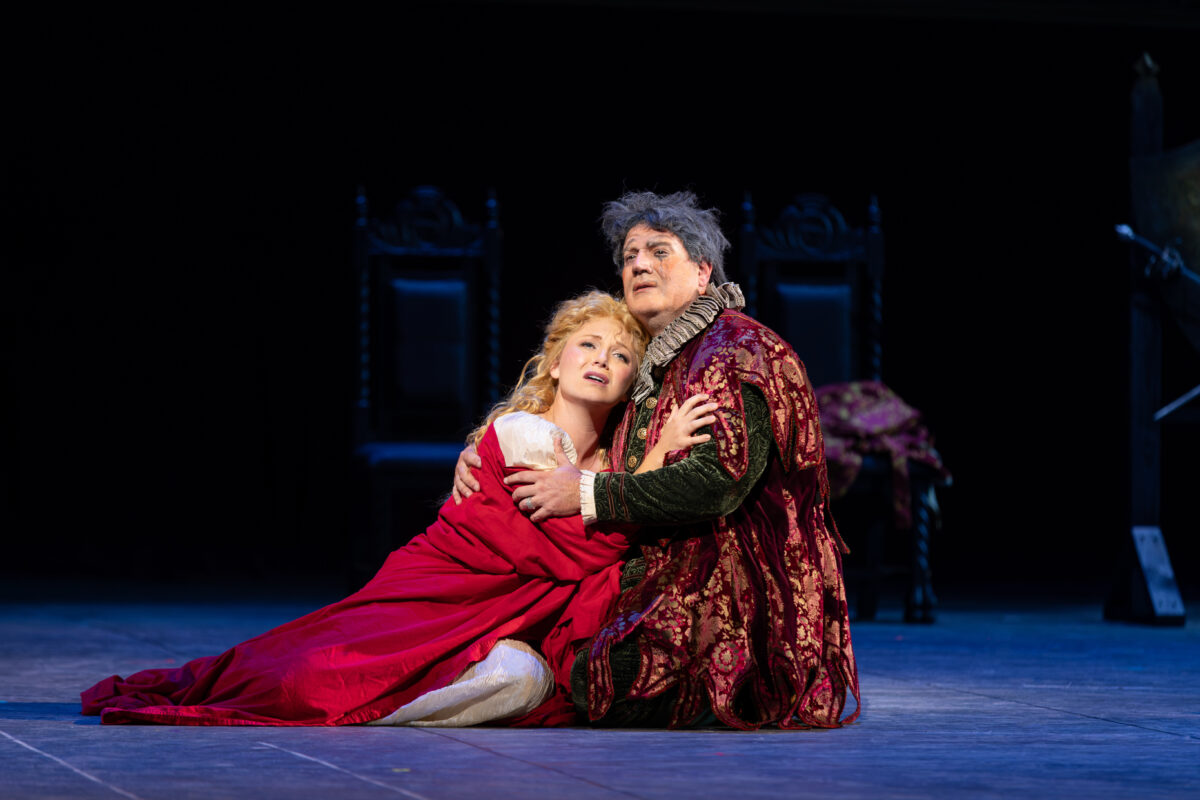
Madison Leonard as Gilda and Michael Chioldi as Rigoletto. Photo: Karli Cadel
Opera’s beloved hunchback returned for the eighth time at San Diego Opera (SDO), as the company opened its 62nd Season with Giuseppe Verdi’s masterpiece Rigoletto on Friday, October 23. As is SDO’s custom, the show was performed three times over the weekend, with the San Diego Symphony Orchestra led by Principal Conductor Yves Abel. This run of Rigoletto was dedicated to the memory of Dr. Harry F. Hixson, Jr., a former SDO board member.
Now in his seventh year at the helm, the Canadian conductor has become SDO’s greatest asset, delivering hit after hit across a wide repertoire. On Friday, his steady hand brought Verdi’s sparkling score to life. The ensemble scenes sounded lively and exciting, and the tender moments felt human and heartfelt. The climaxes were particularly well-timed and coherent, and he kept a tight grip on the story’s arc. His accompaniment for the multiple Gilda/Rigoletto duets was especially noteworthy, as he sensitively used the orchestra as a canvas to paint both characters’ emotions, from the warm father-daughter embrace in Act 1 to the rage of “Sì! Vendetta, tremenda vendetta!” that closed the second act. Little wonder the San Diego audience showered him with the loudest cheers during the bows!
Abel wasn’t alone in elevating the musical aspects of the performance, as he was joined by a great cast on stage. Returning to SDO after 26 years, baritone Michael Chioldi brought a wealth of experience to his interpretation of the title role. With his voice and mannerisms, he turned Rigoletto into a complex Shakespearean character, bringing out the full nuance and color of both Verdi’s score and Francesco Maria Piave’s libretto. With an attractive voice and a secure middle register, he embraced the philosophical side of Rigoletto, shining brightly in the Act I scene in which Rigoletto ruminates over the curse and in the Act II soliloquy “Cortigiani.” One could see how much he loved his daughter and would do anything to save her. It was one of the most satisfying portrayals of the role I’ve seen in a while!
Chioldi met his match in debuting Madison Leonard, who brought equal measures of innocence and maturity. More than a mere songbird, Leonard’s bright instrument carried considerable heft, suggesting a woman capable of making her own decisions and making her final choice completely believable. Leonard capably performed the coloratura passages in “Caro nome,” though not quite as effortlessly as usual. Her duets with Chioldi were truly the night’s highlights, as they developed a great rapport and were totally convincing as a loving father and daughter.
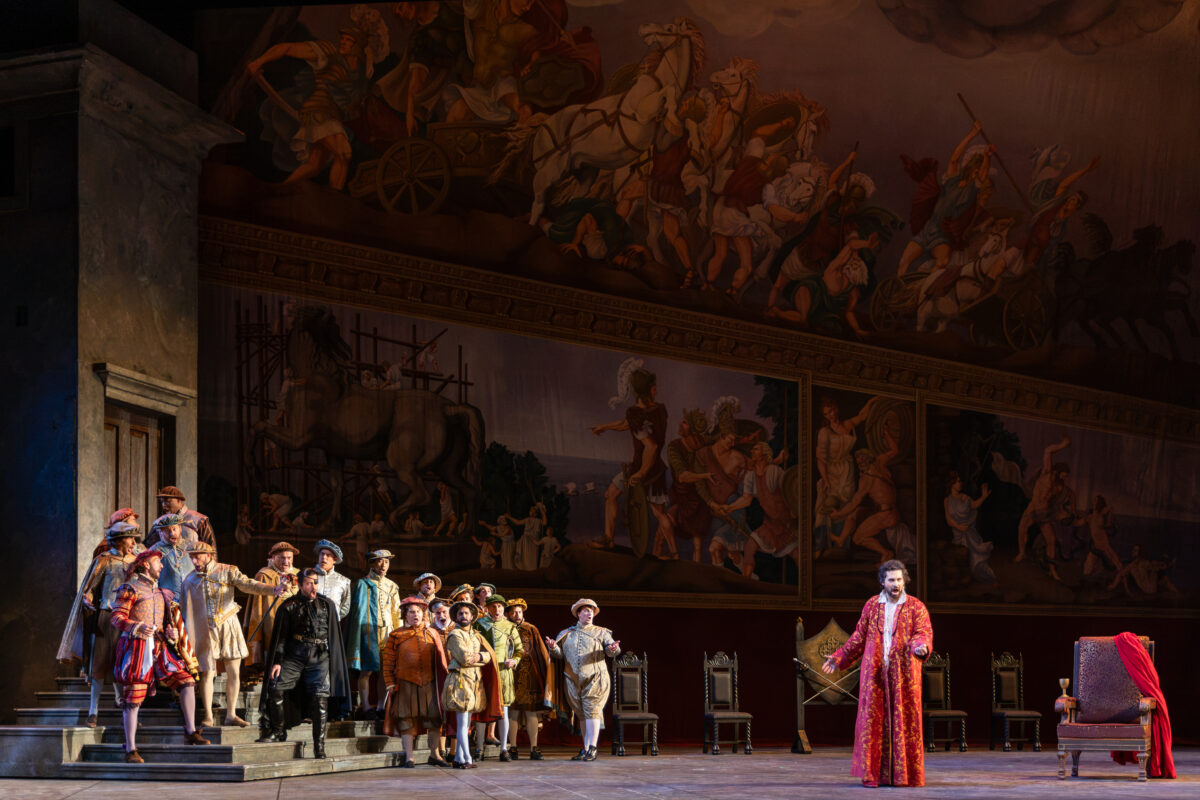
José Simerilla Romero as The Duke, with the cast of Rigoletto. Photo: Karli Cadel
José Simerilla Romero brought a brutish persona to the villainous Duke of Mantua, making the character wholly unsympathetic (and drawing boos at the bows). On Friday, he had a rough start (nerves, maybe?), which led to his being drowned out by the ensemble during the party scene at the beginning of Act 1. “Questa o quella” was marked by choppy phrasing. Fortunately, he recovered in time, delivering the famous “La donna è mobile” with swagger and participating in the subsequent “Bella figlia dell’amore” amorously.
Even better were Peixin Chen’s Sparafucile and, in a smaller role, Joel Balzun‘s debut as Monterone. The always-reliable Chen commanded the stage as the assassin, delivering delicious low notes in his Act 1 encounter with Rigoletto; his sustained F on “Sparafucile” gave me chills! Chen also showed considerable care for his sister Maddalena (coquettishly played by Guadalupe Paz) in the last act. By contrast, Balzun’s booming voice and stentorian declamation gave Monterone a much more dignified presence than the stage time suggested. All other smaller roles were handled competently by a handful of performers, including Søren Pedersen’s Marullo, Adam Caghey’s Matteo Borsa, Travis Sherwood’s Count Ceprano, Maya Goell’s Countess Ceprano, and Emily Weinberg’s funny (and disloyal) Giovanna. As usual, Bruce Stasyna beautifully prepared the men of the SDO Chorus, who actively participated as the court’s courtiers.
Christopher Mattaliano, who directed last year’s successful season opener Pagliacci, returned to the stage for this production, using the SDO’s gorgeous set pieces by Robert Dahlstrom, which first appeared in 2019 (then directed by the late Michael Cavanagh). In his 10th production of Rigoletto, Mattaliano’s familiarity with the opera gave him the upper hand, presenting the work with assured hands; every scene fell perfectly into place. The fact that Verdi and Piave moved the setting of Victor Hugo’s original play Le roi s’amuse from the French king to a defunct Duke of Mantua seems to give directors license to insert their own interpretations; after all, Rigoletto has been set anywhere from Little Italy to Las Vegas, even to the Planet of the Apes! Mattaliano proved that in 2026, a traditional setting for a well-known opera masterpiece still has a place, without feeling stuffy or like a museum piece.
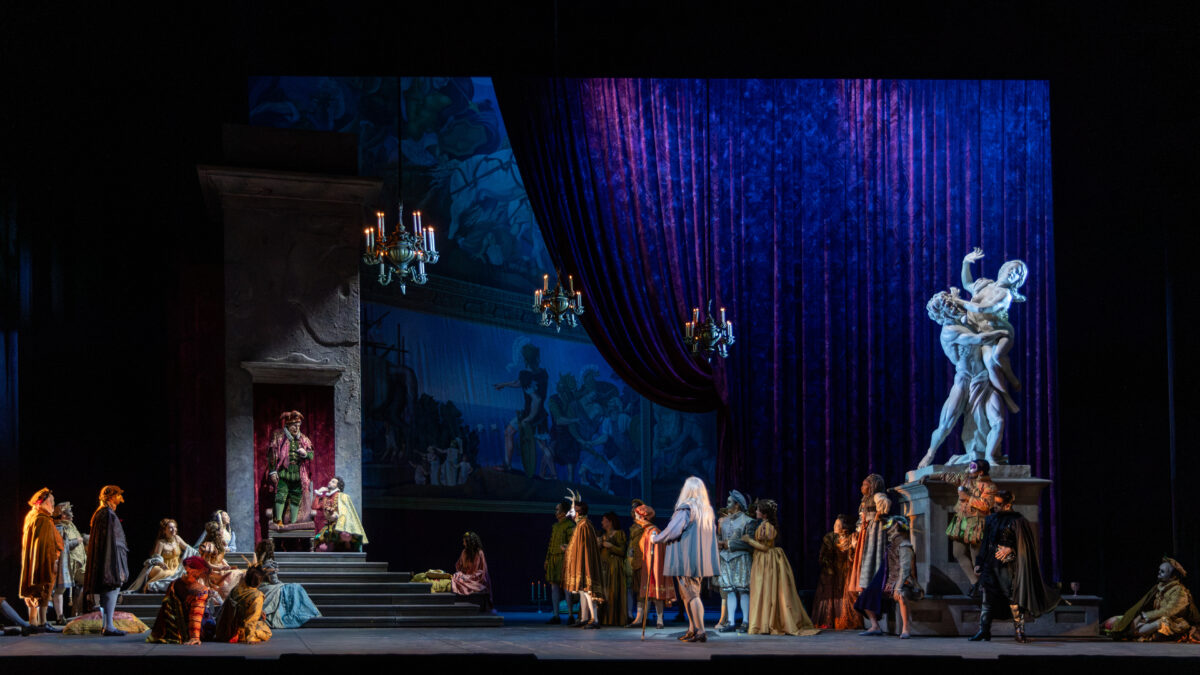
Michael Chioldi as Rigoletto, José Simerlla Romero as The Duke, and Joel Balzun as Count Monterone, with the cast of Rigoletto. Photo: Karli Cadel.
Mattaliano stayed faithfully close to Verdi’s stage directions in the score (even though he was working with previously available sets), making the libretto clear and coherent with the action. He was helped tremendously by Jane Greenwood’s fabulously colorful costumes, depicting the Italian Renaissance era, and by Jason Bieber’s shadow-play lighting. His use of Dahlstrom’s set was exceptional; it felt as if they were built for his vision. He had a fluid sense of direction, well choreographing the movement of everyone on stage and ensuring no one was blocked. He even inserted some of his quirks; when the curtain opened, Rigoletto was seen playfully dragging a girl with a long red cloth (presumably Monterone’s daughter?) across the stage, giving a premonition of the opera’s ending.
Once again, SDO proved itself to be the small opera company capable of presenting well-known works with thoughtful staging and strong musical aspects. What an auspicious season opener for SDO! Next Valentine’s Day weekend, SDO will present Carlisle Floyd’s Susannah, featuring Hailey Clark (who mesmerized as Nedda in last year’s Pagliacci) and veteran bass-baritone Greer Grimsley, in a production directed by Patricia Racette. I can’t wait!