Wait, wait, don’t tell me
Seokyoung looks at how five different versions of “Un bel dì” support and subvert the stakes of Cio-Cio-San’s famous wait for Perspectives on an Aria.
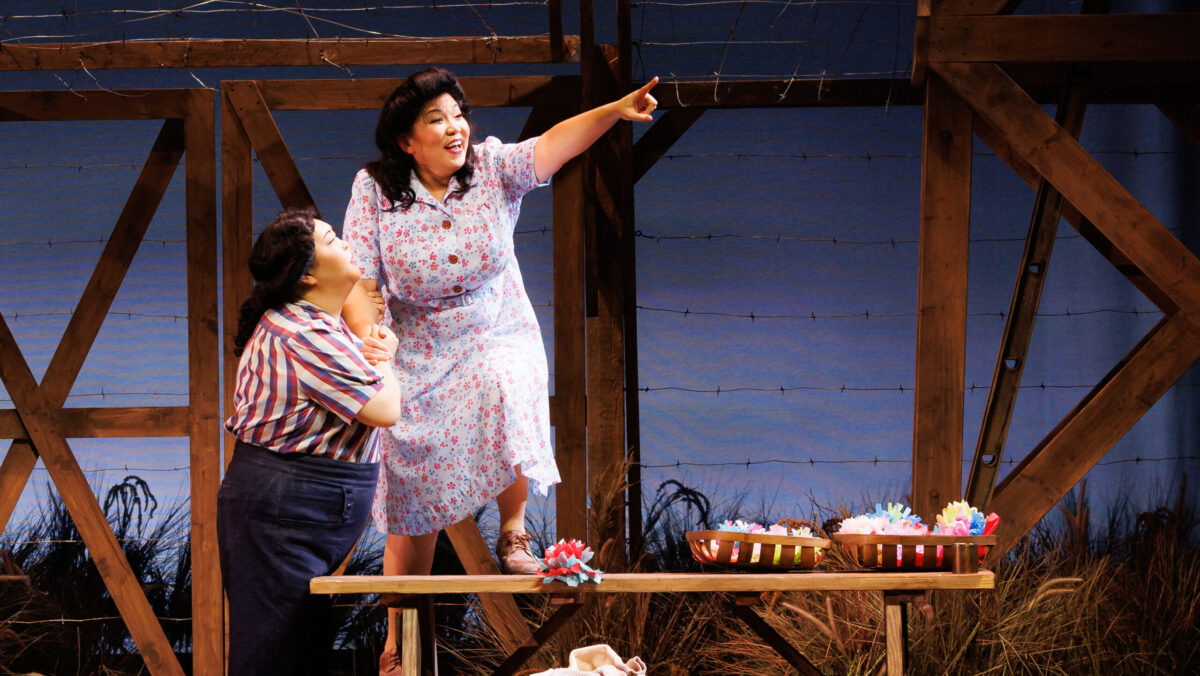
Karen Chia-Ling Ho as Cio-Cio-San and Alice Chung as Suzuki in Madama Butterfly at Boston Lyric Opera in 2023 / Photo: Ken Yotsukura/Boston Lyric Opera
It’s one of your favorite fantasies: The submissive oriental woman and the cruel white man. What would you say if a blonde beauty fell in love with a Japanese man? He treats her cruelly, goes home for three years. Then, when she learns he has remarried, she kills, kills, kills herself. I believe you would consider this girl a deranged idiot. But because it’s oriental who kills herself for a Westerner, ah! You find it beautiful, beautiful, ah!
(Act I, Scene 2, Huang Ruo’s M. Butterfly)
Chinese opera singer Song Liling, clad in a kimono, delivers these lines to French diplomat René Gallimard after performing “Un bel dì, vedremo” as Cio-Cio-San in Huang Ruo’s M. Butterfly (2022), an operatic adaptation of David Henry Hwang’s 1988 play of the same name. Gallimard praises Cio-Cio-San’s “pure sacrifice” as a “beautiful story,” prompting Song’s scathing rebuttal. What, exactly, is he hearing—and imagining—when he calls Cio-Cio-San’s story beautiful?
In Puccini’s Madama Butterfly, “Un bel dì” arrives at a critical juncture in Act II. As Song’s lines allude to, Madama Butterfly tells the story of Cio-Cio-San, a fifteen-year-old Japanese girl who waits three years for her American husband Pinkerton, only to discover upon his return that he has married an American woman and ultimately sacrifices herself. Following the love duet that concludes Act I, “Un bel dì” presents a strikingly different Cio-Cio-San near the beginning of Act II: alone and waiting for Pinkerton’s return. Immediately after Suzuki confronts her with the increasingly desperate reality of their dwindling finances and Pinkerton’s continued absence, Cio-Cio-San makes her case for hope.
That dramatic function makes the aria’s reuse in Huang’s M. Butterfly particularly revealing. Crucially, while Song performs Cio-Cio-San’s death scene in the original play, Huang instead brings in “Un bel dì.” In doing so, the opera shifts the emphasis from the image of the woman who ultimately sacrifices herself to the image of the woman who waits for her Western lover. This substitution also has an earlier cinematic precedent in David Cronenberg’s 1993 film M. Butterfly. Read alongside Song’s speech, “Un bel dì” can therefore seem to reinforce precisely the stereotype embedded in Madama Butterfly that M. Butterfly sets out to expose: the submissive Asian woman whose identity is defined by waiting for, rather than sacrifice to, a Western man. This is, of course, only one way of interpreting the aria.
Beyond the M. Butterfly examples, Puccini’s music for “Un bel dì” leaves considerable room for different interpretations of Cio-Cio-San’s character, as scholars, directors, and singers have found different ways to inhabit—and complicate—the identity his music gives her. Looking at the structure of the aria alongside its text, we can broadly hear it as three sections—ABA′—followed by a coda.
The A section, beginning with “Un bel dì, vedremo,” opens with the sight of smoke rising on the horizon:
| Un bel dì, vedremo | levarsi un fil di fumo
sull’estremo confin del mare. E poi la nave appare. |
One good day, we will see | Arising a strand of smoke
Over the far horizon on the sea And then the ship appears |
In the B section, its longest and textiest, section, the musical material becomes more varied as Cio-Cio-San’s fantasy unfolds. A ship appears and enters the harbor, but rather than going down to meet Pinkerton, she imagines herself waiting on the hill. A distant man begins to climb toward her, and she imagines what he will say as he approaches, calling her “Butterfly.” When he addresses her as “Piccina, mogliettina, olezzo di verbena” (“Dear baby wife of mine, dear little orange blossom”), the opening A-section melody returns, leading into the coda, where Cio-Cio-San turns her imagined future into a firm declaration, culminating in the aria’s signature high B-flat:
| Tutto questo avverrà, | te lo prometto.
Tienti la tua paura, io con sicura fede l’aspetto. |
All this will happen, | I promise you this
Hold back your fears – I with secure faith wait for him. |
The return of the opening material is significant: what began as a vision of smoke on the horizon has become a statement of certainty.
Considering the larger dramatic context of the opera, “Un bel dì” can, on the one hand, be heard as the delusion and fantasy of a woman waiting for a man whose return she cannot know for certain. As musicologist James Hepokoski has argued, the descending ostinato bass of the A section—with its occasional upward motion—continues a long tradition of operatic laments by grieving or abandoned women dating back to the seventeenth century. Its use in the major mode also recalls Handel’s “Piangerò la sorte mia” from Giulio Cesare.
On the other hand, opera director Jennifer Williams approaches the aria as a “performative utopian narrative,” interpreting it as an expression of Cio-Cio-San’s agency and her desire to shed her Japanese identity and identify with America. For this reading, Kunio Hara’s musical analysis offers a useful complement. Ralph P. Locke describes the melody associated with “S’avvia per la collina,” when Pinkerton climbs the hill, as a “memorable whole-tone phrase,” placing it within a musical idiom that Western composers have historically used to represent the exotic Other.
Hara, however, observes that the whole-tone phrase is strikingly similar to a melodic figure found in “Jizuki-Uta,” a Japanese song transcribed by Rudolph Dittrich. In other words, Puccini’s supposedly “exotic” musical material was itself derived from a Japanese melody that had already been mediated through a Western musical context. Hara therefore interprets the phrase as representing Cio-Cio-San’s psychological struggle between her adopted American identity and her Japanese identity.
These competing readings suggest that what we hear depends not only on Puccini’s score, but also on the performer who inhabits it, the production that frames her, and the listener who receives her. The following performances offer precisely those different possibilities. Rather than assembling a canon of the “best” recordings, I want to listen to what happens when different singers (and productions) put different kinds of Cio-Cio-San into the same music.
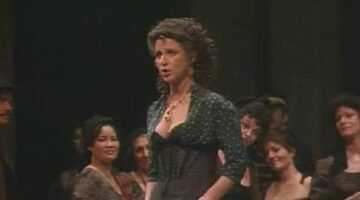
Mirella Freni
In Jean-Pierre Ponnelle’s 1974 film of Madama Butterfly, Freni’s interpretation intersects with Ponnelle’s visual critique of the opera. Freni’s Cio-Cio-San, a role she never sang onstage, seems to know that Pinkerton may never return; she recognizes, at some level, that what she imagines is a delusion, yet she chooses to wait anyway. This becomes particularly striking in the passage, “Poi la nave bianca entra nel porto, romba il suo saluto. Vedi? È venuto!” Her voice surges forward with extraordinary emotional intensity, as if a wave were slowly gathering and then breaking over her. The sheer force with which she sings of Pinkerton’s arrival seems almost to overwhelm the words, creating an ironic effect: the more passionately she insists that he has come, the more strongly we are reminded that he has not.
Ponnelle reinforces this tension visually in the coda, when he films Cio-Cio-San from a low angle. In contrast to the faith expressed in Cio-Cio-San’s words, the low-angle shot introduces a question of who is looking at whom. According to the fantasy she describes, the person who should be looking up at Cio-Cio-San is the man she has been waiting for. Yet we, as viewers, know that he will not come. The shot therefore turns her declaration of faith into something more complicated: rather than simply asking us to believe in her fantasy, it reminds us of the absence at its center. Ultimately, Freni’s interpretation suggests that waiting itself has become Cio-Cio-San’s choice.
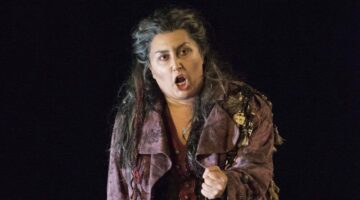
Cristina Gallardo-Domâs
A frequent interpreter of Puccini roles, Chilean soprano Cristina Gallardo-Domâs has performed Madama Butterfly in a variety of productions, including originating Anthony Minghella’s production for the Metropolitan Opera.
In her 2003 performance with the Royal Ballet and Opera, conducted by Antonio Pappano, Gallardo-Domâs presents Cio-Cio-San’s delusion as if it were a mad scene from almost a century earlier. From the very first note, she sings while gazing into the distance, drawing us deeply into Cio-Cio-San’s imagined world. When she reaches the moment at which she imagines Pinkerton’s arrival, her excitement becomes almost uncontrollable. Then, in “Chi sarà? Chi sarà?” she suddenly draws the sound inward, asking the question almost in a whisper and with an intense concentration that pulls us further into her fantasy. By the final coda, however, that restraint has disappeared: she sings each note with striking force, launching the final high B-flat almost like a projectile. The effect is as if her imagined world has reached a point of ecstatic intensity bordering on madness.
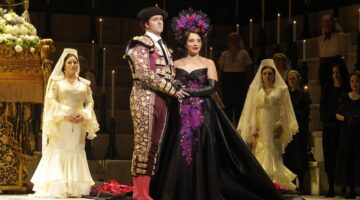
Ailyn Pérez
Pérez took flight as Cio-Cio-San at Houston Grand Opera in the 2025–26 season, bringing her characteristic combination of confidence, delicacy, and emotional nuance to the role. Pérez’s “Un bel dì” offers a particularly intriguing perspective on the very idea of Cio-Cio-San’s fantasy. In terms of narrative perspective, the opening A section initially has the quality of an omniscient narration: Cio-Cio-San describes Pinkerton’s future return almost as though she were recounting an event whose outcome were already known. As she enters the B section, however, the perspective shifts: the young Cio-Cio-San becomes the protagonist of her own fantasy, playfully imagining herself waiting for Pinkerton to climb the hill toward her. The coda introduces another striking shift. Rather than sounding simply like the Cio-Cio-San of the present asserting what will happen in the future, Pérez makes it feel as though a future Cio-Cio-San is speaking back to the woman who is imagining that future, offering her reassurance.
This becomes especially striking in the final high B-flat. Whereas many sopranos sustain the note for roughly one to one and a half measures, Pérez continues it for nearly two and a half measures, passing the one-and-a-half-measure mark and then suddenly drawing the sound down to an almost muted pianissimo. The effect is less like a climactic final declaration than a warm transition back into the present. When the note finally disappears, we seem to return to the Cio-Cio-San who has been with Suzuki—and she turns to embrace her.
Karen Chia-ling Ho
Ho’s Cio-Cio-San stands at the intersection of two important contexts surrounding the representation of the character: the shift from yellowface to casting Asian singers, and the opera’s Orientalism and cultural distortions. The role was historically performed in yellowface before being increasingly performed by Asian singers (see Allison Chu’s “Voicing Quietness”). Yet approaching racial identity itself as a guarantee of authenticity requires just as much caution as yellowface. The 2003 Boston Lyric Opera production, inspired by director Phil Chan’s critique of Orientalism, relocates the story to San Francisco’s Chinatown in 1941. Here, Cio-Cio-San is a Japanese nightclub entertainer who pretends to be Chinese to avoid discrimination.
Ho sings “Un bel dì” against the backdrop of Pearl Harbor and Executive Order 9066, which forced about 120,000 Japanese and Japanese Americans on the West Coast into incarceration camps. Her “Un bel dì” is strikingly restrained, without large fluctuations in emotional intensity, and her interpretation seems to emerge from this intersection: the aria is still about waiting for Pinkerton, but in its Asian-American context, that waiting also becomes an expression of hope that a day will come when discrimination is overcome. This layered meaning becomes especially visible in Ho’s expression after the final note. She first finishes the aria with a fleeting look of happiness, as though imagining the joy of the day she has just described. Then the sadness she has held back briefly rises to the surface, before her expression settles once again into quiet composure—as if to say that she will simply wait for that day. It is in this movement between hope, suppressed sorrow, and quiet resolve that Ho’s Cio-Cio-San seems to emerge: a character shaped by multiple intersecting contexts, and perhaps the Cio-Cio-San that Ho brings into view as an Asian singer.
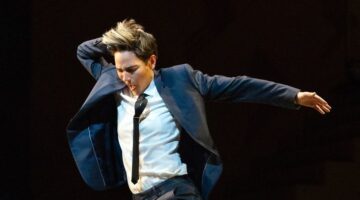
Kangmin Justin Kim
Thanks to Huang’s M. Butterfly, we can hear “Un bel dì” sung by a countertenor. Kim, known as “Kimchilia Bartoli” for performing Cecilia Bartoli’s repertoire in drag, has also taken on roles such as Cherubino in Le nozze di Figaro and Despina in Così fan tutte, expanding the possibilities of gender and casting in opera. In M. Butterfly, Kim’s Song initially appears as a Chinese opera singer dressed as a woman, before ultimately being revealed to be biologically male and a spy. Gallimard, meanwhile, becomes increasingly immersed in his fantasy of the Oriental woman, and Song faithfully performs that fantasy for him. In this context, Kim’s “Un bel dì” becomes an interpretation not simply of Cio-Cio-San’s fantasy, but of the Western fantasy that Song is performing.
Throughout the aria, Kim adopts the dramatic expressiveness of a tragic heroine in a Western melodrama, while using deliberately restrained hand gestures to evoke a stylized image of a Japanese geisha. Moreover, given that this performance of “Un bel dì” is what draws Gallimard further into his fantasy of Song, Kim’s gesture at the word “un uomo” (“a man”) is particularly ingenious. Rather than simply indicating the man whose arrival Cio-Cio-San awaits, Kim points suggestively toward an imagined man, turning the gesture into an act of seduction directed at Gallimard himself. Later in the aria, Gallimard interrupts with a melodic comment, as Huang’s music depicts him gradually taking on Pinkerton’s persona and becoming absorbed in Song’s fantasy. The idea is compelling, though the interruption can feel acoustically less seamless—perhaps precisely because Kim’s “Un bel dì” is so effective on its own.
This season, Ho returned as Cio-Cio-San at Santa Fe Opera in a revival of Lee Blakeley’s production, while Washington National Opera is preparing a new immersive production featuring Korean soprano Karah Son as the title role, running November 7–20. As “Un bel dì” continues to find new contexts and new voices, perhaps the most interesting question is not what the aria means, but what—and whose—story it will tell next.

Seokyoung Kim
Seokyoung Kim is an independent scholar based in Austin, Texas. She received her PhD in musicology from the University of Texas at Austin in 2026. Her research interests include opera studies, contemporary music, East Asian and Asian American music, and music criticism. Her dissertation, “Opera, Interculturality, and Asian American Voices in Huang Ruo’s M. Butterfly (2022),” examines Huang Ruo’s adaptation of Puccini’s Madama Butterfly, exploring interculturality and the representation of racial and cultural minorities in contemporary opera. Her research has been supported by grants from the American Musicological Society and the Virgil Thomson Fellowship from the Society for American Music.
-
Topics: perspectives on an aria
-
People: Ailyn Pérez, Cristina Gallardo-Domas, Kangmin Justin Kim, Karen Chia-ling Ho, Mirella Freni
-
Works: Madama Butterfly