Sue me!
Two experiments in opera — Opera Philadelphia‘s Complications in Sue and Heartbeat Opera‘s MANON! — receive worthy recordings.
 By
Dawn Fatale
By
Dawn Fatale
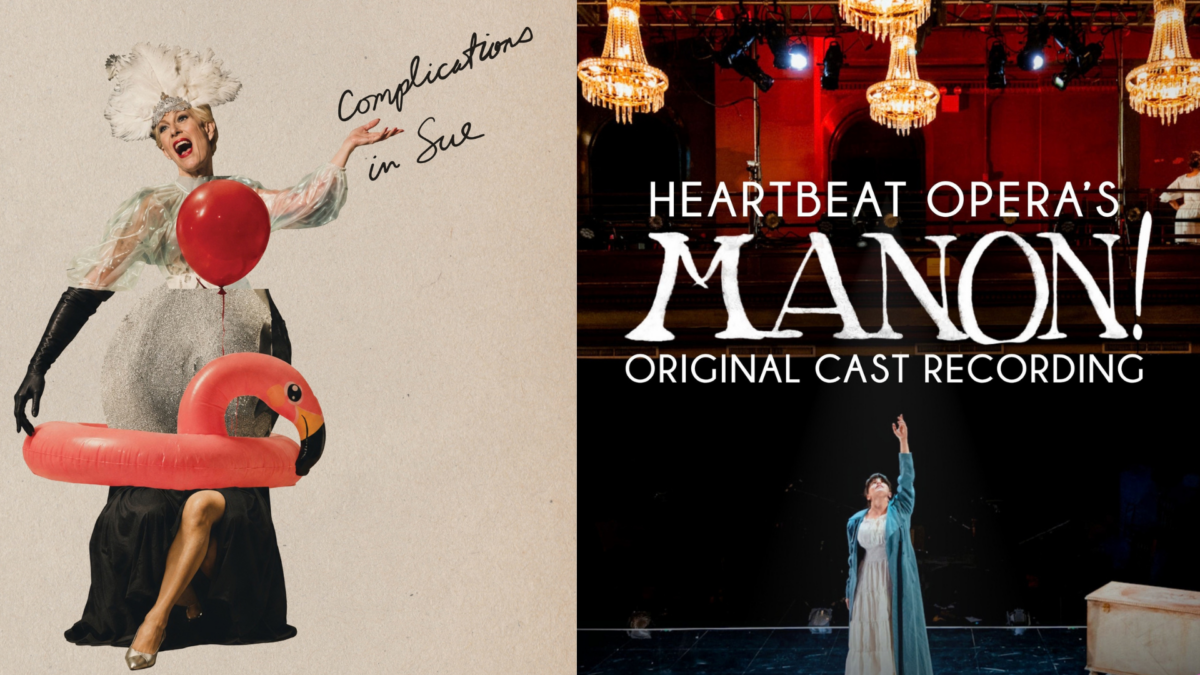
With all the challenges facing opera companies and the classical recording business, I consider it something of a minor miracle whenever we get a new operatic recording. Happily, this summer brought us a number of interesting releases including recordings of recent productions from Opera Philadelphia and Heartbeat Opera.
Complications in Sue had a great success in February 2026 when it premiered in Philadelphia, and I was disappointed to have missed it, especially after David Fox’s enthusiastic review in these pages. Thus, I was particularly excited to learn that a live recording had been made by the record label of Temple University’s Boyer College of Music and Dance. It did not disappoint.
This opera is an 80-minute collaborative work with 10 composers each providing the music for one scene of Michael R Jackson’s libretto. It follows the titular Sue from birth to her death at age 99. There is one scene per decade, focusing on individuals and forces in her life at the time including scenes where Death welcomes Sue to the world and lets her know they will meet again. College coeds gripe about Sue then beg for her attention; her ex Roger contemplates the cause of their breakup; and the Algorithm wonders how to get Sue to click more. The libretto is sharp, innovative in how it frames each scene and deftly mixes the earthy and the poetic with the political.
Sue is portrayed by the cabaret legend and MacArthur Fellow Justin Vivian Bond. Sue only sings briefly, but the character gets two spoken monologues that gleefully take a wrecking ball to the fourth wall. For the second one the libretto merely says “The actress playing Sue speaks her mind extemporaneously” which Bond does, much to the delight of the audience.
The other characters are taken by an impressive quartet of opera singers. Each sings with clear diction, considerable emotional range and the ability to underline the humor in the work with subtlety. They are Kiera Duffy (soprano), Imara Miles (mezzo, who was covering), Nicky Spence (tenor), and Nicholas Newton (bass-baritone). Each one gets a bravura solo scene; they dig into this material with gusto. Miles and Newton were new singers for me and made very strong impressions. I admired Miles’ luxurious mezzo and her ability to handle the many shifting moods in her part. Newton sings with strength and character even when the part takes him into emotionally extreme territory. I’m eager to hear both in person. Miles will be part of Heartbeat Opera’s Queeney Todd presentation in October.
Each composer has their own individual style, but the work coheres quite well. Conductor Caren Levine brings out the special character of each contribution without compromising the overall integrity of the whole. I hope other companies take up this work. With the relatively small forces (modest orchestra, one chanteuse, four opera singers, no chorus), it should be relatively easy to mount. Furthermore, judging by the enthusiastic appreciative whooping at the performance (at appropriate times), it appears to have attracted the elusive youthful opera audience.
One of the ten composers is Dan Schlosberg, a name that NYC opera-goers will recognize as the arranger and conductor for Heartbeat Opera. Heartbeat presents pared-down versions of repertory standards in English translation. They use Schlossberg’s orchestrations for small chamber ensembles and perform in theaters that hold several hundred, rather than several thousand. At their best, they bring immediacy, dramatic intensity and a welcome intimacy to the operatic repertoire.
Heartbeat just released its first recording: their edition of Massenet’s Manon (titled MANON!) recorded in the studio after the run of performances in early 2026. At an hour and forty minutes, it runs roughly an hour shorter than recordings of the complete work. The work is performed by 7 singers and 8 musicians (five more than when they did it at Irondale).
In the materials accompanying the release, the company notes that their aim was to re-envision it as a Broadway-style musical with an updated libretto by Jacob Ashworth and Rory Pelsue.
So what does this all mean in practice? The performance has great theatrical energy and momentum. Unlike many performing editions with extensive cuts, this one doesn’t feel misshapen or Frankenstein-ed together. All the singers have musical theater experience and it shows in their responsiveness to the emotional content of the material, ease with which they handle dialogue, and exemplary diction. There is a mix of operatic and musical theater stylings in their approaches to the material, but it all comes together in a compelling way to tell the story.
My biggest complaint is the emphasis in this version on the raciness and salaciousness of the material. It’s overdone, turning the performance into a tawdry story with great tunes. Adapting shows intended for the Opéra-Comique as Broadway musicals is a good idea. Oscar Hammerstein II figured that out 80 years ago with Carmen Jones, but he also realized that he needed to adapt the plot and setting to make his adaptation work. This effort comes across as Manon slathered with an over-application of Moulin Rouge.
Heartbeat has assembled a fine cast with a wide range of backgrounds. Manon, Emma Grimsley, creates a vivid characterization for Manon and has significant power for the big climaxes. Of the singers, I can envision her taking on operatic roles in larger houses. She has great chemistry with her Des Grieux, Matt Dengler. He has a lighter tenor voice and shows some strain at the climaxes, but his interpretation works within the context of this performance.
The other singers include Glenn Seven Allen as Guillot, Jamari Darling as Lescaut, Justin Lee Miller as Count Des Grieux, Kathryn McCreary as Pousette, and Natalie Walker as Javotte. They also take on some of the minor parts, but Rosette and the chorus are gone entirely. Reading through their bios, there is an interesting mix of opera and music theater experience. These are performers who could perform more opera with more opportunities, but the realities of the opera world have taken away so many opportunities. I, for one, want more opera performances with theatricality and spirit, like the ones here.
These two recordings represent important experiments in the creation and presentation of opera. Efforts like these, even when flawed will help keep opera viable and exciting. More, please.
Dawn Fatale
Richard Lynn is a New York City based opera lover who writes at parterre box under the name Dawn Fatale. His love of opera started at a very young age when he used to listen to the Met broadcasts and obsessively read back issues of Opera News in lieu of socializing at family gatherings. In college, he majored in Chemistry while taking as many music and theater courses as possible. He worked at the Music Library to get access to the opera recordings that were off limits to undergraduates. Since the early 1990s he has been writing about opera at parterre box and other publications and is particularly interested the evolution of staging and performance practices.