Urbane pastoral
Tenet Vocal Artists‘s first-ever opera production, of Monteverdi’s Orfeo, soars to Platonic ideals.
 By
Emma Hoffman
By
Emma Hoffman
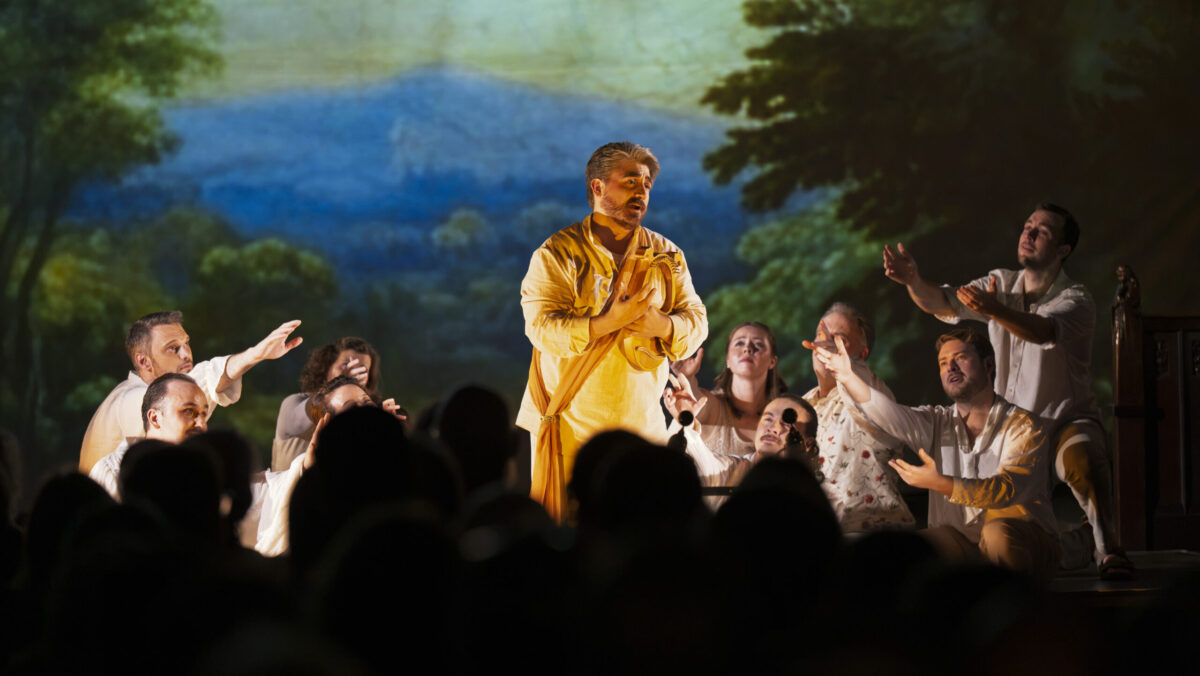
Photo: Jonathan Tichler
Tenet Vocal Artists, an early music ensemble of considerable artistic and programmatic flair, opened its 2026 – 2027 season with its first-ever opera production: Claudio Monteverdi’s Orfeo, an apt choice given its significance to the development of the art form. Their performance bodes well for the ensemble’s operatic ambitions — and New York City’s latent early opera scene.
Mounted in the stark, gothic Park Avenue Christian Church, the evening was nonetheless awash in color thanks to the vibrant playing of the 15-member period instrument ensemble, led by music director and theorbist Charles Weaver. While the opening toccata may have lacked some martial pomp, the ensemble played with considerable flexibility and refinement as the evening progressed. Jeffery Grossman on keyboards conveyed the regality of the foreboding court of Tartarus, while Amanda Beranek on harp brought forth the enchantment of Orfeo’s lyre.
Stage director Alyssa Weathersby, who briefly appeared as a featured dancer in Act I’s pastoral choruses, kept the action unfussy and direct, perhaps owing to the confines of the space, but nonetheless crafted some impactful images: a tableau vivant of a wedding party slowly unfastening into rustic jubilation, the grief-stricken Messaggera processing up the nave in place of Orfeo’s bride, and cassocked spirits dragging that same bride, which, given the venue, lent a gothic tinge to the proceedings. It should be noted that the venue was not ideally suited to staging; at intermission, the ladies behind me kvetched (loudly) about obstructed sightlines, and I (squat as I am) struggled to see.
That left Camilla Tassi’s elegant projections with the task of conveying the setting — and perhaps some of the action — for those seated toward the back. Frescoes of cherubim from Mantua’s Palazzo Ducale dissolved into an equally painterly meadow, a tree climbing up the stained glass of the apse. Light streamed into the blue-grey mists of hell as Orfeo serenaded the pitiless Caronte, and the apse exploded into a field of stars as he ascended to immortality. The one misstep was perhaps a rather obvious depiction of the gates of hell with that immortal phrase, pronounced twice in the opera: “Lasciate ogni speranza, voi ch’entrate.”
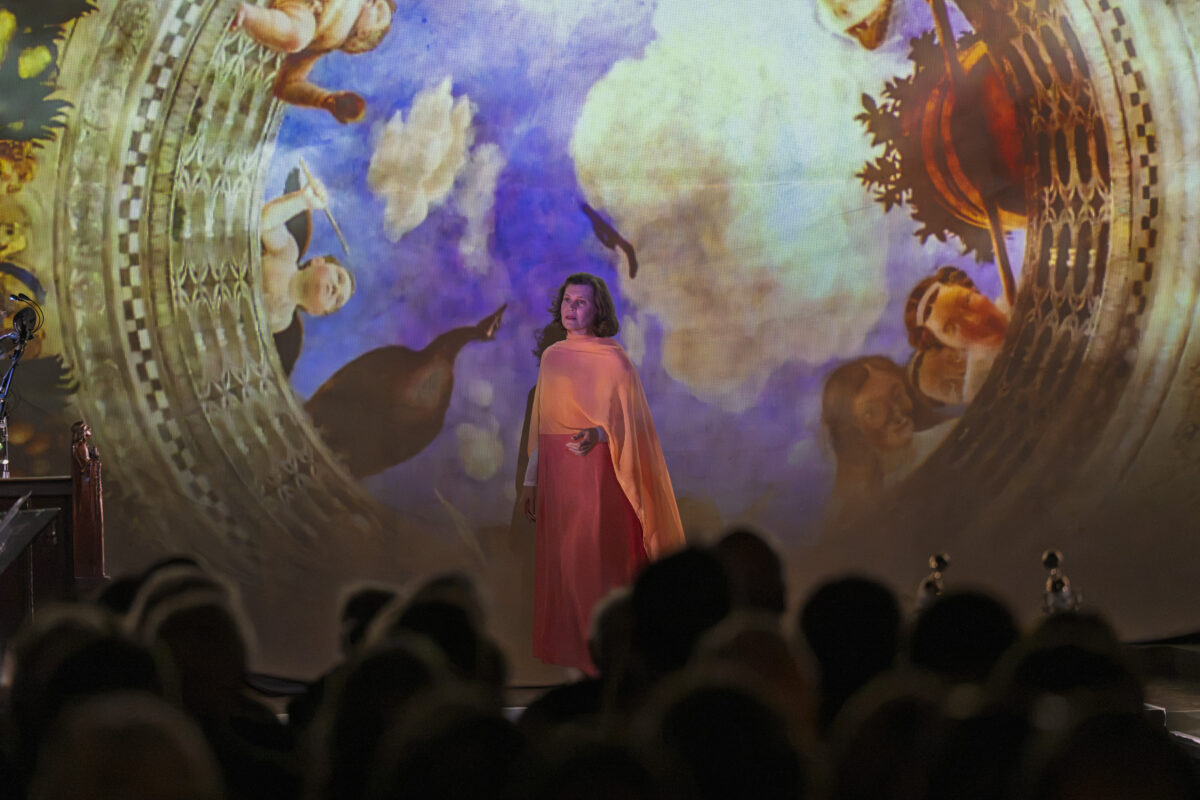
Photo: Jonathan Tichler
Two of the evening’s strongest vocal performances came courtesy of Jolle Greenleaf as La Musica and Elisa Sutherland as La Messaggera and La Speranza. Greenleaf, also Tenet’s artistic director, deployed what could be described as the platonic ideal of an early music voice: a clear tone of unwavering purity, with a delicacy that recalls a sprig of jasmine pressed between the pages of a psalter. A similar delicacy tessellated into silver-edged cries of grief as Sutherland’s Messaggera carried her ill-tidings to the bridegroom. Her expressive handling of the text, both in the Messaggera’s self-castigation and Speranza’s evocation of the gates of hell, brought out the emotionality — and, indeed, playful referentiality — within Alessandro Striggio’s libretto.
The aptly named (for an early music specialist) Jacob Perry was an assured Orfeo, with a supple tenor of cedar-hued luster. The sensitivity he infused into “Rosa del ciel, vita del mondo” lingered still among the boisterous phrases of “Vi ricorda, o boschi ombrosi.” His “Possente spirto” — surely, the first showpiece aria of the operatic canon — would have transfixed with its intimate dynamics, were it not for the sirens blaring on Park Avenue. Nonetheless, his command of period ornamentation rose above the noise, especially his one-note trillo — that early baroque bleating was downright beautiful.
As Euridice, his ill-fated bride, Madeline Healey’s sensuous tone and dramatic commitment nearly compensated for some imprecise pitch. It was a clever choice to have her double for Eco, often sung by a tenor: she who was lost voices the grief of he who remains. Les Arts Florissants alum Paulina Francisco brought equal sultriness as an implausibly contented Proserpina.
James Reese shaped his agile, robust tenor both to the jocular melodies of the shepherd and the expansive, magisterial phrasing of the intervening Apollo. As Caronte, Paul Max Tipton’s bass-baritone plunged well below the gravelly, producing an earthy, resonant sound. Harrison Hintzche’s tone may not have been quite as deep and rounded, but he was nonetheless a commanding Plutone.
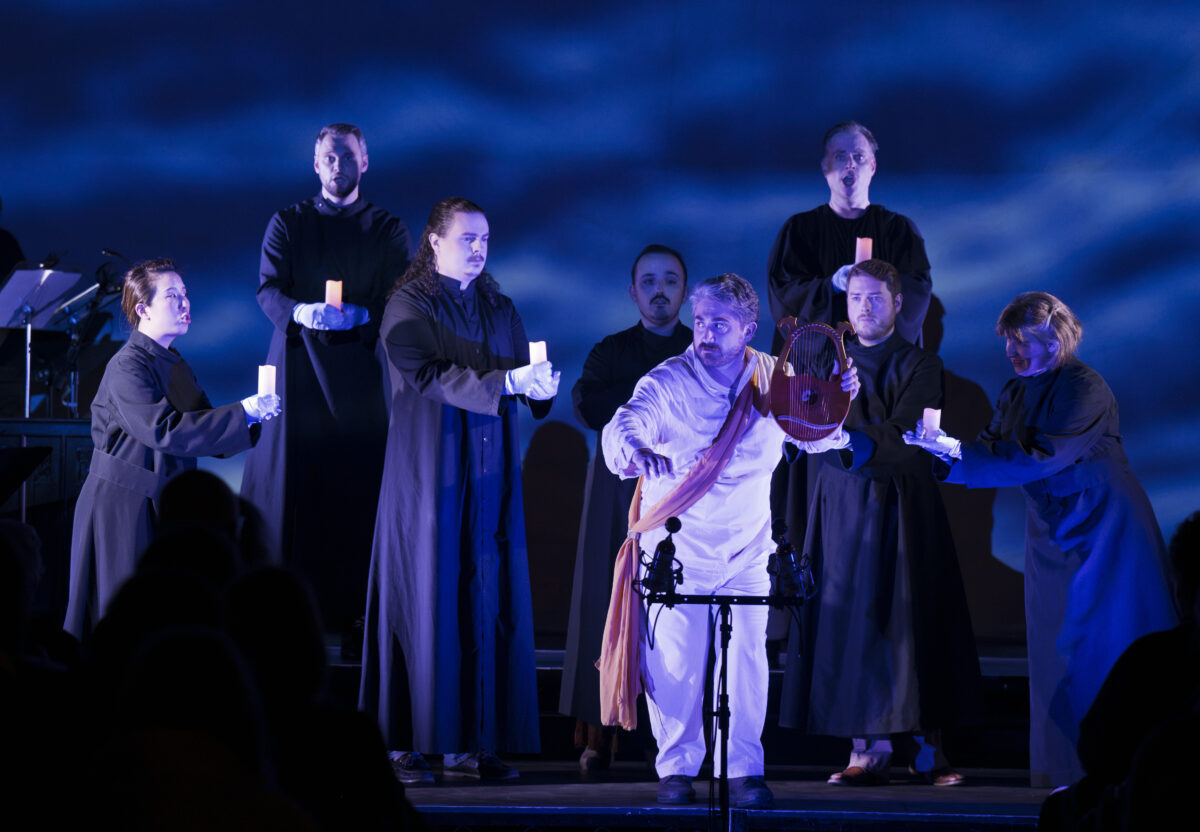
Photo: Jonathan Tichler
Most of the cast pulled double duty in the ensemble, and the opera’s many madrigal-like choruses were crisp and pulsating. The choruses set within the underworld had a particular funereal glow, thanks, in part, to the strength of the ensemble’s low voices.
Overall, it was a successful first for Tenet, with both performances selling out. Hopefully, it foretells more operatic endeavors — in more conducive venues — for the company.
Emma Hoffman
Emma Hoffman is a graduate of Barnard College. In 20 years she’ll be a crusty Upper West Sider in a babushka.
-
Topics: early music, monteverdi, Review
-
People: Alyssa Weathersby, Camilla Tassi, Charles Weaver, Elisa Sutherland, Harrison Hintzche, Jacob Perry, James Reese, Jolle Greenleaf, Madeline Healey, Paul Max Tipton
-
Works: Orfeo (Monteverdi)
-
Places & Organizations: TENET