Così Island
The Metropolitan Opera gets its freak on — or about as close as it can — in a revival of its Coney Island-set production of Così fan tutte.
 By
Dan Johnson
By
Dan Johnson
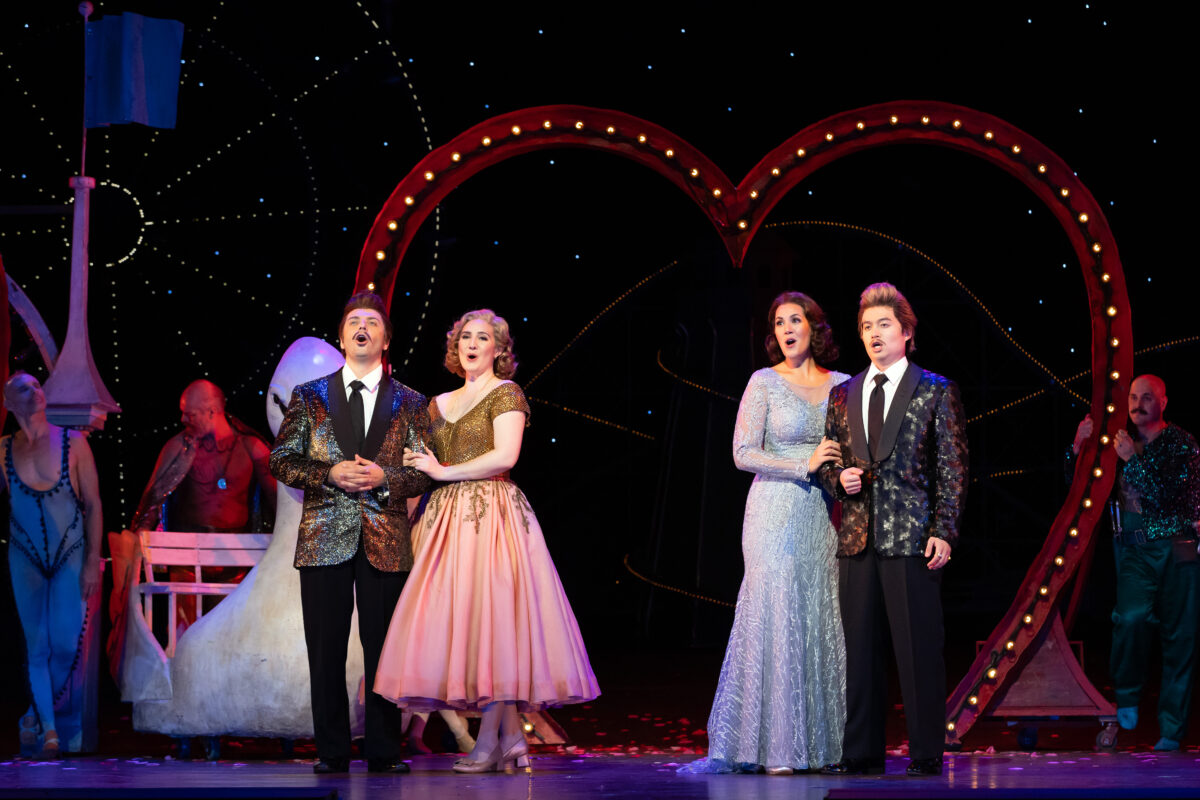
Andrey Zhilikhovsky as Guglielmo, Samantha Hankey as Dorabella, Federica Lombardi as Fiordiligi, and Duke Kim as Ferrando in Mozart’s “Così fan tutte.” Photo: Marty Sohl / Met Opera
Okay, they haven’t quite nailed Don Giovanni. But otherwise, the Metropolitan Opera’s recent productions of Mozart’s late operas — Richard Eyre’s Nozze di Figaro, Simon McBurney’s Zauberflöte, and Phelim McDermott’s Così fan tutte — have managed to translate Mozart’s magnificently strange and complex music dramas into modern (well, 20th-century) drag to great success.
The Met’s aesthetic program is largely conservative, trading capes and hoop skirts for neckties and cocktail dresses, stirring in a little extra stage business, but otherwise not taking any wild or confusing interpretive swings — resulting in productions that are, at their worst, tepid and weak, but at their best, readily accessible and entertaining stagings like these. I’ve been fortunate enough to see most of these productions performed more than once, but Wednesday’s season premiere of Così fan tutte confirmed that it’s one of the most satisfying watches out of the bunch.
Mozart’s most musically splendid opera, Così might also be one of the most difficult, out of all the works in the standard repertoire, to stage persuasively — or, at least, out of all the works in the standard repertoire that don’t have a dragon in them. The misogyny in Lorenzo Da Ponte’s libretto could not be more overt (It’s right in the title! ALL ladies, the marquee announces, will let you down!), but as in, say, The Merchant of Venice, the work is so beautifully strange and nuanced that it seems to undermine the prejudices of its own time.
So how do you let this plot play out in such a way that its contradictions seem sophisticated instead of merely contradictory? How do you stage a story where the moral is so … amoral? How can we root for lovers who behave so hatefully?
Quick plot synopsis: Ferrando and Guglielmo think that their fiancées, the sisters Dorabella and Fiordiligi, are perfectly faithful. Don Alfonso bets the boys that no woman is that faithful, and to test his theory, the two pretend to go off to war and come back in disguise to seduce each other’s girl. He enlists a chambermaid, Despina, to help with their scheme, the boys pretend to drink poison to win the girls’ pity, and they keep up the farce until they have the girls signing marriage contracts to their new suitors.
It’s a pileup of perverse incentives; Alfonso has not only manipulated the girls into breaking their vows, but he’s also manipulated the boys into competing to cuck each other and lose the bet. It’s all rendered more comic, yet also strangely moving, by the serious beauty of the music. McDermott’s production responds by leaning into an aesthetic that embraces contradiction —sparkling, cheap, distorted, farcical, earnest, lovely, ugly — namely, the carnivalesque spirit of a Coney Island-like seaside amusement park in the 1950s.
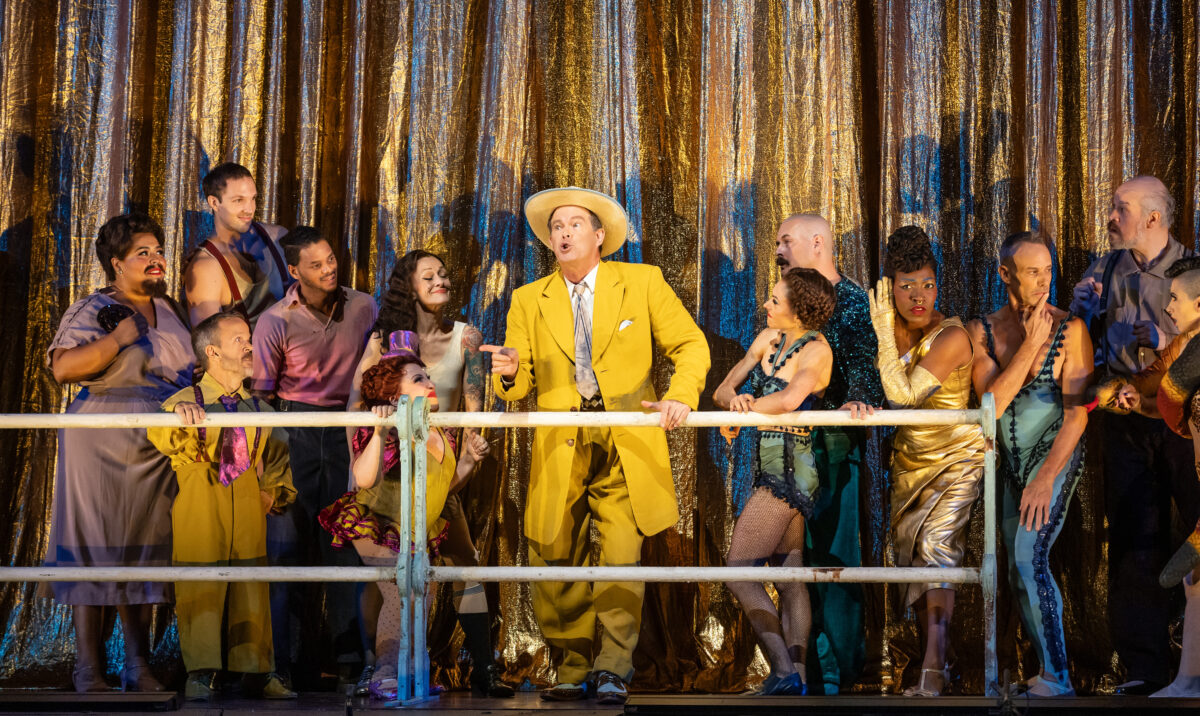
Gerald Finley as Don Alfonso in Mozart’s “Così fan tutte.” Photo: Marty Sohl / Met Opera
The time and place fit perfectly with the themes of the piece: The mores of midcentury America erode at the wavering line where land meets sea and sky, a little vacation spot where the rules of everyday life seem to have been suspended. The characters stay at a nearby motel, that place where Americans can most easily disguise their identities or disappear completely. In the most striking addition to the opera, this Don Alfonso commands a sideshow troupe of supernumeraries, who help him run the show he puts on for us (moving set pieces, etc.), as well as the various charades he puts on within the opera.
Between the puppetry in his pivotal production of Satyagraha, the juggling in his Akhnaten, and the sideshow performers in this Così, Phelim McDermott has a pretty good track record of using “low” spectacle to enliven the solemn stage of the Met, and this is no exception. As classical comedy upsets the hierarchies of class and gender, the bonds of monogamy, these performers — a bearded lady, a pair of contortionists, a pair of little people, and so on — suggest a world in which the very bounds of the human body have been suspended.
Watching the performance this time, hearing the audience laugh and cheer as the little people emerge from Alfonso’s magic trunk at the start of the overture, I was also struck by parallels between the uneasy way in which the spectator engages with a sideshow “freak” and the ways in which Mozart and Da Ponte toy with our sympathies. 20th-century sideshows could be sites of ridicule and exploitation, or homes where people who would have been undesirable according to the hypocrisies of polite society could find work, home, and community, where instead of outcasts, they could become celebrities to a paying audience. Are you laughing at the differences of these sideshow performers, or are you celebrating them? When the characters in Così are heartbroken, are we laughing at their misery, or commiserating with them?
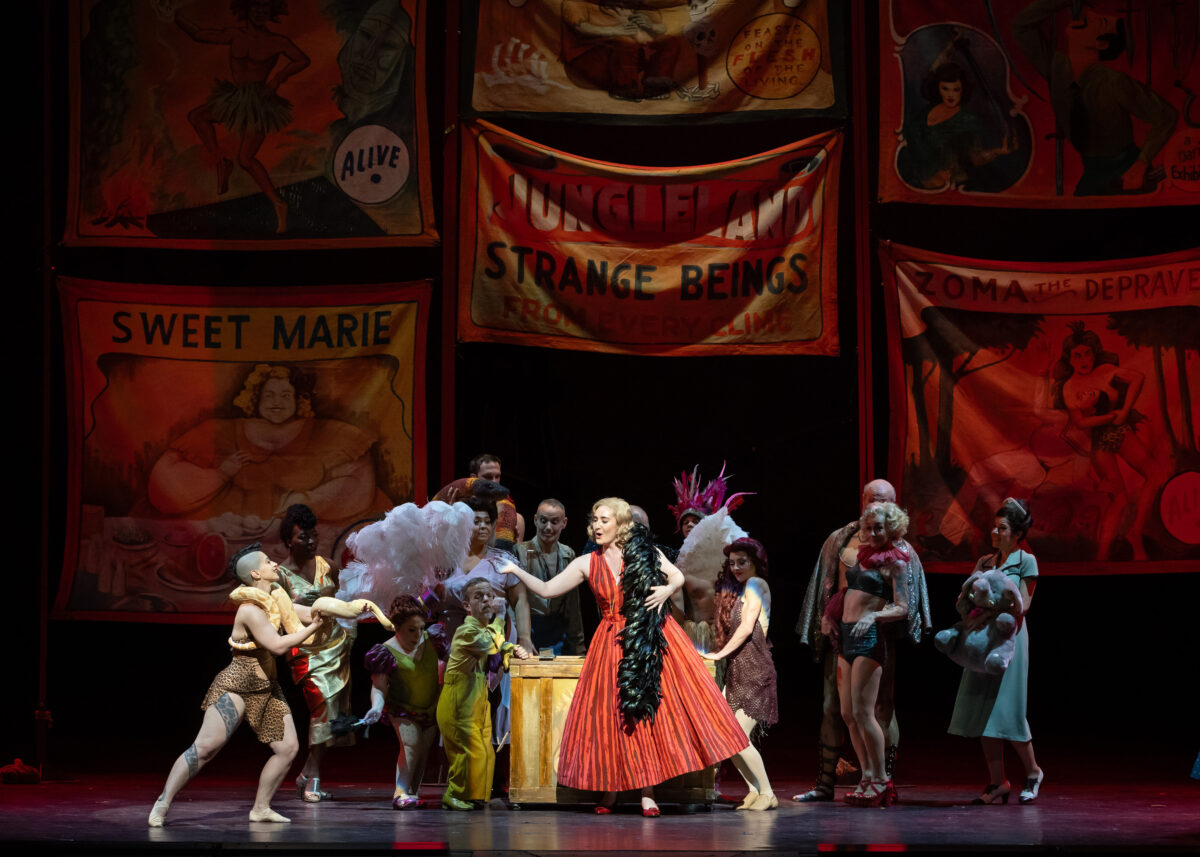
Samantha Hankey as Dorabella in a scene from Mozart’s “Così fan tutte.” Photo: Marty Sohl / Met Opera
Because that’s the thing about Coney and Così: The opera isn’t remotely plausible; the characters are too mean or too stupid to be remotely sympathetic… and yet. It’s just the way it feels when you go to noisy, greasy, vulgar Coney Island, and the sun starts to set on the tacky, ugly decorations, and all the twinkling multicolored lights come on in the dimming radiance of a long summer twilight — you’re going to find that beautiful whether you want to or not. The carnival rides also lend the stage tableaux a visual scale that an intimate piece like Così would otherwise lack under the massive Met proscenium.
One downside of making Don Alfonso a seedy Coney Island character is that the opera’s class analysis goes out the window. He’s not a respectable aristocratic philosopher here; he’s just some guy in a Cab Calloway suit — and while I’m at it, I should admit that Gerald Finley, who played the role on Wednesday night, is simply not a very funny actor. But he is a brilliant musician and a compelling stage performer, and his dark-hued voice and physical gravitas bring out the sinister side of what is, ultimately, quite a diabolical character. (This production even puts him in a red sequined suit for the big wedding finale!)
Just as the Don Alfonso of Da Ponte’s libretto has, by virtue of his class, transcended conventional morality, his partner in crime — the chambermaid Despina — is conversely liberated from respectability by the meanness of her own station. As the opera’s MVP, Despina is smart, funny, and likable, and Ana María Martínez managed to be all three, while lending the role an intriguing vocal color I’d never quite heard before — bright, but not brassy, more like a clarinet — and of course, she clowned it up with a shrill, reedy sound for her scenes where she gets up in drag to play a quack or a notary.
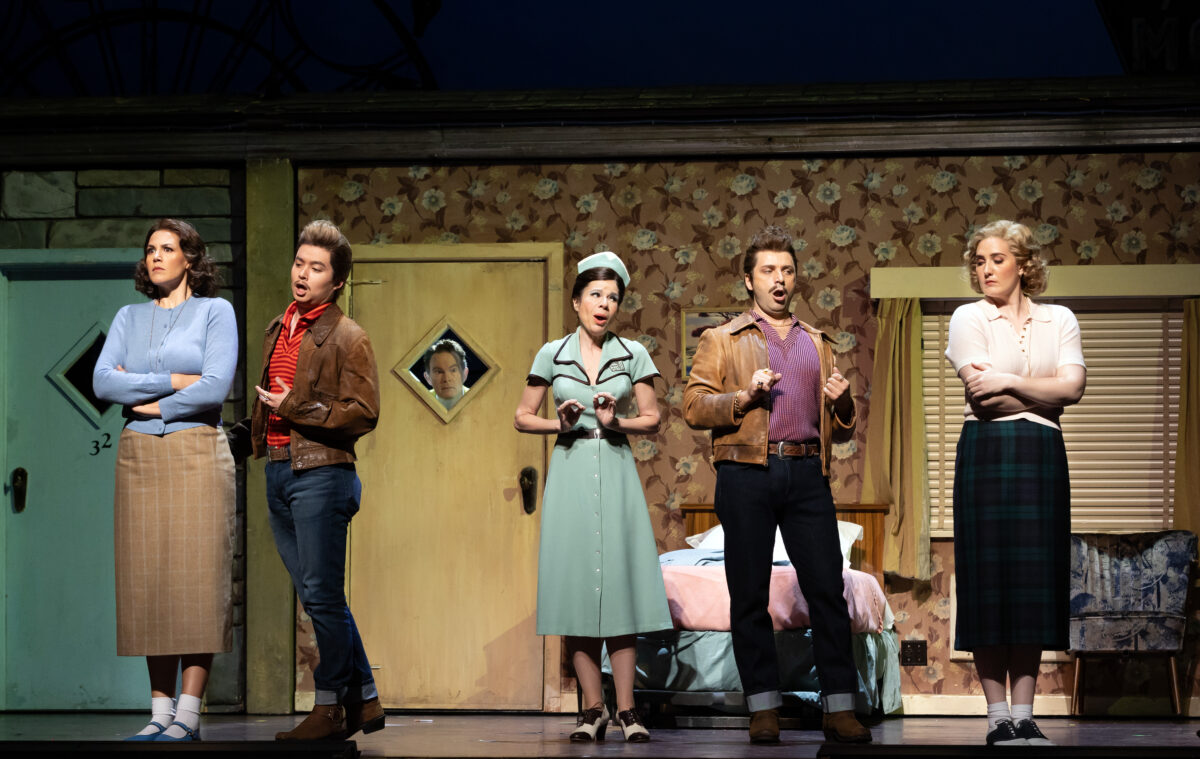
Federica Lombardi as Fiordiligi, Duke Kim as Ferrando, Gerald Finley as Don Alfonso, Ana María Martínez as Despina, Andrey Zhilikhovsky as Guglielmo, and Samantha Hankey as Dorabella in Mozart’s “Così fan tutte.” Photo: Marty Sohl / Met Opera
On the whole, the cast was nearly as attractive to the eye as to the ear, with the ladies sinking their teeth into the text and giving opera seria realness in the emotional weight of their vocal performances. Samantha Hankey’s Dorabella showed off a big, luscious instrument, and the flashes of brightness in Federica Lombardi’s Fiordiligi were especially appealing. As Ferrando, the shockingly handsome Duke Kim married a sweet, lyrical tenor, recently heard in his Met debut as Tamino, to an appealingly awkward stage presence — after all, he’s playing an idiot playing a lothario —, but I was most taken with Andrey Zhilikovsky, a Moldovan baritone heretofore unknown to me, and his hammy, horny Guglielmo. Funny, sexy, in command of a wide range of vocal colors, his performance was a bona fide star turn.
I won’t shock anybody who’s ever heard the Met orchestra when I say that they gave us an exquisite performance, their well-balanced and -blended choirs of instruments supporting the singers with billowing chords. Conductor Nimrod David Pfeffer, unknown to me despite his increasingly frequent engagements as a Mozartian at the Met, leaned indulgently into the loveliness of the score — not the screwball pace I would usually demand for a Mozart comedy, but it gave us the time to settle into the richness of Così.
As for this revival: does the production hold up? Well, as with any fun fair, a bit of the glitter is bound to rub off. When Fiordiligi climbs into one of the cars on the Ferris wheel and rides up and down, a little light shines on that car in the miniature Ferris wheel upstage, so we know we’re seeing it in close-up—but on Wednesday night, when I saw the wheel again later in the show, I noticed that the light was still on. Why? Was it like that in previous stagings of this production, and I just never caught it? Or was it a rare mistake by one of the Met’s brilliant stagehands? Most of my complaints with the evening were like this — minor quibbles, where something of the original magic was lost along with the pleasant surprise that had accompanied the premiere performances. But all in all, it was a show I was as happy to return to as I am to Coney Island on a summer night. Familiar, yes, but a familiar delight.
Dan Johnson
Dan Johnson was born in the desert and learned to play the fiddle. Now he lives in Brooklyn, working as a freelance writer and music communications specialist and helping to throw some of the city's most notorious underground parties.
-
People: Ana María Martínez, Andrey Zhilikovsky, Duke Kim, Federica Lombardi, Gerald Finley, Nimrod David Pfeffer, Phelim McDermott, Samantha Hankey
-
Works: Così fan tutte
-
Places & Organizations: Metropolitan Opera