All about Eve
Haley Whitney shines as the mother of us all in The Marigny Opera Ballet‘s stirring staging of Scarlatti’s Cain.
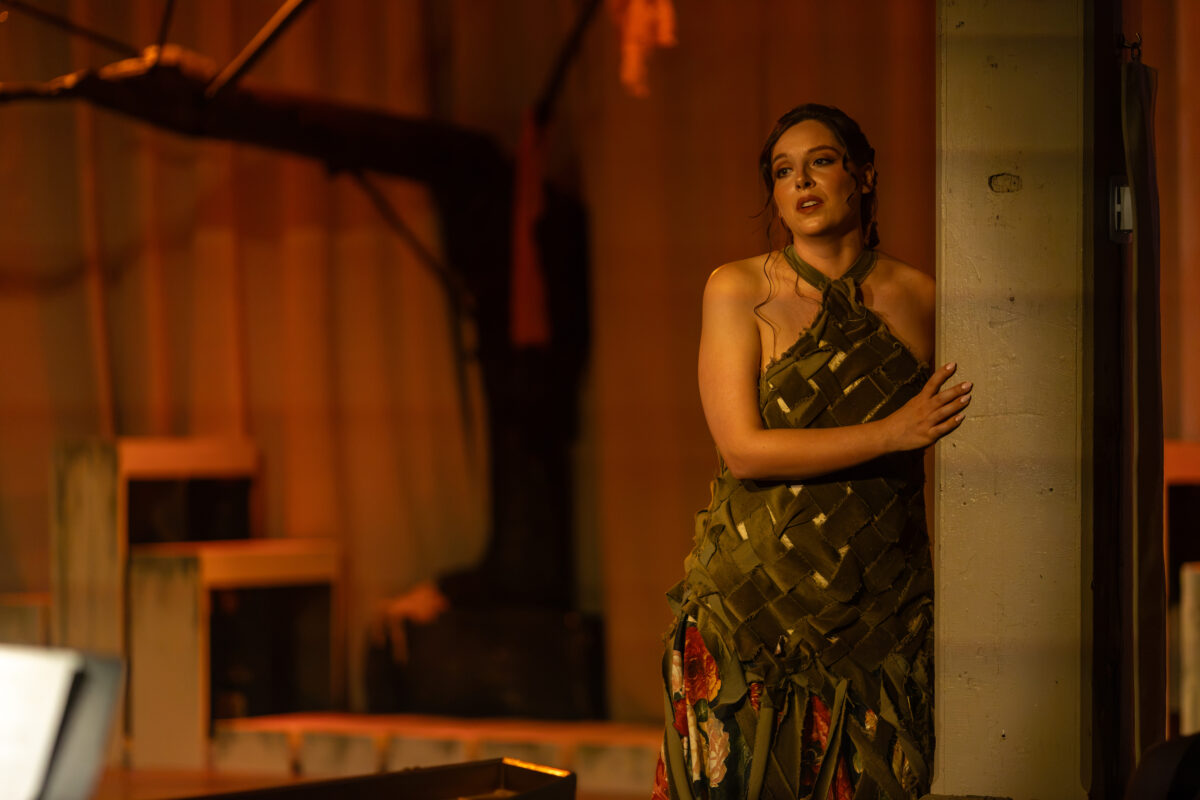
Photo: Dmitriy Pritykin
Adam and Eve and Cain and Abel can come across as static figures, allegories in stained glass. Or they can retreat into abstractions in the deflating explanations of bien pensant scholars and clerics. “Yes, yes, humans fell from grace,” we might imagine a bookish pastor assuring us with a scotch in one hand and an anthropology monograph in the other, “but let’s leave behind a literal Adam and Eve. Cain and Abel were not real people.”
The Marigny Opera Ballet in New Orleans offered more imaginative possibilities. Partnering with the Verismo Opera company, their September staging of Alessandro Scarlatti’s oratorio Cain, overo il primo omicidio gave us biblical figures who bleed and weep and cling and care and stagger forward heavy with remorse.
Opera season in New Orleans normally starts at the Mahalia Jackson Theater with a production from the New Orleans Opera Association, but this fall finds the NOOA experiencing institutional turbulence — an inauspicious sign indeed when a city’s major opera organization does not have a “Season” button on its website. So this year, we kicked off in the Marigny neighborhood with this oratorio turned opera-ballet.
The selection of Scarlatti merits praise. Artistic director Bogdan Mynka has curated a season of works that provide promising opportunities for collaboration between opera and ballet. This year at the Marigny Opera House, we’ll see fully-staged productions of Kurt Weill’s Die Sieben Todsünden, Berlioz’s La Damnation de Faust, and Purcell’s Dido and Aeneas. Give me this repertoire over the one-billionth Bohème any day.
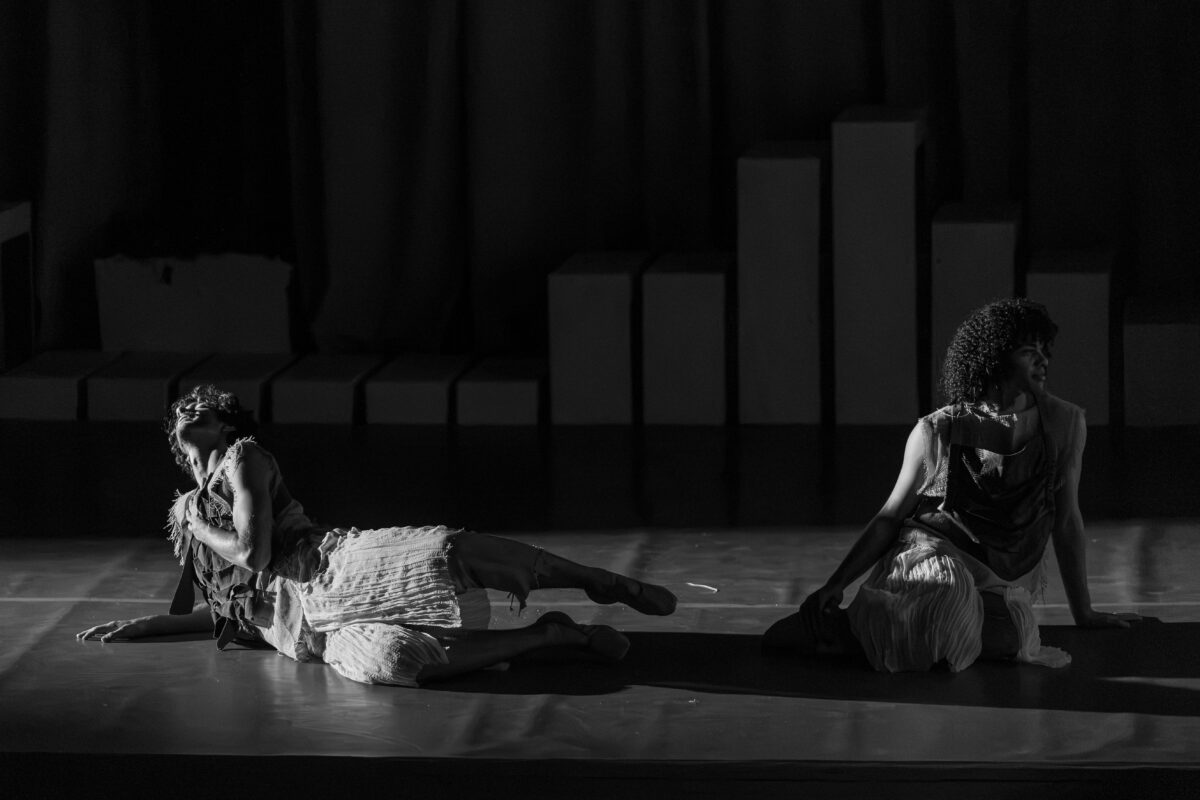
Photo: Dmitriy Pritykin
The combo-company seems confident in balancing opera and ballet on the same stage in ways that avoid the busy excesses of, say, a Peter Sellars production. Mynka announced the structure before the show: Cain (Claudio Caverni) and Abel (Caleb Chesson) would not sing but dance, accompanied by orchestral improvisations on Scarlatti’s score led by Paul Weber, music director and harpsichordist. While they danced — at times with either fallen or non-fallen angels — faint supertitles (indeed, fainter, ghostlier than the ones projected during sung portions of the piece) displayed translations of the Cain and Abel arias.
The best use of these “wordless” arias came when the murdered Abel danced beside his grieving mother. In the original oratorio, the voice of Abel issues from Heaven to console his parents. Here, a translation of the line “Più del vivo è salvo il morto” hung over Eve and Abel’s heads for minutes on end. Chesson danced as Haley Whitney’s Eve mourned — a moment of dramatic subtlety and power. I can imagine only the fustiest purist grousing over the lost arias.
Like the dead Abel, though, the lost arias were not truly lost. Earlier when Chesson, exuding pastoral playfulness, hopped merrily across the stage anticipating his sacrifice to God, Weber and orchestra improvised on “Dalla mandra un puro agnello,” ensuring that the cut of the aria did not mean a radical departure from the spirit of Scarlatti’s piece. Cheers to Caverni for dancing a brooding and self-centered Cain and to Chesson, whose effervescence and sweetness fleshed out a figure Genesis does not describe in detail. At one point, he leaped onto the unamused Cain in what seemed an affectionate embrace, only to be flung across the stage. Love me, brother! But then, the rebuff.
The highlight of this Cain: it’s all about Haley Whitney’s Eve. Her early arias “Caro sposo, prole amata” and “Sommo Dio nel mio peccato” set the tone for the entire opera. No detached allegories here; this is a psychologically-textured depiction of a mother wrenchingly aware of her past misjudgments and how her and her husband’s actions destroyed the possibility of an untroubled life for their sons. Whitney’s talents as a singer and stage presence as an actress meant that we felt with Eve, not only her remorse but her dignified sense that she and her family must move forward. Time does not stop because of sin. The “sacro legno” of the Cross is yet to come, and this Eve refuses to stagnate in despair.
Adam, sung by Mynka himself, stood out for the delicacy of his vocal phrasing: a plaintive, gentle Adam. He and Whitney did marvelous work with the duet “Aderite / Obbedite” in which Adam and Eve, in a rollicking back-and-forth, counsel their sons on the pleasures of conformity to the divine will.
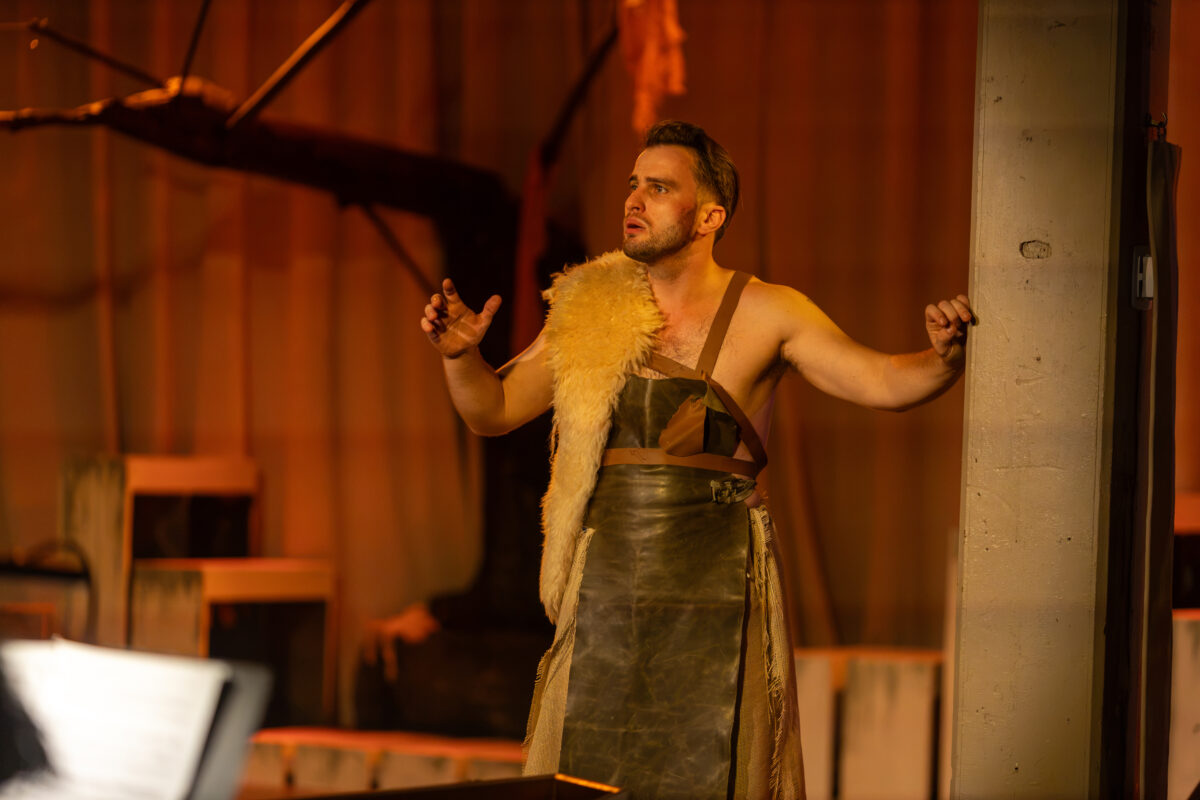
Photo: Dmitriy Pritykin
God, sung with clarity and composure by Claire Shackleton, stunned in a sparkling headdress created by the French Quarter fashion designer Magdalene. Shackleton’s steady, crystal-clear delivery served as a foil to the hammy qualities of Steve Valenzuela’s roguish Lucifer. At first, I worried this Lucifer leaned too far into rascality for a conspirator in fratricide, but once Valenzuela settled into his work on Cain’s frustrated ego, his singing shaded into a darker form of diabolism.
Intermission came immediately after the murder, leaving an entire second act for our first family to process the loss of Abel. What Scarlatti emphasizes over and over is that nobody (except Lucifer) is giving up on Cain. Adam and Eve both admit in separate arias that their love continues to extend to both their sons: “Piango l’uno, perch’è errante, / Piango l’altro, perch’è ucciso.” The erring and now-errant son still deserves care, and even God does not impose the death penalty on the first murderer.
Caverni’s Cain set off carrying his bloody baggage, represented by a trailing cloth, half-stained red, that he tried to stuff into a literal suitcase but then drew out and tangled around himself. The choreography by Amalia Nejara for Cain, up until this point mostly conveying a hardness and self-absorption, now granted him a tortured sensitivity.
We ended with Adam, Eve, God, and Lucifer bidding farewell to Cain beside the gnarled tree at center stage. A few sad strips of colored ribbon hung from the blackened branches. Bethany Lee’s set design depicted a bare and blasted world that the first humans had tried to beautify in little ways with a little art. The quartet, instead of the standard ending to the oratorio, sang an adaptation of Scarlatti’s “O Morte” from his Madrigali. Suitcase in hand, Cain moved offstage — remorseful, changed, broken, but not done with life.
Matthew Paul Smith
Matthew Paul Smith is an instructor in the English Department at Tulane University. His publications include a chapter on post-Civil War New Orleans literature in New Orleans: A Literary History (Cambridge UP, 2019) and an article on plantation tourism, narrative, and aesthetics in Southern Quarterly (2018). He has two forthcoming edited collections: The Cambridge Companion to the Literature of New Orleans (Cambridge UP) and Cross Cultural Encounters in Early Modern Japan: Foreigners Within the Samurai Class, 1550-1900 (Routledge). He is a native of New Iberia, Louisiana and a current resident of New Orleans.
-
People: Amalia Nejara, Bethany Lee, Bogdan Mynka, Caleb Chesson, Claire Shackleton, Claudio Caverni, Haley Whitney, Paul Weber, Steve Valenzuela
-
Works: Cain
-
Places & Organizations: Marigny Opera Ballet