Bang to whimper
Opera San José opened its season with a new production of Don Giovanni that embraced the opera’s challenges with youthful abandon, even as it was sometimes felled by them.
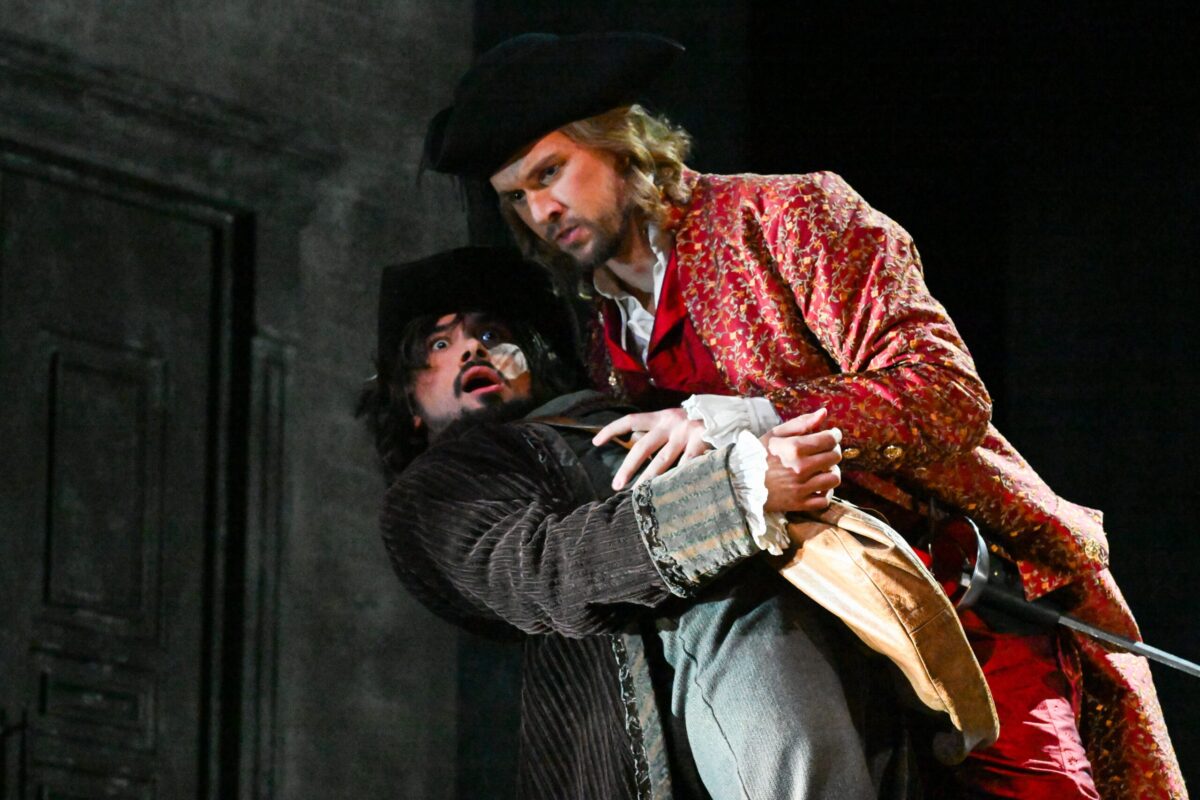
Photo: Don Lepori/Opera San José
Don Giovanni is an opera about opera. Of any of Mozart’s works for the stage, it reminds us that it’s a work for the stage. Mozart even quotes another of his operas in the score. And while Don Giovanni is reminding us what it is, it’s also shoving our expectations of grand opera back in our face.
It begins with a murder committed onstage in full view of the audience. No build, no suspense, no rising action. Boom. That’s it. The opera is peopled with rather flat characters who struggle to be in any way likable or redeemable. The music is as smart, sumptuous, and layered as the humor is sophomoric, inane, and predictable. The opera toggles back and forth between middle school jokes and profound heartbreak, from hellish retribution to “aw shucks” moralizing.
Also: Thanks, Mozart, for calling it a dramma giocoso, which is like calling it a jumbo shrimp or a truthful liar. There is no such thing as a “funny drama” anymore than there is such a thing as a wordless poem or a baseball game without a baseball. Mozart tells us right away that nothing is really going to make sense in this opera, and that we’ll have to accept contradictions and be fine doing it.
In short, Don Giovanni is perhaps the weirdest opera to be a cornerstone of the repertoire. It’s also Mozart’s most visceral and most passionate and most energetic opera. It is perfect for a company like Opera San José, the second-largest opera company in Northern California and a company known and beloved for nurturing the careers of young artists. With casts of mainly rising singers, the company’s offerings, even of opera warhorses, are always exciting and leave me energized.
Opera San José opened its season with a new production of Don Giovanni, a production that embraced the opera’s challenges with youthful abandon, even as it was sometimes felled by them.
In the hands of tenor turned stage director Alek Shrader (himself a former Don Ottavio), this largely traditionalist production offered a few memorable twists as it largely hewed closely to a down-the-middle approach. But there was no denying the sheer energy.
At the podium was music director Joseph Marcheso. One couldn’t ask for a more solid conductor. I’m happy to be able to complain (so to speak) that he was almost too solid. I found myself wishing he would assert the role of the orchestra a bit more, because the orchestra was flawless — another example of the Bay Area’s embarrassment of riches when it comes to ensembles.
As is the norm for productions at Opera San José, Don Giovanni was set as a period piece, and in a vaguely 18th-century Europe. (For the record, Lorenzo da Ponte’s libretto simply sets it in “a city in Spain” which is usually understood to be Seville). Feathered caps, panniers, foils, capes all came along for the ride. Of any of Mozart’s operas, Don Giovanni probably holds up the best when moved to a different time period or produced with a bold aesthetic approach. Shrader and the design team played it relatively safe, even a bit on-the-nose, which lent the production an air of sweet earnestness that doesn’t always match the acrid anarchy of the opera itself.
The curtain opened on Steven C. Kemp’s greyscale unit set. It was a bit of a stylistic mish-mash between classicism and unintended brutalism, the flat grey walls a blunt counterpoint to the period finishes. Don Giovanni’s party palace featured Corinthian columns (one black, one gilt) and an oversized mirror, while Donna Elvira’s balcony was simply a large red box. Garden scenes featured a wall covered in vines of quite rigid straightness and symmetry. Most effective was the forest where we met Zerlina and Masetto. A simple scrim for background and silhouetted trees were elegant and tasteful. The graveyard achieved a similar effect with a backlit scrim and simple gravestones. Because we can see everything in a theatre as small as OSJ’s, more impressionistic sets work better. And when Kemp went in that direction, the results were striking.
Caitlin Cisek’s costumes were similarly a bit of a mish-mash of styles. Don Giovanni and Leporello were clothed in what looked like Renaissance attire, while Donna Elvira, Donna Anna, and Don Ottavio were squarely in the 18th century. Masetto and Zerlina were in peasant garb that could have been anywhere but seemed Neapolitan if anything (Masetto’s modern trousers were out of place among the kneebreeches and pantaloons). Cisek smartly used color to highlight the various relationships among the characters, an oft-overlooked skill that a good costumer masters. Cisek has mastered it.
Shrader’s direction kept the action moving. This is a blessing in any Mozart opera which, when slow, can feel an hour too long. We were spared any sort of park-and-bark. There were times, however, when I wanted characters to feel free to ground themselves and just sing. Donna Elvira was a case in point, stalking about the stage, clutching at Zerlina. None of it really did the characterization any favors. Shrader clearly felt that Elvira was a woman at her breaking point. And this is a fair reading of the character.
Shrader was onto something with Elvira, and I wish the rest of the production had supported this fraying of Elvira’s psyche. But it also went a bit too far.
What makes a character like Elvira watchable is her attempt to not look unhinged. No one wants to be an object of ridicule. Elvira may be obsessed with Giovanni, but she can’t necessarily appear to be obsessed with him. Soprano Maria Brea held nothing back, which was admirable. I’ll always take a performing throwing everything into a role over keeping the character at arm’s length. But the effect was to make Donna Elvira feel one of the heroines of The First Wives Club, comically hellbent on annihilation. Her showpiece aria “Mi tradi quell’alma ingrata”, and a moment of profound introspection, found Brea crawling on the floor. I so wanted Brea’s Donna Elvira to take a moment and just exist.
Vocally, Brea tossed off high notes like they were mere trifles but struggled with how low the role sits for a soprano (she particularly struggled in the recitatives). She has a sleek sound that is thankfully unfussy. But the paradox was that her lack of bluster or wooliness meant she could not conceal the intonation issues lower in the voice. I would love to hear her as Donna Anna.
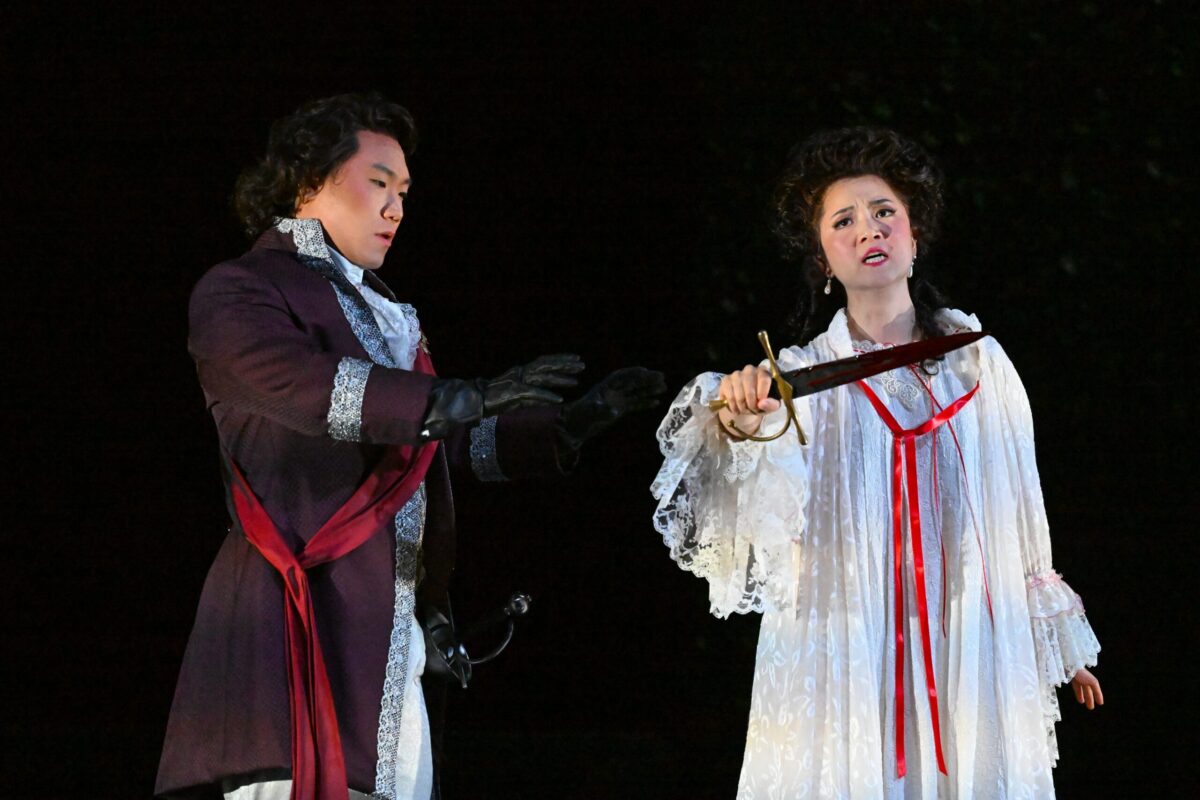
Photo: Don Lepori/Opera San José
Speaking of which, Shrader’s take on Donna Anna was not as concrete or memorable. At the top of Act I when she’s fending off a masked and predatory Don Giovanni, soprano Yulan Piao couldn’t seem to decide whether her Anna was being assaulted or wooed. Mozart makes it fairly clear that Anna is attacked, which is why she becomes an avenging angel for the next three hours. Anna is single of purpose: She will be Giovanni’s judge, jury, and executioner. Piao had no problem vocally embodying vengeance, almost singing herself to combustion. It’s not a massive voice, but it’s a voice with squillo, that ‘ping’ that cuts through everything. It’s also a Mozart role that requires a fuller, more dramatic voice, a voice in its 30’s or 40’s. Mozart puts that voice under significant strain — for two-thirds of the opera, nothing Donna Anna sings is necessarily pretty. Piao’s voice is more suited to Susanna or even Konstanze.
Where I came to appreciate Piao’s talent and technique was in the gentler and more lyrical aria “Crudele! Ah, no mio bene…Non mi dir” late in the opera (Anna’s attempt to mollify her fiancée who is tired of her single-minded need for revenge). Piao unfurled Anna’s long-breathed phrases with a welcome elegance. For most of the opera, her intonation was solid if sometimes a bit shaky from the sheer force of the sound she pushed out. Here, she was note-perfect, landing squarely on the notes and spinning them out with a maturity that belied her years. I still left the theatre thinking she’s really more of a Pamina than Donna Anna. But I look forward to her Donna Anna in about ten years.
Tenor Jonghyun Park as the put-upon Don Ottavio walked away with the show — ironic, since Ottavio is one of the biggest duds in all opera. He’s about as cardboard as a cardboard cutout of a character can be (I like to think he is Mozart’s satire of the bland tenor hero from operas of the period). Park didn’t introduce anything particular radical to his reading of the character: His Ottavio was earnest, chisel-jawed, stalwart, and painfully loyal. Standard stuff. But the voice is a marvel. Park has Bach in his background, and you can absolutely hear it in his pristine diction and unfussy approach to the score. There was no scooping or hooting, just true bel canto singing with perfect intonation and flawless phrasing. I’ve never wanted a Don Ottavio to sing more — and I wanted Park to sing more. He confirmed my belief that every Mozartean should have Bach in their repertoire. (A perhaps apocryphal story has Mozart in Leipzig hearing a Bach motet and exclaiming: “Now there is something one can learn from!”)
His evil counterpart, the titular Giovanni, should be the character to walk away with the opera, not Don Ottavio. Acknowledgement: it’s a beast of a role. A singer has to have a lyric bass or bass-baritone with some heft, a voice that can serenade with a mandolin, a voice that can summon a room full of bacchantes to party harder, and a voice that can do battle with the supernatural. Wm. Clay Thompson’s Giovanni seemed to hold back. His Giovanni was an ambivalent presence, almost a spectator in his own opera. Thompson leaned into the lyrical part of the role, so his serenade of Donna Elvira’s maid (“Deh vieni alla finestra”) was as charming and delightful as it gets. Less convincing was his embodiment of the conniving creep; I missed the sociopathic glee that then makes his defeat so satisfying. This Giovanni was a sort of Gen-Z stereotype, someone not comfortable with extremity or discomfort.
In his final scene with the Commendatore, suddenly Thompson opened his mouth and a freight train of sound came out. It was like Wotan had stepped in to play Don Giovanni. No, you don’t want a Giovanni singing his face off the entire opera, but I felt a bit cheated: I wanted that command throughout. Thompson clearly has the goods with which to do it.
The other singer who could be said to walk away with the production was Phillip Lopez as Leporello (but, then, what Leporello doesn’t almost walk away with Don Giovanni?). Physically agile and vocally secure, his Leporello was not just an oafish lout, but a true wheeler-dealer. Lopez has a keen understanding of how to sing recitative without grinding everything to a halt, and the famous Catalogue Aria where he lays out Don Giovanni’s conquest of global femininity was a delight. It was clear director Shrader had a lot of fun with Leporello, and it was probably the most coherent, complete characterization. Having Leporello show a nude portrait of Elvira from Giovanni’s diary to Elvira herself was a brilliant bit of stagecraft, emphasizing something visually that we hear about secondhand. I wanted more of these moments.
In supporting roles, Joseph Park as Masetto and Nicole Koh as Zerlina got their fiber intake for a month, because they chewed a lot of scenery. Both are natural comedians (even if Park’s Masetto looked more capable of homicide than Giovanni). They brought a certain unhinged sitcom energy to an opera that already encompasses so many genres, and it generally worked.
Bay Area stalwart Kenneth Kellogg was a menacingly dignified Commendatore who, in a directorial headscratcher, was carried offstage after his death on his two feet like a linebacker injured after a play.
Now to the ending. In Da Ponte’s libretto it states: “è inghiottito dal fuoco e trascinato sottoterra da spiriti infernali” (“He is swallowed by fire and dragged underground by hellish spirits”). And the question asked by directors for over two centuries: What do you do with this?
In Shrader’s staging there were no flames (just a single light center-stage with a red gel not completely attached). There were no hellish spirits, but footmen who trussed Giovanni with red cords, guiding him backward through the mirror the Commendatore had entered through at the top of the scene. Any actor walking backward up a set of stairs is always going to be awkward, and such was the case here. It was really the only bit of stage business all afternoon that didn’t look rehearsed or just fell flat. I imagine it will get tighter in future performances.
Perhaps the biggest coup du théâtre was during the final bars of the opera, when Shrader had Donna Elvira remain onstage after the finger-wagging epilogue, pull out a pistol, and shoot Leporello dead. Perhaps it’s a defensible choice if we assume that Elvira is getting revenge by killing Giovanni’s enabler and minion. But Mozart notably puts a moralistic gloss over the opera by having the remaining characters remind the audience that no good comes from doing evil. Elvira has now committed murder. The hellish spirits should rightly come for her too.
I’m not a purist, nor do I think dramaturgy in opera is sacrosanct (one of Verdi’s most beloved operas has a mother burning alive the wrong child, for goodness’ sake). Shrader’s final directorial choice didn’t really put a button on anything so much as highlight what makes Don Giovanni so weird. Elvira shooting Leporello isn’t even the oddest thing that happens in Don Giovanni. For the bang we were given at the end, the result was more of a whimper.
That’s actually a very Mozart thing. Anytime we think Mozart is giving us grand opera, he undercuts the grandness. He shows us the seams that hold an opera together. He reminds us that opera is fantasy. Opera isn’t life and nor should it be —we were reminded of that in San Jose as poor Leporello lost his own.

Matthew Travisano
Matthew is a San Francisco-based educator and actor. He has taught and lectured on the performing arts for more than two decades. He has trained a generation of actors in the greater Bay Area at both Oakland School for the Arts and Ruth Asawa School of the Arts, where he has also taught literature, composition, literary theory, and aesthetics. He holds a BA in English from UC Berkeley and a Master's in Teaching (MAT) from San Diego State University.
-
People: Alek Shrader, Caitlin Cisek, Jonghyun Park, Joseph Marcheso, Joseph Park, Kenneth Kellogg, Maria Brea, Nicole Koh, Phillip Lopez, Steven C. Kemp, Wm. Clay Thompson, Yulan Piao
-
Works: Don Giovanni
-
Places & Organizations: Opera San Jose