Faerie tale theatre
Zémire et Azor, André-Ernest-Modest Grétry‘s riff on “Beauty and the Beast”, gets a rare outing in the Berkshires.
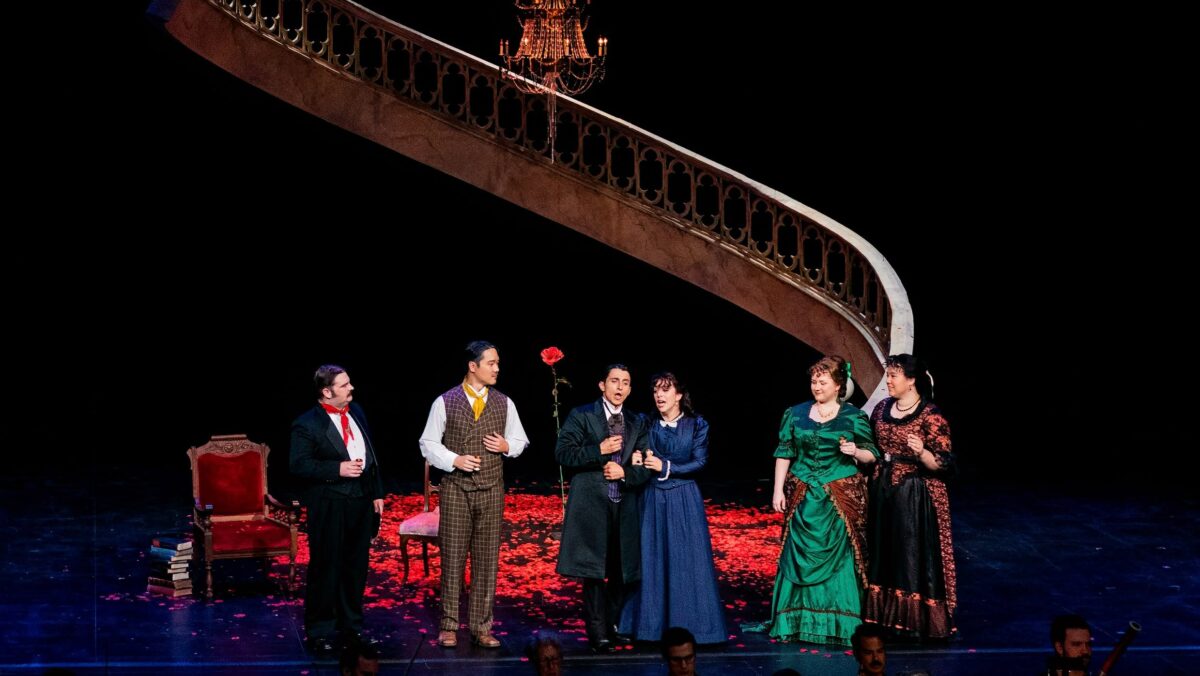
Photo: Steven Taylor
To open the 2026 season, making use of their new Resident Artist Program and the PS21 Arts Center in Chatham, New York, the Berkshire Opera Festival presented Zémire et Azor, a once beloved opéra-comique by André-Ernest-Modest Grétry (1741-1813). Liégeois by birth, Grétry studied the light operas of Italy and then moved on to Paris. His fifty-odd stage works were a great success right through the Revolutionary Era.
Grétry is best remembered today, perhaps, for Richard Coeur de Lion (1784), in which the English king, imprisoned on the way home from the Crusades, is romantically set free. (Rescue operas were hot.) The learned Tchaikovsky extracted an aria from Richard to set the macabre mood in the Queen of Spades’s boudoir on the eve of her murder. But most of Grétry is much jollier than that, including Zémire et Azor, a fairy tale opera and a huge hit, premiered before the court of Louis XV in 1771. Mozart, passing through, was delighted with it, and Beethoven composed variations on one of its tunes.
Fairy tale operas were in fashion in the 1770s — come to think of it, they’re always in fashion. A simple story that everybody already knows appeals to a composer, who is free to play with pace and style without fear of forfeiting comprehension. Zémire et Azor is “Beauty and the Beast” to most of us. This perennial fable was set to music again in 1819 by Louis Spohr, auf deutsch. A couple of small companies have performed Spohr’s version in New York, but I honestly can’t remember a note of it. (And I like Spohr!) Like most of you, I remember “Beauty and the Beast” best from Jean Cocteau’s magical film and from the lively Menken-Ashman score of the Disney cartoon.
Wikipedia calls Zémire et Azor a “comédie-ballet mêlée de chants et de danses.” “Ballet-mêlée” implies that it once included dance movements or perhaps martial arts (“mêlée”?) — the French always liked dance as much as song on the lyric stage — but no dances were performed in Chatham. A production of the opera in St. Louis in 2005 sounds, from a review I read in the Post-Dispatch, quite fantastic — an ocean of silk with a galleon sinking upon it, the Beast sung by sturdy John Osborn dressed as a giant owl. We got none of that grandeur at PS21.
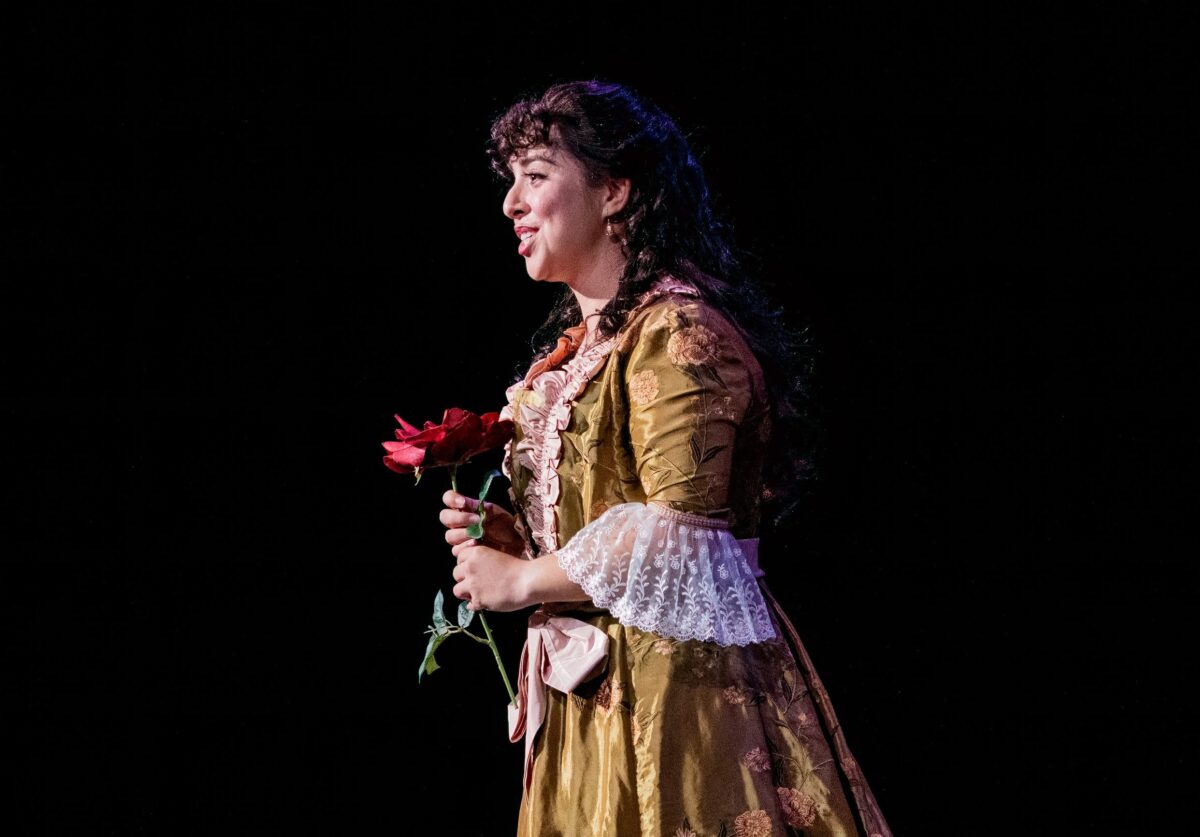
Photo: Steven Taylor
The work is in four short scenes, each by courtesy labeled an “act.” At PS21, the musical numbers were sung in French with surtitles, the spoken dialogue, translated into English, briefly and badly. The tunes tinkled and flowed neatly. The trio (troubled father, sympathetic daughters) in Act II is a gem, and there are some winning duets, but the only piece in the score that really allows a singer to do her stuff is an exemplary aria (somewhat like the Lesson Aria in Rossini’s Barbiere) that the Beauty sings to give pleasure to her Bestial host. It’s a tour de force, and the Berkshire’s prima donna, Ethel Trujillo, had a marvelous time showing off her glamorous soprano, a sizable but well-schooled instrument, flexible and hearty.
The director, Mo Zhou, has set the tale in New York’s “Gilded Age”. She explains her reasoning at some length in the program, but unless you read that before the performance — and who does? — her story made little sense. She writes: “We move past fairy tale to observe a society obsessed with curated façades, in which appearances were not merely valued but weaponized,” and I do give her pretentiousness points for “curated façades.” But that is not what Grétry composed. He gave us a magical fairy tale. Removing the magic leaves us with a drab, uneventful soap opera.
The trouble is the Beast. We must have a Beast, and he must be scary. No fright, no redemption. The score is written that way, even if the director doesn’t think so. Azor is a monster whose true nature emerges due to love, which Zémire gradually — slowly — recognizes. If there is just a dapper tenor in a Phantom mask, we do not comprehend his isolation, the magical curse that love will break, the horror of Zémire’s father and family at the mere sight of him. If Berkshire Opera could not afford anything too monstrous, too bestial, creative costuming and surly acting are surely called for. Scott Rubén La Marca looked and behaved like an opéra-comique valet or perhaps the gardener in Mozart’s Seraglio. Scare was not to be found in him, and giving him a mask added nothing. No one could possibly fear him — certainly not a prima donna of Ms. Trujillo’s voluptuous caliber.
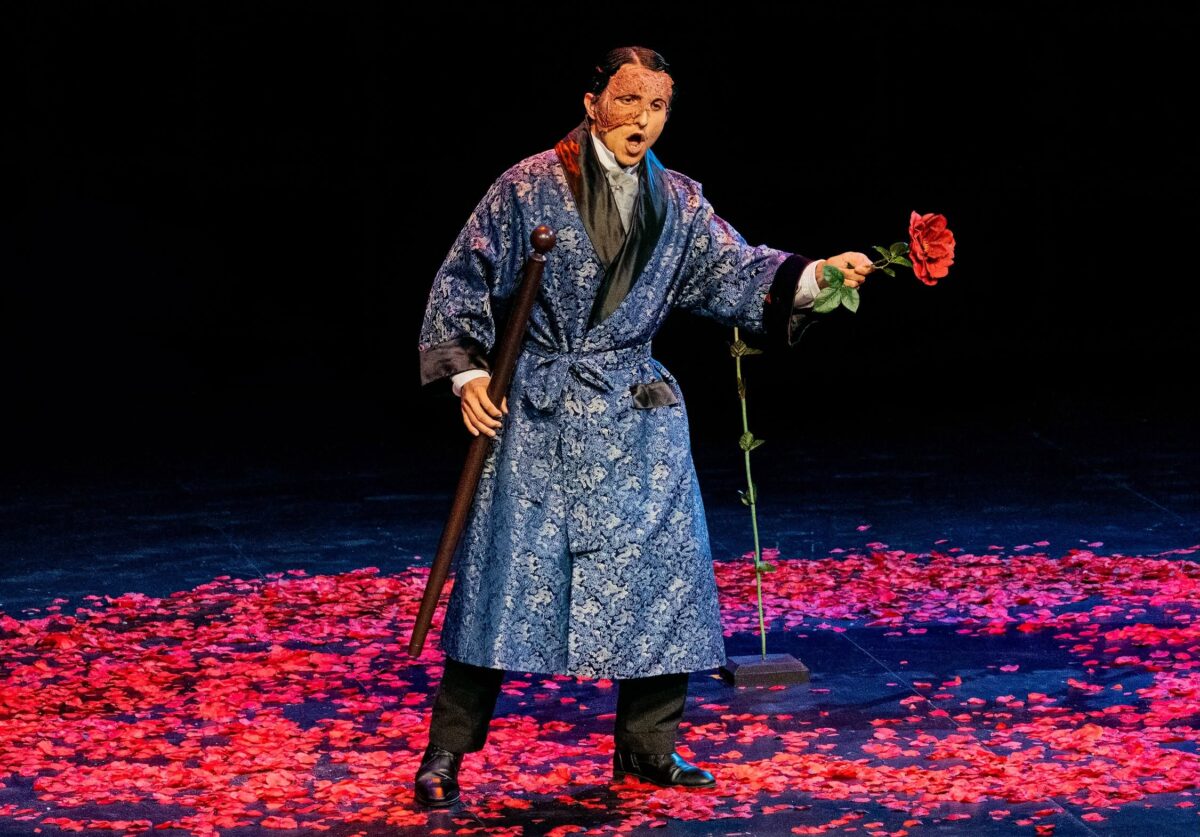
Photo: Steven Taylor
Zémire’s awkward father, Sander, who has plucked the wrong rose to set our plot rolling, was Will Kim, a forthright bass-baritone of vigorous vocal character. His comic servant, Zachary Taylor, also had a pleasant sound but his shtick sank on the shoals of awkward translation.
The other great flaw in this libretto was Beauty’s sisters. As every fan of any version of Cinderella knows, bad girls are fun, and can save almost any fairy tale into which they are thrust. (Think of Rossini’s Cenerentola — or Rodgers’s Cinderella — or Prokofiev’s — or King Lear.) Cocteau reveled in his Beauty’s bitchy sisters, but they had nothing to do here but rejoice in her happiness and join her in trios. Or has the piece been cut significantly?
The orchestra, led by Brian Garman, were able and the singers pleasant, but without a monstrous frisson they could make nothing important of the fable. Ms. Trujillo should definitely keep that one showy aria around for recitals of the future, where something unknown always makes an audience sit up. She lit up the house!
John Yohalem
John Yohalem's critical writings have appeared in the New York Times Book Review, American Theater, Opera News, the Seattle Weekly, Christopher Street, Opera Today, Musical America and Enchanté: The Journal for the Urbane Pagan, among other publications. He claims to have attended 628 different operatic works (not to mention forty operettas), but others who were present are not sure they spotted him. What fascinates him, besides the links between operatic event and contemporary history, is how the operatic machine works: How voice and music and the ritual experience of theater interact to produce something beyond itself. He is writing a book on Shamanic Opera-Going.
-
People: Brian Garman, Ethel Trujillo, Jean Cocteau, John Osborn, Louis Spohr, Ludwig van Beethoven, Mo Zhou, Pyotr Ilyich Tchaikovsky, Scott Rubén La Marca, Will Kim, Wolfgang Amadeus Mozart, Zachary Taylor
-
Works: Cinderella, Il barbiere di Siviglia, King Lear, La cenerentola, Richard Coeur de Lion, The Queen of Spades, Zémire et Azor
-
Places & Organizations: Berkshire Opera Festival