To the moon and back
Yuval Sharon‘s production of The Excursions of Mr. Brouček shoots for the moon — and lands somewhat limply on Lake Constance.
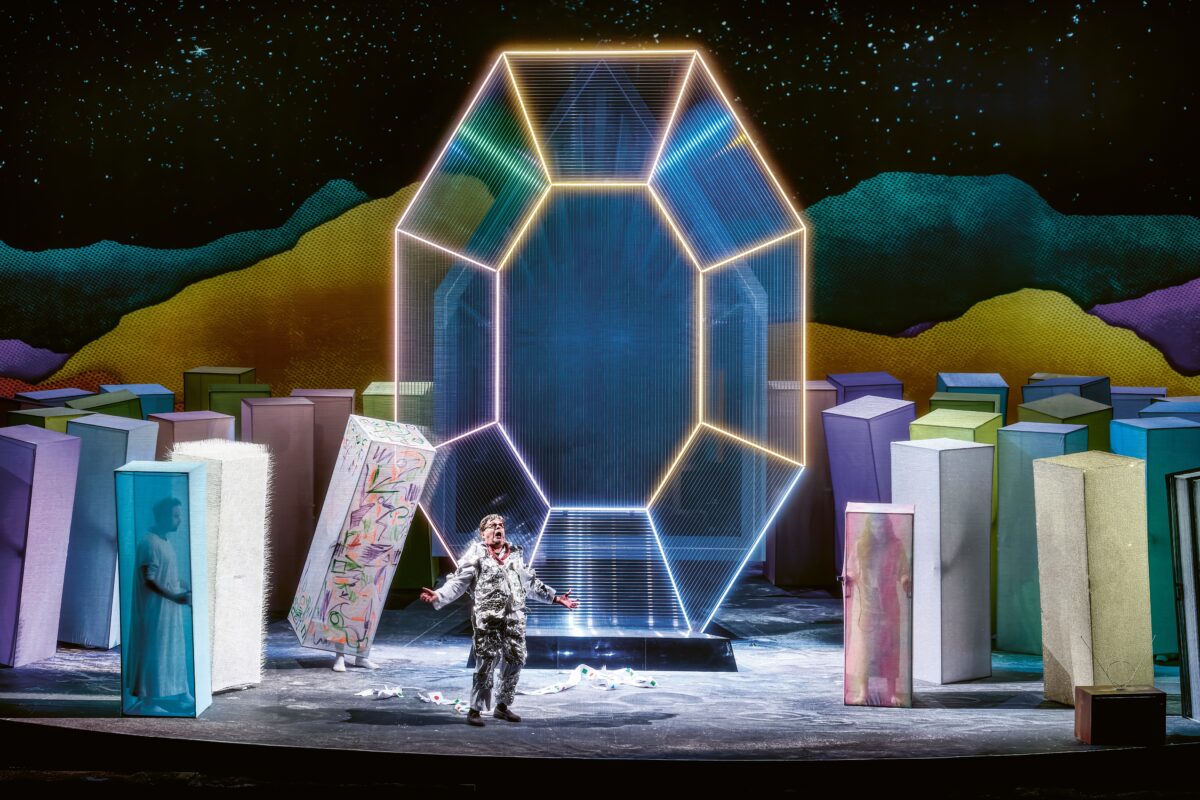
Photo: Bregenzer Festspiele/Daniel Ammann
The Bregenz Festival is famous for its 7,000-seat “Seebühne”, a massive open-air floating stage on Lake Constance in the foothills of the Alps. While the main stage always has operatic blockbusters, the festival’s indoor Festspielhaus annually hosts lesser-known works. This year’s selection, Leoš Janáček’s The Excursions of Mr. Brouček to the Moon and to the 15th Century, was a musical and visual carnival. The Sunday matinee performance, the second in a short three-show run (the July 23 premiere was recorded by ORF and is available on demand for a month) made a compelling case for Janáček’s underrated spectacle, yet it could have done more with the work’s brilliant nuance.
Yuval Sharon’s production aptly presented the quirkiness and irreverence of Janáček’s score but, like his approach Tristan und Isolde at the Met Opera last March, it lacked an extra punch to dig into the opera’s many layers. For Sharon, history and identity drive the story, as he explained in an interview: “We build walls around us and make ourselves comfortable in our own world. But that is precisely what limits us … When we stop being curious about the world, or when we no longer search for our roots or our past, we begin to die inside.” Sharon gestures to The Excursions of Mr. Brouček’s satire of bourgeois aestheticism, historical determinism, and selfish individualism but does not dig deep enough into Janáček’s rich material. Janáček wrote the opera between 1908-1918, a turbulent time in Czech history, such that the work is more than a comic tale of a philistine landlord transported to the moon and medieval Prague.
The costume and set design by Jon Bausor, lighting by Yi Zhao, and video projections by Hannah Wasileski were all impressive. Rather than socialize in a tavern, here Brouček is a reclusive landlord who prefers to have Würfl’s beer delivered while he watches television at home in his armchair. Each part employs impressive stagecraft for Brouček’s voyage. In Part 1, his small house rises and rotates upside down, accompanied by fantastical starry images as he travels to the moon. In Part 2, his home sinks to subterranean Prague, revealing a large mirror that reflects onto a quasi-archeological dig of the medieval city. Zhao’s lighting also highlights the difference between the two halves: bright colors bedazzle the lunar cultural ceremonies, while an almost black backdrop is interspersed with flashes of cannon fire as the Hussites battle the Catholic crusaders in 1420.
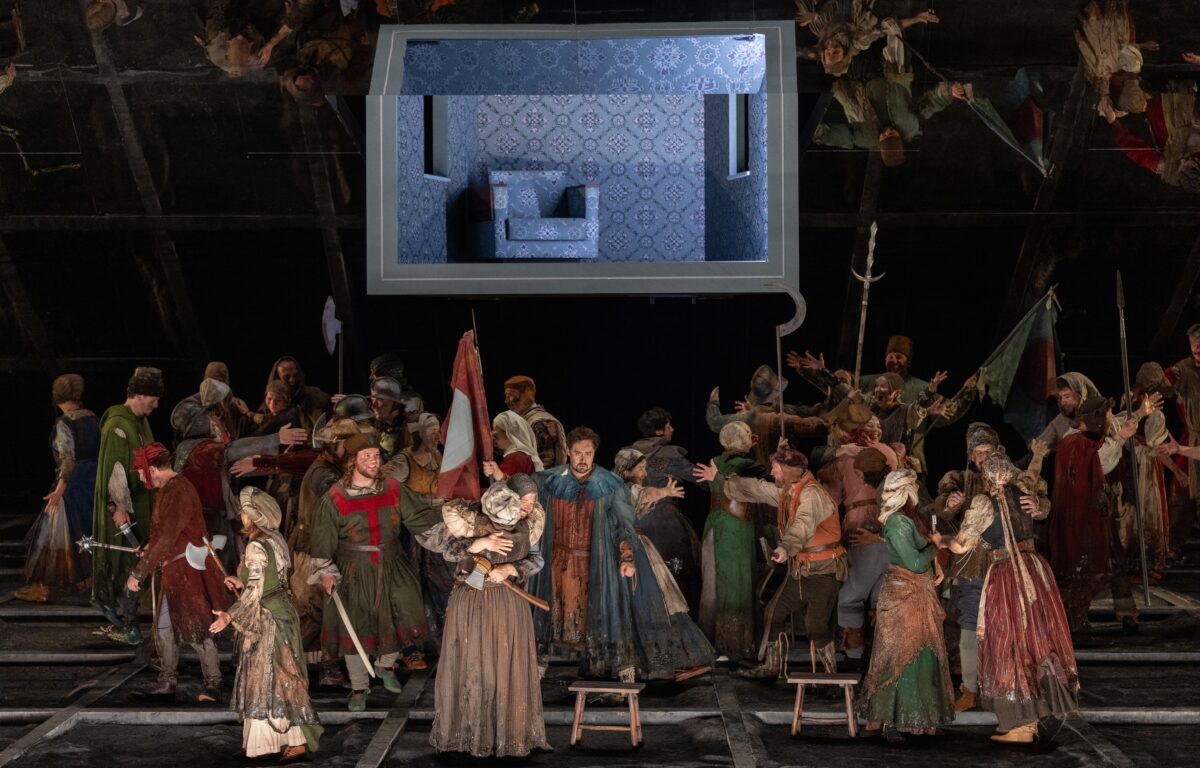
Photo: Bregenzer Festspiele/Daniel Ammann
According to Sharon, the lunar set and costumes were inspired by Czech Dadaism and the Theater of the Absurd. The alien characters don color-coded boxes to represent the abstracted form and pretentious aestheticism that bewilders the sausage and beer-loving Brouček, who himself wears a makeshift tinfoil astronaut suit with his television as a helmet. The chorus of aliens, choreographed by Crispin Lord, shake and tilt rather than move their limbs. In the second part, the 15th century historical figures wear period robes and armor, while the opening and closing scenes set in the 1980s feature appropriate perms and baggy jeans.
Yet the transposed the frame story set in Prague 1988 (rather than the original 1888) felt a bit like a missed opportunity regarding the production’s ruminations on history: A city on the cusp of Velvet Revolution and the collapse of the Cold War communist regime, Sharon’s production only hints at the 1980s through fashion, as well as Brouček’s materialistic television consumption. This setting would have provided a chance to also explore, for example, in the epilogue how Brouček’s beer-barreled cowardice in 1420 translates to modern political (in)activism. Moreover, the central tension between the archaic prose of rebellious Hussites and Brouček’s modern German-infused Czech vocabulary had enormous political currency both in Svatopluk Čech’s original fin-de-siecle novels and Janáček’s own work with the collapse of the Austro-Hungarian Empire and surging Czech nationalism. When the Hussite chorus sings of the coming “Antichrist” in the form of Emperor Sigismund, this recursive rhetoric resonated in Čech and Janáček’s own times and continued through the 20th century (and even today in the age of AI). In Sharon’s version, the spirit of Čech is not a 19th-century nationalist novelist but rather is billed simply as “poet of the past” dressed in Hussite garb, thereby flattening out this added layer of historical urgency to Brouček by conflating the historical past into one generic character.
The multiple historical layers, especially the 1988 setting—Czechoslovakia on the verge of West European integration—could have therefore been a bigger vehicle for Sharon’s desire to “search for our roots or our past,” resist deterministic historical narratives, and examine Brouček’s complex modern identity.
Janáček veteran Peter Hoare anchored the performance as the title character. Hoare’s sharp Czech diction and aloof characterization conveyed a Scrooge-like Brouček. Rather than depict a clueless landlord, his punctuated protestations and powerful dynamic range in the face of lunar aesthetes and religious zealots showcased a Brouček willfully obstinate.
The Excursions of Mr. Brouček’s frame story has singers take on multiple difficult parts, though Sharon’s Personenregie gave them far less action compared to Hoare’s anti-hero. The combination of the aliens’ costumes partially obstructing their sound and Janáček’s restless vocal writing in Part 1 led to some coordination challenges that generally improved in the more melodic lines in Part 2.
Tenor Mihails Culpajevs as three frustrated lovers (Mazal, Blankytny, Petrik) started off with a flattened upper register but then hit his high notes with piercing accuracy. Tatev Baroyan played his lovers (Malinka, Etherea, Kunka). While her initial portrayal of Malinka was somewhat static, Baroyan delivered the opera’s most poignant moment as Kunka mourns her father after battle, her agile soprano voice conveying rich pathos sorely lacking in the miserly Brouček. Similarly, her father in each scene (the Sacristan, Lunobor the lunar art critic, Domšik), baritone Karoly Szemeredy, provided a gravitas that commanded authority. The spirit of Čech was sung somberly by baritone Svatopluk Sem, while soprano Gaja Napast’s youthful bright timbre conveyed the waiter Cisnicek, child prodigy, and the overly eager Hussite student.
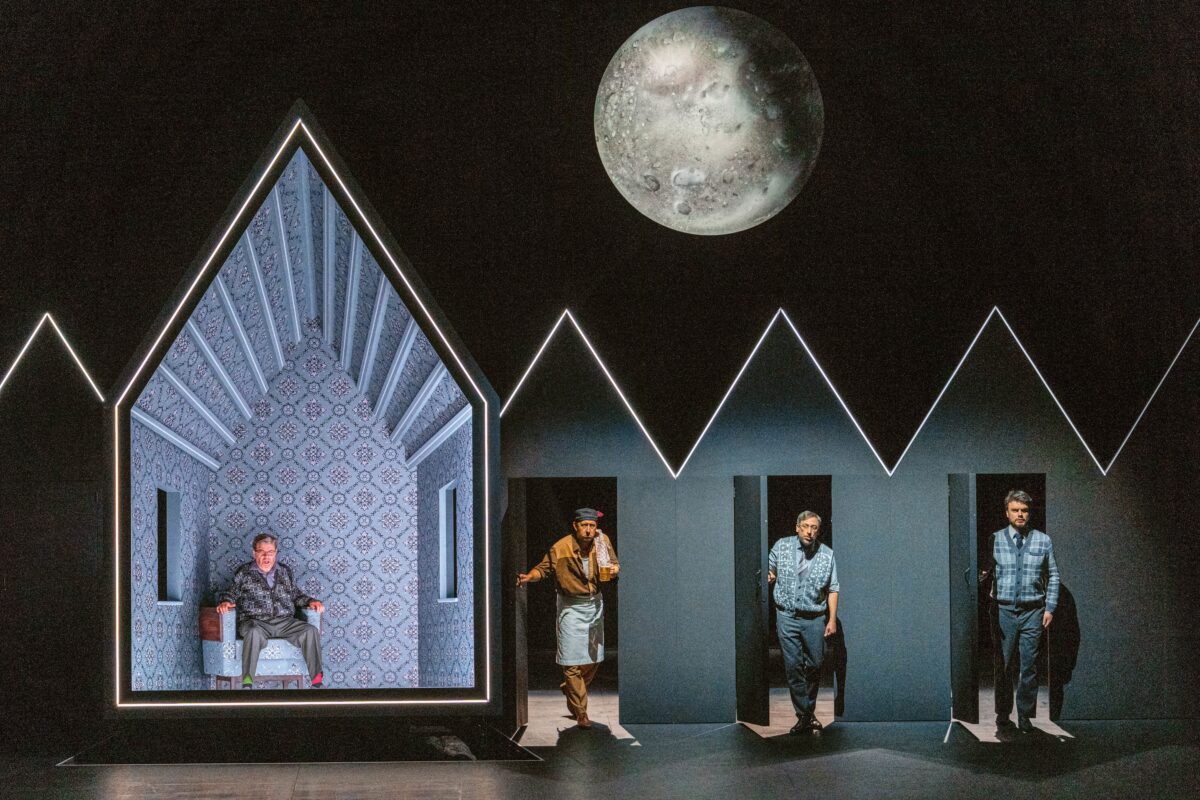
Photo: Bregenzer Festspiele/Daniel Ammann
The Wiener Symphoniker, the resident orchestra at Bregenz, gave a confident reading of Janáček’s score. While there were some balance issues covering the singers, especially in Part 1 with the box-like aliens, conductor Robert Jindra brought both appropriate joviality to the satirical moments and darker lyricism in Part 2 for orchestral colors reminiscent of Taras Bulba and Káťa Kabanová (composed around the same time). The Prague Philharmonic Choir were especially commendable for their clear diction and projection, particularly during the Hussite chorales.
At a moment when many cultural institutions and festivals are rethinking their futures, the Bregenzer Festpiele seems to have struck a good balance between crowd-pleasers and hidden masterpieces. Nevertheless, the festival has had to adapt to changing times. For example, this year’s La Traviata, directed by Damiano Michieletto, uses the new basin separating the stage from the lake (originally created in 2024 for Die Freischütz), built in part to mitigate water’s climate change-induced volatility.
Sharon will return to Bregenz in 2028-29, directing Wagner’s The Flying Dutchman on the Seebühne in 2028-29 (in the middle of his Ring cycle at the Met). One hopes this next production can further and more deeply engage the urgent social questions of our times.
Montagu James
Montagu James is a PhD student at Brown University studying modern European political and cultural history. He also enjoys composing and conducting.
-
People: Crispin Lord, Damiano Michieletto, Gaja Napast, Hannah Wasileski, Jon Bausor, Karoly Szemeredy, Leoš Janá?ek, Mihails Culpajevs, Peter Hoare, Prague Philharmonic Choir, Robert Jindra, Svatopluk Sem, Tatev Baroyan, Wiener Symphoniker, Yi Zhao, Yuval Sharon
-
Works: Der fliegende Holländer, Der Freischütz, Kát'a Kabanová, La traviata, The Excursions of Mr. Brou?ek, Tristan und Isolde
-
Places & Organizations: Bregenz Festival, Metropolitan Opera, ORF