Rubber soul
Video Artists International brings us back to a time when opera was carried over the airwaves by great voices—and a tire company.
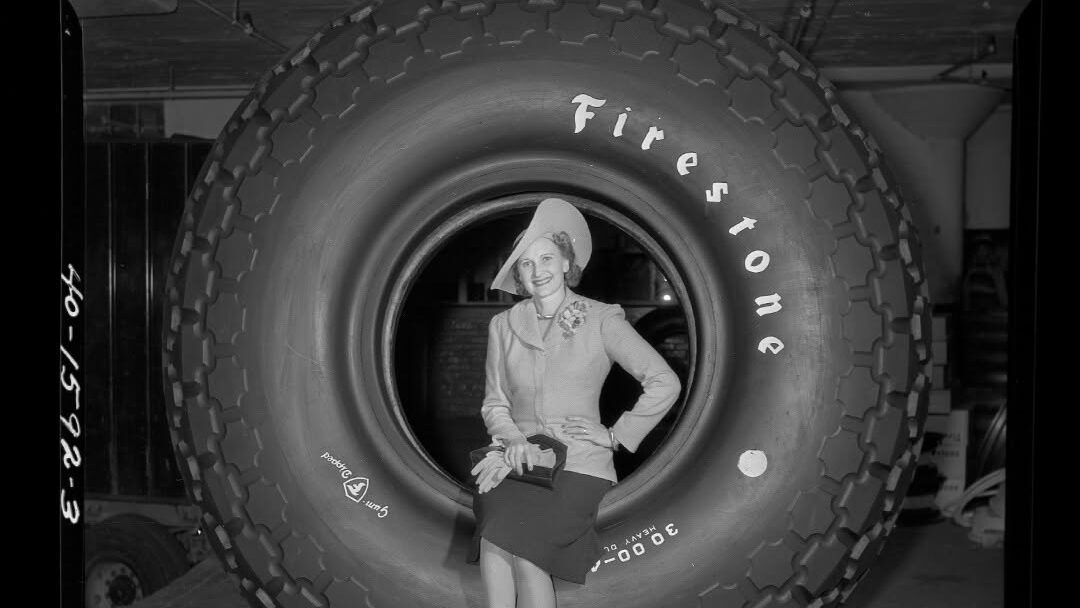
Photo c/o the Firestone Archives
Opera has always depended on the oligarchy for its continued existence. It cannot support itself. Whether it be kings, dukes, millionaire businessmen (or their socially ambitious wives), opera has depended on the generosity of the monied upper crust to keep going. One of the problems in today’s society is that the new breed of one-percenter billionaire (often coming from the world of tech) has no interest in classical music and consider opera old, elitist, and non-chic. So the money is drying up, and the opera world is under significant stress. (In Europe they have government subsidies but not in the US). Texaco sponsored the Metropolitan Opera Broadcasts for decades until the end of the 2003–2004 season.
The tire company Firestone produced the classical music program The Voice of Firestone first on the radio from 1928 and then on television and radio from 1949–1963. Stars of the Metropolitan Opera were featured in both operatic and light classical repetoire as well as popular compositions. Company founder Harvey S. Firestone (1868–1938) was married to Idabelle Firestone, née Smith, who was a published composer. Firestone senior and his son, Harvey S. Firestone, Jr., who succeeded his father as chairman of the company, remained committed to the classical music broadcasts. Idabelle’s songs “If I Could Tell You” and “In My Garden” were used as the intro and sign-off for the program.
So it is a nostalgic thrill to go back and look at the old Voice of Firestone programs from 1949–1963 to visit a lost world where opera and opera stars were a regular event on television. In the early years of television there was a great need for content of all kinds and there were many idealists in the business who weren’t looking for the lowest-common-denominator money grab but wanted to promulgate culture to the average American in a real democratic fashion. Many of the stars of “The Voice of Firestone” also performed on The Bell Telephone Hour and The Ed Sullivan Show, among others. Martina Arroyo and Beverly Sills were regulars on the Johnny Carson Tonight Show.
The kinescopes of the Voice of Firestone programs were donated to the library of the New England Conservatory in Boston, MA, and they lay there untouched and unseen until 1990, when Allan Altman of Video Artists International (“VAI”) reached out to release them on home video; at that time, the format was VHS cassettes. A whole series of VHS releases came out featuring such beloved stars as Eleanor Steber, Robert Merrill, Richard Tucker, Roberta Peters, Dorothy Kirsten, Risë Stevens, and Lauritz Melchior, among many others. Later the label Kultur rereleased a selection of the Firestone programs on DVD, using the masters created by VAI from the kinescopes with no restoration or enhancement.
Of course, since 1990, high-definition images and digital-quality sound have become the norm. There was absolutely priceless material on these broadcasts but one had to look and listen through hazy, washed out black and white kinescope visuals and flat mono audio to appreciate the lost treasures. The emergence of HDTVs with 1080p and 4K image quality made the technical drawbacks of the prior releases that much more evident and difficult to endure.
Three years ago Altman decided to revisit the Firestone kinescope archive and see if modern visual and audio technology could render better visuals and audio for home video releases. Altman discovered many other artists and never-before-released performances that had lain unseen for over seventy years. Utilizing computer technology to restore the sound and visuals, Altman has released five DVD’s of the Voice of Firestone material, in best-ever quality that plays with clarity on 21st century home entertainment technology.
Viewing the five DVD’s of these restored performances, the picture has none of the weird artifacts or occasional distortion of badly applied computer enhancement; a fuzzy kinescope image now looks more like restored vintage 35mm film. A richer image emerges with deeper blacks with greater definition and smoother movement. The sound is forward and vibrant with no distortion or artificial added resonance. It’s still black and white and mono but much clearer, more detailed and easier to watch on a modern high-def television.
The first two releases are “The Golden Age of Singing” Volume 1 and Volume 2.
In 1949 and early 1950, Eleanor Steber, Helen Traubel, Jan Peerce, and Leonard Warren perform in concert format in formal wear in front of the orchestra. Later on, cardboard sets and dated costume pieces were added along with kitschy staging to give the pieces dramatic and visual interest as well as putting the arias in context. It’s often humorous and campy but charming in its dated, period way.
On all these DVDs, we have a series of operatic selections by various singers of all vocal types followed by “Encore” selections of songs, lieder, operetta, and lighter operatic favorites.
We are given a potpourri of singers including several never before seen in earlier releases. These include the bass Cesare Siepi, who blocked their release 30 years ago due to what he regarded as their low, campy quality. With his passing, he is seen in several selections, and once his mouth opens with that voluminous basso cantante, you ain’t laughing or looking at the cheap scenery. Familiar faces like Steber or Stevens are seen in new and often surprising selections.
Certain artists are clearly comfortable in front of the camera whereas others seem to be projecting to the Metropolitan Opera balcony. Richard Tucker and Licia Albanese are among those who are not camera-friendly though both are intense performers and vocally imposing. Renata Tebaldi is rather stiff and presentational on camera in three Puccini arias. By 1959, her cream and velvet spinto soprano was developing that tug in the upper register where effort and flat singing are starting to intrude.
Roberta Peters, Patrice Munsel, veteran Lauritz Melchior, Anna Moffo, and Risë Stevens had Hollywood and television experience and come off naturally on camera. Others are a surprise. The camera adores Swiss soprano Lisa Della Casa; she is a natural film actress who reacts when listening to her tenor (Gedda and Tucker) and visibly thinks of what she is about to sing before she sings it. Her eyes are full of intention and emotional specificity—and she is gorgeous. I have found Della Casa’s silvery voice on recordings lovely but her singing can lack “face” audio only (in comparison to her contemporary rival Schwarzkopf who could have too much “face” and sound mannered and busy). Here Della Casa’s visual presence adds another crucial layer to her artistry. The newly included Hilde Güden is a charmer on records but is a total enchantress when seen as well as heard.
However, many singers who we consider “B” also-rans emerge as stars. Giuseppe Campora sounds golden and phrases deliciously in several Neapolitan canzone. He is also rather cute. Gabriella Tucci has a smoky soprano somewhere between full lyric and spinto. Her earthy, exotic beauty and unaffected manner are reminiscent of 1950 Italian film stars. Her rendition of “La Mamma Morta” isn’t a grande dame drama queen moment but a young girl exploring trauma in an intimate manner, building to a searing but still introspective climax. Mario Sereni is handsome and so is his baritone voice—I found myself preferring his “Di Provenza al Mar” to Robert Merrill’s.
One thing that must be mentioned is that the period between 1949 and 1963 was not only a golden age of singing but all these singers were in their absolute vocal prime. Lauritz Melchior, who was in his early sixties might be considered somewhat past it but he is still impressive despite a certain wooden quality to his upper register which comes and goes. Otherwise, he is still a vocal titan and a real charmer in lighter material like a Danish Children’s Song composed by his old music teacher. Melchior’s adorable former actress wife Kleinchen beams charmingly on the sidelines in his selections.
Melchior is seen in several selections of the DVD “The Scandinavians”, which also includes Jussi Björling and his wife Anna-Lisa, Birgit Nilsson, Nicolai Gedda, and American-born singers of Scandinavian descent, such as Risë Stevens, and the all-but-forgotten Dorothy Warenskjold. Warenskjold (who never sang at the Met but at San Francisco Opera) is one of the many revelations of this set: Her “Depuis le Jour” is radiant with a scintillatingly pure soprano tone that sends chills down your spine. She also has a wholesome beauty and lovely screen presence that engages and charms. Mimi Benzell and Robert Rounseville, more remembered for their crossover Broadway work, are heartbreaking and vocally stylish in “Nuit d’Hyménée” the farewell duet from Roméo et Juliette. Mildred Miller is beguiling singing “Connais-tu le pays” from Thomas’ Mignon. Eugene Conley is handsome and charismatic (before alcohol did its damage) with ringing tops in the “Aubade” from Le Roi D’Ys. Jean Madeira is a formidable but glamorous Dalila singing “Amour, viens aider ma faiblesse” in a thundering mezzo-contralto. Elena Nikolaidi, movie star pretty, is a kittenish playful Carmen.
“The Italians”, which includes the Italian-American Anna Moffo and the Swiss Lisa Della Casa, gives us surprises like the aforementioned Gabriella Tucci but also Daniele Barioni and Campora and Sereni. Franco Corelli is slightly awkward but impressive as Turiddu and Calaf.
“The Americans” shows us the contingent of young American opera stars discovered by the Canadian general manager of the Metropolitan Opera, Edward Johnson, who were mostly kept on by Rudolf Bing and provided a solid core of top notch house artists who were augmented by established European stars. These American artists were often underrated, undervalued and sometimes really criminally dismissed (several by Rudolf Bing himself). The greatest possibly was Eleanor Steber, who was at her zenith from 1949–1962 and was a constant presence on the Voice of Firestone, making multiple appearances a year. Her reputation had dimmed due to the decline of her career due to alcoholism and personal problems, including a few embarrassing comebacks (the Continental Baths). The initial release in several volumes on VHS of Steber at her radiantly youthful peak slaying one operatic aria after another occasioned a major reevaluation of her artistry and position as one of the greatest American—no, just one of greatest opera singers ever. Her rendition of Violetta’s Act I and Act IV arias are vocally faultless and the “Addio del Passato” from La Traviata even features a heartbreaking reading of the letter and eloquent screen acting from Steber.
Patrice Munsel has been dismissed as a show-biz soubrette posing as an opera star who inevitably went Broadway. Well, her “Mi chiamano Mimì” is not only sung with a gleaming, rich yet lean lyric soprano but acted in a revelatory way. She sings the aria directly to the chorister dummy Rodolfo with real seduction and pointed charm – basically seducing him (and us) with her personality and girlish appeal. It really works, and Munsel really puts over musical points and text with personality and specificity. She also sparkles as Donizetti’s “The Daughter of the Regiment” and in the folk song “Black is the Color of My True Love’s Hair”.
These DVD’s can be ordered from the VAI website. For those who are no longer doing physical media (small Manhattan apartments are not friendly to collectors) much of this material is available on VAI’s streaming channel along with their releases of the Bell Telephone Hour and other music programs.
I encourage you to acquire these Voice of Firestone gems in either physical or streaming format—the success of these releases will encourage VAI to release more. There is much more Stevens, Steber and Merrill out there and these programs did not include Mary Costa, Rosalind Elias, and Jerome Hines. George London had much more material available. Plus, more new treasures are being unearthed from the New England Conservatory archives. Where the rubber meets the road, it will take you to a musical paradise!
-
Topics: recording
-
People: Anna Moffo, Beverly Sills, Birgit Nilsson, Cesare Siepi, Daniele Barioni, Dorothy Kirsten, Dorothy Warenskjold, Edward Johnson, Eleanor Steber, Eugene Conley, Franco Corelli, Gabriella Tucci, George London, Giuseppe Campora, Helen Traubel, Hilde Güden, Idabelle Firestone, Jan Peerce, Jean Madeira, Jerome Hines, Jussi Björling, Lauritz Melchior, Leonard Warren, Licia Albanese, Lisa Della Casa, Mario Sereni, Martina Arroyo, Mary Testa, Mildred Miller, Nicolai Gedda, Patrice Munsel, Renata Tebaldi, Richard Tucker, Rise Stevens, Robert Merrill, Robert Rounseville, Roberta Peters, Rosalind Elias, Rudolf Bing
-
Works: Carmen, Cavalleria Rusticana, La bohème, La fille du régiment, La traviata, Le Roi d'Ys, Mignon, Roméo et Juliette, Samson et Dalila, Turandot
-
Places & Organizations: Metropolitan Opera, New England Conservatory, San Francisco Opera