
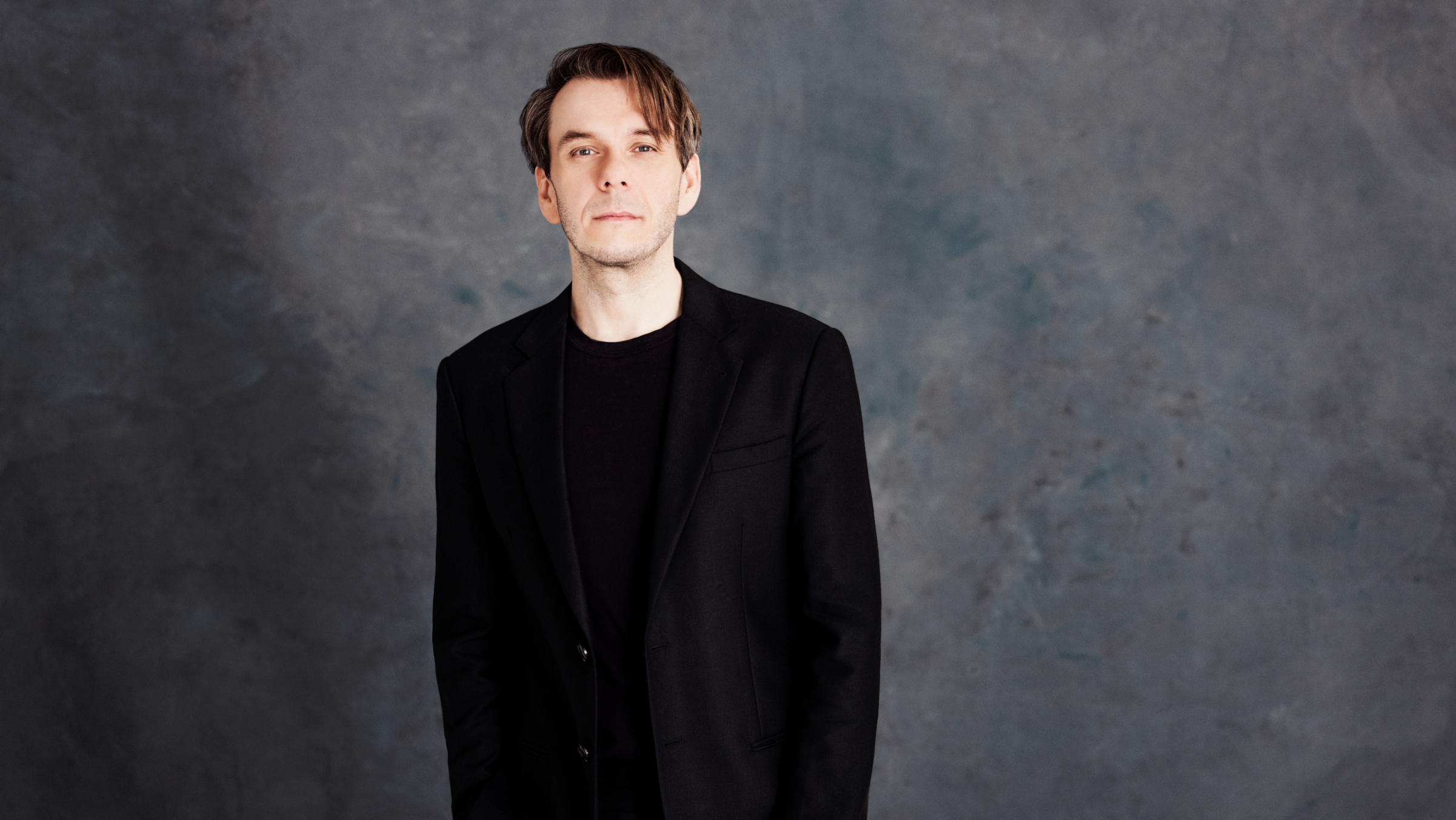
Photo: Julia Wesley
Benjamin Bernheim is not one to take the path of least resistance.
“I don’t want easy,” he told me during our conversation in February. “All these opera directors want me to sing these blockbusters that are easy to program. But I don’t want easy.”
We met in New York shortly after he made his Princeton University Concerts debut, accompanied by Carrie-Anne Matheson, in a program centered on mélodie (French art song) and chanson (popular song, rooted in the rhythms of the French language), much of which can be heard on his debut solo song album, Douce France. Judging from the elegance and ease with which he approaches Duparc, Chausson, and others on that album, as well as the congeniality and candor he brought to our conversation, it would be easy to assume Bernheim to be a natural recitalist. Not so: he confessed that he once felt more comfortable amid the scenery and sweep of the stage than in the concert hall. “When you do opera, you’re surrounded in a beautiful blanket of people working together,” he explained. “But your responsibility is smaller; you are there to embrace a concept, a universe.”
In recent years, Bernheim has found himself on stages even larger than those of the Bastille or the Metropolitan Opera, lending vocal luster to the closing ceremonies of the 2024 Olympic Games and the reopening of Notre Dame de Paris in the same year. Both experiences filled him with awe and, as a Frenchman, pride, but the real challenge lay beyond that constellation of national pageantry, in spaces and repertoire far more intimate—and risky. “A recital is an experience of nudity in front of an audience—it’s very different.”
Walking up to an audience in “a nice suit, with no costume, no set, no fire—nothing” proved intimidating at first—Bernheim likened it to auditioning—but over time, he came to appreciate not merely embracing a universe but owning it: “You have to take responsibility for everything that you present as a storyteller. And I have learned to like this freedom. I realized you have to invite the audience on a journey. You have to dare it.” In his recent recitals, Bernheim is daring audiences (and, perhaps, arts administrators) to give greater prominence to the French repertoire. “When people think about recitals, they think about the ‘sacred’ German repertoire. Even in France, when you do a mélodie program, people ask you, ‘Why don’t you bring Winterreise? Why don’t you bring Dichterliebe?’ It’s been imposed. But people are beginning to learn that there is also another story.”
The story of mélodie, broadly, begins in mid-19th century France. While its German counterpart carried the storm and stress of its poets into emotionally charged, Romantic songs, the French tradition prioritized prosody, sophistication, and subtly of expression–far different, even, from the emotional palette presented onstage by the likes of Massenet and Gounod, Bernheim’s operatic bread and butter. If the exposed C at the end of “Salut! Demeure chaste et pure” is designed to overwhelm the listener with a besotted man’s longing, then something like Ernest Chausson’s Poème de l’amour et de la mer, Bernheim suggested, with its “projections of the sea…. of heartbreak, lets us just drift away.”
Bernheim discovered this repertoire later than one might have suspected. Raised between Paris and Geneva, his parents, both singers in amateur and regional companies, introduced him to opera at an early age; he claims to have known all the recitatives and arias from Le nozze di Figaro by heart by the age of four. Throughout his studies at the Lausanne Conservatory under Gary Magby, he remained focused on opera: “For me, it made no sense to think about mélodie. It was a different career, actually.” He added, “It’s interesting because I built my relationship with this repertoire when I already had a career. So, there were no old habits—we got to start fresh.”
Bernheim’s increased focus on mélodie comes at a point in his vocal development where there has been “growth in terms of depth and sound, but also malleability.” Nearly twenty years into his professional career, he feels that his voice, which he describes as having a clear, silvery quality, has “a tad more ability to turn: to maneuver things in a different way, maneuver pianissimo in the high notes.” He credited this growth to the variety of operatic roles he has taken on, which required him to develop a chameleon-like ability to “adapt to the music and take color from it.” Each musical world, as he put it, is an “exercise” for the voice. “I want to show that the bridge between mélodie and opera is not that long… and that you can be, if not close, then loyal to the musical by actually singing it in the same way.”
Without the thrill of an operatic high note to keep his audience in sway, he leads them down this bridge gradually. “In the last few concerts I did, I began with some of the Duparc or with Bizet and then Poeme de l’amour et la mer, which are risky because they are slow.” A pause. “I like the idea that you actually invite the audience in, step by step—it’s a bit of a flirt, a sort of a blind date with an audience. Bit by bit, you bring a point of view and see how they react. And instead of imposing a color, you invite them to enter a new world.”

Photo: Julia Wesley
Just as Bernheim does not wish to impose a color upon his audience, he likewise seeks to avoid placing the core of repertoire into a niche. Early in our conversation, I asked him about his approach to French style and technique; he furrowed his brow slightly. “Every language has to be taken seriously in terms of the work, in terms of the attitude of an artist,” he replied. “Because language is as rich as there are people and ways to say things. At the same time, I’ve had people asking me to roll my r’s when I sing French, which for me is not natural and does not allow me to tell a story correctly.”
“When singing French, the question is ‘how can you make this language singable for me, in my own voice?’ And so, I’m using the things I learned in German, Italian, and other languages to make it simple, singable, golden [like in Italian] too, when necessary. That’s keeping with the essence of French. Just listen to Roberto Alagna, Laurent Naouri, Ludovic Tézier—all very valid ways to sing this repertoire, with a tone is true to the language. Everybody embraces it in their own way. It’s a language—a love language, in a way. How do you love this? How do you want to show the love to this repertoire?”
He added, “You cannot say, ‘This is the way to sing in French.’ That doesn’t exist. I think people who are saying this are trying to build a cult and have people pay for it.”
Beneath this talk of flirtation, love languages, and cults, there is a seriousness of craft and intention. Whether for an operatic role or recital, Bernheim puts in the research. As he prepares to debut as Cavaradossi in Staatsoper Unter den Linden’s revival of Tosca in October, he is immersing himself in the social and political milieu of Puccini, as well as the revolutionary times of Sardou and his doomed painter. “I want to get a context about things, to imagine what it was like at this time and what it meant for the composer, the writers, the poets. I want to know the whole context of the piece so you can offer all to you audience, so you can defend it.”
I pressed him on what he meant by defending a piece; he explained that it might be a matter of translation, but continued, “Actually, I like this idea. I am not the composer. I am not the institution. I’m just a singer who is representing the score—and I must defend it. Maybe this is old-fashioned, but I’m very proud to defend these texts that have history and that are linked to poetry, mythology, and to so many things that move across the world and history. It’s beautiful. And it’s always deeper and more complex than we think.”
In future seasons, Bernheim will have the opportunity to make his defense as Don José in Carmen and Riccardo in Un ballo in maschera. He first approached the latter role 20 years ago in a masterclass with Carlo Bergonzi in Busseto, Verdi’s hometown. Upon hearing the young tenor, Bergonzi declared, “You’re going to be the Riccardo of your generation.” The two subsequently worked on the role, a move which Bernheim credited as “what built me vocally.” He next makes a rare stateside appearance in recital at Alice Tully Hall on 21 April, accompanied again by Matheson, where he will present songs by Durpac, Pizzetti, and Puccini; well-known chansons; and arias by Bizet, Gounod, and Tchaikovsky. (I, for one, am excited to see the sublime “Je crois entendre encore” on the program.)
Toward the end of our conversation, he told me, “Every time I go onstage, I risk something. There is a sensation of danger. Sometimes I think it’s the last time I will ever sing. But sometimes you need to remind yourself that if something happens and you can’t sing tomorrow, then you should make it special.” However unaware of the risk or danger Bernheim’s audience may be, they cannot help but realize that there is something special about this voice—and this artist.