Photo by Todd Rosenberg
Can you simultaneously celebrate and critique a 20th century operatic masterpiece by viewing it through the 21st century technological prisms of Virtual Reality (VR) and Artificial Intelligence (AI)? Director Matthew Ozawa ambitiously does so in his insightful staging of Giacomo Puccini‘s indestructible Madama Butterfly, now being revived by the Lyric Opera of Chicago through April 12.
I say indestructible, since Madama Butterfly still gets across all its heart-wrenching drama while also being literally boxed in by Ozawa’s modern framing device that prods audiences to question the opera itself as a western fantasy about Asian culture. Ozawa and his primarily female design team of Japanese heritage (costume designer Maiko Matsushima, lighting designer Yuki Nakase Link, and Kimie Nishikawa who is part of the collective dots for the set design) all do their part to elaborately illustrate the many demands of this Italian staple of global opera performance, while also questioning the orientalist storytelling legacies that have emanated from it since 1904.
Ozawa’s Madama Butterfly debuted in July 2023 with Cincinnati Opera and then fluttered its VR-inspired wings to Detroit Opera later that year. Ozawa’s Butterfly then landed in 2025 at its remaining two original co-producer companies of Pittsburgh Opera and Utah Opera. I was in Salt Lake City at the time, so I was able to see Ozawa’s Madama Butterfly squeezed for space at the rehabbed 1913 Janet Quinney Lawson Capitol Theatre. Now in the Lyric’s more expansive 1929 art deco Civic Opera House (renamed the Lyric Opera House in 2017), Ozawa’s up-to-the-moment vision for Madama Butterfly can more easily spread its complex wings.
This “new-to-Chicago production” is an artistic homecoming for Ozawa. He has previously directed six productions for Lyric (including Fidelio and Sondra Radvanovsky in The Three Queens), and Ozawa has held the company’s specially created position of chief artistic administration officer since 2022. Previous Lyric general director Anthony Freud was at the 2023 Cincinnati opening night of this Butterfly, and he made the advance commitment to program it for Chicago in 2026.
Ozawa is also a fourth-generation son of a Japanese American father who was born during World War II while the U.S. government forced his Los Angeles-based family to be relocated to the Heart Mountain internment camp in Wyoming. Ozawa’s biracial heritage (like the opera’s child character of Trouble/Sorrow) certainly gives him personal credence to attempt an honest 21st century examination of the U.S.-Japanese cultural clash that is built into Madama Butterfly.
Ozawa’s production silently opens in a contemporary apartment of an American white male who is obsessed with Japanese pop culture. After cracking open a beer, this gamer guy (American tenor Evan LeRoy Johnson) puts on a VR headset, and the music begins as he becomes the U.S. naval officer Lieutenant B.F. Pinkerton.
Then the marriage broker Goro (Filipino American tenor Rodell Rosel) appears with a maquette of a Meiji-era Japanese house. Goro’s recitative reminds Pinkerton that he can rearrange the house’s architecture, which fits with any gamer tinkering within open-world virtual platforms like The Sims or Minecraft.
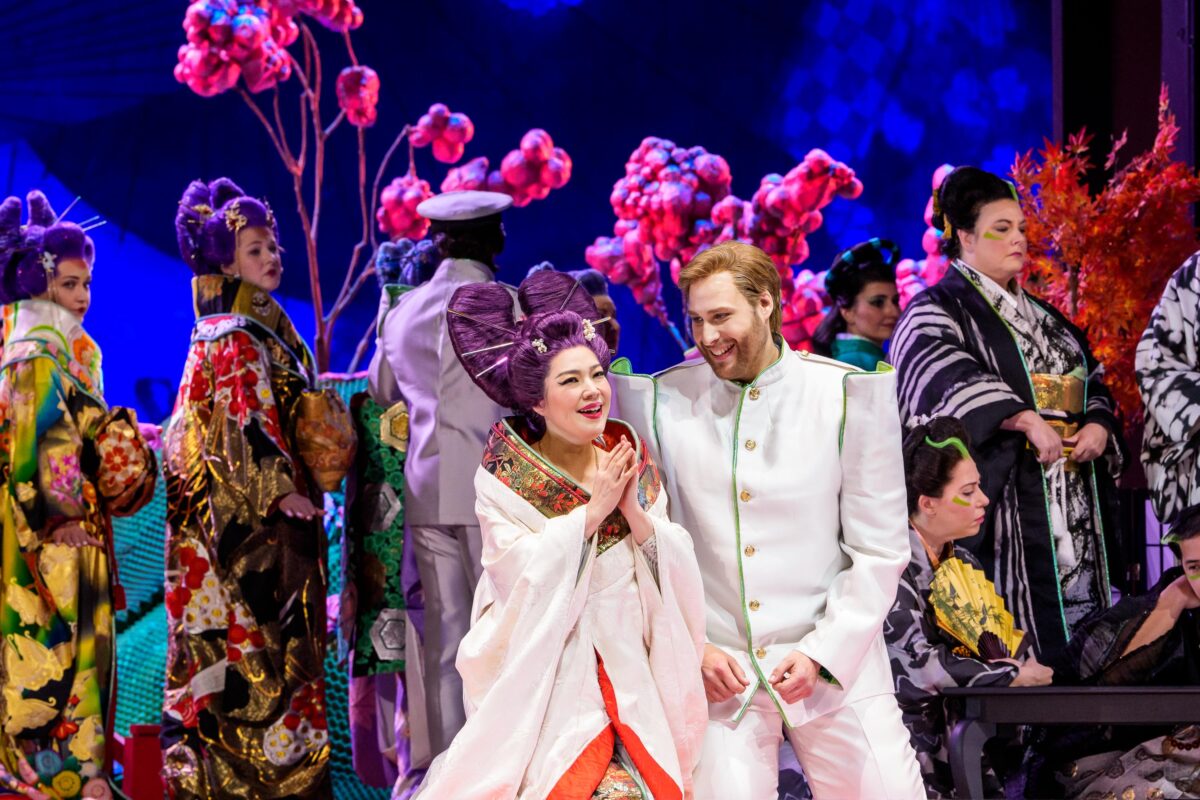
The contemporary apartment then splits apart as Pinkerton’s new VR Nagasaki home creeps down center stage. Against a geographically incongruous sliding-screen backdrop of Mt. Fuji (which is more than 500 miles away), Pinkerton is warned by the U.S. consul Sharpless (American baritone Zachary Nelson) about exploiting the trusting heart of a young Japanese bride. But Pinkerton persists with his questionable game play as the landscape bursts with garish “computer-generated” color and textures for the wedding party arrival of his intended bride Cio-Cio-San (Korean soprano Karah Son). With bright-hued hair you typically see in imported manga comic books or anime cartoons, Cio-Cio-San and her devoted servant, Suzuki (Japanese mezzo-soprano Nozomi Kato), both emerge as strong female characters who are nonetheless also ongoing figments of male western imaginations — a constant reminder thanks to this production’s game play concept.
Are we as audiences allowed to revel in the heartbreaking emotion of a wronged Japanese mother clinging onto a hopeless dream of love? Or should we be cringing at this lingering storytelling trope of an Asian woman who will willingly commit suicide and give up her son for an unfaithful Westerner?
That’s what’s compelling about Ozawa’s interpretation of Madama Butterfly, because it allows all of these perspectives to play out simultaneously in performance. Of course, Ozawa tips the scales by opening cuts to earlier versions of the libretto of Giuseppe Giacosa and Luigi Illica to brutally make Pinkerton more of an unsympathetic heel.
In this age of horrifying Epstein files revelations, it can be unnerving to square Puccini’s gorgeously romantic music when it underscores how Pinkerton just paid 100 yen to marry and abandon a 15-year-old bride. When revealed as a bigamist in Act III, Pinkerton prods others to be the proxies to pay off Cio-Cio-San for all her grief and suffering since he isn’t brave enough to do it himself.
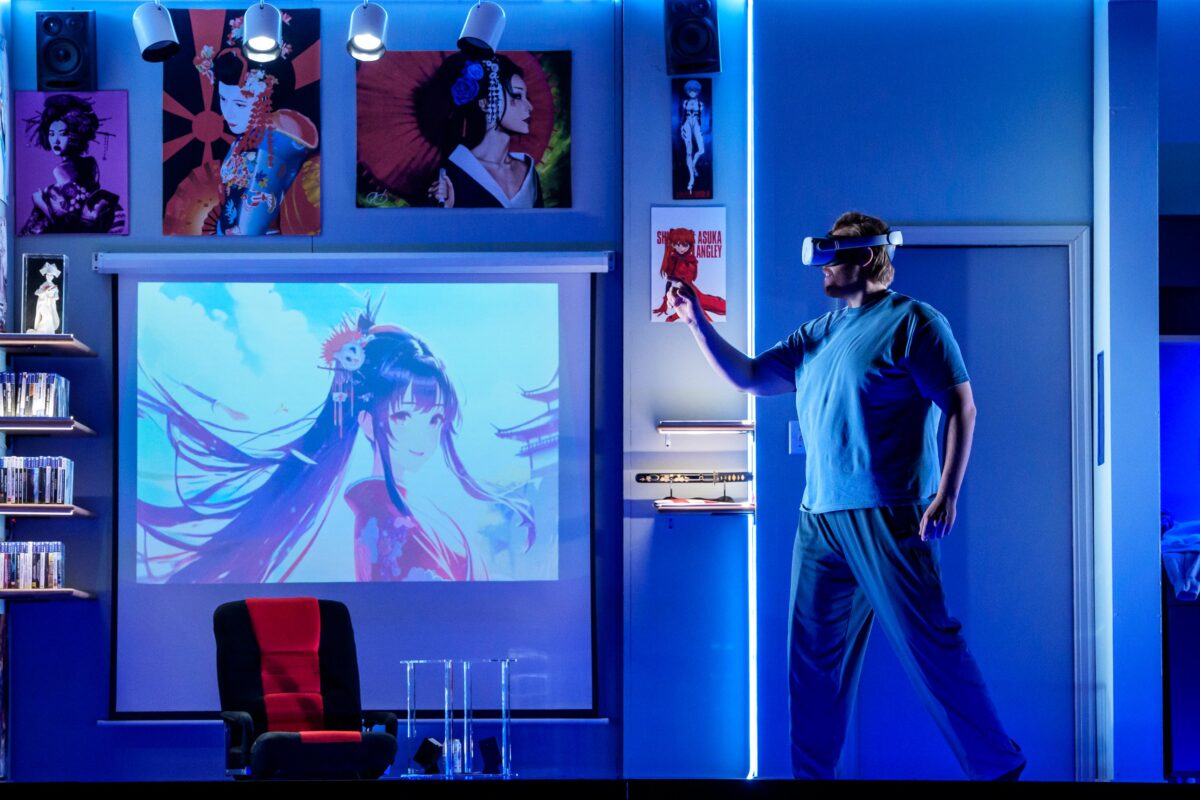
Photo by Todd Rosenberg
This gamer guy also proves to be as uncaring and sloppy in the VR world as in real life. Ozawa has Pinkerton crudely forget to have Suzuki leave the bridal chamber at the end of Act I. And then in the final two combined acts, this gamer increasingly becomes dis-associative from reality.
Act II opens with a pantomimed argument between the gamer and his partner who later becomes his U.S. wife Kate Pinkerton (American mezzo-soprano Alexis Peart) in the VR realm. Though the real-life Kate gestures to the gamer guy to join her in his bed, he is more content to retreat into his VR Japanese fantasy where Pinkerton gets to silently spy on all of the suffering he has wrought on his Madama Butterfly game characters.
A friend of mine who had never seen the opera before (but had seen its derivative 1989 West End musical adaptation Miss Saigon) was shocked at how unsympathetic Pinkerton was in comparison to his Vietnam War compatriot. My friend also complained that Ozawa’s VR framing of Madama Butterfly lowered the dramatic stakes since this Cio-Cio-San wasn’t real. But I countered that Cio-Cio-San has always been a fictional western male creation stretching back to David Belasco’s 1900 Broadway play Madame Butterfly and its literary predecessors of John Luther Long’s 1898 short story adaptation of Pierre Loti’s 1887 French novel Madame Chrysanthème. The scenic design by dots has the contemporary apartment physically framing the VR Nagasaki house as a constant reminder of this. And it’s safe to assume Ozawa’s American gamer guy, like Puccini, had never been to Japan either.
That Puccini and his collaborators’ opera plot machinations still successfully survives Ozawa’s framing device is a testament to the storytelling strength of Madama Butterfly itself. And other than the occasional “computer programming glitches” when the background characters zoned out as Pinkerton sang out his inner thoughts, Ozawa’s Lyric cast largely played the dramatic stakes as if they were in a non-concept staging.
Despite her petite height, Karah Son expertly paced and marshaled her dramatic and vocal resources to have a big presence as Cio-Cio-San on stage. Son is a veteran of Ozawa’s production, so she gave a very lived-in portrayal of Puccini’s tragic heroine.
As Pinkerton, Evan LeRoy Johnson needed a little time to warm up vocally on opening night, but was in fine form throughout when I caught a subsequent performance on March 19. With Ozawa’s staging, Pinkerton really becomes the main tragic character. Johnson delivered on both the cad in the opera and the real-life gamer increasingly addicted to technology as a recluse in his own apartment.
Nozomi Kato as Suzuki is another veteran of Ozawa’s production, and she proved to be the durably emotional and vocal support we expect of the role. As Sharpless, Zachary Nelson also skillfully got across the regret of a government official being pulled into a messy domestic drama. As the scheming Goro, Rodell Rosel fit very well into the concept of the production. You believed him as both the opera’s marriage broker and the introductory video game character who guides players into this colorful VR world.
The majority of the smaller roles were made up of singers from young artist programs. Korean bass-baritone Jongwon Han, a current San Francisco Opera’s Adler Fellow, made a fiery Lyric debut as The Bonze who essentially became a video game character that Pinkerton literally had to defeat via the fight choreography devised by Chuck Coyl.
Current members of the Lyric’s Patrick G. and Shirley W. Ryan Opera Center also did fine jobs, including Chinese baritone Sihao Hu as the pining Prince Yamadori, American bass-baritone Christopher Humbert Jr. as the Imperial Commissioner, and American baritone Sankara Harouna as the Official Registrar.
First-year Ryan Opera Center member Alexis Peart also stood out to give Kate Pinkerton more of a direct and anguished presence in the production. Peart not only got to play a neglected partner at the top of Act II, but also the fictional American wife who is uncomfortably recruited to help clean up the mess of her husband’s earlier sexual adventures in Act III.
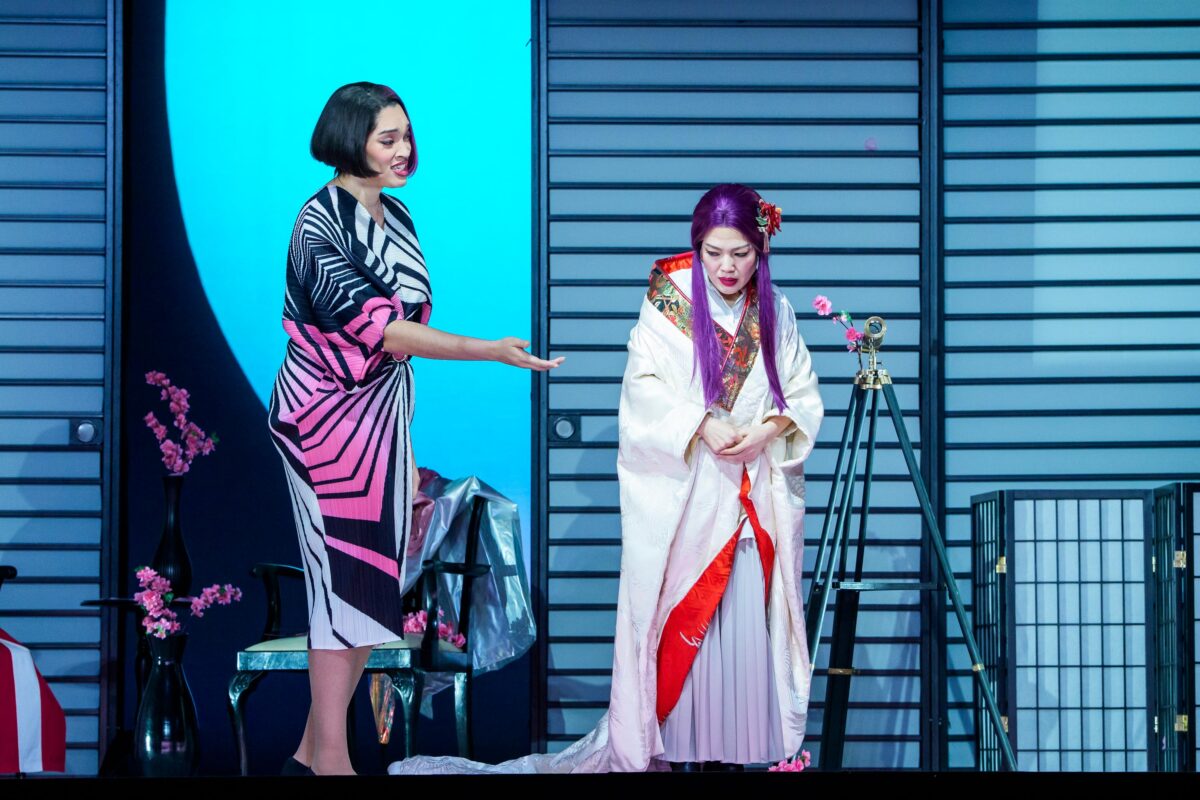
Photo by Todd Rosenberg
LA Opera music director designate Domingo Hindoyan conducted the Lyric Opera Orchestra with assured performances both times that I caught Madama Butterfly. Hindoyan importantly did not let the orchestra overpower the singers, and he worked well with Chorus Director Michael Black in the large ensemble moments.
By the time we reach the opera’s tragic end, Ozawa has the contemporary apartment merge back into place as Pinkerton is wearing his VR headset to eagerly watch Cio-Cio-San’s suicide in his living room. But instead falling lifeless after plunging in the ceremonial knife, Son sheds Butterfly’s wedding dress and purple wig to emerge as a real Asian woman who steps out in front of the apartment set.
Then Johnson’s Pinkerton rushes to caress the cast-off geisha clothing while repeatedly singing, “Butterfly!” in his VR revelry. Meanwhile, Son marches across the front lip of the stage as a follow spot catches her glaring out at the audience as the orchestra blares out the final notes.
Clearly this ending is open to audience interpretation. Surely some opera traditionalists who only want to experience “historically accurate” productions could view Ozawa’s final tableau as the ultimate “Fuck You!” for their desire to yet again take dramatic pleasure from the suicide of a Japanese woman.
But I’m more inclined to interpret Ozawa’s ending as a reminder that Madama Butterfly has been and always will be a dramatically compelling western fantasy of Japan. The opera endures thanks to its extremely effective storytelling and emotionally shattering music, but Ozawa wants you remember that fact and not to confuse Madama Butterfly with any semblance of reality.