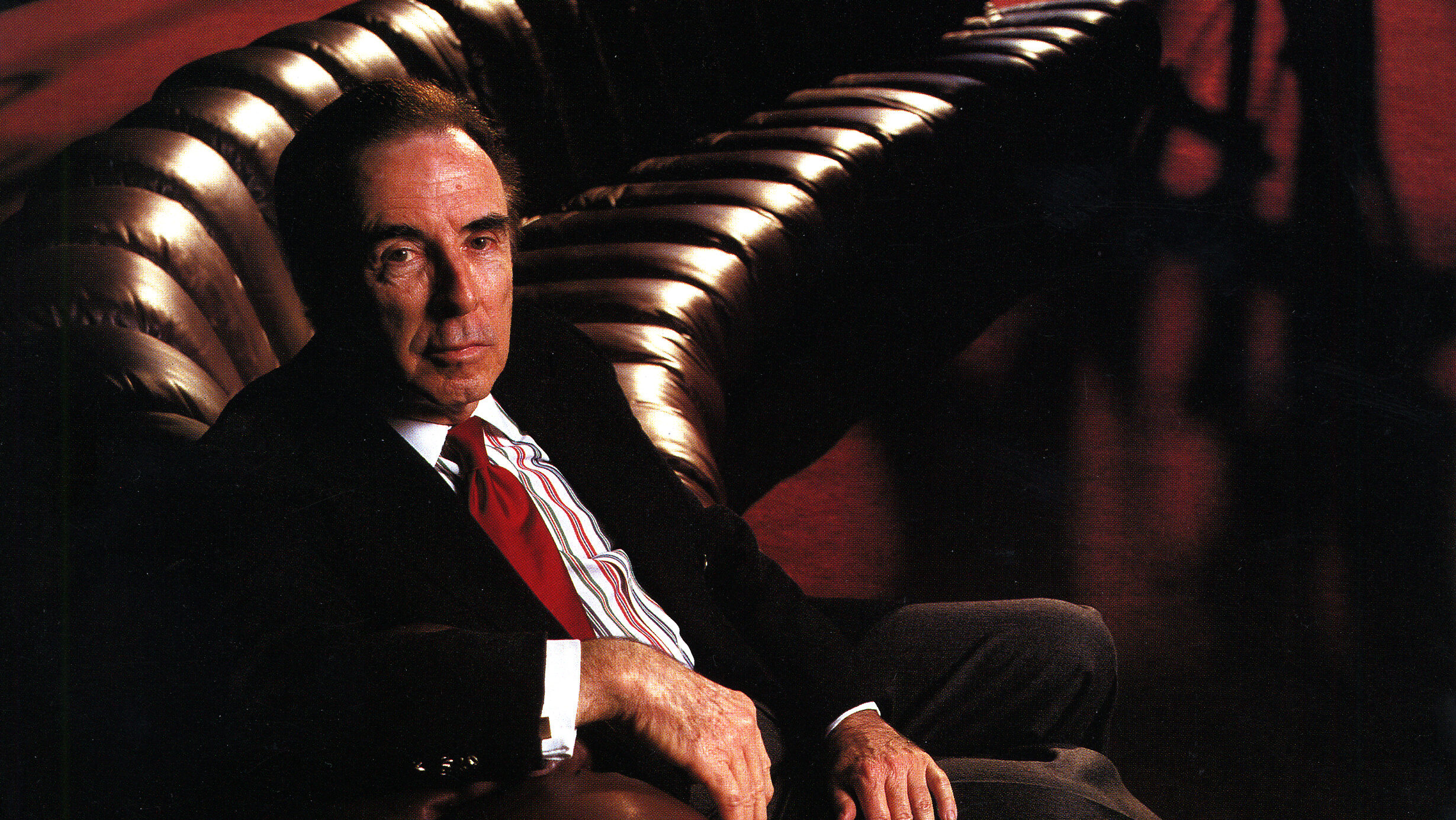
Carlisle Floyd / Photo: Houston Grand Opera
Houston Grand Opera is having a very American year.
The 2025-26 season kicked off with Gershwin’s Porgy and Bess, with American conductor James Gaffigan on the podium. During that run, HGO announced that Gaffigan would become HGO’s new Music Director, beginning in 2027. The company has been trumpeting their Grammy win for the recording of Jake Heggie’s Intelligence, an opera set during the U.S. Civil War. And now Houston audiences can look forward to an opera by another American composer: Carlisle Floyd’s Of Mice and Men.
HGO isn’t alone in celebrating Floyd this year. 11 June would have marked the composer’s 100th birthday, and The Carlisle Floyd Centennial lists dozens of planned performances, with many more to be announced as 2026-27 opera seasons are revealed. More than 25 opera companies and universities will join the festivities.
But Floyd’s connection to HGO is unique. Music Director Patrick Summers described it to me as “the longest relationship of any composer with any opera house” and spoke of the profound influence Floyd had on every premiere HGO produced during his time. “There was no precedent for a living composer’s effect on a company like what Carlisle had with Houston Grand Opera.”
One of Floyd’s legacies at HGO is the company’s young artist program. Co-founded by HGO General Director David Gockley and Carlisle Floyd in 1977, the HGO Studio combines intensive training with performance opportunities. For many years, those opportunities included a full, staged opera each season. (Notably, Mark Adamo’s Little Women premiered as an HGO Studio production.) But HGO hasn’t produced a studio opera in 25 years – until now.
The confluence of the Floyd centenary and Sarah and Ernest Butler’s $22M gift in 2023 to support the studio (the program has since been renamed the Butler Studio in their honor) have inspired and enabled HGO to revive the tradition. On 13 March, director Kristine McIntyre’s new staging of Of Mice and Men will open at the Cullen Theater for two performances, starring HGO’s Butler Studio artists. (This co-production will then appear at Des Moines Metro Opera, Florida State University, where Floyd’s Susannah premiered, and Lyric Opera of Kansas City.)
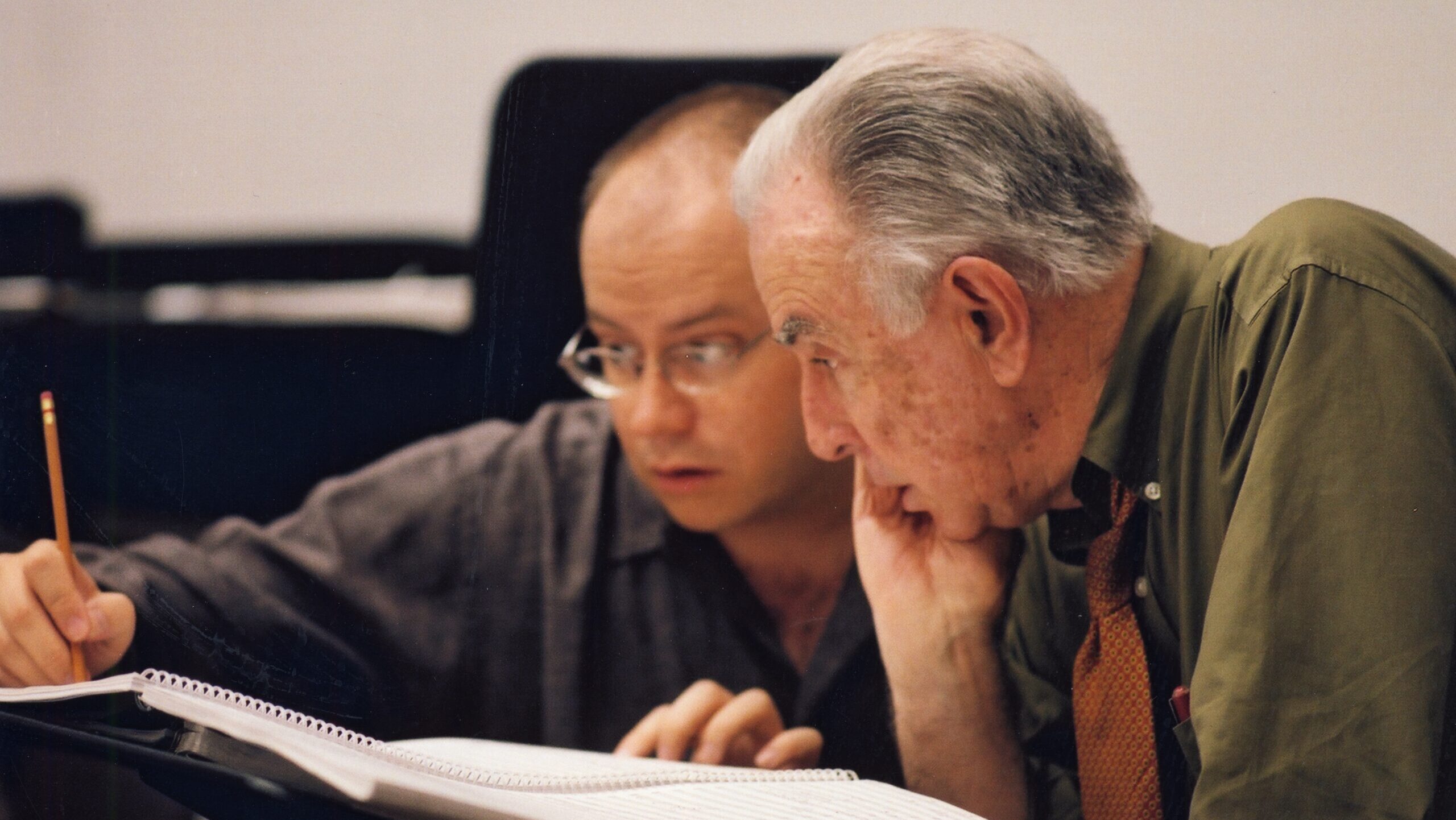
Carlisle Floyd and Patrick Summers / Photo: Houston Grand Opera
A Floyd opera was certainly due for the centennial, but why this Floyd opera? According to Summers, it was Floyd’s favorite, though it got off to a rocky start. Kurt Adler at San Francisco Opera initially asked Floyd to adapt Of Mice and Men, a project Floyd enthusiastically embraced. He worked and reworked the piece, at first adapting Steinbeck’s play version of his novel, but then mining the novel itself for additional depth. After two years of work, Floyd shared the first Act with Adler, who rejected it. Undaunted, he started over on both the music and libretto. By his own account, he “never revised an opera more.”
Of Mice and Men finally premiered in 1970 in Seattle, and then in Cincinnati. There, David Gockley – who would be appointed Houston Grand Opera’s general director two years later – saw it and met Floyd, kicking off a collaboration that lasted until Floyd’s death in 2021.
All this wrestling with his “problem child” didn’t sour Floyd on Of Mice and Men; quite the opposite. As Summers explained, “He had a very deep emotional connection to the story, to the friendship depicted between George and Lennie. It moved Carlisle every single time he engaged with it – every time he was at a performance of it, every time he talked about it.” Floyd’s respect for Steinbeck prompted a determination to do his book justice.
Summers clearly loves this “masterpiece,” which he conducted at HGO in 2002. (That production was the first – and as far as I can tell, still the only – professionally released recording of this score.) It is “hauntingly beautiful, dark and heavy” and really “captures the weight of Steinbeck country, of the Salinas Valley” as well as drawing “distinct musical characters” for the two leads. There is something inevitable about the music: “It’s so organic. It doesn’t feel like these characters could sing in any other way.”
Importantly, the Butler Studio also has the right artists to perform Of Mice and Men this season. The presence of bass-baritone Sam Dhobany and tenor Demetrious Sampson Jr. in the studio “certainly played a role” in selecting this opera, per Summers. Both have already wowed Houston audiences in multiple mainstage appearances; Demetrious’s turn as Sportin’ Life in Porgy and Bess this fall stole the show. (On the strength of that performance, several friends have planned a trek to Austin for his debut as Rodolfo in April.)
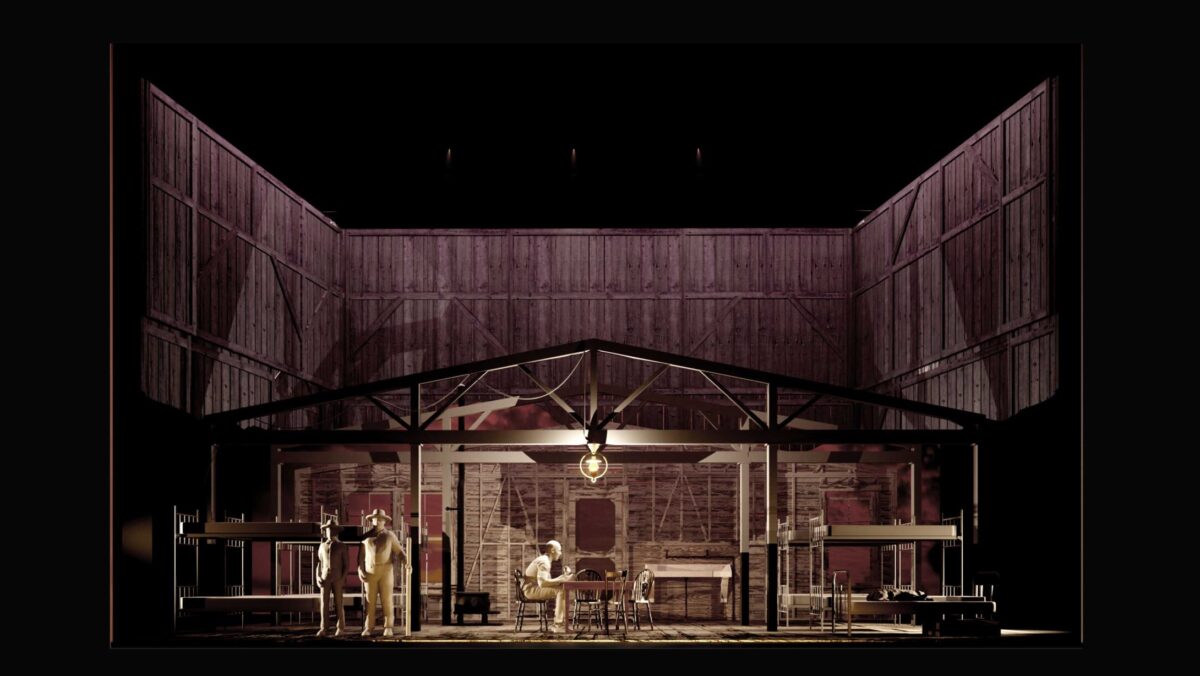
Set Design for Of Mice and Men by Luke Cantarella / Photo: Houston Grand Opera
I spoke with Sam and Demetrious about Of Mice and Men. Sam recalled stumbling across the opera in the music library during undergrad and being thrilled to discover an adaptation of “one of [his] favorite novels of all time.” As he explored the score, he determined that George would suit his voice and began nursing hopes of someday performing the role – a dream that, five years later, is coming true. “I just relate so much to Geroge,” he explained. “He’s the everyman character… he tries the best for himself. And every time he’s tried to get out of this stingy life of being a ranch hand and being lonely, it’s always been a slap in the face.” He drew emotional parallels to a career singing opera: loneliness, constant travel, and separation from family and friends. (He was too tactful to mention financial struggles, but of course those burden many singers as well.)
Demetrious saw connections between Of Mice and Men and his other recent roles at HGO (Sportin’ Life in Porgy and Bess, and the Witch in HGO’s English-language family performance of Hansel and Gretel). “All three of them are in English, and two of them are by quintessential American composers of the classical idiom. They’re all characters that require imagination… a full release of reality and ego.” He admits that Lennie in Of Mice and Men has been the most challenging of the three. It has both the most difficult score, and ample spoken dialogue. But, echoing Summers’s comments, he says it feels just right: “If I were searching for the things to say myself, [this music is] how my mind would do that.”
Sam raved about the score, how Floyd “paints the scenery,” draws on folk tunes, introduces wrenching leitmotivs (particularly for the farm George and Lennie dream of), and runs the emotional gamut (“the highs are highs and the lows are lows”). Demetrious praised the composer’s ability to “bring tenderness into moments of chaos.” Much of that tenderness comes from his character of Lennie. Lennie “sings the most tonal music” and often resolves other characters’ dissonances. To Demetrious, there’s something special about the balance Floyd strikes: “The intervals are crazy. Sometimes the orchestration or the piano, it’s no help at all… but I love that it still feels human and pretty.”
Both singers particularly enjoy one of the opera’s few lighthearted moments — the swinging trio between Candy, Lenny, and George, which Sam described as “something Sondheim might have written” and Demetrious noted for its “honky tonk rhythm section.” They spoke at length of the opera’s wrenching finale, the contrast between George’s heartbreaking knowledge that he is about to shoot Lennie, and Lennie’s own jolly obliviousness. “That’s what Floyd does so well,” Sam enthused, “He can create two separate worlds simultaneously happening.”
To prepare dramatically, studio members have been workshopping Steinbeck’s play with the Alley Theater. This collaboration between two of Houston’s flagship arts institutions has been eye-opening for the cast. They’re doing the kind of deep script work in which actors often engage: unearthing characters’ objectives in every scene, analyzing monologues line-by-line, switching roles to take different perspectives, and experimenting with masks and physicality. It’s not something short opera rehearsal periods often allow for. Sam wishes they would: “We should be doing this with all the operas!” Demetrious has found the experience particularly helpful in tackling the challenges of his role: portraying mental illness with realism and respect, and ensuring Lennie is unaware of his impending doom, even as Demetrious knows all too well what’s in store for his character.
Being in the Butler Studio together means the members of the cast have bonded deeply, over an extended period, and can weather this story’s difficulties together. “We know each other well,” Demetrious explained, “so we can really help each other and lift each other up.” That closeness has been built not just through rehearsals and performances, but also hot pot restaurant outings and card game nights at each other’s homes.
When I spoke with them, the cast had just begun rehearsals, but they were already excited about Kristine McIntyre’s new staging. (While she has directed Of Mice and Men before, this will be a new production.) Visually inspired by Dorothea Lange’s photographs of the Depression era, McIntyre’s “gorgeous” scenescape “looks real” (Demetrious’s words). Bright, sweeping projections serve as backdrops. The bunk house, made entirely of metal, is both solid and bare – befitting transitory ranch hands with few possessions. McIntyre is adamant about smooth transitions and about staging “every single note of music in the opera,” ensuring that the piece, is, per Sam, “always moving.”
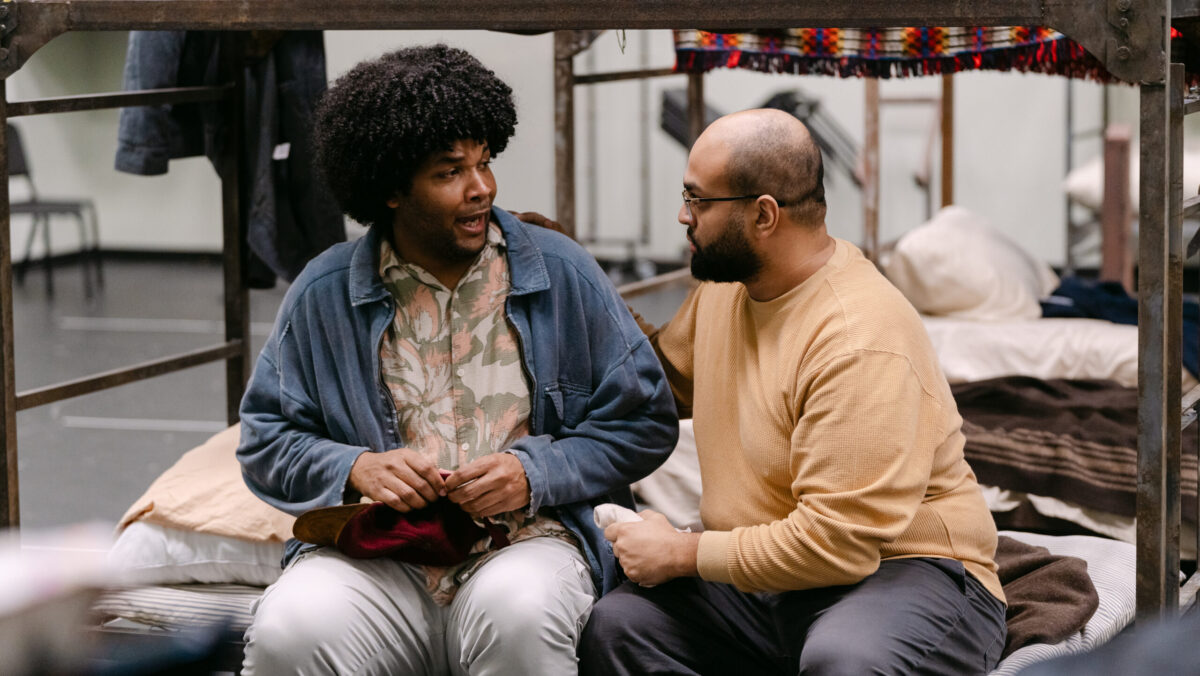
Demetrious Sampson Jr. and Sam Dhobhany rehearsing Of Mice and Men / Photo: Michael Bishop
Houston’s racially diverse cast also sends a message. These migrant workers – portrayed by singers of color – are wrestling with the precarity of their existence, the seeming impossibility of their dreams, and the fear of persecution. So are the (mostly immigrant, mostly non-white) workers who power America’s agricultural industry today. The perpetual underclass that feeds our country remains mostly invisible until something goes wrong and it’s time to assign blame. Modern political echoes might not be universally appreciated by Houston’s purple opera audiences, but they make this not just an historically important piece of Americana, but an opera for Americans today.
And proud Americans in Houston owe Floyd a listen. If HGO is waving its American flag high this season, we can trace that back to Floyd. Summers credits him with helping the company “rethink what an American opera company could be – that we didn’t need to be Eurocentric.” His influence extended well beyond the founding of the studio. Floyd’s “aesthetic and his devotion to new work and his belief in opera as an art form” are “a big part of the DNA of Houston Grand Opera.”
Floyd’s impact on American opera beyond Houston lives on as well. At a time when the influence of the Second Viennese School held sway and academic tastemakers lauded Copland and Boulez, Floyd wrote tunes and arias. American composers that followed him imitated not his musical style, but his example of originality. According to Summers, “He always wrote in his own voice. He never tried to write music for music critics or for theory. He held to his style… that was a very radical thing to do. What he encouraged was not other composers to write in his style, but other composers to hold onto their voices.” Summers cited Jake Heggie and John Adams as two who benefited from Floyd’s example and encouragement.
It’s fitting, then, that Heggie’s Intelligence and Floyd’s Of Mice and Men are both sources of excitement in Houston this year. We’re celebrating two American composers, one inspired by the other, sharing their versions of deeply American stories. What a great birthday party, for Floyd at 100 and for the United States at 250.