Photo by Monika Rittershaus.
Nothing’s going right at the royal court of Isfahan. The young sultan Darío refuses to visit his harem, leaving his odalisques languishing, while his sister Benamor is willful and unladylike, more interested in arms and dancing girls than the foreign princes suing for her hand. The already thorny matter of affairs grows more complicated with the arrival of the charming adventurer Juan de León, who comes to court the princess but quickly finds himself entangled with the sultan instead. But nothing here is as it seems…
Such is the essence of Benamor (1923), the most successful opereta of Pablo Luna (1879–1942), one of 20th century Spain’s foremost zarzuela composers. It is the perfect, delightfully unserious Carnival absurdity, its rollicking plot defined by switched identities, gender confusion, and rampant homoeroticism, buoyed by Luna’s humorous, sparkling score. It’s also the sleeper hit of the MusikTheater an der Wien’s season, thanks to Christof Loy’s ingenious production and a stupendous cast.
Though the Theater an der Wien has a long, happy history of rediscovering long-forgotten works and staging operettas both (this season’s first main-stage production was Stefan Herheim’s new Die Fledermaus), zarzuelas, ever so rarely performed outside Spain, have just now found their way to the Viennese house. Benamor, rescued from obscurity by the Teatro de la Zarzuela’s 2021 production, owes this Austrian export to chance: Christof Loy saw one of the Madrid performances and, enamored, pitched it to the Theater an der Wien.
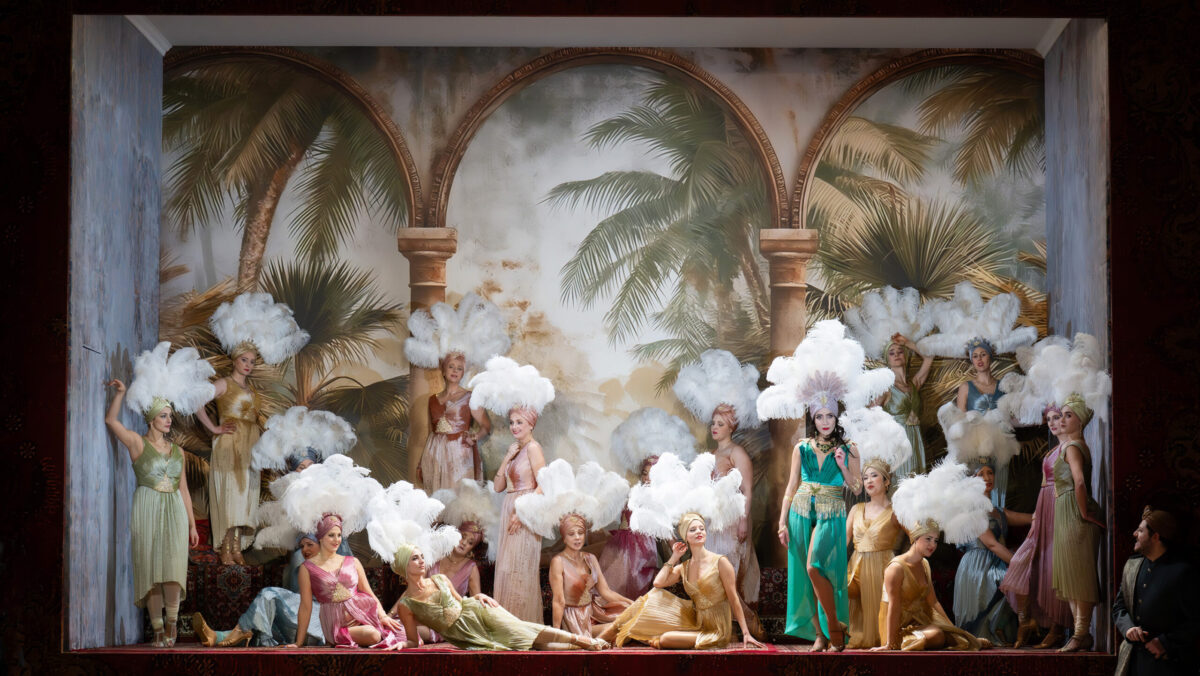
Photo by Monika Rittershaus.
It’s an auspicious debut – perhaps in no small part because Benamor is of the opereta-zarzuela variety, a sub-genre heavily influenced by Lehár and English musical theater (or, in musicologist Christopher Webber’s words, the “Anglo-Viennese invasion” of the Spanish stage). Throw Puccini-esque lyricism, the copious use of contemporary dances (foxtrot, shimmy, and, of course, waltz), and the perfumes of the Orient and Spain into the mix, and you get a score that’s both familiar and immediately appealing, well-orchestrated and full of catchy numbers. Antonio Paso and Ricardo González del Toro’s libretto is charmingly silly, its faux-historical Persian setting bookending Luna’s so-called “Oriental trilogy” (following the 1916 El asombro de Damasco and the 1918 El niño judío, containing the enduring hit “De España vengo”). The libretto invents a barbaric law which decrees that the sultan’s first offspring can only be a boy, and the second only a girl – if a child has the misfortune to be born the “wrong” gender, they will be put to death. To save her ill-timed children, the sultana Pantea has raised her daughter as the sultan Darío, and her son as the princess Benamor. (I will refer to these characters by their “pretend” names and gender, as does the libretto throughout.)
In the spirit of “operetta reality”, as Loy jokingly puts it, neither child is aware of their true gender, though they both strain against the limitations placed on them by gender norms. Pantea senses impending disaster when Darío decides to marry off his sister and fesses up to the Grand Vizier Abedul about her deception (though, in a running gag of temporary post-coital deafness, he hears none of it, necessitating a repeat that the kids too will overhear). Further complications arise as Darío grows obsessed with Juan de León, while Benamor, escaping the palace, falls for a beautiful slave girl, Nitetis. Everything does, of course, work out in the end, with the royal siblings deciding to embark on a grand tour, allowing them to switch back their opportunities in secret. Yet, the social order is not quite restored as the finale finds them still in their assumed identities, with their lovers by their side to boot.
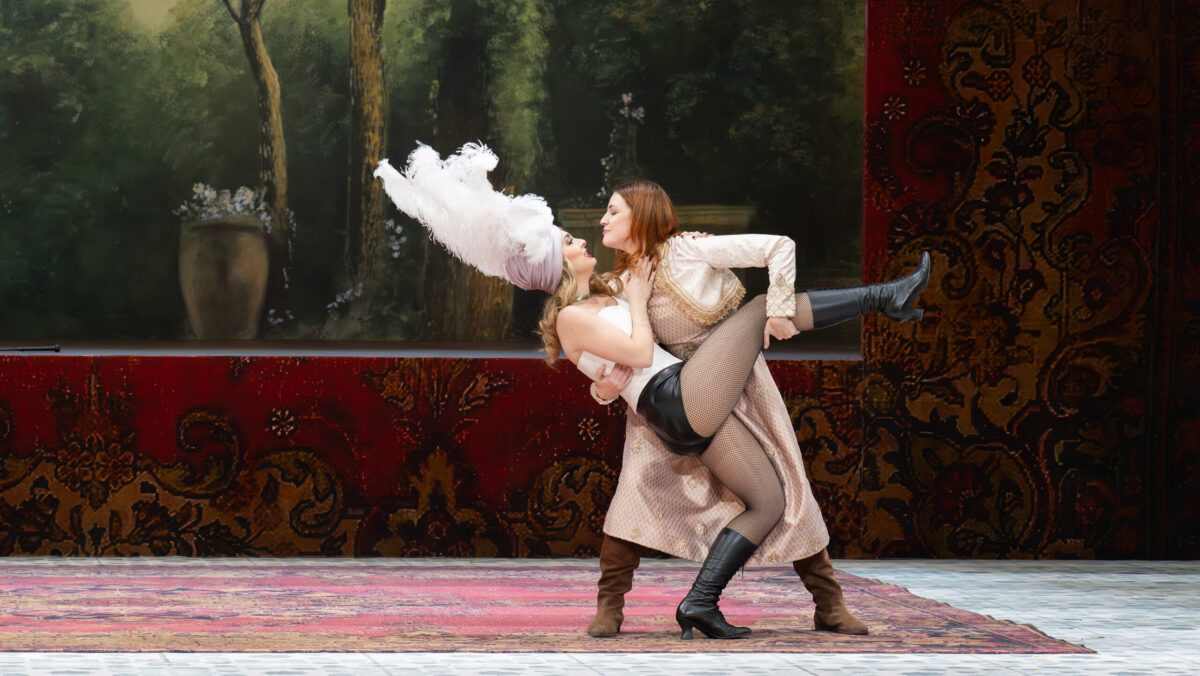
The Theater an der Wien’s production is a felicitous meeting of work, venue, and performers. The house provides an intimate space where both the lighter-voiced cast and the prose dialogue can work without strain, while Loy lets the work’s vivacious energy shine, ramping up its queerness with abandon. Though Benamor offers more than enough kinky material to get the wheels in the head of a director like Calixto Bieito turning, Loy is content to play the work for an irreverent, lovable fairy tale. There is, to be sure, a smart bit of polishing. Herbert Murauer’s sets and Barbara Drosihn’s costumes humorously reflect on the work’s exoticism, playing with its duality of modernity and picture book-like fantasy. Within Loy’s familiar white-walled sets, 19th century Orientalist paintings cover the back of the stage, and though the royal court is dressed elegantly tailored traditional garb and Juan wears a picturesque swashbuckler costume, the odalisques look like they belong on a cabaret stage, and the citizens of Isfahan are all in modern garb. The slaver Babilón hocks his wares from a beat-up caravan, and his most prized asset, Nitetis, enters the stage decked out in pleather, sporting a top hat and a riding crop – all vehemently moving the story away from its simple Orientalist fantasy setting.
Upon this colorful stage, Loy conjures an equally vibrant world. Character portrayals and relationships are expressively, attentively drawn with minutely detailed, vivid acting, if tending towards the exaggeratedly comical when it comes to Darío and Benamor’s cartoonishly “feminine” and “masculine” behavior. Javier Pérez’s choreography ensures exuberant, spectacular movement onstage without unduly straining the principals, while the eight-person dancer corps perform with striking energy and humor, portraying multiple side characters from the ballet-dancing Janissaries and the foreign princes’ back-up crew to the performers of the Act II Danza del fuego’s orgiastic rites.
Loy zeroes in on the rampant sexual tension pervading Benamor, the tone set swiftly by the opening scene where the janissaries fight tooth and nail with their captain to console the neglected odalisques. Consequently, Benamor reacts to every woman with the subtlety of an overgrown Cherubino. The harem’s first odalisque, Cachemira, tries to seduce Darío with exasperated determination, while the sultan, more interested in joining his harem’s chorus line than enjoying their beauty, wastes no time to flirt up a storm with Juan. In a welcome bit of additional queering, Benamor’s rejected suitors, Jacinto and Rajah-Tabla find consolation in each other’s arms, both, as they fess up, only interested in her dowry anyway, and more used to dealing with battle-hardened warriors than women.
The libretto’s blatantly homoerotic scenes – starting with the Act I trio Princesa misteriosa where Darío takes the uncaring Benamor’s place to accept Juan’s courting, swiftly converting an awkward three-way conversation into an impassioned love duet – are mined for full affect, yet Loy also ups the siblings’ “wrong” gender presentation, unchanged throughout the work (even as Benamor courts the odalisques and wins a kiss from Nitetis), with a cheeky casting choice. Both Darío and Benamor have been composed for sopranos: Darío’s part is taken by male soprano Federico Fiorio. It’s not a move that I’d applaud elsewhere, but here, it both effortlessly spoofs the stereotypical gender norms espoused by the characters, and thwarts any recourse to the “proper” heterosexual order: you cannot forget that the two couples onstage are sung, respectively, by two men and two women.
And how well they’re sung! I was apprehensive about Fiorio, but in the house, his voice is clear and resonant, capable of effortless pianissimi, and melding wonderfully together with David Oller’s silky, bright baritone. His portrayal of Darío, even in its comical spirit, offers a sympathetic portrayal of young person longing for love and desperate to find their place in the world. He finds a worthy partner in Oller, ineffably charming and nonchalant as the Spanish adventurer: it’s very easy to get swept up in his passionate rendition of the patriotic ode País del sol and equally difficult to resist his ardent tone in the Act III love duet, where both he and Fiorio do justice to Luna’s lush composition. On the other side of the gender-switching equation, Marina Monzó is an audacious, spirited, and devastatingly horny Benamor, her pleasantly dark, flexible soprano showing off an appropriately macho tone as she blows off her suitors in their trio, then kicks into hormonal overdrive as she charms the odalisques with Al contemplaros tan hermosas. But it’s no blunt force performance: enchantingly softening in her Act I canción, her Junto al mirador casts a spell over onstage listeners and audience alike. Paired with Benamor in a love affair more carnal than sentimental, Sofía Esparza offers a suitably sultry Nitetis, compellingly sung and ravishingly acted, while Joselu López is a hilarious Babilón. As the unfortunate suitors, César Arrieta (Jacinto) and Alejandro Baliñas Vieites (Rajah-Tabla) both delight with appealing young voices and riotous acting, Baliñas Vieites’s warm, commanding bass booming with convincing force in his ferocious entrance aria. Veteran zarzuela actress Milagros Martín is nothing short of brilliant as Pantea, while David Alegret (Abedul), Francisco J. Sánchez (Alifafe) and Nuria Pérez (Cachemira) convincingly round off the sparkling ensemble as the long-suffering royal subjects.
José Miguel Pérez-Sierra, musical director of the Teatro de la Zarzuela, conducts the Arnold Schoenberg Choir and the Vienna Radio Symphony Orchestra with style and verve, drawing a sunny-toned, deeply expressive and exuberant performance from his forces in the pit and on the stage. It’s the kind of performance I could not help but revisit, time, money, and effort be damned – and could there really be anything more to say about a production’s worth?