Photo by Vittorio Greco
The San Francisco Symphony, like most orchestras of international stature, usually programs a full opera-in-concert at least once per season, along with the usual concert vocal repertoire of requiem masses and song cycles. This approach to programming was championed by the ensemble’s two most recent music directors (Michael Tilson Thomas and Esa-Pekka Salonen). The results were usually delightful and sometimes even revelatory.
I still remember Thomas leading a performance of Wagner’s The Flying Dutchman with the brilliant Jane Eaglen as Senta in 2003, which remains the best rendition of the opera I’ve ever heard live. Recent gems at Davis Symphony Hall have included performances of Stravinsky’s Oedipus Rex (2022) and Bartok’s Duke Bluebeard’s Castle (2024), both under Salonen. The orchestra won a Grammy for its recording of Kaija Saariaho’s Adriana Mater in 2023, also under Salonen.
So when the San Francisco Symphony announced its current season, I made particular note of an all-Mozart concert featuring arias from the operas the composer wrote with librettist Lorenzo da Ponte. A subscription concert even partially devoted to opera arias? Rare. I had to go.
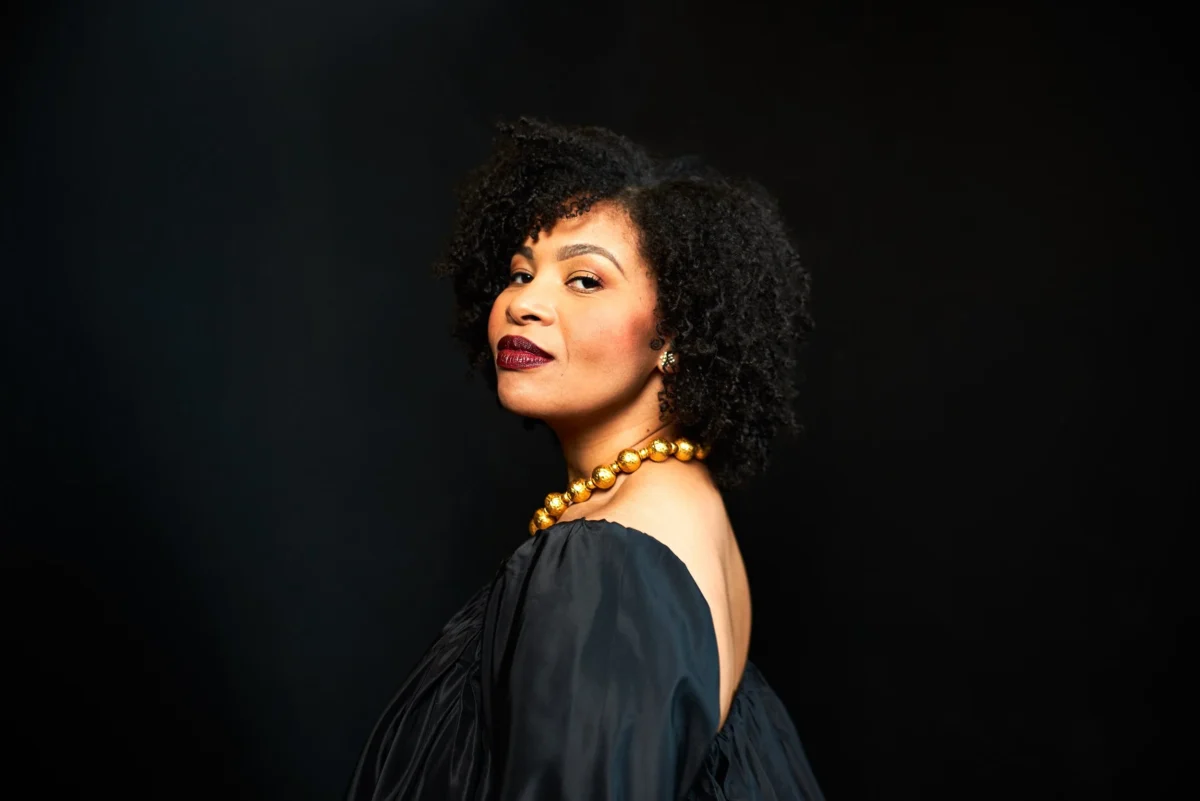
The program was a mixed bill of a serenade, two symphonies, and four arias featuring the Berlin-based South African soprano Golda Schultz. The orchestra was conducted by Mozart specialist Harry Bicket, music director of both the English Concert and the Santa Fe Opera.
What I can say about the instrumental part of the evening is that it was perfectly fine. The instrumental pieces were played with a reduced orchestra, more in keeping with the size of the orchestra for which Mozart would have composed.
I am no fan of letting the perfect be the enemy of the good. However, Davies Symphony Hall is not an optimal venue for composers like Mozart and Haydn. San Francisco is also home to period instrument orchestras of international stature, namely the Philharmonia Baroque Orchestra & Chorale and American Bach Soloists. So the Mozart niche is well-filled. But I also wouldn’t want a world-class ensemble like the San Francisco Symphony not to play Mozart and Haydn, just because Davies is too big and the sound a bit too dry.
In the vast expanse of Davies, Symphony No. 34 and Serenade No. 13 felt a bit staid, with the latter slightly compromised by a tuning problem somewhere in the first violins. Both pieces were competently played by a great orchestra, but there wasn’t that oomph that even the most stately Mozart pieces always have. Bicket’s conducting had solidity and confidence, even if his conducting didn’t exactly set the proverbial world on fire.
Golda Schultz took the stage after intermission. She chose one aria each from the three operas Mozart wrote with Da Ponte, all of which form the basis of her most recent album, You Drive Me Crazy (2024). She added a concert aria as an encore.
Hearing these pieces in a concert hall meant that the text came through in a way that rarely happens in the opera house. It also meant that we could appreciate Mozart’s brilliant setting of Italian. And I newly heard some nuances of Mozart’s writing for the orchestra (like his use of French horns in his “rage arias”).
There were also some downsides to putting Mozart opera in a concert hall.
I should say that having Golda Schultz fly in to do about 20 minutes of singing is the definition of luxury casting. She is an international artist who sings with leading opera companies around the world. She only sung once at San Francisco Opera. And there don’t seem to be any plans for her to return soon. So this was a rare chance to hear her at all.
Schultz began her set with Susanna’s recitative and aria “Giunse alfin il momento…Deh vieni, non tardar,” from Le nozze di Fiagro. It was a surprisingly tentative and uneven start. Schultz’s is a bright and punchy voice when tackling Mozart’s more extroverted characters. By contrast, her Susanna sounded unsure and cautious, almost like a singer trying out a role—not a star, like Schultz, who knows Susanna. I couldn’t quite figure it out. Looking at the characters on the rest of the program that were coming up (Fiordiligi and Donna Anna), it became apparent that she should be singing the Countess. It’s the role in Figaro that is more her calling card. It’s no less challenging, but it’s clearly more in her voice type.
It wasn’t that Schultz didn’t have the high notes—it was that the lightness needed for Susanna is no longer in Schultz’s voice. She is not a soubrette anymore. She’s now a fully lyric soprano with a blazing top. She’s adding roles like Gounod’s Juliette, Mozart’s Countess, and, soon, Puccini’s Lìu. If Mozart didn’t call for a blaze, she sounded a little bit lost.
As any singer will tell you, Mozart leaves a singer utterly exposed. There is no hiding anything. Not bad technique, not nerves, not tentativeness. Schultz is a solid musician, but the wispy accompaniment Mozart provides left Schultz sounding on her own. Bicket’s somewhat sluggish tempo also didn’t help, forcing Schultz to spin out more sustained lines in a part of the voice that maybe isn’t her strongest. This also meant that the acting was vague, never giving us a sense of who Susanna is or why she’s singing. It came across more like a concert aria.
A noticeable feature of her voice throughout the evening was some audible difficulty in the lowest notes. Today’s divisions of soprano and mezzo soprano are not the same as in Mozart’s time, and he famously sends his lyric soprano roles down into the vocal basement. Since Susanna is not a role for which chest voice is considered the thing to use, being a young woman and ingénue, it left Schultz little choice but to be either inaudible at the bottom of her range or even sharp. Audible trouble in the low part of the tessitura seems a somewhat common feature of her operatic singing. Every singer has a wonky part of their voice; this is hers. Such is life.
The moment Schultz began “Come scoglio, immoto resta” from Così fan tutte, however, it was obvious: this was the repertoire she should be singing. She tore into the text. Suddenly, there was a full-bodied characterization, a commitment to Fiordiligi’s imperiousness and her main character energy. She even gave us the Maria Callas arm-at-right-angle-hand-to-God gesture that told us everything we needed to know about this character. And the Callas chest notes showed up. Not surprisingly, the voice sounded far more grounded in this aria.
Once that was the case, the limitations of Davies Symphony Hall were more apparent. From my seat in the rear orchestra boxes, the acoustics for voices were a bit dry and cold. The hall definitely sends the voice out to the audience, but it robs it of some warmth along the way. The Davies acoustic also does funny things to vibrato. Schultz’s voice, not unusual for a lyric soprano, has a fairly rapid and ripe vibrato. There were times when, in the hall, it sounded more like a trill than a vibrato, particularly in the middle voice.
Donna Anna from Don Giovanni is another role far more suited to Schultz than Susanna, as she can tear into the text with all of the righteous anger that Mozart builds in. It was an awkward choice to include the recitative (a brief exchange with Don Ottavio) instead of just starting with the aria itself. Don Ottavio, after singing a few lines, just stands there as Donna Anna has her moment. Samuel White acquitted himself respectably, even if the hall did his voice no favors. His voice, too, was robbed of some Italianate warmth, the hall rendering it a bit bland and faceless (though Don Ottavio is also one of Mozart’s blandest and most faceless tenor roles to begin with).
Schultz’s Donna Anna was not quite as convincing as her Fiordiligi, but it was perhaps the more daring. Donna Anna is an all-or-nothing character, a Tosca before Tosca. This means that the voice is under a lot of pressure. And the body is under a lot of pressure to embody grief and outrage: two emotions that are voice-killers for the singer. Schultz clearly enjoys the role, and the voice is definitely strong enough and secure enough to sing it. There is no questioning her technique. She even threw in some extra embellishment in the final verse and sent Donna Anna up to a D-flat with no problem.
There were some rockier moments: a jumped entrance and a final note that was flat (in an ending that, to be fair, is written by Mozart as an awkward whimper and not a bang). But these moments were actually a welcome thing. Schultz is a careful singer. She is a polished singer. That interpolated high note added some spice, even if the spice lingered and muddied the ending. That jumped entrance drove the aria forward, and the orchestra was right there with her.
Schultz ended the evening with a fully planned encore—a requirement at Davies Symphony Hall for visiting soloists since the pandemic. She cheekily noted with wry humor to the audience: “The boss is making me perform an encore.” She offered the concert aria “Chi sà, chi sà, qual sia” which Mozart wrote to be interpolated into Vincente Martín i Soler’s opera Il burbero di buon core. The connection? It also has a text by Lorenzo da Ponte. The effect of the aria was like the singer throwing a rose back to the audience who threw it to her in the first place. It’s not an aria that is going to tax the singer or reveal much, but Schultz dispatched it with panache and solid coloratura technique.
Schultz is someone for young sopranos to look up to. And there are Faustian bargains being made by sopranos right now to have the voice and technique that Schultz has. I’m glad that the San Francisco Symphony took the unusual step to program operatic repertoire. The orchestra provided solid and sensitive accompaniment to the singer. Bicket had everything under control and was moving along confidently. Yet, I wonder if the setting of a concert hall with an orchestra behind her, all quite inauthentic for embodying operatic heroines, robbed her of some of her oomph.
Even so, I’m glad I didn’t let the perfect be the enemy of what was very good.