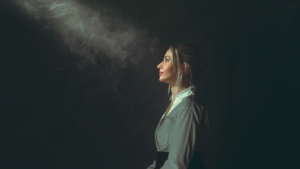
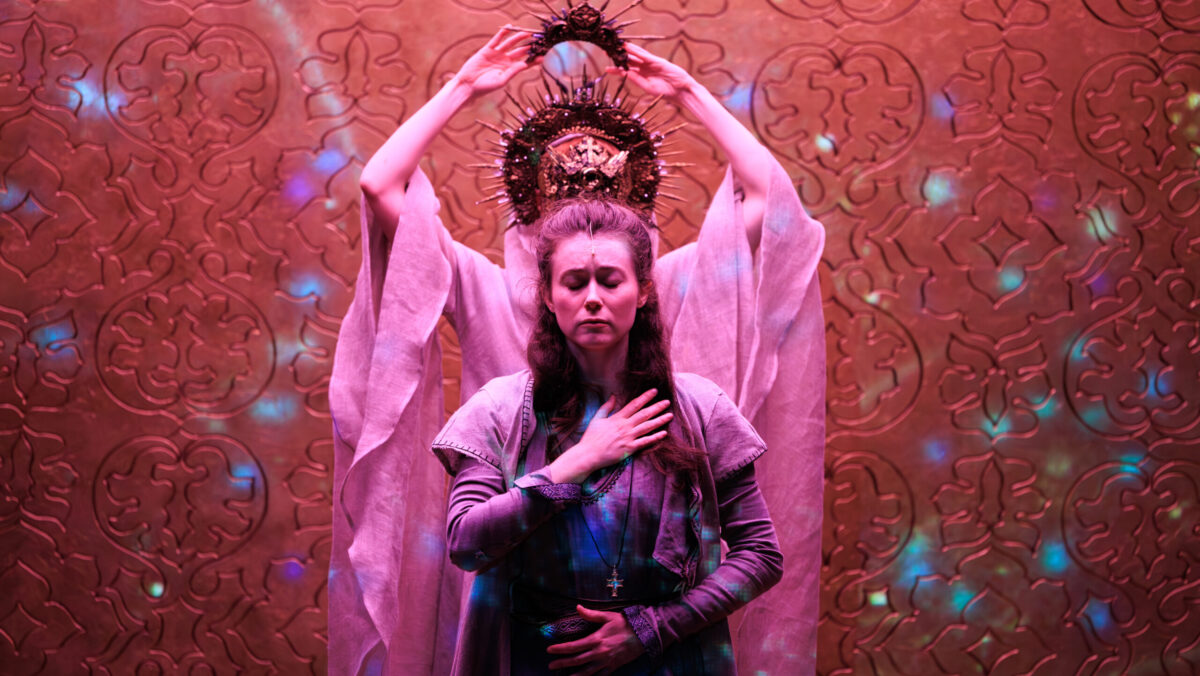
Production photos by Angel Origgi
Who was Hildegard von Bingen, anyway? What do we really know about her? And why would anybody want to write an opera about her?
Hildegard’s life and work are better documented than that of any female composer of her era, but for Sarah Kirkland Snider, whose debut opera Hildegard receives its New York premiere at the PROTOTYPE Festival in January, the life of the 12th-century musician, mystic, and naturalist was much more than what we find in the historical record.
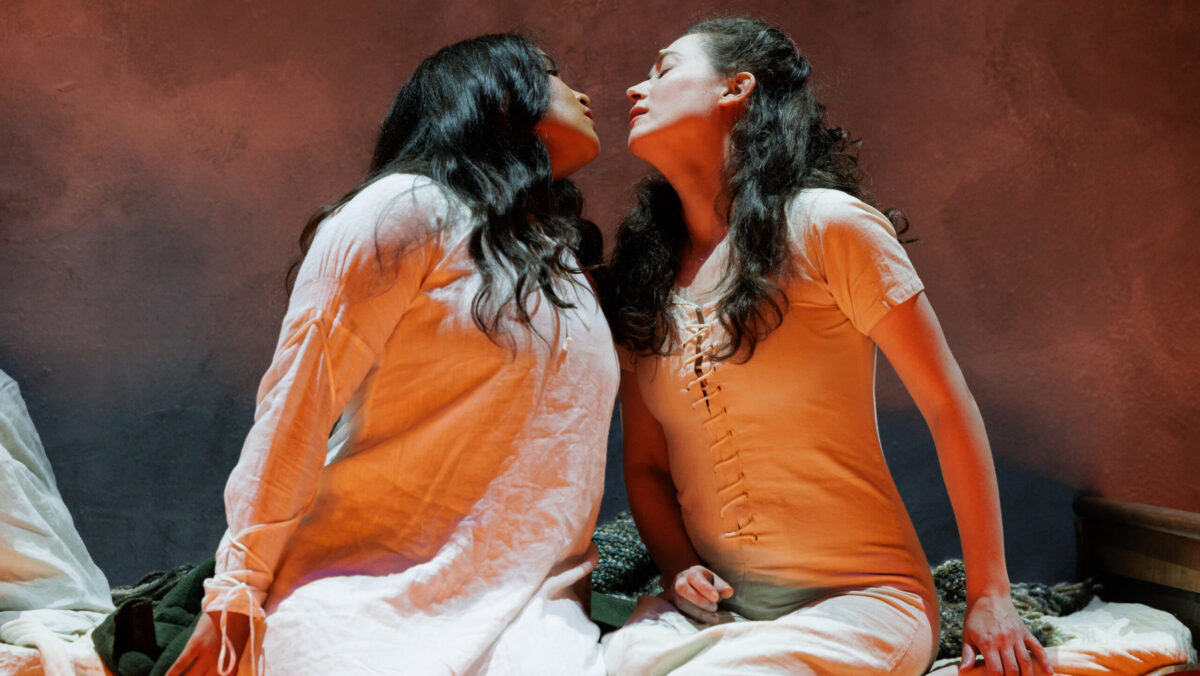
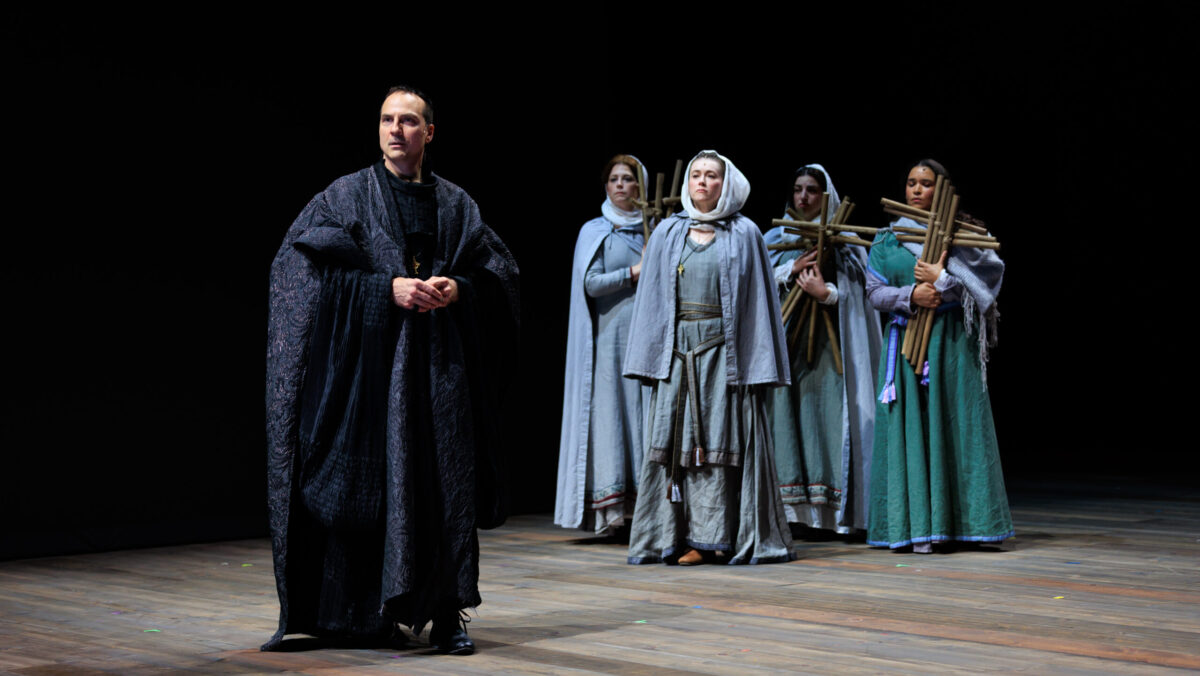
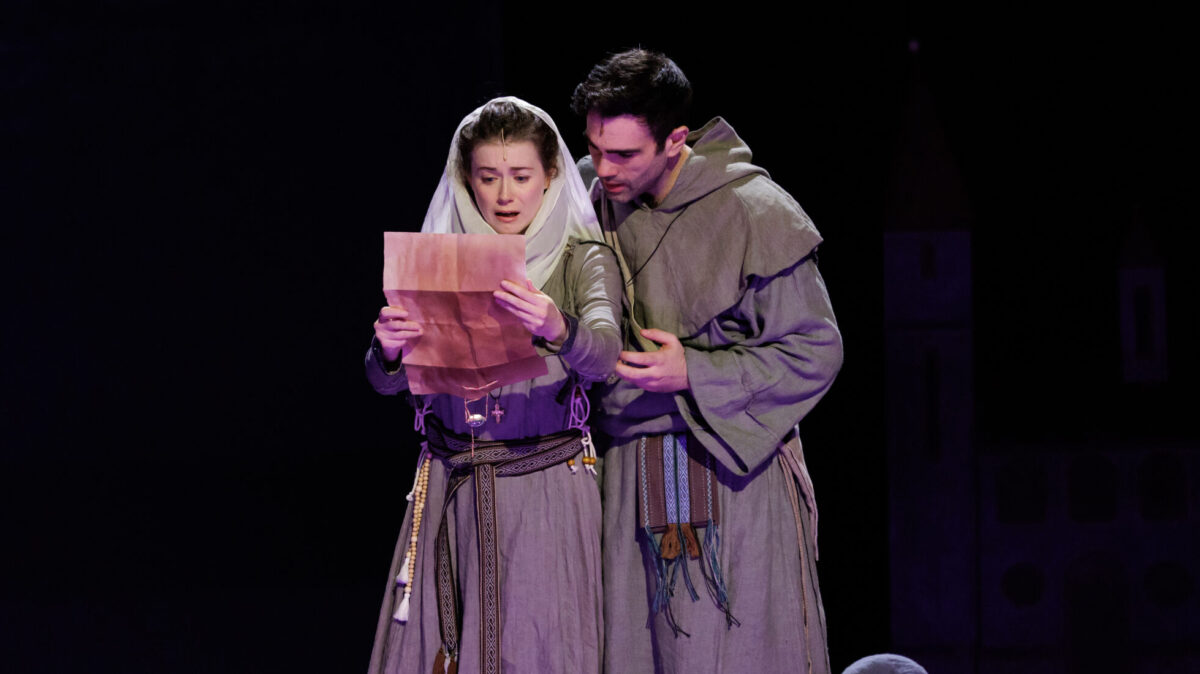
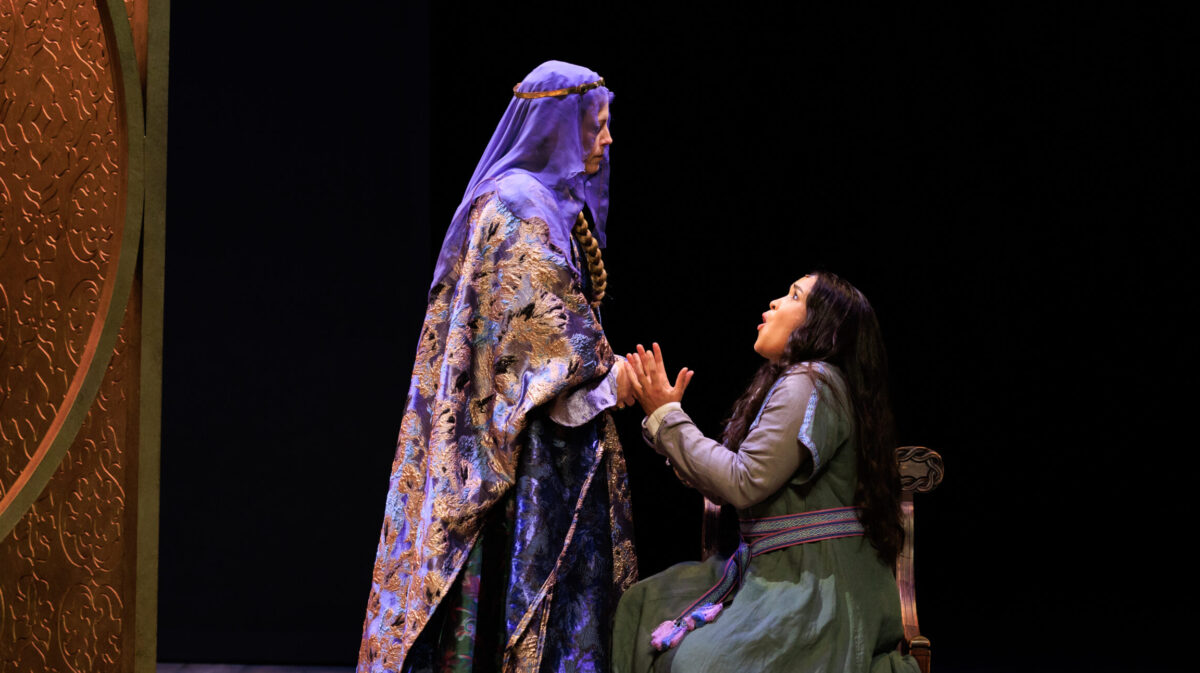
Hildegard, which received its world premiere at L.A. Opera in November, reimagines life of the saint as an unlikely love story between the abbess and one of her charges, playing out during the year in which Hildegard’s submitted her visions to the Vatican for papal imprimatur, to learn whether she will be judged a prophet or a heretic. Hildegard takes in a young woman named Richardis von Stade: prone to epileptic seizures and blessed with a talent for drawing, Richardis becomes Hildegard’s assistant, the object of her desire, and yet another site of a struggle for control between the abbess, Richardis’s family, and the church hierarchy.
Snider spent years immersed in researching the facts of Hildegard’s life before writing the libretto for her opera, with a zeal for the subject that comes through in the effusive, deeply informed, off-the-cuff responses she offers during a lengthy Zoom interview. But aside from the established events of the earlier composer’s life—slightly reshuffled to make for a clearer narrative—much of what the audience sees onstage is Sinder’s own invention.
“We don’t know much, actually, about Hildegard’s inner world,” Snider explains, “because she was very careful to document herself in a very controlled way. She had this hagiography written by her close assistant, Volmar, but she was a very strong, very controlled and controlling person—I think that’s the only way she could have accomplished everything that she did—and I think she was very concerned about appearances.
Production photos by Angel Origgi
“She wrote these beautiful letters, and those were the closest thing that we have to really get an insight into who she was. She presented herself as an educated person (although she wasn’t). But this was all part of her carefully manufactured appearance to the outward world. Her letters to Richardis—there weren’t very many—showed the most human side of her, and they said things like, ‘I love every aspect of your character so deeply that other people have asked me, “What are you doing?”’
“That was the line that has given a lot of people speculation about the nature of their relationship. They were obviously super close, and we know Richardis assisted in the manuscript documenting visions, but we don’t really know how, so it was my own invention that Richardis is the one who’s illustrating them.”
One theme that comes up again and again in my conversation with Snider was the intensely collaborative nature of her own work of art. Each word and note in the piece may have been placed there by Snider’s pen, but producer Beth Morrison and director Elkhanah Pulitzer exerted an enormous influence at every phase, supporting Snider’s creative vision while ensuring that the finished piece was dramatically viable. Even the title was their idea, Snider says: naming the piece after Hildegard herself, rather than something more abstract or mystical, was a way of signaling to potential audiences that this was not an abstract study of Hildegard’s work, but an intimate portrait of the private woman.
“We don’t know a lot about Hildegard the person,” says Snider, “and I wanted to explore that in this opera. I wanted to show what she was grappling with emotionally in terms of her feelings for Richardis—which, again, pure speculation—maybe she wasn’t tormented by these feelings! But she really abused her power after Richardis was taken away from her, and put in another abbey by Richardis’s mother.
“Hildegard wrote these lovestruck, inappropriate letters to every person of power within the Roman Empire, and anyone with any sort of ecclesiastical authority or municipal authority. She was like, ‘You need to bring her back to me, or God will bring down the sword on you!’ At this point, she had really taken this idea that she was this prophet, and that she spoke for God, and used it to try to get whatever she wanted.

Sarah Kirkland Snider / Photo: Anja Schütz
“Now, this is something that, of course, any man would have done in her position, though it was not necessarily a professional thing to do. And a lot of these letters were either met with silence, or with a cursory kind of blow-off, like, ‘You’re a little crazy, and I’m not gonna deal with this,’ kind of response. But the heated nature of those letters also suggested that her feelings for Richardis were very intense, and perhaps more of a romantic nature than a purely collegial one. I thought all of that was interesting, especially in light of her intensely homophobic writings—which, of course, she probably would have had to write in any case, because that was how you toed the line back then, right?”
“Any piece that is about any historical figure or event,” director Elkhanah Pulitzer tells me in a separate conversation, “ultimately is only shared to help illuminate our own condition and our own moment in time.”
Pulitzer was brought aboard the project early in its inception, super-producer Morrison explained in an interview with Pulitzer as well as the two soprano leads, as one of her favorite parts of her highly disciplined creative process: hand-picking collaborators, and then setting them up together to see who will play well together, personally and artistically.
“I had just done David Lang’s Prisoner of the State at the New York Phil,” says Pulitzer. “I was sitting at the fountain out front with Beth, talking about what kinds of work I’m interested in. I said I’m interested in what lies beyond this mortal coil, and things that are female-empowered and female-centered. I’m interested in the poetic, the mysterious, and something greater than the ‘kitchen sink.’ She said, ‘Okay, I think I have something in mind for you.’”
Lang, Adams and Snider are much more Pulitzer’s speed than the big pieces from the standard repertoire. What’s it like, I ask, working with a live composer instead of a dead one?
“It’s incredibly liberating in the sense that, it’s not like when Tosca grabs the candlestick, right?” (Longtime Parterre Box readers will recall the ensuing firestorm when Luc Bondy did away with that sacrosanct bit of business at the Met.) “I was literally in tech rehearsals for Hildegard saying to myself, that’s partly why I love working on new pieces—because I’m liberated from the museum trappings, from that troped-out history.” When her streamlined direction conflicted with Snider’s libretto, the only person who needed to be won over was the librettist herself.
Production photos by Angel Origgi
This was not easy. “A lot of that didn’t make sense to me,” says Snider, candidly relating her shock at seeing her stage directions hit the cutting room floor. “But this is the beauty and the pain of opera, is that it’s a collaborative process, and you can’t just bring one vision. You have to let other people have their creative fingerprints in there.”
As it happens, Snider had not been her own first choice as librettist, but in the end, she was persuaded that it was the only way for the piece to move forward, partly because of the precise balance she had in mind between historical fact and creative liberties.
Nola Richardson, who premiered the role of Hildegard and will reprise it in New York, recalls that before she joined the project, “There was one person I think she talked with who wanted it to be more like a biopic—more historically accurate—and didn’t want to mess with the timeline. And Sarah ended up going with her own instincts, and I’m so glad she did. Like Shakespeare’s histories or Donizetti’s Maria Stuarda, it doesn’t adhere to the exact historical timeline—and that’s great! Because you’re condensing it into this two-hour thing, and you need to have these moments of drama.”
“When a composer who has never written a libretto says they want to write the libretto,” says Morrison, “there’s a bit of terror that goes down your back. I was supportive of it, because we had tried two different librettists, and it just didn’t work out, and they basically said to her, ‘You know, you actually should write this, because you know what you want, to the point where it’s too limiting for me to work with you.’ She knew the story she wanted to tell; she’s so deeply enmeshed in all things Hildegard. She understood these characters better than any librettist that we could have worked with. But it was a difficult moment.”
“It’s been a wonderful journey of discovery,” says Pulitzer, “and for her to grow into this union, within her own work, as librettist and composer, has been a really beautiful and empowering process. Finding a match in somebody else just wasn’t taking off, because she ultimately had clear ideas about what it needed to be.”
Pulitzer, Morrison, and dramaturge Annie Jin Wang worked closely with Snider to refine the structure of the libretto. Morrison described feeding Snider a syllabus of contemporary opera libretti so that she could see how to strike a balance between arias, ensemble numbers, and moments of action.
The resulting dramatic variety is exactly what Pulitzer praises in Snider’s text. “For a first libretto,” she says, “it’s really strong, and the structure has an incredible backbone, and it has metaphor and complexity. Scenes don’t always trope out in the same way, which I think is sort of a newbie challenge, when you have a first-time writer.”
I haven’t heard more of the opera than was presented at the Guggenheim Museum’s Works & Process preview (you can see some of that above, including an aria of Hildegard’s), but I have read the libretto, and I was pleasantly surprised by the strength of the writing. An opera libretto presents a triple challenge to the writer: ideally, it should have that dramatic skeleton Pulitzer praises, and it should be musically settable and singable, in addition to offering its own poetic beauty. For an opera to work onstage, the first two criteria are essential; the last, less so, which explains why so many operas manage to move the audience despite throwing out so many clunky lines and awkward turns of phrase.
Hildegard, as far as I can tell, works on all three counts. The text that I heard sings well, Snider sets it elegantly, and while the libretto might not be as refined as the masterpieces of the genre by Auden & Kallman or Goodman, at its heights it easily surpasses the work of many of her peers. Take the opening stanzas of the aria in which Hildegard shows Richardis the open grave in which she was made to lie in order to show that she had died to the world by entering the convent:
This is where they enclosed me, as a child.
They lay me here
with a girl named Jutta.Face down, veiled in ash.
Our mortal lives now past,
we were Christ’s eternal brides.Twice a day, for thirty-six years,
we lay in these graves to remember:
We had died.
Not quite rhyming, but relishing the repetition of certain sounds, this is the writing of someone who pays attention to the way words are shaped by the mouth of the speaker—it fairly begs to be sung.
Production photos by Angel Origgi
One of the first performers to come aboard the lengthy workshop process was Mikaela Bennett as Richardis, whose musicianship, stage presence, and personality had attracted Snider well before this project was underway.
“I had an opportunity to sing a few of her pieces from Unremembered,” Bennett relates, “on a concert produced by Beth Morrison at National Sawdust. Sarah and I really connected there, which was so lovely. I found out that she was writing her first opera, and I immediately emailed my manager, being like, ‘How can I be involved in this?’”
Bennett remained with the project through a workshop at Cincinnati Opera, an orchestral workshop at Mannes School, and the premiere at LA Opera, and will reprise the role again at PROTOTYPE. Snider explains that the opera went through extensive cuts and revisions over the development process to find its two-hour running length: “There were so many versions of this opera. It kept changing shape at every stage, because of everyone’s comments and influence.” Incredibly, one of the arias that was nearly cut from the final piece was Richardis’s only solo which was added after a week of rehearsals in cincinnati. “The piece changes with who you’ve got in the room, and the conversations you have, and I think that’s really exciting—that it’s so flexible and so spontaneous.”
But the title role wasn’t filled until much later. Coming from a career singing predominantly lighter parts, early and sacred music, Nola Richardson was totally unknown to Snider until she came up for the part.
“I got a request through my agent to audition,” says Nola, “and I thought, ‘Okay, I’ll do a video, nothing will come of it, it’s a video audition…’ But Sarah actually wrote to me and said she appreciated my audition and was hoping it would work out for me to come on board.
“I think she really appreciated the fact that I have such a strong early music background, and I thrilled to have a chance to do this, because—Hildegard von Bingen, I’ve sung a lot of her works, and, known of her and admired her for a long time, so this was kind of a dream role.”
It was also a very unusual role for a lighter soprano voice.
“I’ll be honest, when I got cast, I went through a lot of imposter syndrome over the summer as I was preparing and learning the role, because I thought, ‘This is such an incredible historical figure who has inspired so many. Will I be able to portray enough of the gravitas? Will I be able to instill this character with the meaning I feel it deserves?’ And vocally, I’m a lighter soprano, and often the types of roles I would play in traditional opera would be more like the younger sister, or the ingenue, based on my voice type.
“The thing I had to just keep reminding myself was, Sarah wrote this opera, she was looking for a particular sound, and she wanted my sound, so I don’t have to sound like someone else, I don’t have to pretend to be something I’m not. I should sing this with my real voice, as me: how would I feel in these situations? Because Hildegard was a real person, and this opera is set when she’s in her early 40s. I’m 39, so how different is that? I can be me in this role, inhabiting a woman who has great strength, great potential, great promise, but she still hasn’t reached the fulfillment of her powers. She’s—in this opera—growing into them. And that kind of gave me a lot of help, to remind myself of those things, that her vulnerability is also important. She doesn’t have to be this strong, indefatigable leader the whole time.”
Production photos by Angel Origgi
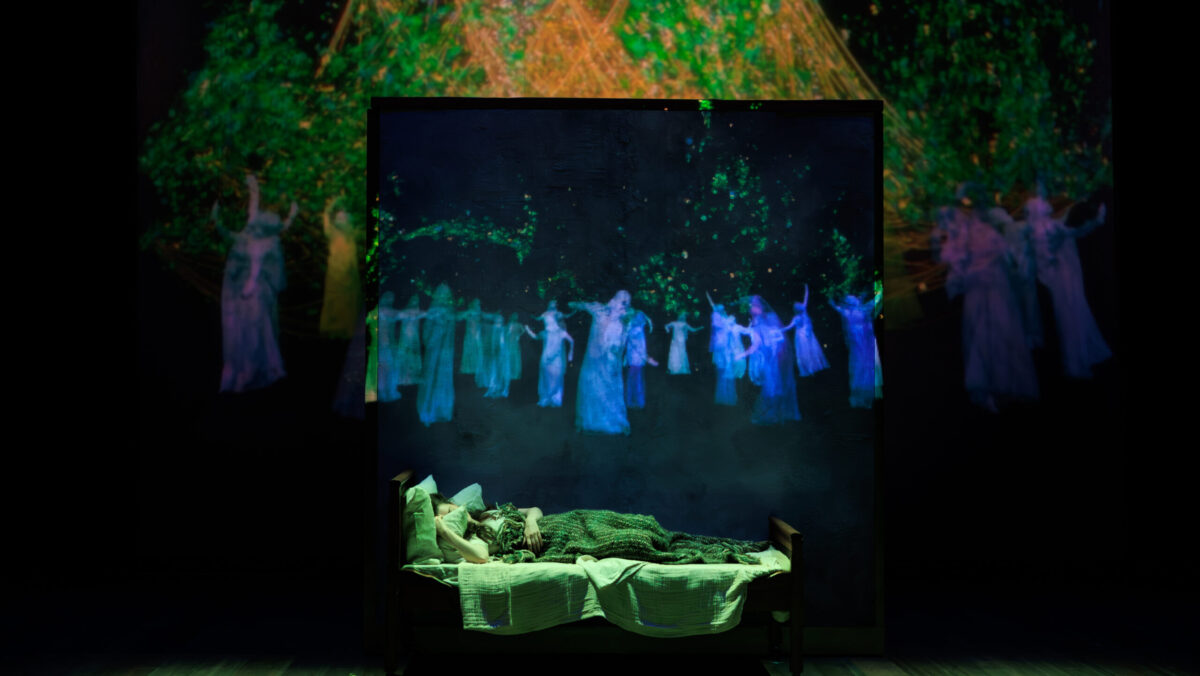
The part does require a nearly indefatigable singer. Hildegard is onstage for nearly the entire opera. And while certain Parterre readers—you know who you are—will surely express dismay at learning that the soloists are mic’d throughout the piece, the electronic enhancement is designed not to artificially inflate the sound of the voice, but to create an artificial ambience through the use of church-like reverb and other electro-acoustic effects.
The voice of Hildegard is essential to her character, not just as it is sung but as it is composed. Bennett observes that the characters’ vocal material is clearly delineated: “Hildegard’s music is so sweet, and so soothing, and plays a lot with long, sustained, and extended vocal lines. While Richardis, her music is earthier and warmer, and a little more unpredictable, and also plays more with range which is really exciting, because those characters are so opposite of each other. But as the opera develops, and these characters grow in their connection, their vocal lines start to blend in such a beautiful way, and Richardis starts to sing more sustained lines like Hildegard does. It’s as if she’s learning from Hildegard, or becoming more relaxed and warm with this budding relationship and this safe space.”
“Even though we’re both sopranos,“ Richardson concurs, “we take turns when we sing together, who’s higher and who’s lower. But often, as Richardis is panicking, or she’s extremely worried, her voice rises, and Hildegard’s trying to stay calm, and so it’s a lower register, trying to console and comfort her.
“And Hildegard’s chant, as opposed to Gregorian chant, has a much wider range, there are more big leaps, and Sarah echoes that in the writing for the women versus, the main male roles in the show. Like Abbot Kuno, especially when he’s not emotionally worked up, he’s intoning on a single note or just a few notes, like he’s the measured, calm voice of the church, whereas Hildegard has this kind of creative excitability even when she’s trying be a leader, being calm and collected. Almost like she can’t contain this inner ecstatic worldview.”
Did she ask Snider to make any changes to the part, to tailor the writing to her instrument?
“There were one or two spots where I first thought, ‘Oh, this is quite low. I wonder if I would have more volume or power if it was just a little bit higher,’” Richardson recalls. “But then I thought, ‘Maybe Sarah really wants that sound because she wants it to sound more recitative or spoken. Maybe Hildegard is speaking in a lower voice for a reason.’ I challenged myself not to make some of the easy requests and to just live with it a bit.”
The role is a challenging one as written, spanning over two octaves from a high B to a low A. Occasionally, the role suddenly jumps to a high note from where it had previously been centered in the middle-to-low range as Hildegard’s emotional states change. But Richardson finds the challenges especially rewarding: Sometimes when something is a little challenging and you pull it off, that gives more than if you just make everything sound easy.”
In an eloquent email, music director Gabriel Crouch—who previously conducted Snider’s Mass for the Endangered, released in 2025 on Snider’s own New Amsterdam Records—observes how Hildegarddistinguishes itself from the earlier score through its use of motivic development to shape the work dramatically. “The harmonic language and melodic material tell us what location we’re in,” he observes, “and the subtle evolutions in both give us a sense of the unfolding emotional landscape.”
In the writing for the small orchestra (strings and, in a nod to the 12th-century setting, a harp), Crouch says, “There’s a treasure chest of musical effects—col legno, sul ponticello, tremolo, etc.—to add emphasis to the drama. The vocal writing takes all the principals to the (manageable) extremes of their range.”
Production photos by Angel Origgi
The writing is “quite difficult to perform well,” Crouch adds, “and requires the same humble application that goes into its composition. Having said that—I’ve heard countless singers say that her vocal lines are a great pleasure to sing, and I’m in full agreement. The shape and length of phrase, the consideration of the passage of breath, the balance of higher and lower tessitura—all these elements make for a happy singing experience.”
Richardson agrees. “She has an especially wonderful understanding of the soprano voice, because she’s sung in the past, and so the way she sets text and has these beautiful lines… the phrasing is also wonderful for a breath, and a very singerly way of writing, which I think kind of emulates some of Hildegard’s beautiful melodies.”
Might this be because Snider was a singer herself? This is news to me. I ask her about it, just before the end of our interview.
“Oh yeah,” she says, “I did a whole lot of choral singing, and I attended the American Boy Choir School which closed in 2017 following a scandal. They had a summer program that was co-ed. I went there for like seven summers, so I got to work with all of these wonderful international choral conductors.” She sang in chamber choirs as an undergraduate at Wesleyan as well—but not, she hastens to add, as an operatic soloist.
This clicks into place like one last tile in the mosaic of her musical style. Her background as a choral singer illuminates her understanding of the voice, the elegant choral writing in pieces like her Mass, and even her affinity for Hildegard’s body of work. It might help explain, in part, the light, non-operatic vocalists she has used in her song cycles—and perhaps even her eagerness to cast a lighter, “early music” soprano in the title role of Hildegard itself.
Before signing off, I make an offhand reference to a mutual friend, Nico Muhly, whose own background as a boy treble informed his writing for years before he became an opera composer.
She demurs. “I don’t know if I’m an opera composer yet.”
I almost hate to break it to her, but: she is.