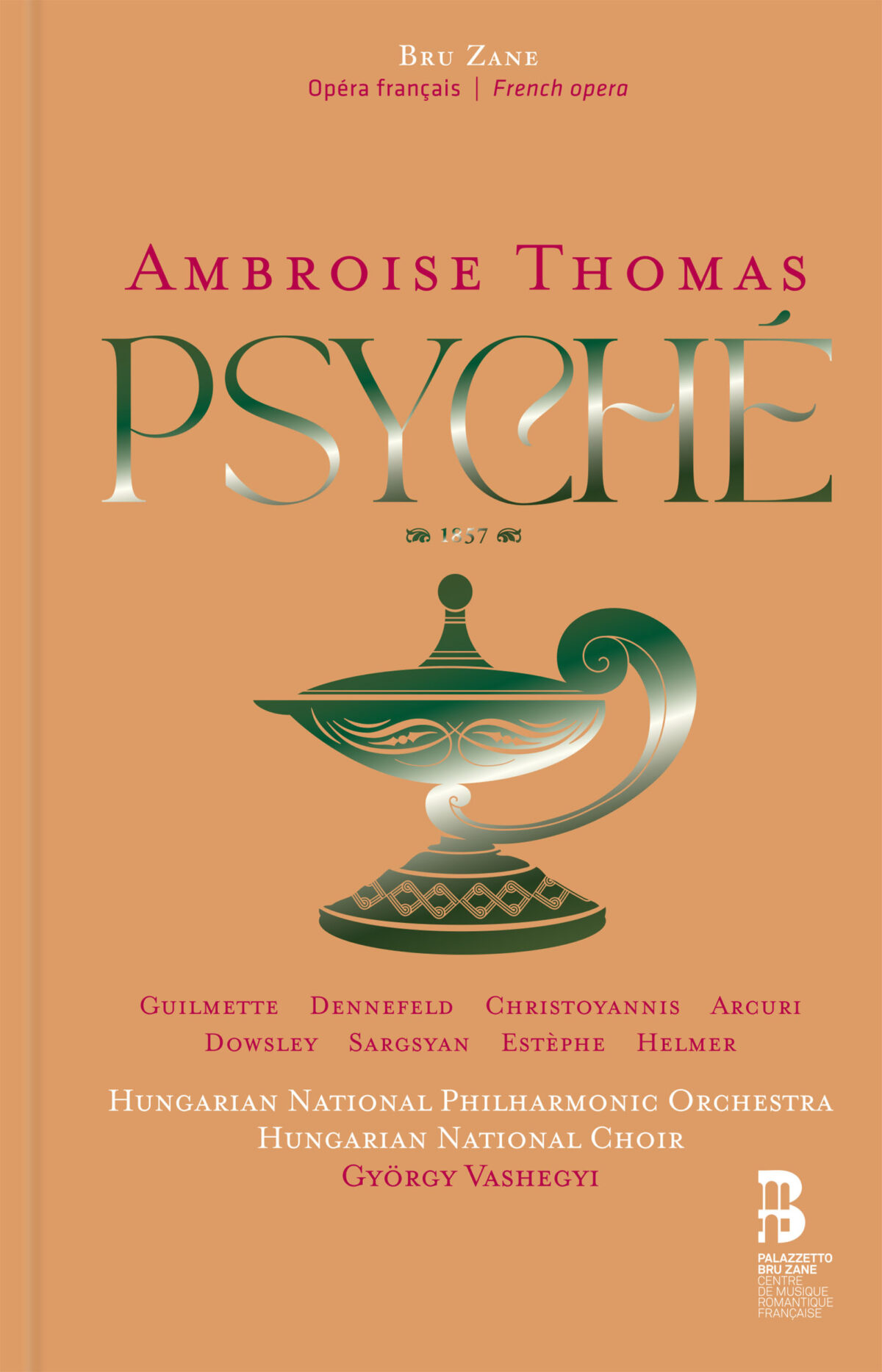
In fifty years of composing for the stage, Thomas made opéra comique his primary genre. The majority of his twenty-odd works had been written for the Opéra-Comique, from his 1837 debut with La double échelle to his first major success with the 1849 Le caïd, and the first work that would grant him enduring fame: Mignon. By the time of Psyché’s creation, Thomas was an experienced, well-respected opera composer, but he was earning his laurels outside of the opera house more than within, being elected to the Académie des Beaux-Arts in 1851 and appointed to the Conservatoire as a professor of composition in 1856. Criticism of the kind voiced by Adolphe Adam in an 1855 review that Thomas, after two decades of composing “[had] not yet hit upon that model which encapsulates the manner of a composer, and is imbued with his individuality” must have stung.
1857’s Psyché, a vibrant, delightful work bursting out of its comique mold, can easily be read then as a transitional moment, a search for this individual voice; a momentary turn to a classical sujet means flirtation with a grander style, the wit and vocal virtuosity of Auber and Rossini harmonizing in an eclectic mix with the grand opéra touches of Meyerbeer and Donizetti. More significantly, Psyché marks the first collaboration between Thomas and Jules Barbier and Michel Carré, the future giants of French Romantic opera who would go on to author Mignon and Hamlet for the composer.
This was a happy meeting between true men of the theatre, as the new recording of the opera – the latest miracle of resurrection from the Palazzetto Bru Zane – proves aplenty. Barbier and Carré rendered the mythological tale of Eros and Psyche with keen dramatic instinct, their libretto skillfully alternating between high and low, the passionate, almost-tragic love affair of Éros and Psyché with the comic interludes of human pettiness, centered around Psyché’s envious sisters, Bérénice and Dafné (in the mold of Cinderella’s stepsisters), and their pompous suitors, Antinoüs and Gorgias. Bridging the gap between the two worlds is Mércure, the main intriguer, acting as the vengeful Vénus’s envoy, happy to interfere with everyone’s life and fate in his pursuit of Psyché’s ruin.
Though Thomas’s setting of the libretto presents an enthusiastic response to this material, a disclaimer is first in order: Bru Zane’s performing edition is based on the 1857 version of the work, but incorporates multiple elements of its 1878 revision, originally prepared for a new staging at the Opéra proper but ending up back at the Opéra-Comique. In its latter version, Thomas and Barbier transformed the work into a grand opéra, expanding three Acts into four, setting spoken dialogue as recitatives, pruning the comic elements, and adding multiple new numbers. The revisions must have been seen as a crucial necessity, even without the change of venue, but they proved no triumph; despite its successful premiere season, Psyché was unable to hold the stage, falling immediately into obscurity. As Alexandre Dratwicki’s essay recounts in the booklet, not even the Parisian critics were uniformly enthused by the transformation; Eduard Hanslick, attending the dress rehearsal, declared that the opera “became stylistically more unified, but certainly not more lively or effective”.
The version recorded here retains the 1857 version’s core structure with its three Acts and spoken dialogues, but adapts Psyché’s two new arias (Ah! si j’avais jusqu’à ce soir in Act I, and the so-called Air de l’extase in Act II), as well as the transposition of Mércure’s role from bass to baritone. The editorial interference might be questionable, faithful to neither of Thomas’s operas in creating a hybrid of the two, but it must be said that none of the additions feel greatly out of place (though the combination of both Act II finales tacked onto each other is a somewhat brittle construction)
And the end result gives plenty to delight in. A fine melodist, Thomas’s writing is never less than graceful and evocative, light-footed and endearing in the comic passages and strikingly dramatic in the climactic scenes. The score abounds in chromaticism and is supported by his elegant, richly drawn orchestration. His comic talent is flexed with verve in the sisters’ Act I duet and the quartet between Psyché, Éros, Antinoüs and Gorgias, one of the unquestionable highlights of the work (and my personal earworm since attending the presentation of the opera in concert back in February).
Thomas’s feeling for a nobler lyricism and grandeur, on the other hand, is perfectly on display in the gentle opening chorus, the Act I final ensemble, and the crowning glory of the finale: Éros’s vengeful invocation and Psyché’s apotheosis. (The latter is noteworthy a gesture towards what’s to come from Barbier and Carré, Psyché’s deification clearly prefiguring Marguerite’s salvation in Faust.) Choruses are used colorfully throughout: other than their poignant contributions to the finale, a wonderful humming chorus underscoring Éros’s first entrance, the vivacious Act II Ballet chanté and the Act III Bacchanale are all worthy of mention, as is the tender “Hymen! Hyménée!,” accompanying Éros and Psyché’s later Act II interactions.
The cast assembled for the recording makes an eloquent case for the work. Per the pre-Covid plans for Psyché, the title role was meant for Jodie Devos, but following Devos’s tragic passing last year, which Parterre Box honored by sharing her in another Thomas opera, Hélène Guilmette took up the mantle. Guilmette draws a suitably charming figure here, graceful and gentle in her comport, and her silvery soprano, though somewhat thin at the top, has the necessary agility to navigate the role. Her phrasing of her prayer to Vénus, “Ah! si j’avais jusqu’à ce soir,” imbues the aria with a welcome touch of playfulness, and she’s scintillating in the Act I quartet, fending off her insistent suitors. Her interactions with Antoinette Dennefeld’s Éros are impassioned and her portrayal of the desolate Psyché in Act III, where the intrigue starts wearing thin, remains expressive and moving.
The role of Éros has also changed hands a couple of times since the originally scheduled concert of 2020: first meant for Karine Deshayes, then Michèle Losier, the portrayal of the young god of love finally fell to Antoinette Dennefeld. In concert, it was nothing short of a triumph for Dennefeld, whose radiant, full-bodied mezzo gains a rougher edge on recording, with the somewhat intrusive vibrato having no space reach its full sonority. But her portrayal remains bold, ardent, and captivating, if a touch less cheeky than in her concert performance: combining vocal force and remarkable agility, she masters the considerable demands of her role with aplomb (her Act II stretta,
“Prenez donc vers elle,” includes some particularly punishing leaps). Rounding off the main trio, Tassis Christoyannis continues his devilish streak after Grisélidis and clearly has a ball playing the Méphisto-lite Mércure, bright-toned and playfully wicked.
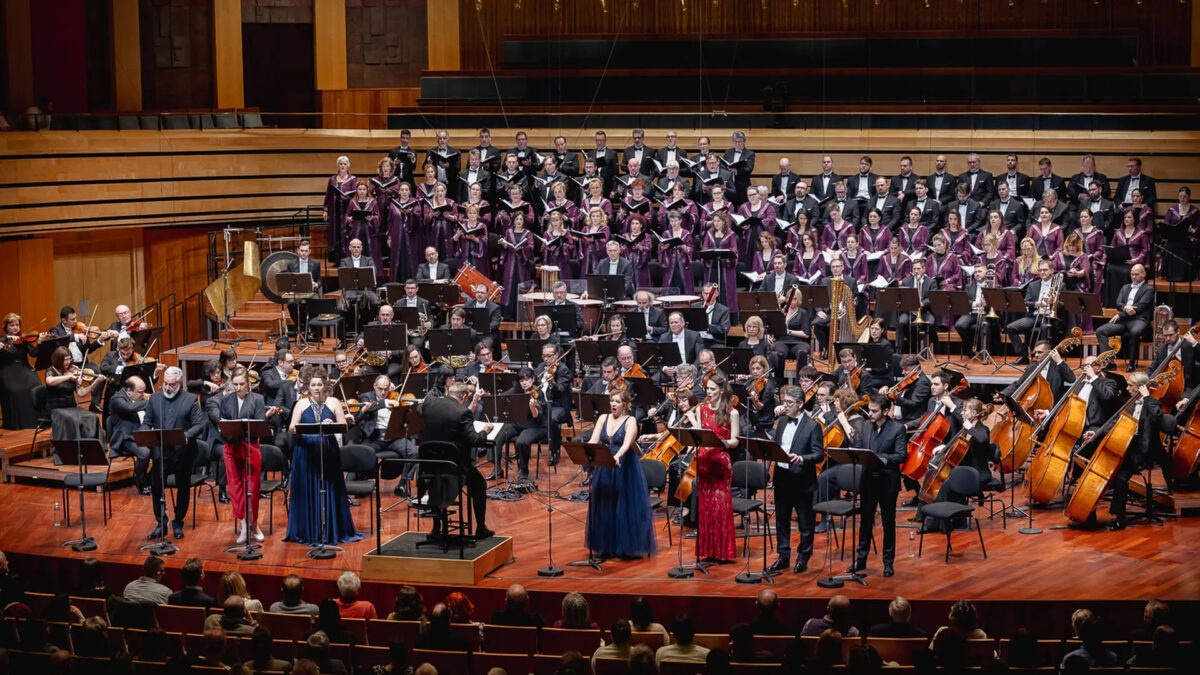
Recording of Psyché at Müpa, Budapest in 2025 / Photo: Szilvia Csibi
In the supporting roles, the impeccable quartet of Mercedes Arcuri, Anna Dowsley, Artavazd Sargsyan, and Philippe Estèphe brings their petty and delightfully ridiculous characters to life with great zest, ensuring a thoroughly entertaining portrayal of the opera’s comic register. (Dowsley’s French diction leaves something to be desired, but her deliciously plummy mezzo and opportune scenery-chewing compensates for it aplenty.)
The transplanting of the recording sessions from Paris to Budapest meant that the performance was reassigned to long-time Bru Zane collaborator György Vashegyi and the Hungarian National Philharmonic Orchestra and Choir, previously heard on Bru Zane’s recordings of Le roi d’Ys and Werther. It’s no homegrown pride that makes me write that the Hungarian forces do outstanding work here: the orchestra and the chorus both offering a generously warm-toned, polished, and enthusiastic performance, navigating the shift between stylistic registers with sensitivity and lively expression.
If this opera is the work of a talented craftsman rather than an epochal genius, it’s no less joyful a discovery. Now, who’s up for a staging?