Is Richard Strauss’s opera Arabella a farcical romp or a serious family drama? Does Arabella herself have traditional or modern views on love and marriage? Does the opera celebrate or decry toxic masculinity? Is her cross-dressing sister Zdenka a farcical plot contrivance or something more mysterious and new? In Tobias Kratzer’s fascinating production for the Deutsche Oper Berlin, now available on a Naxos DVD, the answer to all these questions is an enthusiastic “Both!” Kratzer embraces the contradictions in the work and uses them to drive the dramatic action forward.
He makes the compelling argument that these conflicting perspectives, which arise from the opera’s problematic gestation, are essential to the work and should be embraced by the director. For their sixth collaboration together, Richard Strauss asked his librettist Hugo von Hofmannstahl for something light and Offenbachian. Hofmannsthal pushed back and the two squabbled over plot and tone. Very early on, Hoffmanstahl conceived of a scenario with Zdenka as the main character and a plot focused on the collateral damage caused by her sister’s desperate search for a suitor.
That quickly shifted and Strauss requested further changes that softened the character of Arabella. However, only the first Act of the libretto had been revised to Strauss’s satisfaction when Hofmannstahl died suddenly in 1929, two days after the librettist’s son’s suicide. Strauss did not update the next two acts. The result is tonally inconsistent as it moves from Strauss‘s conception back to something closer to the librettist‘s original intention.
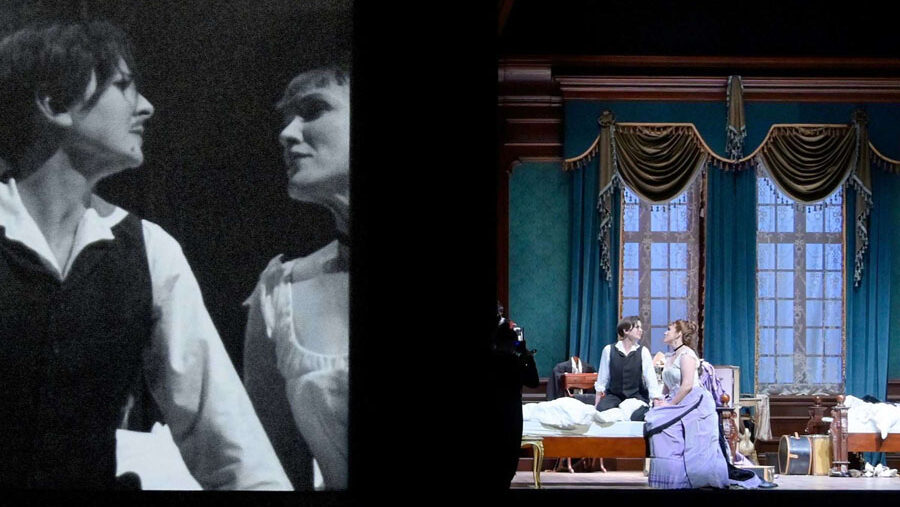
In this staging, the first Act uses period appropriate sets and costumes. By dividing the stage into different playing areas that shift to show different parts of the hotel, the production solves the problem of displaying the cramped modesty of Arabella’s family’s quarters on a vast operatic stage. Roaming the stage are videographers whose black and white camera feeds are projected on a screen that takes over the unused playing area. It gives the feel of watching a silent movie being created in real time as the action unfolds. Zdenka sports a dashing pencil moustache. As performed by Elena Tsallagova and costumed by Clara Hertel, Zdenka is, for once, completely convincing as her masculine alter ego Zdenko. Zdenka’s interactions with her sister are quite nuanced and touching, with Zdenka convinced that Arabella is sacrificing herself for the sake of her family.
For Act II, the action shifts to a long corridor outside the ballroom that turns out to be a time tunnel. (What is it with time tunnels at the Deutsche Oper Berlin?) Each time the main characters move in and out of the corridor’s doors, the action jumping forward in time to Weimar Berlin with a nice simian nod to Cabaret. Next, we’re in the 60s and finally the present day. The time shift loosens and frees these characters, the women much more than the men.
Arabella acquires more agency and spunk as she moves towards the opera’s denouement and the dynamic between Arabella and Mandryka is completely transformed by the end. (One cannot imagine the Arabella of Act I telling Mandryka to “Take me as I am.”) Zdenkx undergoes a similar liberation in the third Act, embracing their complex sexuality. There are lots of surprises in Act III, that I don’t want to spoil, but they’re guessable from the production trailer if you’re intrigued.
Thomas Aurin / Deutsche Oper Berlin
The cast is uniformly musical and they all handle the complexities of the staging compellingly. Sara Jakubiak is Arabella. Her voice is perhaps a touch heavier than we are used to in this role, but she summons a genuine sweetness and delicacy when required. Russell Braun is her Mandryka and he is not afraid to be a jerk as necessitated by the plot and staging. His crash-out when he thinks Arabella is having an assignation feels genuine.
I’ve already noted how exceptional Elena Tsallagova is as Zdenka, a true singing actress in a part that greatly benefits from her care. Doris Soffel, who was around 75 when this was filmed and sounds and looks fantastic, is Adelaide. As the time period shifts, she gets to wear the heck out of some truly bodacious outfits.
Hye-Young Moon accomplished the impossible in that she actually got me to tolerate the character of Fiakermilli. She is helped by the staging which gives her more dramatic purpose than usual, but she handles all the tricky coloratura with poise and facility. Robert Watson is the Matteo. It’s a thankless part, but he imbues the part with more personality than usual and even finds some tenderness at the end.
Donald Runnicles is the conductor. I felt he struck the right balance between lyricism and momentum, but he was the recipient of some ardent boos in the curtain call. To be fair, the production team got booed more vigorously
This recommended performance is also available in the US on Amazon Prime Video for purchase or rental.