Priamo Tolu
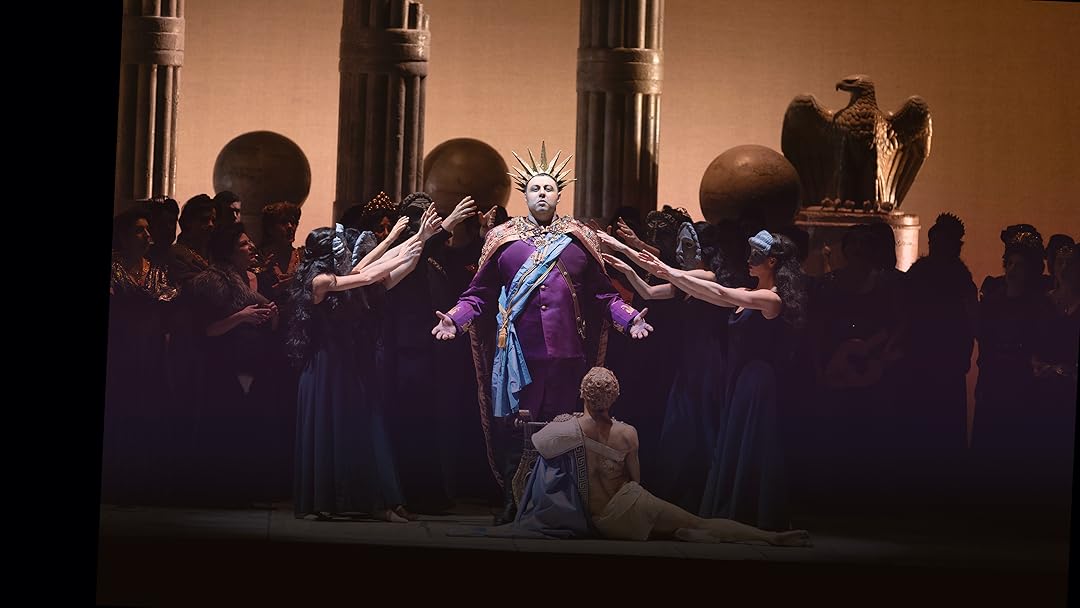
I finally caught up with Arrigo Boito’s Nerone thanks to a recent new recording on Naxos from a live performance at the Teatro Lirico in Cagliari in 2024. This production is also available on DVD, I have not seen the video, which can also be purchased or rented through Amazon Prime Video
This opera had an exceptionally complex gestation. Boito labored on it for several decades and told his publisher that it was complete in 1911. Nevertheless, when Boito died in 1918, it had never been published or produced. Arturo Toscanini declared that the work was incomplete and worked with the musicologist Vincenzo Tommasini to prepare a performing edition for its premiere at La Scala in 1924. The production was exceptionally expensive and elaborate. Just take a look at this photo of the final scene or these set designs.
While the opera had successful premieres at major cities around Italy, it is an extreme rarity nowadays. It is easy to understand why. Aside from the complex scenic and musical demands, the work is both a serious, insightful attempt to portray the deranged emperor and a seriously cheesy melodrama with a cast of characters including a Rasputin-esque Roman priest (Simon Mago, baritone), Simon’s archenemy the leader of the Christians (Fanuèl, baritone), a young Roman woman who is obsessed with Nero (Asteria, soprano) and a young Christian woman hiding a big secret (Rubria, mezzo-soprano).
The opera takes place in the days leading up to the Great Fire in AD 64. The main characters keep conveniently turning up in the unlikeliest of places at the same time, such as a graveyard near the Appian Way, an underground Roman temple, a hidden Christian meeting place, the Circus Maximus and finally the Spoliarium – where the dead bodies from the Circus were dumped. Nero, who is offstage for half the opera, functions as a chaos agent who shows up periodically to do crazy emperor things that advance the plot: running around with an urn containing the ashes of his recently matricided mother and wondering if the cher public still likes him; directing that the soprano be thrown in a snake pit (she survives); crowning himself with laurel and taking up a handy lyre to perform his Cabaret Act as the curtain falls; having Simon Mago thrown off the roof; starting a killing spree in the Circus Maximus that is only stopped when the Great Fire breaks out.
Boito seems to have wanted to capture everything he knew about this period in ancient Rome into one night at the opera. A typical stage direction reads, “The still feeble light… gradually reveals what lies in the background, houses scattered in the distant countryside, the arches of the Aqua Tepula and Aqua Marcia aqueducts, the peaks of some funeral monuments on the Via Latina. Very far away, somewhere near the eighth milestone, some trumpets peal.” His panoramic vision would probably be better served as an operatic “swords and sandals” epic on IMAX screen in surround sound.
Despite this highly dramatic action and enormous musical resources, the music is brooding and somber. There are big dramatic outbursts and some massive climaxes, but it does not have the ecstasy of Mefistofele. Instead, the consequences of the events in this opera weigh heavily on the score, resulting in a mournful work. That said, it is a fascinating work that I enjoyed more in each rehearing.
The ensemble displays impressive mastery of this complex work. Francesco Cilluffo is the conductor and he leads with lots of atmosphere and shapes the score effectively. Mikheil Sheshaberidze, a new singer to me, takes on Nerone and conquers the many challenges of the role — I certainly am eager to hear him in the theater. Soprano Valentina Boi sings the part of Asteria who stans Nero. I had not heard her previously, either, and she appears to have a genuine dramatic soprano voice and the appropriate temperament for those roles. The climaxes can get a little wild, but it does not distract from the performance. The last new name in the cast is Deniz Uzun as Rubria. She has a lovely mezzo voice and she handles the big dramatic moments with minimal strain and impressive fervor, but this part is heavier than the other roles she typically sings.
Two more familiar baritones complete the cast: Franco Vassallo as Simon Mago and Roberto Frontali as his Christian rival Fanuèl. They both are well along in their careers, but there are only minor signs of age in their singing. Their moving, intense performances are highlights of the recording.
For those of you wanting to go on a Nerone deep dive, a libretto is available here and there are some interesting recordings by participants in the world premiere. I’ve made a playlist on youtube that includes selections by Aureliano Pertile, the original Nero and Marcel Journet, the original Simon Mago. Toscanini included Act III and the Act IV finale in the Boito memorial concert broadcast in 1948. That is on the playlist as well. The whole concert is available via streaming and is well worth exploring.